10 Maple Trees for the Best Fall Color
Compare maple trees for fall color by mature size, autumn hues, climate and site needs, including reliable red cultivars and regional planting cautions.
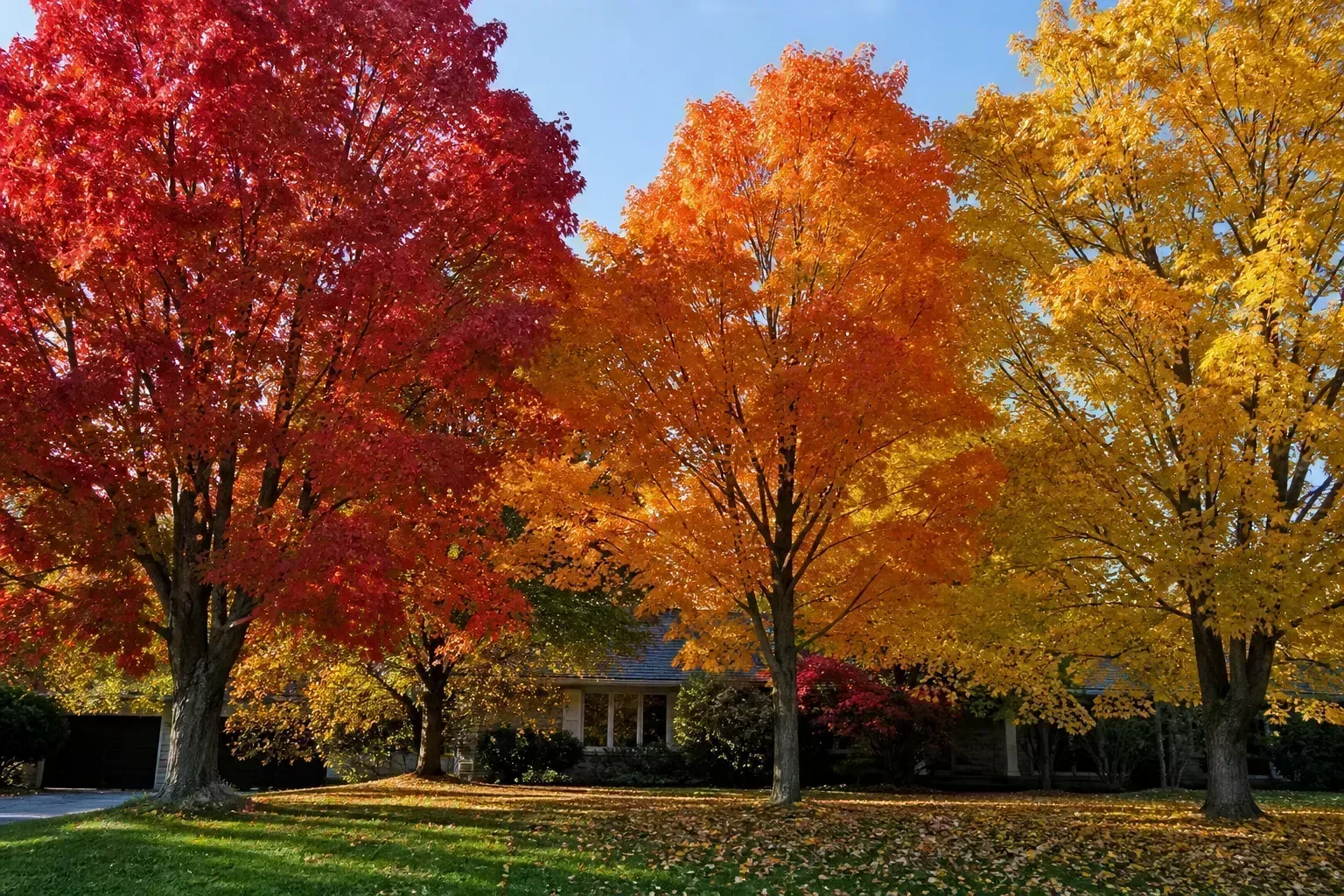
The best maple for autumn color depends on what your yard can support. For a spacious lawn in a cool region, a sugar maple or a named red maple cultivar can become a large, long-lived canopy tree. For a courtyard or smaller garden, Japanese and paperbark maples offer strong color at a far more manageable scale. A photograph of a scarlet tree is not enough to choose: mature width, summer heat, soil moisture, and local invasive-plant rules matter just as much.
If you want red leaves, start with a named selection such as ‘Red Sunset’ or ‘October Glory’ rather than an unnamed seedling red maple. If you want a small ornamental, compare Japanese maple cultivars by fall color and heat tolerance. And if you are considering Amur or Norway maple, check your state and county lists before you buy; these trees are restricted or considered invasive in some places. The choices below are grouped by what they do well and where they can disappoint.
Start With the Site, Then Pick a Color
First measure the planting area from the trunk location to the house, pavement, overhead lines, and other trees. A mature maple’s spread can be wider than its advertised height suggests, and a young nursery tree gives little hint of the root system and crown it will develop over decades. If you have room for a tree 40 to 70 feet tall, red maple and Freeman maple can be candidates; if your usable space is a small courtyard or a narrow border, focus on Japanese, paperbark, vine, or striped maple.
Next decide whether you want a color spectacle or a small tree with several seasons of interest. Sugar and red maples can cast deep shade but need real room. Japanese and paperbark maples are more often specimen trees, chosen for leaf detail, structure, and manageable scale as much as the few weeks of autumn color. A striped maple is a different kind of choice: its clear yellow leaves belong in a cool woodland edge, not a hot exposed lawn.
Finally, check the conditions at the actual planting spot. “Full sun” on a tree label does not mean the same thing in cool New England and a hot, dry Southern yard. Maples with thin leaves may scorch in harsh afternoon sun, while deeply shaded trees often produce a weaker display. Your best result comes from matching the species and cultivar to your climate first; fall color is the reward, not the only selection criterion.
10 Maples Worth Choosing
These selections include large native shade trees, compact ornamentals, and a few regional trees. Their colors are not equally intense, and they do not belong in the same kind of yard. Use the notes on size and site to narrow the list before comparing shades.
1. Red Maple: Choose a Named Cultivar for Red
Red maple (Acer rubrum) is the most adaptable large maple on this list, native across much of eastern North America. In a favorable site, its fall leaves can turn red, orange, or yellow, but a seed-grown tree may not match the vivid red one pictured at a nursery. North Carolina State Extension notes that color varies among trees and cultivars, so the practical way to improve your odds is to buy a named selection with a documented color history rather than a generic red maple.
‘Red Sunset’ is known for early orange-scarlet color; ‘October Glory’ tends to color later and is often selected for a strong red display. Neither is a guarantee against an unusually warm, dry autumn, but a named cultivar gives you a more informed starting point than a seedling. Red maples are large: many reach roughly 40 to 70 feet high and 30 to 50 feet wide. They suit open lawns and broad planting strips, not a narrow bed against a foundation. North Carolina State Extension also cautions that surface roots can buckle nearby pavement and compete with plants beneath the canopy.
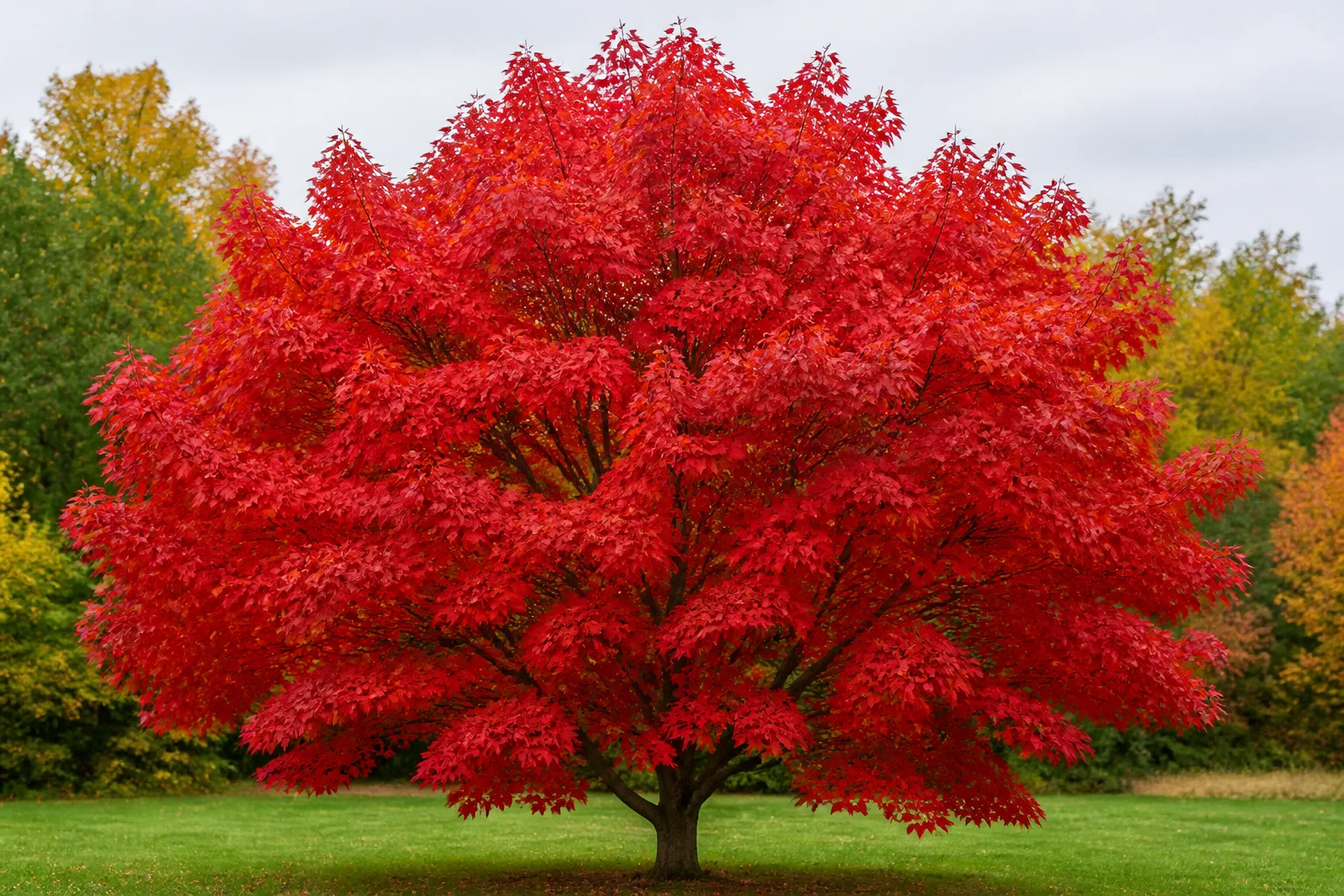
2. Autumn Blaze Freeman Maple: A Large Red-Orange Hybrid
Autumn Blaze is the trademarked name for Freeman maple (Acer × freemanii) ‘Jeffersred’, a hybrid of red and silver maples. It is worth considering when you want a large shade tree with an orange-red autumn display and need a tree that can handle a broader range of conditions than a sugar maple. North Carolina State Extension describes the parent hybrid as a fast-growing tree with red-orange fall leaves and a mature size of about 45 to 70 feet tall by 35 to 50 feet wide.
The useful distinction is that “hybrid” does not mean “small.” Autumn Blaze can fill a suburban lawn quickly, but it still needs substantial horizontal clearance from buildings, pavement, and overhead utility lines. Its color is a reason to consider it, not a reason to plant it in a small parkway. Check the tag to confirm you are buying ‘Jeffersred’; other Freeman cultivars have different habits and fall-color performance. NC State’s Freeman maple profile describes the hybrid and distinguishes its named selections.
3. Sugar Maple: A Full Palette for Cool, Moist Sites
Sugar maple (Acer saccharum) is the classic large-canopy choice where summers are not too hot and soil stays moist without becoming waterlogged. Its broad leaves may turn yellow, orange, or red in fall, sometimes showing several colors across one crown. The Oak Ridge National Laboratory Arboretum describes its autumn palette as ranging from gold to crimson, while NC State Extension notes that the species grows best in moist, well-drained, slightly acidic soil.
This is a poor shortcut for a hot, compacted, salt-splashed street edge. Sugar maple is sensitive to heat, drought, soil compaction, air pollution, and road salt, so an exposed parking strip can undermine both tree health and the color you planted for. It is also a truly large tree: expect roughly 50 to 120 feet at maturity depending on conditions and selection. Give it a broad lawn or woodland-edge setting and leave enough room for a wide crown.
Black maple is closely related and is treated by some authorities as a separate species, while others place it within the sugar maple group. Its autumn shades overlap with sugar maple, so it is not a dependable color upgrade just because it has a different common name. If a local nursery offers black maple, ask about its regional performance and mature size before choosing it over a locally proven sugar maple cultivar.
4. Amur Maple: Compact Color With a Regional Caveat
Amur maple (Acer tataricum subsp. ginnala, also sold as Acer ginnala) is a small tree or large shrub that can fit a space where a 60-foot maple cannot. Its leaves may turn from yellow to red, and cultivars such as ‘Flame’ and ‘Embers’ are sold for stronger autumn color. Utah State University Extension describes the color as potentially excellent but inconsistent, which is a more useful expectation than assuming every Amur maple will become bright scarlet.
Its main drawback is not size or color but regional suitability. Oregon State University’s landscape plant database warns that Amur maple has invasive traits and notes that Minnesota lists it as invasive. That status is not identical everywhere, so check current official invasive-plant lists for your state, county, and municipality before buying. In a place where it is restricted or has been observed escaping cultivation, choose a native small maple instead. Where it is accepted, give it sun for a stronger display and remember that even a small maple needs room to form its natural crown.
5. Striped Maple: A Native Yellow-Leaf Understory Tree
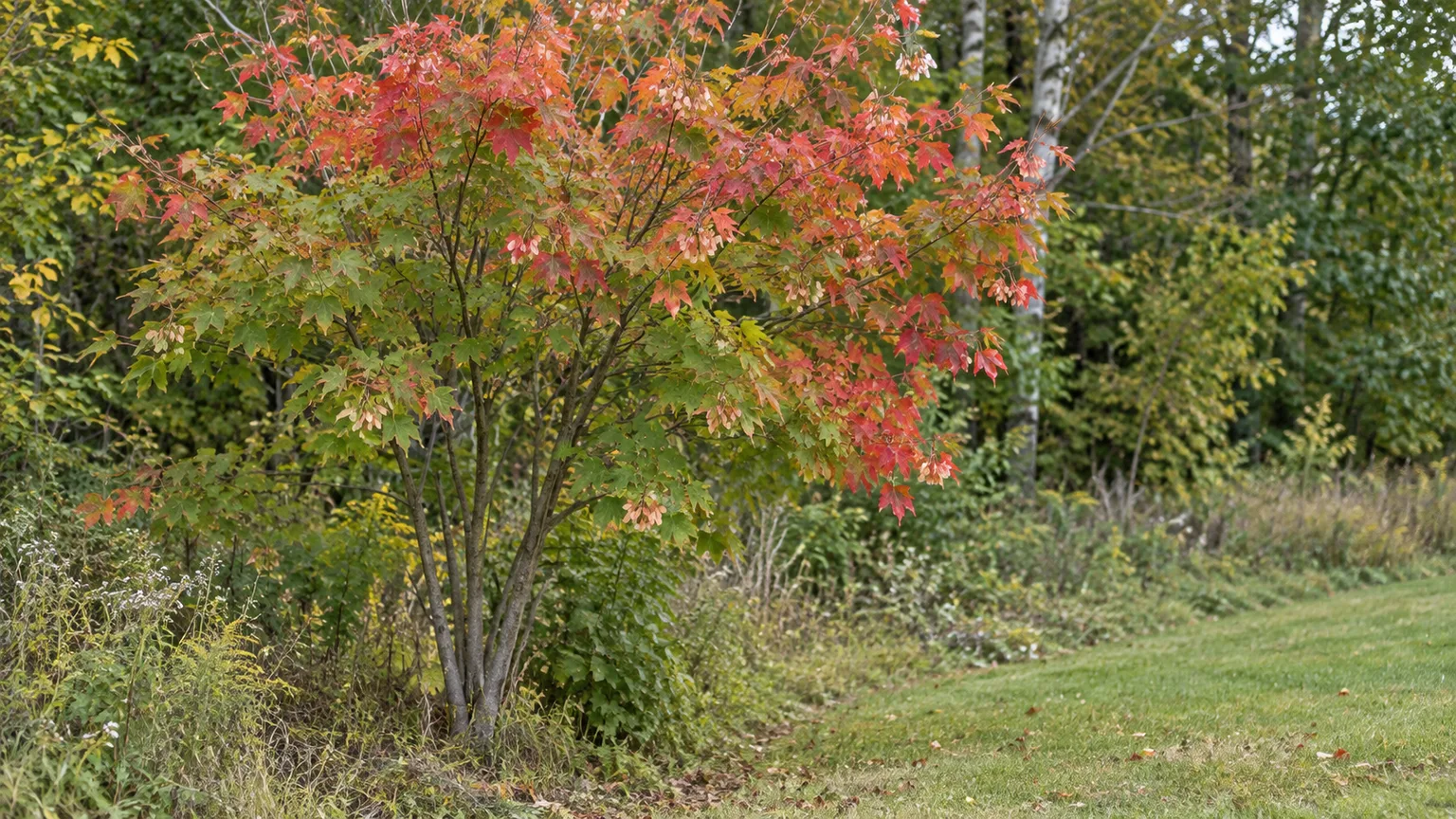
Striped maple (Acer pensylvanicum), also called moosewood or snakebark maple, is a small eastern North American understory tree with striking pale stripes on young bark. Its fall color is yellow to golden rather than scarlet, so it is best for gardeners who want a quiet woodland effect and winter bark interest rather than a red canopy. Oregon State University’s landscape profile describes a mature tree around 15 to 20 feet tall, suited to part shade and cool, moist, acidic, well-drained soil.
This maple does not belong in the hottest, driest corner of a yard. In nature it grows in cool woods, so a spot with filtered light and reliable moisture is a better match than baking afternoon sun. Its small scale makes it useful under larger trees or along a woodland edge, provided the soil drains and the site stays cool. If you garden in a warmer region far outside its natural range, choose a species better adapted to your local summers rather than trying to force the northern understory conditions it prefers.
6. Japanese Maple ‘Osakazuki’: A Small Tree for Scarlet
‘Osakazuki’ is a Japanese maple (Acer palmatum) cultivar chosen for its vivid scarlet fall color. It is a small ornamental rather than a shade tree, generally reaching about 15 to 25 feet, and its spreading, layered form gives it presence even outside autumn. North Carolina State Extension lists the cultivar for excellent fall color, and Gardening Know How also highlights its transition from green summer leaves to scarlet in fall.
A Japanese maple is a better fit than a red maple when you need a focal point near a patio, an entry, or a compact lawn. In hot climates, filtered light or morning sun with afternoon shade can reduce leaf scorch; in cooler places, more sun may be tolerated when the soil remains evenly moist. Do not assume every Japanese maple appreciates full, reflected heat beside a south-facing wall. Protect the shallow root zone with mulch, keep turf and mowers away from the trunk, and avoid letting the root ball dry hard during hot spells.
7. Japanese Maple ‘Bloodgood’: Burgundy Foliage and Crimson Fall
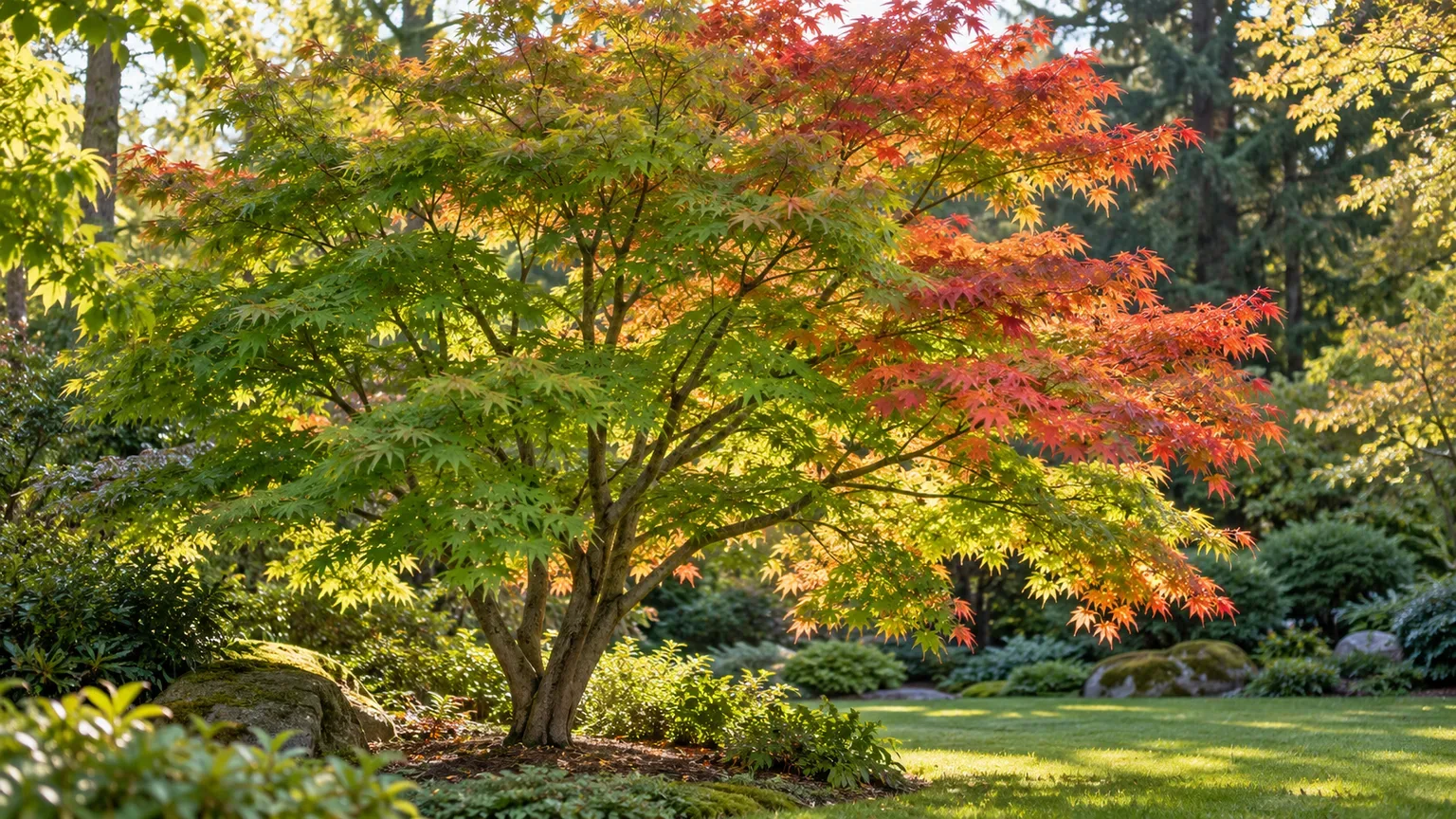
‘Bloodgood’ is a good choice if you want dark red-purple leaves through much of the growing season and a crimson fall finish. Its appeal is not a dramatic green-to-red transformation: the leaves already carry burgundy tones, then deepen or brighten toward crimson as autumn progresses. Better Homes and Gardens describes the cultivar’s purple-red summer foliage and crimson fall color; NC State Extension similarly records deep burgundy foliage turning bright crimson.
That seasonal continuity makes ‘Bloodgood’ useful as a focal point against green shrubs, but it also means its foliage can be less visibly surprising than a green-leaf cultivar that turns brilliant red. A mature tree may be around 15 to 20 feet, although cultivar and growing conditions affect the final form. In a hot site, shelter it from punishing late-day sun and dry wind; in a cool, humid climate, a brighter position may work. Buy a healthy grafted tree with the cultivar name on its label, and do not use hard pruning to keep it artificially small.
8. Fullmoon Maple ‘Aconitifolium’: A Multicolor Display
Fullmoon maple (Acer japonicum) ‘Aconitifolium’ offers broader, deeply divided leaves and an autumn mix that can include red, orange, and yellow. It is a strong option when you want more than one color in a small ornamental tree and can provide moist soil and room for a rounded crown. Better Homes and Gardens lists the cultivar for a full-sun-to-part-shade position in moist, well-drained soil and gives a typical hardiness range of zones 5 to 7.
The “fullmoon” name matters at the nursery: this is a different species from Japanese maple (Acer palmatum), even though both are small Asian maples sold for ornamental foliage. Think of Acer japonicum as a collector-friendly alternative with larger leaves and a different texture. Its foliage is especially effective where it can be seen close up, but it should not be crowded between large trees or squeezed into a tiny foundation bed. Confirm that your summer climate suits it; a hardiness zone alone does not tell you whether the leaves will handle hot, dry exposure.
9. Paperbark Maple: Orange-Red Leaves and Winter Bark
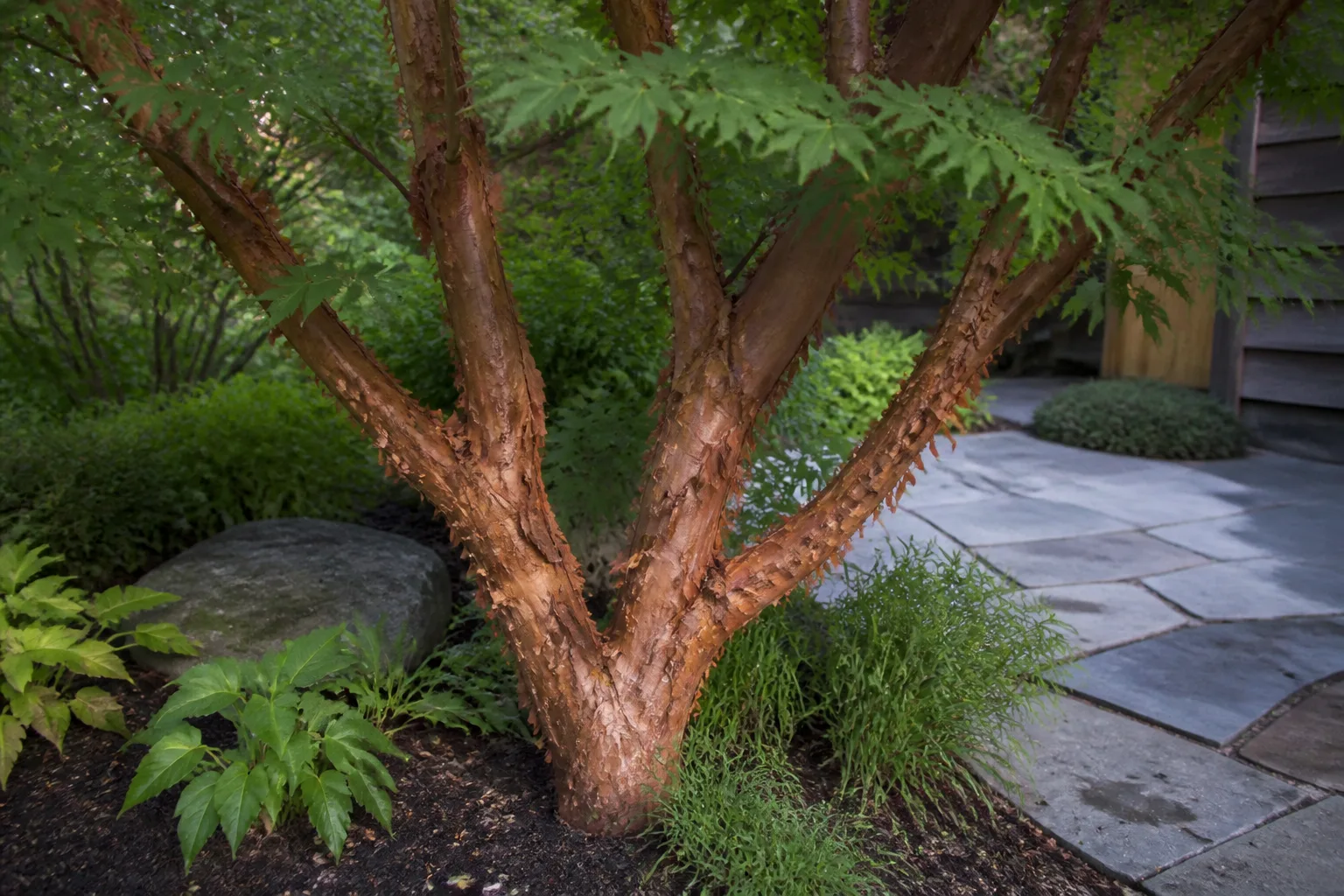
Paperbark maple (Acer griseum) combines warm orange-red fall color with cinnamon-colored peeling bark that remains ornamental after the leaves drop. It grows slowly into a small tree, commonly about 15 to 30 feet tall, making it valuable where a large shade tree is impractical. Fine Gardening calls it one of the best small ornamental trees and recommends moist, well-drained soil in sun to part shade.
Choose this tree for a year-round specimen, not for the fastest canopy or the most uniform scarlet leaves. The bark gives it an advantage over maples whose only season of interest is autumn, and the modest size makes it easier to place near a patio or a small lawn. Paperbark maple can be harder to find and slower to establish than mass-market trees. Give it time, avoid drought stress while it establishes, and leave enough open space around the trunk to appreciate its bark as it matures.
10. Vine Maple: A Pacific Northwest Native for Layered Color
Vine maple (Acer circinatum) is a small, often multistemmed maple native to the Pacific Northwest. Oregon State University describes trees and large shrubs around 10 to 20 feet tall, with fall leaves that can turn red, orange, and yellow when the plant receives sun. In shade, its branching form becomes more horizontal and graceful, making it useful for woodland gardens and layered planting rather than a formal upright street-tree look.
Vine maple is an especially good choice for a garden in its native region where summers are not excessively dry and the soil holds moisture. It can tolerate sun, but the best position depends on the local climate: full exposure is more demanding in a dry inland site than in a cooler, moist coastal garden. Unlike the large shade maples, it works in a small landscape without requiring decades of pruning to control its scale. Ask a local nursery about local seed sources or cultivars, and leave room for its natural multistem habit rather than training it into a single trunk unless you are prepared to maintain that form.
Why Maple Fall Color Changes From Year to Year
A tree does not manufacture the same color on a calendar schedule. As days shorten, chlorophyll—the pigment that makes leaves look green—breaks down. Yellow and orange pigments already present in leaves become easier to see, while some trees produce red pigments during the fall transition. Better Homes and Gardens summarizes the process and notes that light, temperature, moisture, and precipitation affect when the color peaks and how vivid it appears.
Genetics sets the likely range, but weather changes the result. A named red maple cultivar is a better bet than an unknown seedling, yet it cannot guarantee the exact hue or the number of days the leaves hold. A hot, dry late summer, an early freeze, or prolonged wet weather can shift timing or shorten the show. Judge the tree over several years, not by one muted October. If it is otherwise healthy, a less vivid fall is not proof that you bought the wrong species.
Site stress is a different matter. A tree with early browning, sparse foliage, or dead branches may be struggling with drought, compacted soil, root injury, or a poor site rather than simply displaying normal seasonal variation. Do not try to “fix” ordinary color with a late-season fertilizer application. First check soil moisture, drainage, and the condition of the canopy; the best path to good autumn color is a healthy tree growing within its natural limits.
Maples I Would Not Plant Just for Fall Color
Norway maple (Acer platanoides) is often sold or inherited as a tough urban shade tree, but fall color is usually yellow rather than the red or orange many people want from a color-first planting. More importantly, it is invasive in parts of North America. North Carolina State Extension lists invasive concerns and describes the tree’s prolific seeding and dense shade. Do not choose it without checking your local status and considering a native substitute.
Amur maple can be colorful, but its invasive status is also regional, so it belongs in the conditional category above rather than on every gardener’s shopping list. Hedge maple (Acer campestre) has a dense, useful form and can tolerate urban stress, but its yellow fall foliage is not usually as intense as the reds of red-maple cultivars or Japanese maples. It may be a sound hedge or street-tree choice in the right location, but it is not the first tree I would buy solely for a vivid autumn display. Black maple is another case where naming should not distract from fit: it is closely related to sugar maple and does not automatically promise more reliable color.
Compare the Ten Choices by Size, Color, and Site
Use this as a shortlist, not a guarantee. Mature sizes are approximate and vary with cultivar, climate, and growing conditions; verify the specific tree label and local references before planting.
| Maple | Approximate mature scale | Typical fall color | Best fit | Main caution |
|---|---|---|---|---|
| Red maple | Large, about 40–70 ft | Red, orange, or yellow | Broad lawn; choose a named cultivar for red | Seedling color varies; surface roots need room |
| Autumn Blaze Freeman maple | Large, about 45–70 ft | Orange-red | Open yard needing a large shade tree | Its crown is broad; not a small-lot tree |
| Sugar maple | Large, about 50–120 ft | Yellow through orange to red | Cool region, moist and well-drained soil | Sensitive to heat, salt, drought, and compaction |
| Amur maple | Small, often 15–20 ft | Yellow to red | Compact site only where locally appropriate | Invasive in some regions; color can be inconsistent |
| Striped maple | Small, about 15–20 ft | Yellow to gold | Cool, moist woodland edge | Needs part shade and suitable climate |
| ‘Osakazuki’ Japanese maple | Small to medium, about 15–25 ft | Scarlet | Ornamental focal point | Protect from hot, dry exposure |
| ‘Bloodgood’ Japanese maple | Small to medium, about 15–20 ft | Crimson | Red foliage from spring through fall | Cultivar size and heat response vary |
| ‘Aconitifolium’ fullmoon maple | Small to medium | Red, orange, and yellow | Moist, sheltered ornamental garden | Confirm summer-climate fit |
| Paperbark maple | Small, about 15–30 ft | Orange-red | Patio specimen with winter interest | Slow growth; needs establishment care |
| Vine maple | Small, often 10–20 ft | Red, orange, and yellow | Pacific Northwest woodland or layered garden | Best suited to its regional moisture and climate |
For the strongest chance of a red display, begin with red maple ‘Red Sunset’ or ‘October Glory’, then compare Freeman maple if your yard can accommodate its width. For a smaller yard, choose Japanese maple ‘Osakazuki’ for a bright scarlet display, ‘Bloodgood’ for burgundy foliage, or paperbark maple when bark interest matters as much as the fall leaves. Amur maple is a conditional choice, not a default recommendation.
Plant for a Healthy Tree, Not a Promised Shade of Red
Make the decision in this order: space, climate, soil, then color. That sequence prevents the common mistake of buying a tree because its fall photograph is perfect, then discovering it will outgrow the site or struggle with the summer climate. Measure the crown width as carefully as height, and keep large maples clear of foundations, pavement, overhead wires, septic systems, and buried utilities.
Prepare the site for the tree rather than amending only a small planting hole. Maples generally do best when the root ball sits at the correct depth, the root flare remains visible, and the surrounding soil drains well. Water thoroughly while the tree establishes, then adjust irrigation to rainfall and soil texture instead of following a rigid schedule. A 2- to 3-inch mulch layer over the root zone helps conserve moisture and protects shallow roots, but keep mulch several inches away from the trunk so the bark stays dry.
Do not expect fertilizer to intensify fall color. If the tree is growing well, routine high-nitrogen feeding may push lush shoots rather than solve an autumn-color concern. If leaves scorch or turn brown early, check whether the site is too hot, roots are drying out, or paving is reflecting heat. If color is the only disappointment and the tree is otherwise healthy, give it another season before making a costly replacement decision.
A cultivar label is useful only when the tree is correctly identified and suited to your region. Keep the tag, note the nursery’s stated mature dimensions, and ask whether the tree was selected for color in a climate similar to yours. If you need a native tree, look first at maples native to your region rather than assuming a species native somewhere else on the continent will thrive locally. Regional extension and arboretum references can help you narrow the options; a nearby botanic garden can show how named maples perform in your area.
Conclusion
The best maple for fall color is the one whose color, mature size, and climate needs all fit your yard. Red maple cultivars and Autumn Blaze are strong choices for large spaces; sugar maple rewards cool, moist sites; and Japanese, paperbark, fullmoon, vine, and striped maples offer smaller-scale options with different color palettes. Amur maple can look excellent but needs a local invasive-status check before planting.
Start with your available space and local climate, then choose a named cultivar when a particular color matters. Leave enough room for roots and branches, keep the tree watered while it establishes, and treat fall color as a seasonal range rather than a guarantee. That is how you get a maple that looks good in October and still belongs in your landscape years later.



