How to Grow and Care for Autumn Blaze Maple Trees
Planning to grow an Autumn Blaze maple? Get its mature footprint, planting steps, establishment watering, structural pruning advice, and common stress clues.

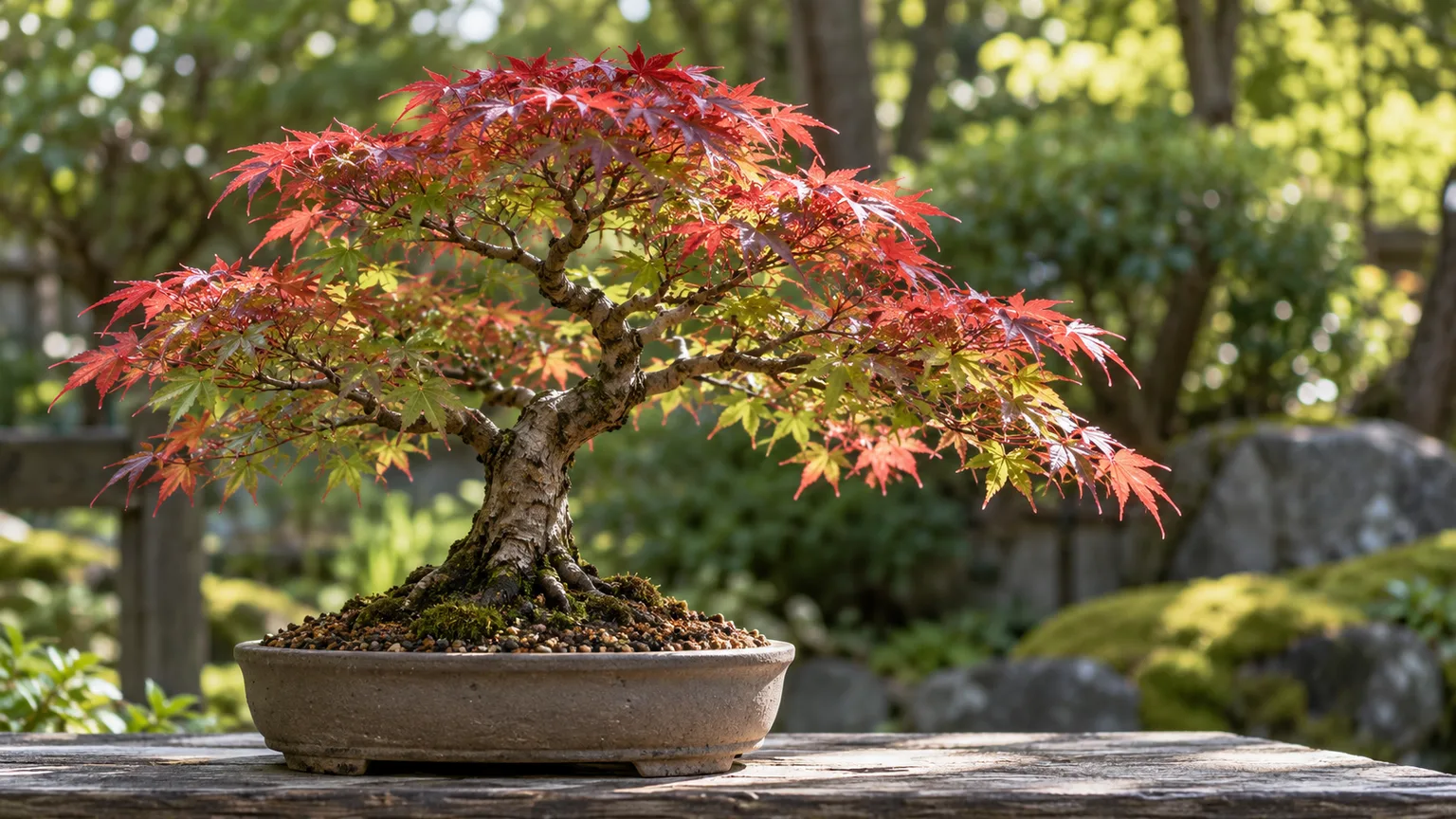
An Autumn Blaze maple is a fast-growing, large shade tree chosen for its broad oval canopy and dependable orange-red autumn display. It can be a good fit for a roomy lawn or park-like yard, but it is not a compact ornamental: plan for a mature tree roughly 40 to 60 feet tall and about 30 to 50 feet wide, then confirm the dimensions expected for the nursery stock and growing region.
The name also matters. Autumn Blaze® is the trade name for the named Freeman maple cultivar ‘Jeffersred’, not a generic name for every red maple. Its vigor can give a new landscape shade sooner, while the tree’s eventual scale, roots, and branch attachments make correct placement and early inspection more important than a fertilizer schedule.
Is an Autumn Blaze maple right for your yard?
Choose this tree if you want a large deciduous canopy, have room for it to spread, and can water it while its roots establish. A mature crown provides substantial summer shade, and the leaves often turn orange-red to scarlet in fall. It also adapts to a range of climates and urban conditions, although that does not mean it will thrive in every compacted, alkaline, or poorly drained site.
Skip it for a narrow planting strip, beneath overhead lines, beside a small patio that needs to stay sunny, or where you would have to prune the crown away from a building as it grows. A fast-growing tree can outgrow an undersized location quickly, and repeated severe cuts are a poor substitute for adequate space. If the yard is modest, pick a smaller tree matched to the actual soil and local climate rather than relying on a nursery label that says “urban tolerant.”
Autumn Blaze is also not a low-maintenance choice in the sense of “plant and forget.” Once established, it usually needs little routine feeding, but a young tree benefits from careful watering and occasional checks for weak unions, crossing limbs, or damage. The right decision is less about whether the tree is attractive and more about whether the site can accommodate its mature canopy without recurring conflicts.
What the name Autumn Blaze actually means
Autumn Blaze is Acer × freemanii ‘Jeffersred’, a selected cultivar of Freeman maple. Freeman maple is a hybrid of red maple (Acer rubrum) and silver maple (Acer saccharinum), two North American trees whose ranges overlap and that can also hybridize naturally. The cultivar name ‘Jeffersred’ identifies the selected plant; the trade name is Autumn Blaze. The Missouri Botanical Garden’s plant profile describes its upright, fast-growing habit, deeply cut five-lobed leaves, and sparse flowers and fruit.
That distinction is useful when you shop. A tag may shorten the name to “Autumn Blaze maple,” list it under Freeman maple, or sometimes place it among red maples. Ask for the cultivar name ‘Jeffersred’ if you want this specific tree, and check the tag before assuming another Freeman cultivar will have the same width or fall color. Cultivars such as ‘Armstrong,’ ‘Marmo,’ or ‘Sienna Glen’ are different selections with distinct forms and characteristics.
The hybrid’s reputation often gets reduced to “the best of both parents.” In practice, that means a vigorous tree with attractive fall foliage and broader adaptability than some red maples, not a perfect combination that removes the need to assess soil, roots, or structure. Arboretum profiles describe Autumn Blaze as having a strong central leader and better branching than silver maple, while a certified arborist who has grown it commercially reports that some mature trees develop competing lateral limbs and narrow unions. Those observations are not mutually exclusive: trees and planting conditions vary, so judge the individual specimen by its actual branch attachments. See the Morton Arboretum’s cultivar comparison and the Urban Forest Nursery’s 2026 field notes for those different perspectives. Named cultivars are propagated vegetatively; a seedling from a rare samara will not reliably reproduce ‘Jeffersred.’ For a home landscape, buy a correctly labeled nursery tree rather than relying on seed or a difficult cutting. Gardener’s Path’s Freeman maple guide discusses the propagation limits of hybrid maples.
Mature size and the space it needs
Published profiles for ‘Jeffersred’ range from about 40 to 60 feet tall and 30 to 50 feet wide: Utah State University’s arboretum lists 40–50 by 30–40 feet, Oregon State about 50 by 40, and the Morton Arboretum 50–60 by 40–50. Treat these as context-dependent ranges, not a guarantee; climate, soil, water, and time change the final size. A young nursery tree’s current dimensions do not show its mature footprint.
A simple layout rule helps: picture the canopy extending at least 20 to 25 feet from the trunk, then add clearance for buildings, walks, driveways, neighboring crowns, and overhead utilities. The roots can extend beyond the canopy, so also consider underground lines, septic components, and paving. Call the utility-locating service before digging, and follow local street-tree or utility requirements where they apply. The University of Utah’s arboretum record lists the smaller end of the cultivar’s common range; the Morton Arboretum documents a broader mature spread.
Do not plant this maple directly under power lines and expect frequent topping to keep it there. Avoid narrow lawn islands where the crown will touch a house or garage, and keep enough room that future pruning can preserve the tree’s natural shape. If the location only works when the mature canopy is held to half its likely width, choose another tree now rather than planning for years of corrective cuts.
Sunlight and fall color
Plant in full sun for the strongest canopy growth and best chance of vivid fall color. Autumn Blaze can tolerate some partial shade, but color and density can be less consistent when the tree receives limited direct light. In a hot, dry inland climate, a site with some afternoon relief may reduce heat stress on a newly planted tree, but shade does not compensate for a dry root ball or poor drainage.
Fall color is a seasonal response, not a switch controlled by fertilizer. The cultivar is known for orange-red to scarlet leaves, yet the timing and intensity can shift with local temperatures, day length, moisture, and the condition of the tree. A warm fall or summer drought may shorten the display; trees in the same neighborhood can color at different times. The South Dakota State University Extension profile notes that the cultivar can color early in the season in the Northern Plains, while also cautioning that winter performance there is not uniform.
A broad, healthy canopy is the best foundation for a good autumn show. Maintain even soil moisture during establishment, avoid damaging roots or bark with lawn equipment, and do not apply nitrogen simply to intensify red leaves. Excess fertilizer can stimulate soft leafy growth without solving the factors that determine seasonal color.
Soil and regional climate fit
Autumn Blaze is often rated for USDA hardiness zones 3 through 8, but a zone range is only a first screen. It describes average annual extreme winter temperatures; it does not account for soil drainage, elevation, wind exposure, summer heat, or local soil chemistry. South Dakota State Extension reports hardiness problems for the cultivar in parts of the Northern Plains, including locations within the commonly cited zone range. Ask a local extension office or municipal forester whether this selection performs well in your area.
The safest general soil target is moist but well drained. A tree can tolerate some drought after establishment, and some Freeman maple references describe tolerance of clay, but prolonged saturation is a different problem: roots need oxygen as well as water. In the Intermountain West, Utah State University reports iron chlorosis on Autumn Blaze in high-pH soils; South Dakota State notes that ‘Jeffersred’ handles alkaline conditions better than several other Freeman selections. That regional difference is a reason to check local experience rather than trying to “fix” the soil based on a national one-line description.
A soil test can clarify pH and nutrient conditions before planting, especially in new construction fill or a region known for alkaline soils. Do not automatically add peat, compost, or sulfur to the hole. If the site has standing water after rain, dense construction compaction, or a persistently high pH problem, consider a different tree that is better adapted rather than forcing the maple to cope. Utah State’s Autumn Blaze profile and SDSU Extension’s notes illustrate why the local context matters.
When and how to plant an Autumn Blaze maple
Plant while the tree is dormant or during mild weather when the soil is workable, with timing adjusted for local winter and summer conditions. Early fall works in many temperate regions because roots can grow before the ground freezes; spring is a better option where harsh winters arrive early or where a new tree would face immediate winter exposure. Avoid planting into frozen, waterlogged, or very hot, dry soil if you can wait for a more favorable window.
Choose a nursery tree with a sound trunk, an evenly distributed crown, and no obvious deep cracks or girdling roots. Before you dig, locate the trunk flare—the point where the trunk widens into the roots. A root ball can be sold with extra soil piled over this flare, so the visible top of the container is not always the correct planting level.
Dig a broad, shallow hole about two to three times the root-ball width, with sloping sides, and no deeper than the root ball’s actual depth. Set the tree so the trunk flare sits at or slightly above the surrounding grade, backfill with the site’s native soil, water slowly to settle the soil, and recheck the level after it settles. Iowa State University Extension explains why planting too deep can contribute to long-term decline and why amended soil can confine roots to the hole; see its tree planting instructions.
Set the root flare at the right level
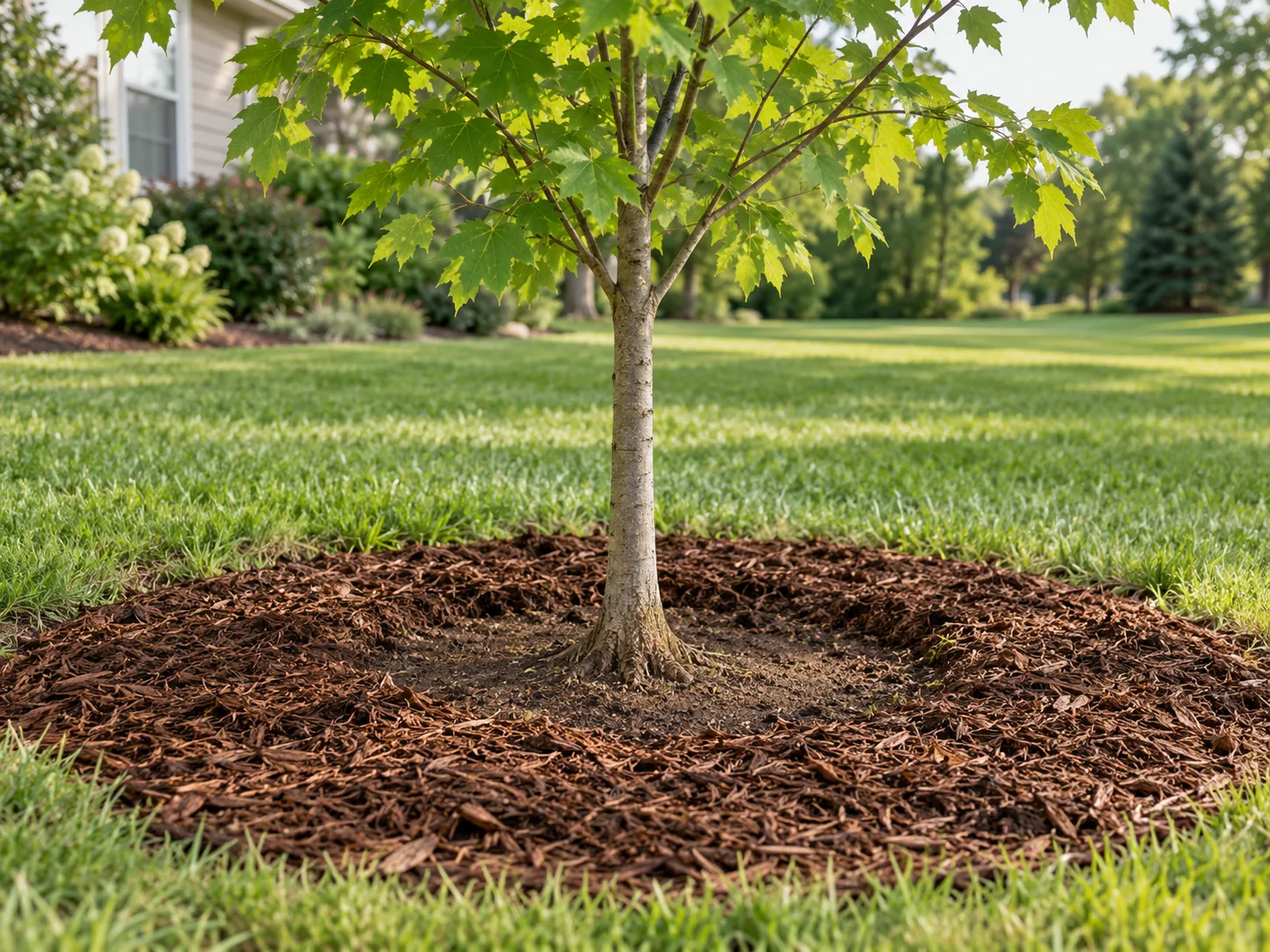
If the root flare is buried, remove excess soil from the top of the root ball until the first structural roots are visible. Keep the flare at the final soil line rather than adding soil over it to make the trunk look straight. A deeply planted tree may survive at first and then struggle as bark stays wet, roots circle, or the trunk is slowly constricted.
Inspect container-grown roots before planting. If they circle tightly around the outside, loosen or correct those roots according to their severity; do not simply place a dense, pot-bound root mass into the hole and hope it will redirect itself. For a large balled-and-burlapped tree, handle the root ball rather than lifting by the trunk, and remove or cut back materials around the top as appropriate without allowing the root ball to fall apart.
Mulch, stake, and protect the young tree
Spread roughly 2 to 4 inches of organic mulch in a wide ring, extending outward as far as practical, and leave at least 6 inches of bare space around the trunk. Mulch conserves moisture, reduces grass competition, and protects bark from mowers and string trimmers. It should look like a shallow doughnut, not a mound piled against the trunk; the latter can hold moisture against bark and conceal problems.
Stake only if the root ball shifts in wind, the tree is top-heavy, or the site is unusually exposed. Use flexible ties low on the trunk so the stem can move slightly, then remove the supports after the tree can stand securely—often by the end of its first growing season. A stake left on too long can rub or girdle the trunk.
In places with severe winter sun, wind, or animal browsing, use a trunk guard only when local conditions warrant it and remove seasonal wrapping in spring. South Dakota State Extension has a region-specific observation that Autumn Blaze may survive Northern Plains winters better in sod than in mulch; that finding should not override broader local tree-care advice elsewhere. In most yards, a mulch ring is useful because it reduces turf competition and protects the trunk from equipment.
Water through establishment, then adjust
The root ball is the priority after planting. For a newly planted tree, feel the original root ball an inch or two below the surface; water when it begins to dry, before the surrounding soil necessarily looks dry. Apply water slowly enough to soak the root ball and nearby soil rather than running off the surface. The exact interval changes with temperature, rainfall, soil texture, wind, and tree size, so a fixed “gallons each week” number is less useful than checking moisture.
As roots spread, gradually widen the area you water. A soaker hose or low-flow trickle can wet the root zone without washing away soil, and rain should count toward the total. Iowa State notes that a newly planted two-inch-caliper tree in zones 4 and 5 may need roughly two years of establishment care, and small trees commonly need active watering for at least one growing season and often two. Continue checking in autumn during dry spells until the ground freezes; do not stop watering simply because leaves have fallen.
Once established, the tree can handle some dry periods, but “drought tolerant” does not mean it needs no water in prolonged heat or drought. Water deeply when the root zone is dry rather than giving frequent shallow sprinkles that wet only the surface. If leaves brown at the margins, scorch early, or fall prematurely during a hot dry period, check soil moisture first; do not respond with fertilizer before ruling out drought, root damage, or poor drainage. See Iowa State’s newly planted tree care guide for root-ball checks, changing watering needs, and establishment timing.
Fertilizer: test before you add anything
Do not fertilize automatically at planting. The tree is rebuilding roots and adjusting to the site; fertilizer cannot substitute for correct depth, water, and oxygen. Iowa State Extension says newly planted trees generally do not need fertilizer, and advises considering it later only when poor growth persists and the diagnosis supports that response.
If growth remains weak after the tree has had time to establish, check the basics first: root flare depth, irrigation, drainage, compaction, light, trunk injury, and whether neighboring grass is competing for water. A soil test can identify pH and nutrient issues. Use a fertilizer only when testing or a qualified local recommendation supports it, and follow the product label’s rate and placement.
Avoid applying high-nitrogen lawn fertilizer beneath the canopy to chase faster shade: excess nutrients can stimulate top growth without fixing light, water, root, or pH problems. Yellow leaves with green veins point toward iron availability rather than a general need for balanced fertilizer.
Structural pruning for a stronger canopy
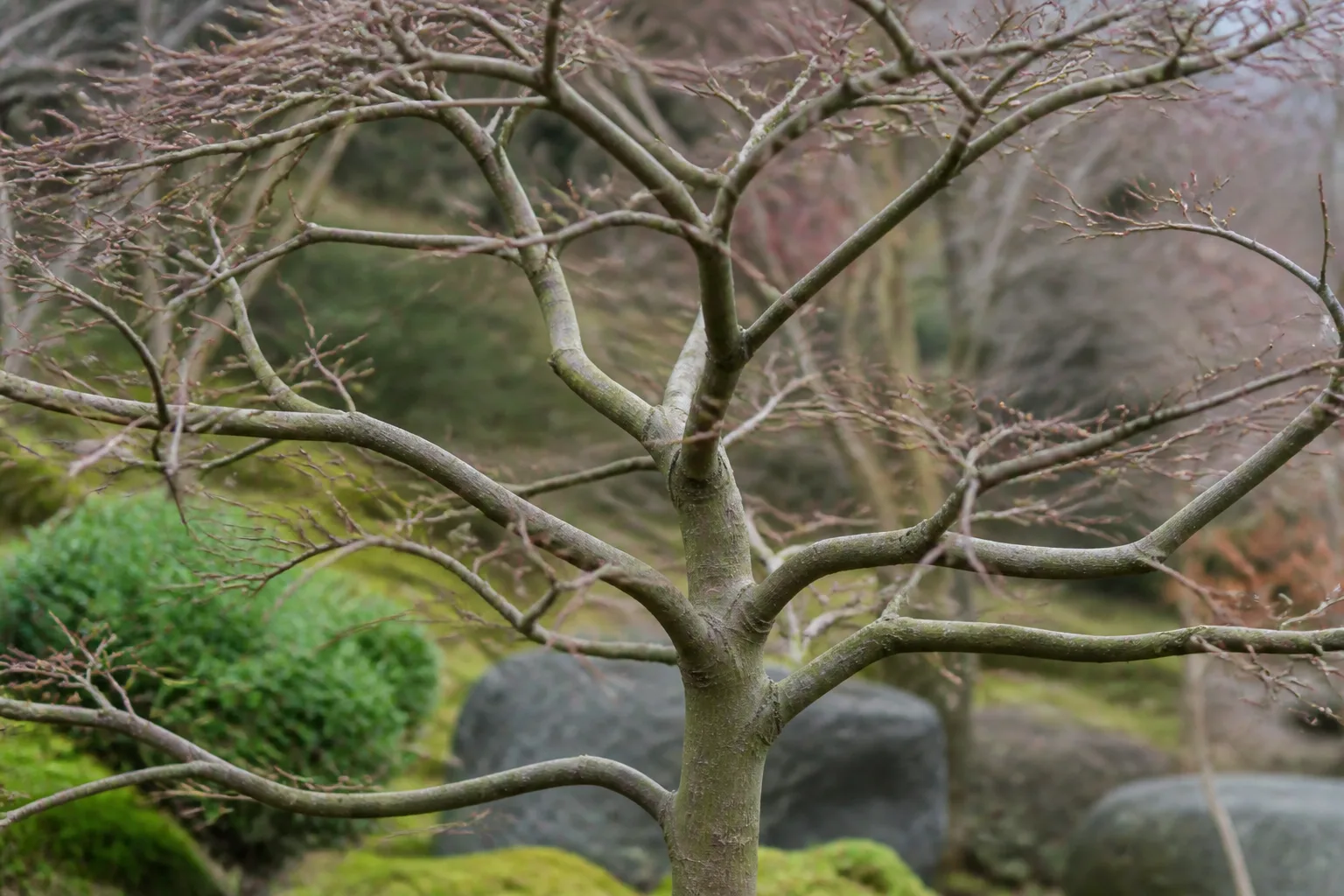
Autumn Blaze is fast growing, so look at its branch architecture while it is young, when small corrective cuts can shape the tree without removing large limbs. The goal is a balanced crown with well-spaced scaffold branches and no obvious weak attachments. Watch for two leaders competing for dominance, a narrow V-shaped union with bark trapped between stems, crossing or rubbing branches, broken limbs, and a heavy lateral limb that is becoming nearly as large as the trunk.
This is a monitoring task, not a requirement to prune every year. The Morton Arboretum describes ‘Jeffersred’ as having a strong central leader and better branch habit than silver maple; the certified arborist’s 2026 field notes describe mature trees whose laterals challenged that leader. If your specimen has a sound structure, leave it alone. If you see a codominant stem or included bark developing, ask an ISA Certified Arborist to evaluate the tree before the defect becomes a large, expensive cut.
When to prune and how to make a clean cut
Maples can “bleed” sap after late-winter pruning. This flow is usually more startling than harmful, but pruning after the leaves have fully expanded in late spring or early summer can reduce it. University of Minnesota Extension lists maples among the trees best pruned after full leaf expansion when avoiding sap flow; local disease and climate conditions may refine the exact timing.
Remove dead, broken, crossing, or narrowly attached branches with cuts just outside the branch collar—the slightly raised tissue at the branch base. Do not cut flush to the trunk or leave a long stub. For large limbs, a three-cut method helps prevent bark tearing; for a large branch overhead or any work requiring a ladder, chainsaw, or climbing, hire a qualified arborist. Do not top the tree or strip out a large share of the canopy to force a shape. UMN Extension’s tree pruning guidance covers the branch collar, young-tree training, maple timing, and limits on removing live foliage.
Surface roots, lawns, and nearby structures
Maple roots are not a solid underground mirror of the canopy, and they generally spread through the oxygen-rich upper soil. Some roots may become visible at the surface as the tree matures, especially in compacted soil or turf. That can make mowing difficult, but cutting large roots or burying them under a deep layer of soil can damage the tree and destabilize it.
Keep a mulch area beneath the canopy where practical, and avoid repeated traffic or construction compaction around the root zone. Do not place a raised flower bed over surface roots or add fill to hide them. If a root interferes with a path, consult an arborist about options rather than severing it; root damage close to a large trunk can affect tree stability.
A mature crown may reach 40 feet across, and roots can extend beyond its edge. Leave room from foundations, retaining walls, and drives rather than planning to install root barriers later. Illinois Extension explains that roots occupy the upper soil and can spread well past the canopy; see its tree root guidance.
Pests, leaf spots, and other stress signals
Autumn Blaze is not immune to pests simply because it is a hybrid. Young trees may be visited by leafhoppers, scale insects, or borers; inspect the leaves, twigs, and bark before choosing a treatment. Sticky residue, clusters of small insects, a line of tiny holes, or localized branch dieback are clues to investigate, not a diagnosis by themselves. North Carolina State Extension lists leafhoppers, borers, and scale among potential problems on young Freeman maples, while the Morton Arboretum notes Verticillium wilt and maple gall as possible issues.
Start with a close look and a photo record. Note whether symptoms affect one branch or the whole canopy, whether they appeared after heat or drought, and whether the damage is on old or new growth. If an entire scaffold branch is flagging, bark is splitting, or the tree has a large weak union, contact an arborist. For a small insect population, avoid broad-spectrum spraying before identification; pesticide use should match the pest, product label, season, and local regulations.
Black, tar-like spots that appear on leaves late in summer are often maple tar spot. Leaf spots are usually cosmetic on an otherwise healthy mature tree, and raking fallen leaves may help reduce residue but will not cure every leaf disease. Penn State Extension’s maple disease guide says tar spot does not need control measures; do not apply fungicide just because the leaves look marked. Premature widespread leaf drop, repeated annual defoliation, or declining branches warrants a closer diagnosis.
Tell scorch, chlorosis, and leaf spots apart
Leaf scorch often appears as dry brown edges or patches during heat, wind, drought, or root stress. Check the soil before assuming disease: a wet surface can hide a dry root ball, while saturated clay can deprive roots of oxygen. Correct the moisture problem gradually and protect the tree from additional root or trunk damage.
Iron chlorosis usually looks like yellow tissue between greener veins, first on newer leaves. High-pH soils can make iron unavailable even when the soil contains iron, and Utah State Extension has documented this problem on Autumn Blaze in the Intermountain West. A soil test and local diagnosis matter because indiscriminate iron or acidifying treatments may be costly, temporary, or ineffective.
Leaf spots and galls often appear in spring or late summer and can look dramatic at close range. Their pattern, timing, and distribution help distinguish them from drought or nutrient stress. University and extension references list several maple leaf spots and gall mites that rarely justify chemical treatment; focus on tree vigor and get a diagnosis if damage is severe or repeated.
Fall and winter care
A healthy, established tree needs little seasonal preparation. Keep watering during dry autumn weather until the soil freezes, clear fallen leaves from paths, and maintain mulch without piling it against the trunk. Do not fertilize late in the season in an attempt to force new growth before winter.
Once leaves have dropped, the branch structure is easier to inspect. Remove only small dead or broken branches that can be handled safely, and mark defects such as a narrow union or a competing stem for an arborist’s assessment. Avoid major pruning because it is convenient to see the branches; the best timing for maples depends on the purpose of the cut and local conditions.
In snowy or icy regions, prioritize sound branch structure and never shake ice-covered limbs. Keep people clear of a split or hanging branch over a roof or walkway and call an arborist; use temporary animal guards only where local conditions warrant, removing wraps in spring.
Better choices for smaller or difficult sites
If you love the red fall color but cannot fit a 40-foot spread, choose a smaller species or cultivar rather than treating Autumn Blaze as a small-yard tree. A narrower Freeman cultivar such as ‘Armstrong’ may have a tighter columnar crown, but it can still grow very tall and is not automatically right beneath wires. A red maple cultivar may be a better fit where local soils and climate suit it; a serviceberry, redbud, or other small flowering tree may provide more appropriate scale and seasonal interest.
If you are planting near a natural area, use the local invasive-plant list and municipal tree recommendations rather than treating all maples as interchangeable. Freeman maple is different from Norway maple, a species that is regulated as invasive in parts of the Northeast; Cornell’s invasive-ornamental alternatives page lists Freeman maple as an alternative to Norway maple in New York. That does not make every hybrid suitable everywhere, so confirm local rules and habitat priorities before planting.
For dry, high-pH western soil or a wet low spot, choose a tree adapted to the site’s chemistry and drainage. For a confined street strip, verify mature width and utility clearances before buying; a similar-looking fast-growing maple is not automatically a better fit.
Conclusion
Autumn Blaze maple can deliver quick shade and vivid fall color when it has room to reach its full size. Identify the cultivar as ‘Jeffersred,’ check local hardiness and soil conditions, and reserve space for a broad crown and expanding roots before planting.
Set the root flare at grade, water the original root ball as it establishes, keep mulch away from the trunk, and inspect young branches for weak attachments without pruning on an automatic schedule. If the site is too small, poorly drained, or prone to high-pH chlorosis, another tree may be a better long-term choice.