Ginkgo Biloba Tree Care: Planting, Watering & Pruning
Get practical ginkgo biloba tree care advice on cultivar sex, site selection, planting, watering, pruning, fall color, and female trees’ smelly seeds.

A ginkgo is a long-term landscape choice, not a quick way to fill an empty corner. The species can eventually form a substantial shade tree, and a female tree can leave pungent, slippery seeds beneath it in autumn. Choose the right cultivar and give it room, however, and ginkgo offers unusual fan-shaped leaves, brilliant yellow fall color, and a reputation for coping with conditions that challenge many other trees.
The most useful order is simple: confirm the tree’s sex and mature form, check that the site drains and has enough root and canopy space, then plant the root flare at the right depth and water consistently while roots establish. Routine fertilizer and heavy pruning usually do less good than those early decisions.
Ginkgo care at a glance
| Need | Practical target |
|---|---|
| Light | Full sun for the strongest growth and fall color; partial shade is tolerated |
| Soil | Adaptable to several textures and pH ranges, provided drainage is good |
| Mature size | The species commonly reaches about 50–80 feet tall and 30–40 feet wide; cultivar form varies |
| Water | Keep the root ball and surrounding soil evenly moist during establishment; established trees tolerate some drought |
| Pruning | Little routine pruning; correct structural problems while the tree is young |
| Main selection issue | Buy a clearly labeled, grafted male cultivar if you want to avoid seed mess and odor |
Those ranges are not a substitute for the dimensions of a particular cultivar or the conditions in your region. Extension and arboretum references agree that ginkgo tolerates a broad range of soils and urban stress, but they also emphasize sun, drainage, and giving the tree adequate space. (NC State Extension; Virginia Cooperative Extension)
Choose a male cultivar before anything else
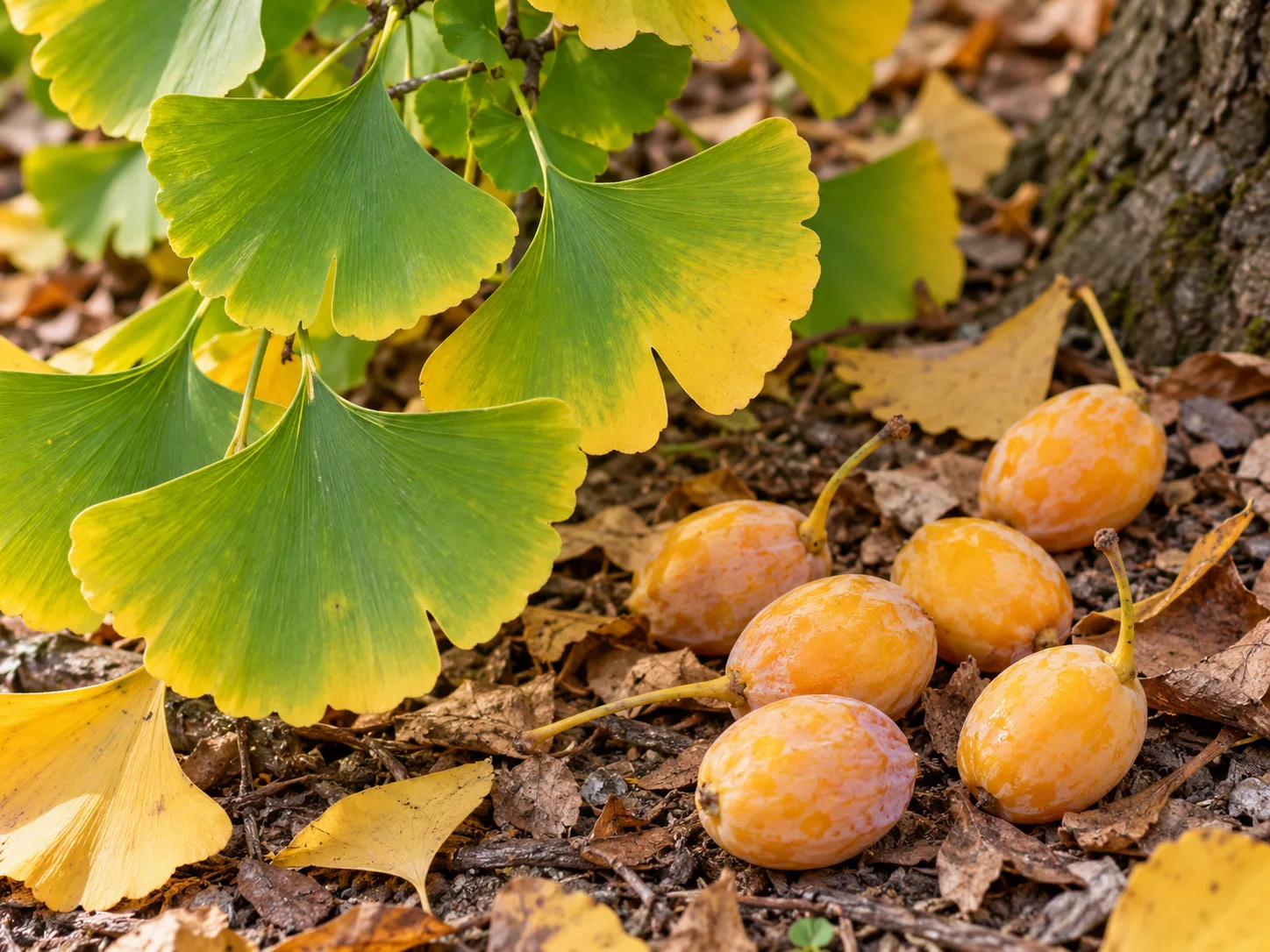
Ginkgo is dioecious: individual trees are generally male or female. Male trees produce pollen cones. Female trees produce ovules that, after pollination, develop into seeds surrounded by a soft, yellow-orange outer layer. That layer is not a true fruit in the botanical sense, because ginkgo is a gymnosperm, but it is the part that creates the notorious smell as it breaks down on the ground. (NC State Extension)
If the tree will stand near a sidewalk, driveway, patio, play space, or a frequently used path, choosing a named male cultivar is the easiest way to prevent the seasonal cleanup problem. The smell comes from the fleshy seed coat, and fallen seeds can also make paving slippery. Female trees can still be worthwhile in a botanical collection or a large setting where the seeds are acceptable, but they are a poor surprise beside a front walk.
A male tree is not automatically the best choice for every household. It produces pollen, but evidence about ginkgo-specific pollen allergy remains limited; anyone with a diagnosed pollen allergy can ask a clinician about tree selection and placement. A female tree avoids pollen but can produce odorous seeds if pollinated. There is no universally perfect sex; the right choice depends on where the tree will stand and which seasonal nuisance you would rather avoid. (review of urban pollen allergenicity)
How to read a nursery label
Look for a named cultivar explicitly identified as male or non-fruiting, and buy from a nursery that can confirm the plant is grafted or otherwise true to that named selection. A seed-grown sapling cannot be reliably identified as male or female from its leaves or juvenile shape; sex becomes apparent only when it reaches reproductive maturity, which can take years. A tag that says only “ginkgo” or “maidenhair tree” does not tell you the sex.
Common male selections include ‘Autumn Gold’, known for a broadly spreading, fairly uniform canopy and strong yellow fall color, and ‘Princeton Sentry’, selected for a narrower, upright form. ‘Saratoga’ is grown for unusually narrow, butterfly-like leaves, while columnar selections such as ‘Fastigiata’ suit tighter overhead spaces better than the full species. Cultivar dimensions and descriptions vary among references and nurseries, so compare the actual label and expected mature width before buying. (The Morton Arboretum; UF/IFAS Extension; Fine Gardening)
Match the mature tree to the site
A standard ginkgo is not a small ornamental. NC State lists the species at roughly 50 to 80 feet tall and 30 to 40 feet wide, though a particular tree may fall outside that range depending on its cultivar and growing conditions. A narrow cultivar changes the canopy shape, but it does not turn a large tree into a shrub; check the cultivar’s expected spread and height, then allow room for the mature crown rather than spacing it according to the nursery pot.
Think both above and below ground. Keep the trunk and eventual crown clear of buildings, rooflines, overhead wires, vehicles, and sight lines. At the same time, avoid a tiny paved cutout where the roots will have little soil volume. Ginkgo is often used as a street tree because it handles air pollution and many urban conditions, but urban tolerance is not permission to ignore root space, drainage, or establishment watering.
A ginkgo can become an excellent specimen tree or shade tree in a lawn, parkway, or broad planting bed. It is less suitable where a tree must remain compact, where a low-maintenance evergreen screen is the goal, or where the yellow leaf drop would block drains or cover a heavily used walkway. If the available width is limited, choose a narrow named cultivar and verify its mature dimensions with the nursery or local extension service.
Sunlight, soil, and drainage
Give ginkgo a sunny position if possible. Full sun supports a fuller crown and helps produce the clear golden autumn display. It tolerates some shade, especially in hot locations, but a deeply shaded site can slow growth and leave the canopy open. In a hot-summer region, ask a local extension service whether a particular cultivar is suited to your heat and winter conditions; hardiness labels are not a guarantee of equal performance in every climate.
Soil texture is flexible: ginkgo can grow in sandy, loamy, or clay soils, and it tolerates a wide pH range. Drainage is the key qualifier. A tree may cope with compacted urban soil better than many species, but roots still need oxygen. Avoid a low spot that stays saturated after rain or a planting hole that acts like a basin in dense clay. If water remains in a test hole for a long time, improve the site or choose a better-drained planting location rather than trying to solve persistent waterlogging with fertilizer.
Plant ginkgo for long-term establishment
Plant in a cool, moderate-weather window when the ground is workable and the tree can establish roots before the hardest heat or freeze period. In many temperate areas that means fall or spring. Local climate, nursery stock type, and soil moisture can shift the best timing, so follow regional extension guidance if your winters are severe or summers arrive early.
Before digging, mark the future tree’s mature canopy and check for utilities, paving, and overhead conflicts. For a large tree, call the local utility marking service before excavation. A good planting site is easier to choose before the roots are in the ground than to correct after the canopy reaches a roof or line.
Get the root ball and planting depth right
Dig a broad, shallow hole about two to three times wider than the root ball, but no deeper than the root ball itself. Find the root flare, where the trunk widens into the first structural roots, and set it at or slightly above surrounding grade. A tree planted too deep may struggle because the buried trunk and roots receive too little oxygen; later mulch piled against the trunk can compound that problem. (Penn State Extension; University of Minnesota Extension)
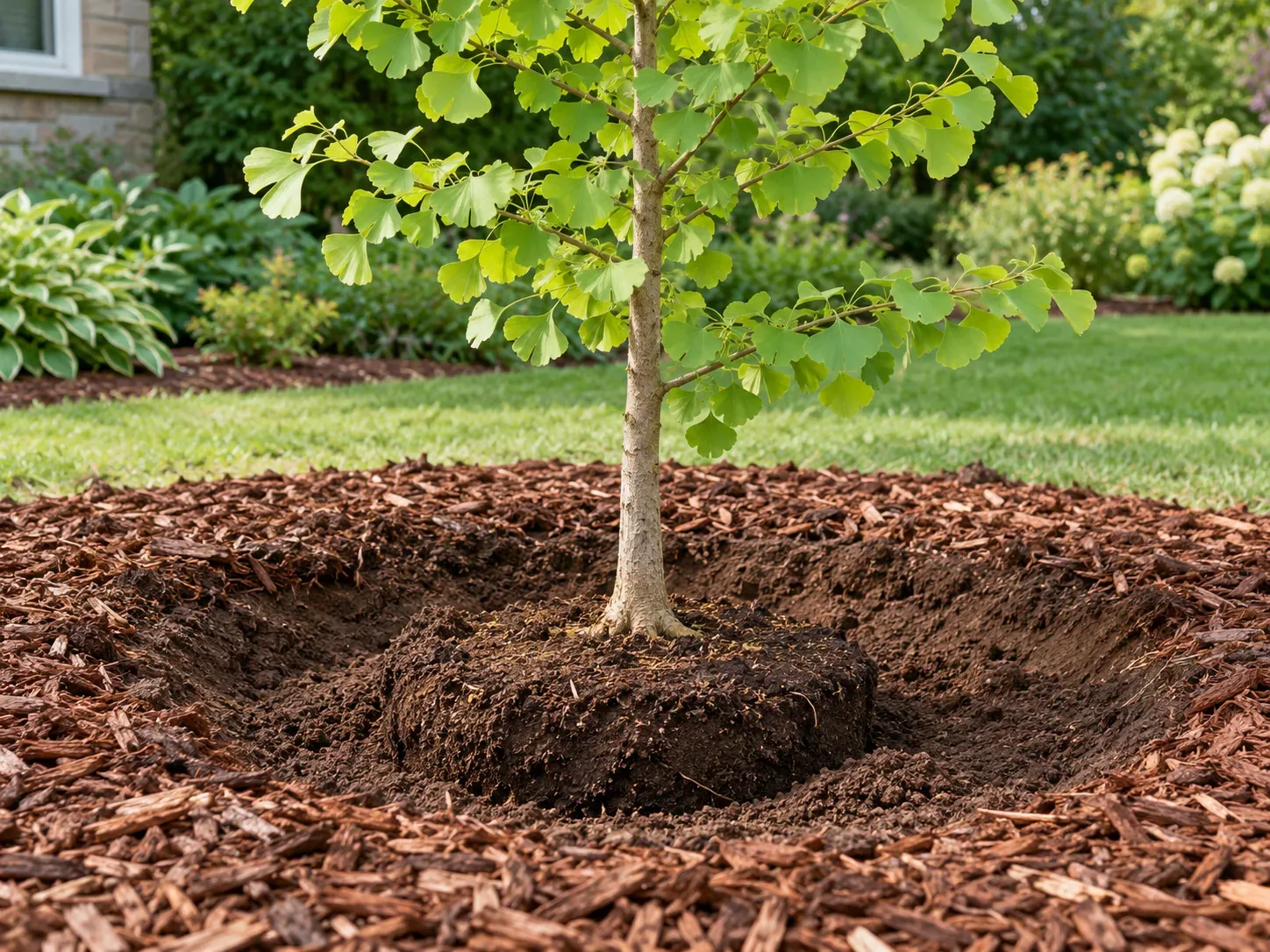
For a container-grown tree, slide off the pot and inspect the outside of the root ball for circling or kinked roots. Loosen or correct the outer roots where practical instead of burying a tight spiral that may continue growing around the trunk. For balled-and-burlapped stock, expose the root flare, remove twine from the trunk, and follow local guidance for the basket and burlap; do not leave synthetic material around the root ball.
Backfill with the soil you removed unless a soil test or local recommendation calls for a specific amendment. Avoid filling the hole with rich compost or potting mix: a sharp contrast between the planting hole and native soil can discourage roots from expanding outward. Water slowly as you backfill to settle soil around the roots, then water thoroughly once planting is complete. Finish with a broad, shallow mulch ring, keeping mulch several inches away from the trunk and leaving the root flare visible. (Penn State Extension)
Water through establishment and dry spells
A newly planted ginkgo needs regular moisture while its reduced root system expands into surrounding soil. Water the root ball and the backfill area slowly enough for moisture to soak in; a quick sprinkle over the leaves does not replace root-zone watering. Check soil a few inches down before watering. If it is still moist, wait; if it is beginning to dry, water deeply and reassess after the next weather change.
There is no responsible single schedule for every ginkgo. A small container tree, a large balled-and-burlapped specimen, sandy soil, clay soil, a windy site, and a heat wave all change how quickly the root zone dries. Extension guidance for newly planted trees recommends more frequent watering early, then less frequent but continued watering as roots establish; use local rainfall and the soil itself to adjust the interval. (University of Minnesota Extension)
Keep watering through dry periods during the first growing seasons rather than assuming that a tough species needs no help. The root ball can dry faster than the surrounding ground, especially when it contains a different, lighter nursery medium. As the tree establishes and roots grow outward, it becomes more drought tolerant, but a long dry spell can still cause stress, leaf scorch, or premature leaf drop.
A mulch ring helps maintain moisture and reduces competition from turf. Keep grass and weeds away from the trunk for the first few years, but do not create a mulch “volcano.” A layer around two to three inches deep spread broadly over the root zone is more useful than a thick pile against bark. Avoid frequent shallow irrigation that keeps the surface wet while leaving the deeper root zone dry.
Fertilize only when the tree needs it
Ginkgo does not need a routine fertilizer application simply because spring has arrived. If growth is healthy and the leaves have normal color, leave the tree alone. Before treating weak growth or yellow leaves as a nutrient problem, check planting depth, water, drainage, root competition, and whether the tree is still establishing.
If a soil test identifies a deficiency, use a product and rate appropriate to that test and the tree’s size. Avoid pushing a young tree with high-nitrogen lawn fertilizer; rapid soft growth does not solve a root problem and can create more pruning work. Keep fertilizer off the trunk and follow the product label rather than estimating by handfuls.
Prune for structure, not size
Most established ginkgo trees need little pruning beyond removing dead, broken, or hazardous branches. While the tree is young, inspect the framework once a year and preserve one strong central leader if the cultivar’s natural form calls for one. Remove a competing leader, rubbing branches, or a badly placed branch while the cut can still be small. (RHS: Ginkgo biloba; UF/IFAS Extension)
Prune during dormancy or another locally appropriate window, and make clean cuts just outside the branch collar. Do not top the tree to keep it short; topping removes the natural crown, produces weakly attached regrowth, and leaves large wounds. If a mature ginkgo conflicts with a building, vehicle clearance, or overhead wire, ask a qualified arborist to assess the specific cuts and whether the tree was planted in the wrong place.
Expect vivid gold and a fast leaf drop
Ginkgo foliage is green through the growing season, then turns a clear yellow in autumn. The timing varies with local weather and day length. The color can be especially striking because many leaves turn together, and after a hard frost or other seasonal cue the tree may shed a large share of its leaves in a short span rather than dropping them gradually over many weeks. This is part of the tree’s normal seasonal rhythm, not a disease sign. (Fine Gardening; NC State Extension)
That brief display comes with a practical trade-off: leaves can cover a path almost overnight. If you want the autumn color next to pavement, plan for a quick cleanup and keep catch basins clear. On a lawn or garden bed, shredded leaves can be composted or used as a light mulch after they are collected, but thick mats can smother grass or hold moisture against low plants.
Understand female trees and fallen seeds
Female ginkgo trees produce seeds only after pollination, and the fleshy outer covering turns soft and foul-smelling as it decays. The odor is often compared with rancid butter or vomit because the seed coat contains pungent compounds. The tree is not producing a conventional fruit, but from a homeowner’s perspective the cleanup is similar: collect the fallen material promptly, especially from paving where it can become slick.
Wear gloves when handling fallen seeds and wash exposed skin. The outer covering can irritate some people, so gloves are sensible during cleanup; the seed itself should not be eaten raw or treated as harmless because a few seeds have been consumed safely. (Arnold Arboretum) Fresh ginkgo seeds are toxic when eaten, and the Royal Horticultural Society also warns that seeds are harmful to pets. Keep fallen seeds away from children and animals, and contact a poison center or veterinarian for case-specific advice if ingestion occurs. (NCCIH: Ginkgo—Usefulness and Safety; Royal Horticultural Society)
If an existing female tree is healthy and well placed, removing it is not the only option. You can collect seeds regularly and keep the area clean, but this is ongoing seasonal work. If you are buying a new tree and the odor or cleanup would be a problem, select a named male cultivar from the start instead of hoping a young tree will turn out male.
Solve common ginkgo growing problems
Ginkgo is generally resistant to many common pests and diseases, but “tough” does not mean immune to poor planting or water stress. Diagnose the site and root zone before reaching for a pesticide or fertilizer. A tree can show leaf symptoms because the roots are struggling, and a treatment aimed at the leaves will not correct a buried root flare or persistently wet soil.
Slow growth after planting
A ginkgo may spend its first few seasons building roots rather than adding much visible height. A modest amount of growth by itself is not proof that the tree is failing, especially if the leaves look normal and the buds develop each spring. Confirm that the root flare is visible, the root ball receives water during dry periods, and lawn or weeds are not competing directly over the young root zone.
If the canopy shrinks, branches die back, or the tree remains weak after several seasons of appropriate care, inspect for planting too deeply, circling roots, standing water, or severe compaction. A certified arborist can evaluate root defects and grade problems without the guesswork of adding products to the soil.
Scorched leaves or weak fall color
Brown leaf edges or premature yellowing often follow drought, heat, reflected pavement heat, transplant stress, or damaged roots. Check moisture in the root ball rather than judging only the surface, and verify that water drains away instead of sitting in the planting hole. In a street tree bed, consider whether a small soil opening and intense afternoon heat are combining to dry the roots quickly.
Ginkgo color can also look less dramatic in a shaded location or in a year with unusual weather. A single season of muted color is not a reason to fertilize. If the problem repeats, inspect the light, drainage, irrigation pattern, and root area, then consult a local extension service or arborist if decline continues.
Propagate with sex and cultivar in mind
Ginkgo can be grown from seed or propagated vegetatively, but seed is the wrong route when you specifically want a fruitless male landscape tree. Seedlings may be male or female, and juvenile seedlings cannot be sexed reliably by foliage. They also may not reproduce the narrow or spreading form of a named cultivar.
If preserving a known male cultivar matters, buy a properly labeled grafted tree from a reputable nursery rather than relying on an unidentified seedling. Experienced growers can propagate ginkgo by cuttings or grafting, but rooting and early care require suitable conditions; a cutting is not automatically a quicker or easier result for a home gardener. For most landscapes, paying for the named selection provides more predictable sex and form.
Is ginkgo right for a street or small yard?
Ginkgo can be a strong street-tree candidate where the city or property has adequate soil volume, a planting strip wide enough for the chosen cultivar, and room for the mature canopy. It tolerates air pollution and a range of soil conditions better than many ornamentals, which helps explain its use in urban landscapes. It still needs careful establishment watering, drainage, and protection from trunk damage by mowers or vehicles. (Virginia Cooperative Extension; UF/IFAS Extension)
For a compact property, first decide whether the site can hold a tree at all. A columnar male cultivar such as ‘Princeton Sentry’ may fit where a broad crown would not, but it still grows tall and needs clearance from wires, roofs, and neighboring trees. If the available space cannot accommodate even the narrow cultivar’s listed mature height and spread, choose a genuinely smaller tree rather than planning to prune a ginkgo into a permanent miniature.
A good ginkgo site also makes the fall display an asset rather than a chore. Place the tree where its yellow leaves can be enjoyed and where rapid leaf drop will not routinely clog a drain or create a slip hazard. Avoid planting over a heavily used patio or beside a narrow path if seed cleanup from a nearby female tree is possible.
Conclusion
Growing ginkgo successfully begins before planting: choose a named male cultivar if you want to avoid odorous seeds, match its mature canopy to the actual space, and confirm that water drains from the site. Plant with the root flare at grade, mulch broadly without touching the trunk, and keep the root ball moist through establishment. After that, a sunny, well-drained site and occasional structural pruning are usually more valuable than routine feeding.
The tree’s famous toughness has limits, but with room for its mature form and a little patience while roots establish, ginkgo can provide a distinctive canopy and reliable golden fall color for generations.