Jamun Tree Care for Pots, Terraces & Warm Gardens
Syzygium cumini
Grow Jamun in full sun with deep watering and fertile, well-draining soil. Learn container size, fresh-seed propagation, pruning, and pet-aware placement.
Jamun Tree Care for Pots, Terraces & Warm Gardens
Start with wateringThe most common care mistake for JamunWatering guide →Jamun care essentials
Light
Water
Water deeply when the top 3–5 cm of mix is dry. Young and container-grown trees need even moisture while establishing; mature in-ground trees tolerate drought and brief flooding, but pots should never remain waterlogged.
Soil
Fertile, loamy, well-draining soil that holds some moisture without becoming stagnant. For containers, use an aerated loam-based mix with compost and coarse drainage material; aim for mildly acidic to neutral conditions.
Humidity
Temperature
Fertilizer
About Jamun
Jamun is native to Tropical and subtropical South and Southeast Asia, including India, with a wider native range extending into tropical eastern Africa, typically reaches 2–4 m in a large container with regular pruning; 12–30 m in open ground indoors, with moderate; fairly fast once established in warm, sunny conditions growth. Jamun has a tree like growth habit and part of the Myrtaceae family. It is also known as Java Plum, Jambolan, Indian Blackberry, Black Plum, Malabar Plum, and Jambul.
| Detail | Information |
|---|---|
| Also known as | Java Plum, Jambolan, Indian Blackberry, Black Plum, Malabar Plum, Jambul |
| Native region | Tropical and subtropical South and Southeast Asia, including India, with a wider native range extending into tropical eastern Africa |
| Mature size | 2–4 m in a large container with regular pruning; 12–30 m in open ground |
| Growth rate | Moderate; fairly fast once established in warm, sunny conditions |
| Growth habit | Tree Like |
| Scientific name | Syzygium cumini |
| Family | Myrtaceae |
Jamun Tree Care for Pots, Terraces & Warm Gardens
Jamun is an outdoor evergreen fruit tree, not a foliage houseplant that will stay content beside a dim window. Give Syzygium cumini full sun, fertile soil that drains freely, and enough root room, then manage water and canopy size according to whether it grows in the ground or a pot. That distinction matters: a mature landscape tree and a terrace specimen share the same biology but not the same drying rate, nutrient reserve, or space.
In India and similarly warm regions, the practical challenge is rarely keeping Jamun alive once it is established. It is choosing a sunny site, preventing a container from staying waterlogged in monsoon weather, and accepting that an unpruned tree wants to become large. Use this overview to decide whether your space suits the plant, then open the sibling guides when one care topic needs deeper troubleshooting.
Jamun care at a glance
- Light: Full outdoor sun; Singapore National Parks lists Jamun for full sun with moderate water.
- Temperature: Tropical to subtropical warmth. Young plants are more frost-sensitive than mature landscape trees.
- Water: Soak deeply when the top 3–5 cm of mix has dried. Young and potted trees need steadier moisture than established in-ground trees.
- Soil: Deep, fertile loam that drains well yet holds some moisture; containers need large drainage holes and an aerated mix.
- Pot: A stable, heavy container enlarged in stages; prune roots and canopy if you intend to keep a long-term specimen pot.
- Feeding: Modest organic or balanced feeding during active growth; avoid pushing excessive soft shoot growth on already vigorous trees.
- Pruning: Train a clear framework early; remove dead and crossing wood, and plan regular size control for containers.
If the tree is declining, check the root zone before buying a tonic. Wet, sour mix or standing monsoon water demands a drainage correction; bone-dry mix and a very light pot call for a thorough soak. The detailed Jamun watering guide and Jamun soil guide separate those two problems.
What kind of plant is Jamun?
Syzygium cumini is an accepted species in the myrtle family, Myrtaceae. Kew describes its native range as tropical and subtropical Asia to northern Queensland and notes that it grows primarily in the wet tropical biome. Common names include Java plum, jambolan, Indian blackberry, and black plum—useful aliases when nursery labels vary.
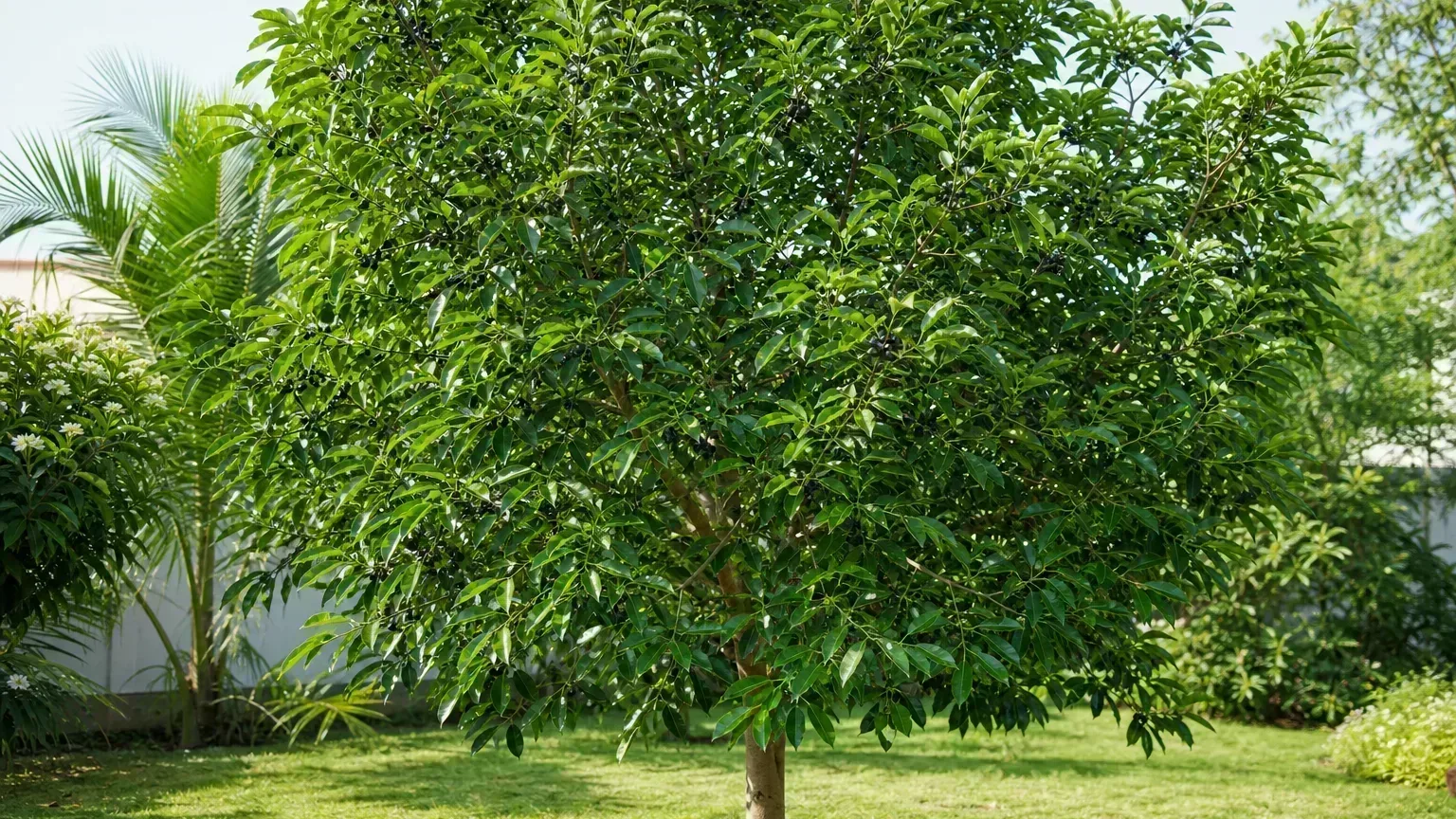
NParks describes a fairly fast-growing tree with a dense crown, glossy dark green mature leaves with yellowish midribs, and pinkish young foliage with a turpentine-like scent. Fragrant cream-to-rose flowers form powderpuff clusters, and the fleshy berries ripen from green through purplish-red to shiny purple-black. Birds and other wildlife seek the fruit, so place the tree where fallen berries will not create a problem under paving or seating.
Growth habit and realistic mature size
An unpruned Jamun is not a patio-sized shrub. NParks lists a maximum height of 12 m to 30 m, and World Agroforestry describes a medium-sized tree 10–30 m high with a stout trunk and irregular or globular crown. Container culture does not genetically dwarf a vigorous seedling; the pot limits roots while pruning limits the canopy, and both also limit how much stress and crop load the tree can support.
World Agroforestry notes that seedlings may reach about 4 m in only two years under favourable conditions, and that the tree coppices and responds vigorously after pruning. That growth rate is encouraging for shade and fruit orchards, but it is a warning for a narrow balcony or anyone expecting a permanently tiny houseplant.
Seedling vs grafted expectations
Home growers often start from fresh fruit seed because Jamun seed is widely available and germinates readily when sown promptly. Tamil Nadu Agricultural University notes that seedling trees typically begin bearing at about 8 to 10 years, while grafted or budded trees may begin in about 6 to 7 years, with commercial bearing later still. Seed-grown trees can be rewarding, but fruit quality and vigour vary more than with a named selection such as Ram Jamun where available.
If predictable fruit and earlier bearing matter, ask nurseries for budded or grafted plants on healthy rootstock rather than an unnamed roadside seedling. Inspect the root ball for circling roots, sour mix, and pest infestation before you buy.
Best placement in India and warm climates
Use the sunniest garden edge, courtyard, or terrace available, with moving air and room for a dense crown. TNAU describes Jamun as suited to tropical and subtropical climates, occurring widely across India and into lower Himalayan elevations. World Agroforestry adds that the species is widely distributed in India except in very arid regions, favours moist situations, and once established can tolerate drought while also tolerating prolonged flooding in the landscape—field tolerances that a pot does not fully share.
In the ground, leave generous spacing. TNAU recommends pits at about 10 m each way for orchard planting, which is a useful reminder that this is a shade tree with a large eventual footprint. Keep the trunk flare free of piled mulch, and avoid low basins that hold stagnant water against a container rim or young root collar.
Outside its native and cultivated range, note a different risk: UF/IFAS reports that Java plum has become invasive in South Florida and does not recommend planting it there. In India and other regions where Jamun is a valued indigenous fruit tree, the practical issues are size, fruit drop, and root-zone management rather than invasion policy—but travellers and expatriate growers should check local guidance before planting.
Growing Jamun in a large container
A container Jamun belongs outdoors. Start with a pot only moderately larger than the current root mass, ensure several generous drainage holes, and step up as roots occupy the mix. An oversized tub around a small root ball can stay wet for too long during monsoon rain, while a tiny pot on a hot terrace can dry dangerously in a day. A heavy base or broad tub helps prevent a leafy tree from overturning in pre-monsoon wind.
Expect a maintained container height nearer 2–4 m with regular pruning rather than the full landscape size. Root-prune and refresh part of the mix when the tree has reached its final pot instead of endlessly upsizing into an unmanageable tub. Use the Jamun repotting guide when roots circle, the mix collapses, or the canopy becomes top-heavy.
Light: treat Jamun as a full-sun tree
Jamun grows and fruits best in full sun. NParks lists full sun as the light preference, and a bright indoor window is not a substitute for open-sky exposure. Glass, awnings, and neighbouring buildings cut usable light sharply; a seedling may linger in a bright room for a short while, but a permanent indoor placement produces weak, spaced growth and little chance of a meaningful crop.
Place a container where walls and taller trees do not shade it through the main part of the day. If growth is long and weak, leaves are widely spaced, and no sturdy new flushes develop, light is the first constraint to examine. Use the Jamun light guide for acclimation steps when moving nursery shade foliage into harsh terrace sun.
Watering young trees, pots, and established landscape trees
Young and container-grown Jamun need more consistent moisture than established landscape trees, but neither benefits from permanently saturated roots. Water a pot slowly until the whole root ball is wet and runoff exits freely, then wait until the upper 3–5 cm has dried before watering again. Check with a finger and learn the pot’s dry weight instead of obeying a fixed calendar.
NParks lists moderate water and notes drought tolerance and short-term flooding tolerance once established. TNAU advises frequent irrigation in early stages, then fewer irrigations for mature trees, with attention during fruit ripening and occasional winter watering when soils are dry. On an exposed Indian terrace, a rooted pot may need checks every few days in hot weather; that does not mean it must be watered daily. During dependable monsoon rain, remove saucers, keep holes clear, and pause irrigation.
Soil and drainage for Jamun
Jamun tolerates a wide range of soils in the landscape, but high yield and good growth favour deep loam that drains yet retains moisture. TNAU states that deep loam and well drained soil are preferred, and that very heavy or very light sandy soils are less economical for productive trees. NParks lists fertile loamy soils, well-drained soils, and waterlogged soils that still drain as root-zone tolerances—again describing field behaviour more than a closed container.
For pots, use an aerated blend such as roughly half loam-based potting mix, one quarter finished compost, and one quarter coarse sand, pumice, or perlite. Aim for mildly acidic to neutral conditions and never leave the pot standing in a tray of runoff. Ground sites should shed water after heavy rain; where local soil floods, a broad raised mound is safer than a low basin.
Feeding without forcing excess soft growth
Feed a young container tree lightly during active warm growth after watering the root ball. A modest dose of well-rotted farmyard manure or a balanced fruit-tree fertilizer is more defensible than frequent high-nitrogen doses that push soft, pest-attractive shoots. TNAU notes that Jamun often stands neglect in the field, and that on very rich soils trees may put on excess vegetative growth and delay fruiting—so adjust feeding to growth response rather than a rigid schedule.
Flush container mix occasionally with plain water so dissolved salts do not accumulate. See the Jamun fertilizer guide for age- and container-specific decisions when yellowing or stalled growth points to nutrition rather than light or water.
Pruning, flowering, and fruit expectations
Train a young Jamun to develop a framework of well-spaced branches above about 60 to 100 cm from ground level, as TNAU recommends for training. Regular severe shearing is unnecessary on landscape trees; remove dry twigs and crossing branches, and use selective cuts to keep a container specimen within reach. The tree responds vigorously after pruning, so plan annual size control rather than one desperate cut after the canopy has already blocked a terrace.
Flowering and fruit timing vary by climate. NParks notes bloom from May to August in Malaysia with later harvest, while TNAU describes North Indian flowering roughly from March into April and fruit ripening around June–July for common types. Fruit should be picked promptly when deep purple or black because ripe berries do not hold well on the tree and can ferment messily beneath the canopy—UF/IFAS notes that accumulated fruit may emit a foul odor and attract flies when left to pile up. Use the Jamun pruning guide for a focused size-control sequence.
Pet cautions and fruit mess
Ripe Jamun fruit is eaten by people, but human edibility does not establish that leaves, bark, seeds, or concentrated preparations are safe for every pet. No species-specific veterinary safety classification was located in the sources used for this guide, so prevent chewing and keep fallen fruit and seeds away from animals that may swallow them whole. Contact a veterinarian after significant ingestion rather than trying a home remedy.
Plan for wildlife and staining. NParks notes that fruit attracts birds and other animals, and purple-black juice can mark paving and seating. Harvest promptly if mess matters, and place containers away from doorways and light-coloured floors where possible.
Common mistakes and first corrective actions
Keeping Jamun indoors permanently: Move it outdoors into full sun, acclimating tender leaves over about a week. Using a huge wet pot for a small root ball: Improve drainage or downsize if the mix stays soggy for many days after rain. Watering through dependable monsoon rain: Stop irrigation, empty saucers, and confirm water can escape the holes.
Expecting a tiny unpruned tree: Start structural pruning early and accept a maintained container height rather than landscape scale. Sowing dried or stored seed: Jamun seed is recalcitrant; World Agroforestry notes viability can be lost within about two weeks of open storage—sow fresh seed promptly and see the Jamun propagation guide for method detail. Responding to every yellow leaf with fertilizer: Inspect moisture, roots, light, and pests first because more salts can worsen a stressed container tree.
When to use this page vs other Jamun guides
Use this overview to decide whether your climate and space suit Jamun and to identify the first care constraint. For exact moisture checks and seasonal adjustments, open Jamun watering; for terrace and acclimation decisions, use Jamun light. The Jamun soil guide covers mixes and drainage, while Jamun propagation explains fresh-seed timing and vegetative options.
Use Jamun repotting when roots circle, the tree dries too quickly, or old mix collapses. Use Jamun fertilizer when growth and nutrition are the main questions, and Jamun pruning when canopy structure or harvest access—not basic health—is the decision.
Related Jamun guides
- Jamun light requirements — outdoor sun and acclimation
- How to water Jamun — pot checks, heat, and monsoon changes
- Best soil for Jamun — drainage and container mix structure
- Jamun fertilizer schedule — feeding by age and setting
- Repotting Jamun — pot size, root pruning, and mix refresh
- Propagating Jamun — fresh seed and vegetative methods
- Pruning Jamun — framework and size control
Conclusion
Jamun rewards growers who treat it as a sun-loving fruit tree with a large eventual canopy. Full outdoor light, deep watering after the upper mix dries, fertile free-draining soil, and honest size management are the core decisions. In a pot, prioritize drainage, a stable container, and regular pruning; in the ground, give it space and avoid chronic waterlogging at the trunk. Start with those constraints, then use the sibling Jamun guides when one topic needs a deeper fix.
How to care for Jamun?
When should you water Jamun?
Water deeply when the top 3–5 cm of mix is dry. Young and container-grown trees need even moisture while establishing; mature in-ground trees tolerate drought and brief flooding, but pots should never remain waterlogged.
- Test the top 3–5 cm of soil and lift the pot - Water deeply when the top 3–5 cm of mix is dry.
- water thoroughly when both feel dry or light - Water deeply when the top 3–5 cm of mix is dry.
- Drain excess water - Water deeply when the top 3–5 cm of mix is dry.
What soil works best for Jamun?
Fertile, loamy, well-draining soil that holds some moisture without becoming stagnant. For containers, use an aerated loam-based mix with compost and coarse drainage material; aim for mildly acidic to neutral conditions.
- 50% loam-based potting mix - For containers, use an aerated loam-based mix with compost and coarse drainage material; aim for mildly acidic to neutral conditions.
- 25% finished compost - For containers, use an aerated loam-based mix with compost and coarse drainage material; aim for mildly acidic to neutral conditions.
- 25% coarse sand, pumice, or perlite - For containers, use an aerated loam-based mix with compost and coarse drainage material; aim for mildly acidic to neutral conditions.
Grower notes for Jamun
What matters most with Jamun
Jamun is a large evergreen fruit tree, not a compact indoor foliage plant. Give it full sun, a substantial container, and enough room for a dense crown. Container culture depends on regular structural pruning and root-space management; without them, Syzygium cumini naturally grows into a 12–30 m tree.
Best placement in a real home
Use the sunniest terrace, courtyard, or garden position available. NParks lists Jamun for full sun and moderate water. A seedling can begin in a pot, but a dim room or narrow balcony is a poor permanent home for this vigorous tree. Keep the container stable and away from paving that could be stained by ripe purple-black fruit.
Water young trees differently
Newly planted and container-grown Jamun has less drought reserve than an established landscape tree. Water deeply after the upper 3–5 cm dries, then let excess drain. Established trees can tolerate drought and short-term flooding, but that field tolerance is not a reason to leave a container standing in water.
Plan for fruit and wildlife
The fragrant cream-to-pink flowers attract insects, and the edible berries attract birds and other wildlife. Fruit ripens from green through reddish purple to glossy purple-black. Harvest promptly if mess matters, and expect seedlings grown from fresh fruit to take time before they become productive trees.
Propagate with fresh seed
Jamun seed is recalcitrant: it does not tolerate drying or long storage. Clean seed from ripe fruit and sow it promptly in a warm, free-draining medium. Stem cuttings are also used, but fresh seed is usually the most accessible method for home growers.
Pet-aware placement
Ripe Jamun fruit is eaten by people, but human edibility does not establish that leaves, bark, seeds, or concentrated preparations are safe for pets. No species-specific veterinary safety classification was found during this review, so prevent chewing and ask a veterinarian if a pet consumes plant material.
Is Jamun safe for pets?
Jamun has no verified species-specific pet-safety classification in the veterinary sources located for this profile. Do not treat human-edible fruit as proof that every plant part is safe; prevent chewing and seek veterinary advice after ingestion.
Pet toxicity for Syzygium cumini is insufficiently documented. Treat the plant as caution rather than confirmed safe, especially its seeds, leaves, bark, and concentrated extracts. Keep fallen fruit and seeds away from pets that may swallow them whole.
Watering Jamun
For Jamun, test the top 3–5 cm of soil and lift the pot; water thoroughly when both feel dry or light and water check every 3–5 days in hot weather and every 7–14 days in cooler months; water only when the upper mix has dried. Keep newly planted trees evenly moist through hot weather; reduce watering in cool or rainy periods when the mix dries slowly.
| Detail | Information |
|---|---|
| How often | Check every 3–5 days in hot weather and every 7–14 days in cooler months; water only when the upper mix has dried |
| How to check | Test the top 3–5 cm of soil and lift the pot; water thoroughly when both feel dry or light |
| Seasonal changes | Keep newly planted trees evenly moist through hot weather; reduce watering in cool or rainy periods when the mix dries slowly |
Signs of overwatering
- persistent yellowing or leaf drop
- sour-smelling, slow-drying soil
- soft dark roots or stalled growth
Signs of underwatering
- drooping young leaves
- dry brown leaf margins
- premature fruit drop or stalled new growth
Soil & potting for Jamun
Use a mix of 50% loam-based potting mix, 25% finished compost, 25% coarse sand, pumice, or perlite for Jamun. Well-drained and moisture-retentive; established trees tolerate short-term flooding, but containers require free drainage. Target soil pH around 6.0–7.5. Repot every 2–3 years while young, or root-prune and refresh the mix when maintaining a large specimen pot, ideally in late winter to early spring, before a strong new flush.
| Detail | Information |
|---|---|
| Recommended mix | 50% loam-based potting mix, 25% finished compost, 25% coarse sand, pumice, or perlite |
| Drainage | Well-drained and moisture-retentive; established trees tolerate short-term flooding, but containers require free drainage |
| Soil pH | 6.0–7.5 |
| Repotting frequency | Every 2–3 years while young, or root-prune and refresh the mix when maintaining a large specimen pot |
| Best season to repot | Late winter to early spring, before a strong new flush |
Signs it needs repotting
- roots circling the pot or emerging from drainage holes
- soil drying within a day in warm weather
- a top-heavy canopy that makes the container unstable
Humidity & temperature for Jamun
Fertilizer & pruning for Jamun
Common problems on Jamun
Yellow Leaves
MediumLikely cause: Common on this plant type; confirm with recent watering, light, and root checks.
Quick fix: Inspect the plant and correct the most likely care stressor before stacking treatments.
Full fix guide →Brown Tips
MediumLikely cause: Common on this plant type; confirm with recent watering, light, and root checks.
Quick fix: Inspect the plant and correct the most likely care stressor before stacking treatments.
Full fix guide →Root Rot
MediumLikely cause: Common on this plant type; confirm with recent watering, light, and root checks.
Quick fix: Inspect the plant and correct the most likely care stressor before stacking treatments.
Full fix guide →Overwatering
MediumLikely cause: Common on this plant type; confirm with recent watering, light, and root checks.
Quick fix: Inspect the plant and correct the most likely care stressor before stacking treatments.
Full fix guide →Underwatering
MediumLikely cause: Common on this plant type; confirm with recent watering, light, and root checks.
Quick fix: Inspect the plant and correct the most likely care stressor before stacking treatments.
Full fix guide →Spider Mites
MediumLikely cause: Common on this plant type; confirm with recent watering, light, and root checks.
Quick fix: Inspect the plant and correct the most likely care stressor before stacking treatments.
Full fix guide →Mealybugs
MediumLikely cause: Common on this plant type; confirm with recent watering, light, and root checks.
Quick fix: Inspect the plant and correct the most likely care stressor before stacking treatments.
Full fix guide →Aphids
MediumLikely cause: Common on this plant type; confirm with recent watering, light, and root checks.
Quick fix: Inspect the plant and correct the most likely care stressor before stacking treatments.
Full fix guide →Leggy Growth
MediumLikely cause: Common on this plant type; confirm with recent watering, light, and root checks.
Quick fix: Inspect the plant and correct the most likely care stressor before stacking treatments.
Full fix guide →Slow Growth
MediumLikely cause: Common on this plant type; confirm with recent watering, light, and root checks.
Quick fix: Inspect the plant and correct the most likely care stressor before stacking treatments.
Full fix guide →Wilting
MediumLikely cause: Common on this plant type; confirm with recent watering, light, and root checks.
Quick fix: Inspect the plant and correct the most likely care stressor before stacking treatments.
Full fix guide →Drooping Leaves
MediumLikely cause: Common on this plant type; confirm with recent watering, light, and root checks.
Quick fix: Inspect the plant and correct the most likely care stressor before stacking treatments.
Full fix guide →Low Humidity
MediumLikely cause: Common on this plant type; confirm with recent watering, light, and root checks.
Quick fix: Inspect the plant and correct the most likely care stressor before stacking treatments.
Full fix guide →Not Enough Light
MediumLikely cause: Common on this plant type; confirm with recent watering, light, and root checks.
Quick fix: Inspect the plant and correct the most likely care stressor before stacking treatments.
Full fix guide →Fungus Gnats
MediumLikely cause: Common on this plant type; confirm with recent watering, light, and root checks.
Quick fix: Inspect the plant and correct the most likely care stressor before stacking treatments.
Full fix guide →Mold on Soil
MediumLikely cause: Common on this plant type; confirm with recent watering, light, and root checks.
Quick fix: Inspect the plant and correct the most likely care stressor before stacking treatments.
Full fix guide →