Low Humidity on Jamun: Causes, Checks & Fixes
Quick answer
Dry indoor air crisps Jamun leaf margins and stalls the tender new flush. Move the pot out of the dry-air blast, set up a pebble tray or humidifier, and check for spider mites before changing anything else.
Low Humidity on Jamun: Causes, Checks & Fixes
This guide covers low humidity on Jamun. See also the general Low Humidity guide, watering, and light pages for this plant.
Low Humidity on Jamun: Causes, Checks & Fixes
Quick answer
Dry indoor air crisps Jamun leaf margins and stalls the tender new flush. Move the pot out of the dry-air blast, set up a pebble tray or humidifier, and check for spider mites before changing anything else.
Jamun is a subtropical-tropical evergreen fruit tree that thrives in full sun, warmth and humidity, so a container specimen parked beside an air-conditioner vent or a winter radiator is living in the opposite of its comfort zone. For how dry air pulls water from leaves in general, see our low humidity guide. On Jamun specifically, the damage almost always shows first on the soft new flush rather than the leathery mature leaves.
What low humidity looks like on Jamun
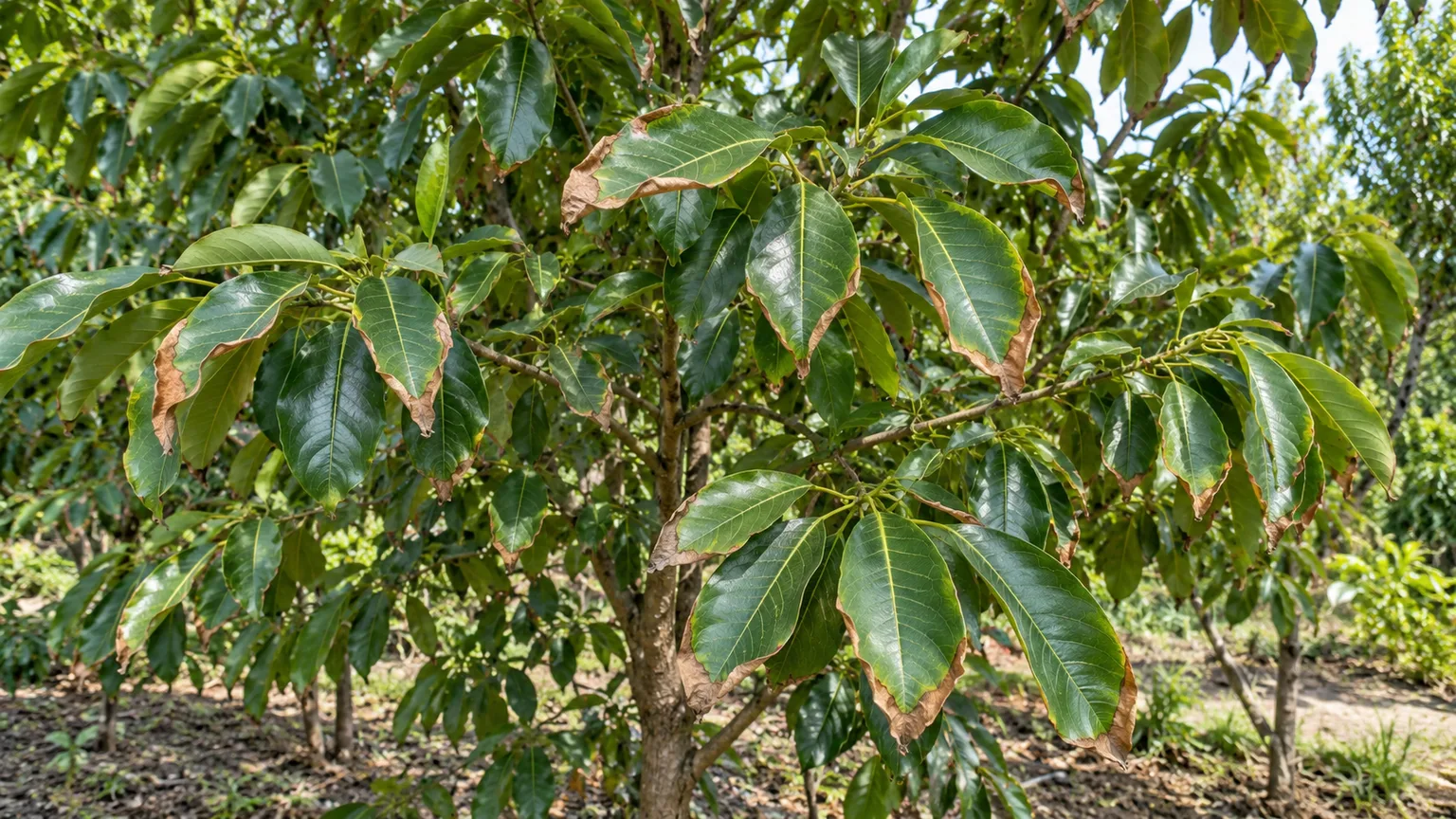
New Jamun leaves emerge pinkish and soft before hardening into glossy dark green, and that young tissue is the humidity sensor for the whole tree. Margins turn papery and brown while the center of the leaf still looks healthy, and badly affected flushes expand small, cupped, or scorched at the tip. Mature leathery leaves resist longer, then develop dry brown edges that never soften again.
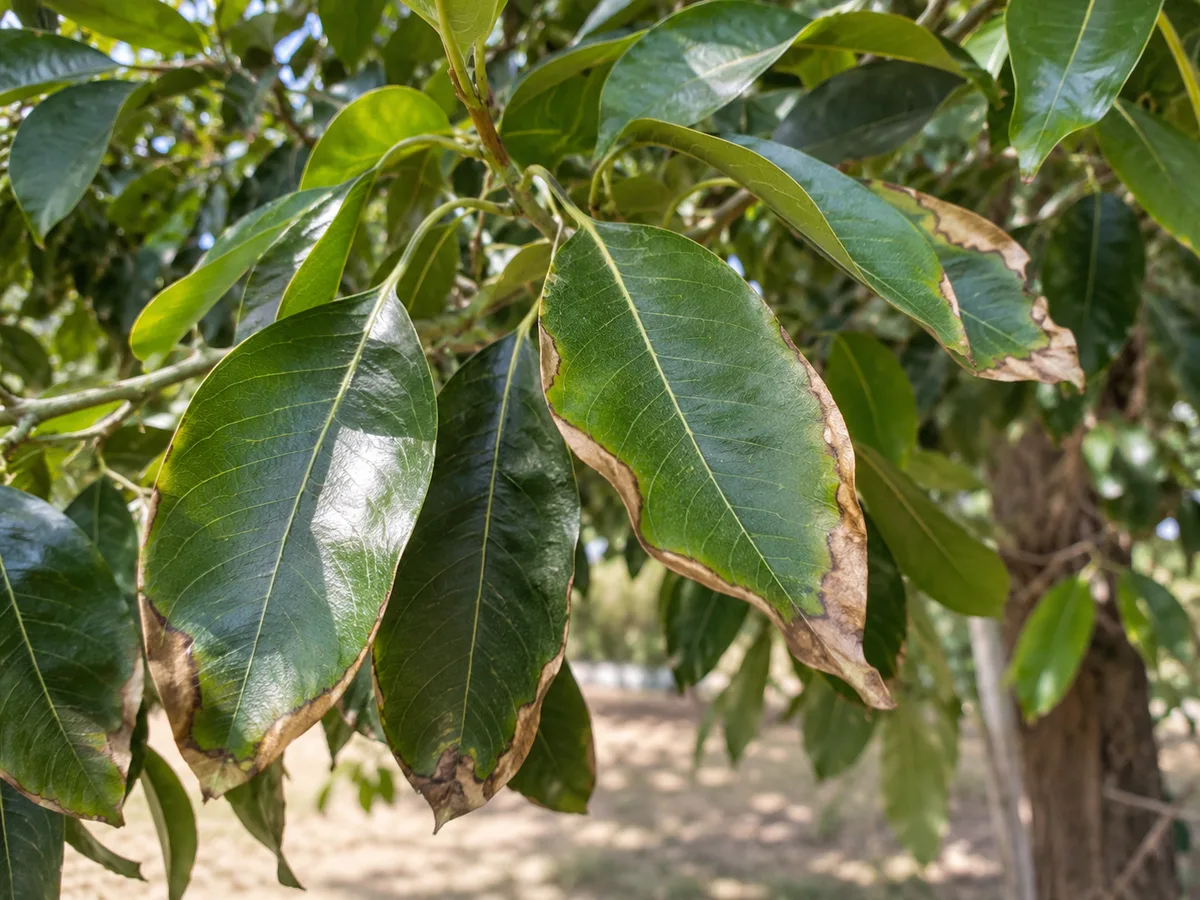
Close-up: papery brown margins on the tender flush with healthy green centers. Mature glossy leaves with the same edging confirm dry air rather than a passing scorch event.
Indoor seedlings may also stall: the next flush arrives late, smaller than the last, or drops before hardening. That stalled-flush pattern is distinct from slow growth caused by dim light, because the light-starved tree stretches with wide internodes while the dry-air tree stays compact but scorched.
Why a monsoon-climate tree still crisps in dry indoor air
Jamun’s native range spans secondary rainforest and monsoon forest, and established landscape trees tolerate drought and short-term flooding. That field toughness misleads container growers: the drought tolerance belongs to a deep-rooted 12 to 30 m tree, not a seedling in a 30 cm pot whose entire root zone can bake dry in a day beside hot glass.
Pots remove the buffer. A large canopy of broad evergreen leaves keeps transpiring while a small volume of mix runs out of water, and heated or air-conditioned room air accelerates the loss. Extension guidance notes that most homes sit at 10 to 20 percent relative humidity while tropical plants expect far more, and that below 20 percent is considered low for interior plants. A Jamun seedling that sailed through a humid monsoon summer on the terrace can crisp within weeks of moving to a dry winter room.
Reading the flush: young pink leaves vs mature glossy leaves
Use the two leaf generations as your diagnostic instrument. Jamun pushes pinkish young growth with a turpentine scent when crushed, and this flush tells the truth about current air conditions. If the pink flush burns at the edges while older glossy leaves stay clean, dry air or a hot vent is the prime suspect.
If mature leaves yellow or drop while the new flush looks fine, look elsewhere: persistent yellowing with wet mix points to overwatering, and sudden collapse points to wilting from root trouble. When both generations show dry brown margins plus tiny leaves, compare with the underwatering pattern too, because a dry root zone and dry air produce similar edging and often arrive together in a small pot.
How to confirm dry air is the cause
Spend one day measuring before buying equipment.
- Read the room. Set a small hygrometer at canopy height for 24 hours. Persistent readings under 40 percent with crispy new margins confirm the diagnosis; brief midday dips do not.
- Map the blast zone. Note distance to AC vents, heaters, fans, and west-facing glass. A tree within two meters of a vent can sit in single-digit local humidity even when the room reads 45 percent.
- Feel the mix at depth. Push a finger 3 to 5 cm down. If it is powdery and the pot feels light, the tree faces combined air and soil dryness, and watering correction comes first.
- Inspect leaf undersides. Dry air invites spider mites, so check young leaves for grayish-yellow speckling and fine webbing with a hand lens. Mites thrive in hot and dry conditions, and their stippling is easy to mistake for humidity scorch.
- Rule out the lookalikes. Uniform pale leaves in dim corners suggest not enough light rather than dry air. Soggy mix with yellowing suggests root-zone trouble, covered under brown-tip and root guides.
Low humidity injury typically shows as dry, curling leaves, brown leaf tips, or small leaves, and a portable humidity monitor costs less than a bottle of tonic and settles the question in a day.
The first fix: get it out of the dry-air blast
Do one thing first: relocate the pot away from the vent, radiator, or blasting fan, and park it with other plants over a wide pebble tray. Grouping plants builds a shared pocket of transpired moisture, and a shallow container filled with water and lava rocks or gravel raises local humidity through steady evaporation. Keep the pot base above the waterline so the mix never wicks.
This single move often stops new damage within a week, because it removes the extreme local dryness that no amount of misting can offset. Misting alone is nearly worthless indoors: you would need to mist every few minutes indefinitely to shift the reading. A small humidifier near the canopy is the reliable upgrade if the hygrometer still reads under 40 percent after relocation.
Step-by-step recovery
Once the tree sits in kinder air, work through the rest in order.
- Stabilize watering. Soak until water escapes the drainage holes whenever the top 3 to 5 cm has dried, then empty the saucer. Container Jamun wants full sun and moderate water, and steady root moisture lets new leaves expand without scorching. Our Jamun watering guide details the seasonal rhythm.
- Treat mites if present. If stippling or webbing appeared during inspection, shower the foliage firmly, then apply insecticidal soap to leaf undersides and repeat at label intervals. See spider mites on Jamun for the full routine.
- Trim only the dead tissue. Snip fully crisp margins with clean scissors, leaving a thin brown rim so you never cut into living green. Do not defoliate scorched-but-alive leaves; they still photosynthesize for the next flush.
- Feed nothing until the flush resumes. Hold fertilizer until new growth emerges clean and expands normally, then resume at half strength in the growing season.
What not to do
Do not compensate for dry air by drowning the pot. Waterlogged mix plus humid air invites the exact root and soil problems described in brown tips and mold guides, and Jamun containers must drain freely. Do not seal the tree in a plastic tent either: stagnant saturated air on broad evergreen leaves encourages fungal spots, and a terrace tree needs air movement.
Do not prune the whole canopy hoping for a reset. Jamun back-buds on wood, but a stressed seedling forced to refoliate in still-dry air just burns a second flush. Fix the air, confirm one clean flush, and only then shape the tree using the Jamun pruning approach if structure needs work.
Recovery timeline
Expect damage to halt within one to two weeks of relocation: no fresh margins browning on the current flush. The next flush, usually three to six weeks later in warm weather, is the real verdict. Clean full-sized pinkish growth that hardens glossy means the fix worked.
If successive flushes still emerge scorched despite readings above 50 percent, the root zone is the limiter: a root-bound pot drying daily cannot supply even humid air’s modest demand. Check whether roots circle the pot or water runs straight through, and plan a late-winter repot rather than another humidity gadget.
How to prevent it next time
Grow container Jamun like the terrace fruit tree it is. Keep it in the sunniest sheltered outdoor position available through the warm months, where ambient humidity and air movement do the work for free. Start from the Jamun overview if you are still deciding whether your space can host a tree that wants to reach for the sky.
Indoors, prevention is seasonal. Group pots before winter, run the humidifier when heating starts, and keep the watering check at 3 to 5 cm so the root zone never rides empty. Review the Jamun light guide when repositioning, since the brightest dry corner trades one stress for another, and browse the full Jamun problems hub whenever a new symptom appears so small issues stay small.
When to use this page vs other Jamun guides
Use this page when hygrometer readings are low and the youngest leaves crisp first. Switch to underwatering when the whole canopy droops and deep mix is powdery, to wilting when collapse is sudden, and to spider mites when stippling and webbing dominate. If older leaves yellow while the flush looks clean, start with yellow leaves instead.
Related Jamun guides
- Jamun overview — decide whether your space suits a large evergreen fruit tree before investing in humidity gear.
- Jamun problems hub — compare this symptom against every documented Jamun issue when the diagnosis is uncertain.
- Brown tips on Jamun — separate tip burn from fertilizer, salts, and water quality when margins brown despite good humidity.
- Underwatering on Jamun — use when dry mix and drooping young leaves suggest the roots, not the air, are the limiter.
- Spider mites on Jamun — follow when dry air has already invited stippling pests on the flush.
- Not enough light on Jamun — check when pale stretched growth accompanies the crispy edges after an indoor move.
Related tool
Use the Humidity Calculator to narrow causes for low humidity on this plant before changing multiple variables at once.