Not Enough Light on Jamun: Causes, Checks & Fixes
Quick answer
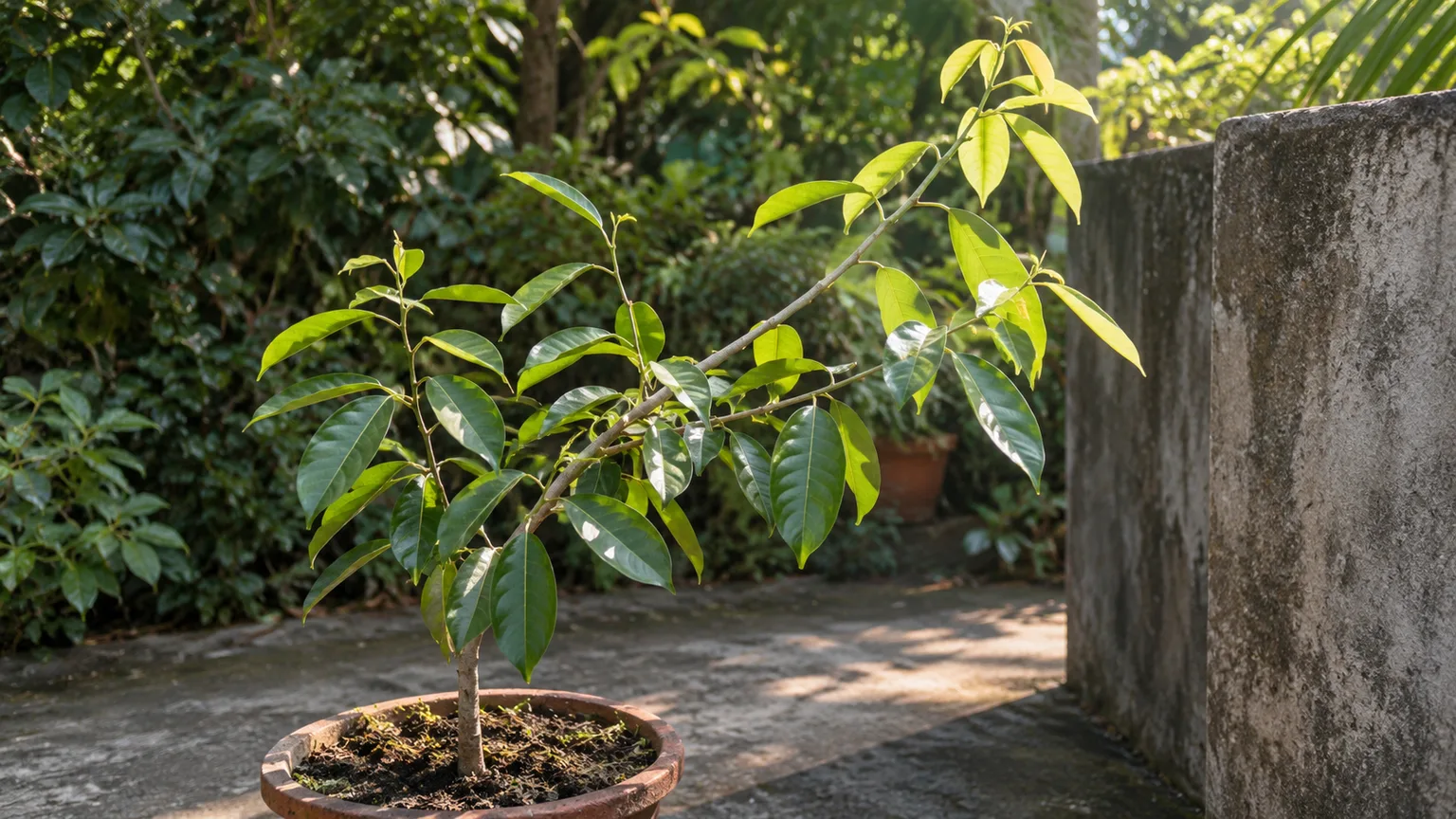
A light-starved Jamun stretches toward the brightest opening, with long gaps between small pale leaves and one-sided growth. First, move it toward open sun in stages over 7–14 days. Stretched stems never shorten, so judge recovery by compact new flushes, not by old growth filling in.
Not Enough Light on Jamun: Causes, Checks & Fixes
This guide covers not enough light on Jamun. See also the general Not Enough Light guide, watering, and light pages for this plant.
Not Enough Light on Jamun: Causes, Checks & Fixes
Quick answer
A light-starved Jamun stretches toward the brightest opening, with long gaps between small pale leaves and one-sided growth. First, move it toward open sun in stages over 7–14 days rather than all at once. Stretched stems never shorten, so judge recovery by the next flush: shorter gaps between leaves, larger glossier blades, and balanced growth around the crown.
For the general mechanics of how dim interiors starve plants, see our low-light guide. Everything below is about how that problem behaves specifically on this fast-growing fruit tree.
What low light looks like on Jamun
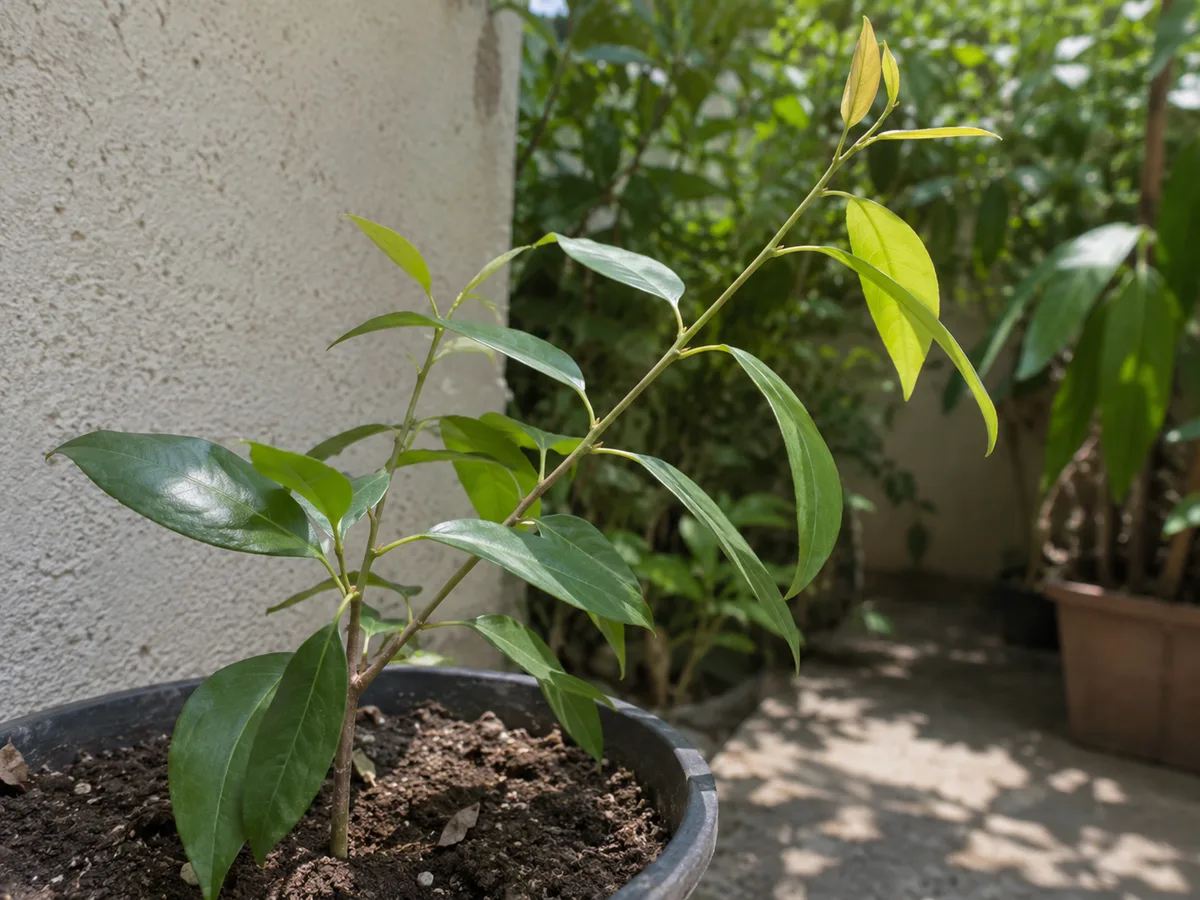
Close-up: stretched Jamun shoot with wide internode gaps and small pale leaves — the classic low-light signature on new flushes.
On Jamun the signature is etiolation with a woody-tree accent: internodes stretch, new leaves emerge smaller and paler than the leathery mature foliage, and the whole crown leans toward the window or balcony opening. Lower shaded leaves often yellow and drop while the tip keeps reaching, leaving a bare lower stem with a tuft of weak growth at the end. Oklahoma State Extension describes exactly this pattern for light-starved plants generally — tall, lanky, small-leafed growth — and on Jamun it appears fast because seedlings are extremely vigorous.
Growth also becomes one-sided. A Jamun parked against a wall fills foliage on the open side while the room-facing side stalls, and rotating the pot only evens the shape without creating energy. Flowering and fruiting on a young tree are not useful diagnostic clues — a seedling will not fruit regardless — so read the spacing and size of new leaves instead.
Why a full-sun tree ends up light-starved
Singapore’s National Parks Board lists Jamun’s light preference as Full Sun, and Kew places Syzygium cumini in the wet tropical biome across tropical Asia — an ecology built on strong overhead light. Most indoor cases trace back to treating a future 12–30 m tree (the mature size NParks lists for the same species) as if it were a foliage houseplant. A seedling can hold green leaves at a bright window for a year or two while silently stretching, then outgrow the room long before it ever resembles a productive tree. If you have not already done so, check the Jamun overview to confirm this species fits your space at all.
Nursery shade follows the plant home
Garden centers commonly hold young Jamun under shade net, and that soft foliage scorches if thrown straight onto a May rooftop. The common overcorrection is keeping the plant in that nursery shade permanently — under a covered verandah, behind a tinted balcony, or several feet inside a bright room. UGA Extension notes that outdoor sun on a bright day reaches around 10,000 foot-candles while shade under a large tree drops to 250 or less, and a dim room sits far below even that shade. A spot that feels bright to you can be a cave to a tree evolved for open tropical sun.
Young flushes stretch first
Jamun pushes soft, often pinkish new flushes whose leaves are thin until they harden into the glossy mature blades UF/IFAS describes as smooth, glossy, and leathery. In dim light these flushes never firm up properly: they stay thin, pale, and widely spaced, and they harden into weak wood. Because a young tree flushes repeatedly in warm weather, several months of dim culture compound into a tall, floppy sapling with poor branch structure. This is the Jamun-specific reason to act early — every etiolated flush becomes permanent weak framework.
A shade-tree canopy that shades itself
Jamun is widely planted as a roadside shade and windbreak tree — Tamil Nadu Agricultural University notes it is generally grown for shade and windbreak on roads and avenues — and UF/IFAS records that Java plum’s fast growth and dense canopy shade out competing plants where it naturalizes. That dense crown turns inward in a container: once the outer shell leafs out, the interior sits in its own shade and drops leaves. A potted Jamun under a balcony overhang gets shaded twice, by the building and by itself. Interior leaf drop on an otherwise sunlit plant usually means the canopy needs thinning and spacing, not more fertilizer — see the Jamun pruning guide before cutting.
Seedling vigor cuts both ways
Plants for a Future reports that Jamun seedlings can reach 4 metres in only 2 years, and that while the species prefers a sunny position, young plants are moderately shade-tolerant. That combination misleads growers: a shaded seedling survives and keeps gaining height, which looks like success, but the height is hollow — thin stems, wide internodes, and a root system sized for a much smaller crown. Fast upward growth in a dim room is a warning sign on this species, not a compliment to your care. Pair any light upgrade with the Jamun repotting guide if roots are circling, since a top-heavy stretched tree in a small pot becomes unstable.
How to confirm light is the cause
Work through these checks in order before moving the plant:
- Measure the light at the leaves. Hold your hand where the canopy sits: a spot that casts no defined shadow at midday is dim by Jamun standards. Count hours of direct beam actually striking leaves, not general brightness in the room. Fewer than about 4 hours of direct sun means light is a prime suspect.
- Read the internodes. Compare the gap between leaves on the newest flush with older growth. Stretched gaps plus smaller, paler blades mean light hunger. Uniformly small leaves with normal spacing point elsewhere.
- Check direction. Strong lean or foliage massed on one side means the plant is foraging for light. Note which side faces the opening.
- Rule out the root zone. Test the top 3–5 cm of mix and lift the pot, as the Jamun watering guide describes. Soggy, sour mix with yellowing lower leaves suggests overwatering on Jamun or early root rot on Jamun; dry, light pots with crisp margins suggest underwatering. Fix water first if the root zone is clearly wrong.
- Inspect for passengers. Look under leaves and at shoot tips for aphids, mealybugs, or sooty residue. Distorted sticky flushes may be aphids on Jamun rather than pure light stretch. If you find insects, handle them before or alongside the light move.
- Check drainage and surface. Algae, moss, or mold on soil on Jamun in a dim corner confirms the pot is staying wet because low light has slowed water use — a supporting clue, not the main diagnosis.
If several of the light signs line up and the root zone is sound, you have your diagnosis. Full-sun demand plus stretched one-sided growth plus a dim position is conclusive enough to act on.
The first fix for Jamun
Move the tree toward genuinely brighter light — but in stages, not all at once. Start by placing it in morning sun with bright open shade for the rest of the day, then add an hour or two of stronger midday exposure every few days over 7–14 days. Nursery-soft or indoor-grown foliage scorches under a sudden full-day blast, and scorched leaves will not recover. One relocation done gradually is the entire first fix; do not prune, repot, and fertilize on the same day.
Step-by-step recovery
- Stage the move. Begin with morning sun and open shade, advancing toward at least 6–8 hours of direct sun on clear days. Pause the advance if new leaves develop pale papery patches, and resume once fresh growth emerges clean. The detailed placement logic — direction, sky view, rooftop heat — is covered in the Jamun light guide.
- Rotate for symmetry. Turn the pot a quarter-turn every week or two so all sides of the crown receive the beam. Rotation evens growth; it does not substitute for the brighter position itself.
- Adjust watering to the new light. A sunnier Jamun transpires more — UGA Extension notes that plants under higher light transpire more water — so check the top 3–5 cm of mix more often after the move. Conversely, while the tree still sits dim, water less often and empty any saucer so the slowed root zone does not go stagnant. Coordinate with the Jamun soil guide if water lingers despite drainage holes.
- Supplement only as a bridge. If outdoor sun is weeks away, a full-spectrum LED panel run 12–14 hours daily can hold a seedling. Oklahoma State Extension recommends artificial lighting where natural light is limited, but for a high-light tree like Jamun a lamp is a waiting room, not a home — plan the outdoor move in parallel.
- Prune the damage last. Once compact new flushes are forming in good light, cut back the weakest etiolated shoots to firm nodes to rebuild structure. Stretched wood never re-compacts, and hard pruning a still-dim tree just forces more weak regrowth. Use framework cuts from the Jamun pruning guide rather than shearing tips.
- Hold fertilizer until growth restarts. Do not feed a stalled, dim tree to force it — nutrients cannot substitute for photons, and salts accumulate in a slow-drinking pot. Resume feeding only after compact new growth appears, following the Jamun fertilizer guide.
Recovery timeline
Expect the first properly compact flush within 3–6 weeks of reaching good light in warm weather; winter or monsoon cloud stretches this out. Old stretched stems and pale leaves never revert — prune them out gradually once new framework exists. A seedling given open sun can surge remarkably fast on this species, so structural pruning and container size need attention within the same season. If two full flushes in genuine sun still emerge weak and sparse, suspect a secondary problem: circling roots, chronic waterlogging, or pests rather than light alone.
Lookalike symptoms
| What you see | More likely | How to tell apart |
|---|---|---|
| Long bare stems, tiny pale leaves, lean to window | Low light (this page) | Internodes stretched; worst on the shaded side; improves only with sun |
| Long bare stems plus honeydew, ants, curled tips | Aphids on Jamun | Sticky residue and visible colonies on flush tips |
| Yellowing lower leaves, soggy mix, sour smell | Overwatering on Jamun | Pot feels heavy; soil wet days after watering |
| Sudden wilt of soft leaves that perk after watering | Wilting on Jamun and underwatering | Pot light, mix pulling from edges; recovery within hours of a soak |
| Uniformly small pale leaves, normal spacing, no lean | Slow feeding response, not stretch | See slow growth on Jamun; spacing between leaves stays normal |
| Drooping whole canopy in a dim wet corner | Combined light + water stress | See drooping leaves on Jamun; fix drainage and light together |
| Tan crisp patches appearing days after a sudden move | Sunscald from skipping acclimation | Damage only on the most exposed faces, timed to the move — move back one step, not into darkness |
When to use this page vs other Jamun guides
- Use this page when growth is stretched, one-sided, or pale and the position is dim — the fix is placement and acclimation.
- Use the Jamun light guide when choosing a permanent outdoor or balcony position and planning seasonal sun exposure.
- Use leggy growth on Jamun when the main complaint is shape and structure rather than diagnosing the cause.
- Use yellow leaves on Jamun when yellowing dominates without stretch or lean.
- Use the Jamun watering guide when the root zone is clearly too wet or too dry regardless of light.
- Browse the Jamun problems hub if more than one symptom is present and you need to triage.
Mistakes to avoid
- Throwing a dim-grown tree into all-day sun. Purdue’s jambolan notes record that young growth is killed at −1 °C, a reminder that soft unhardened tissue is vulnerable — to cold and equally to sudden scorch. Acclimate over 7–14 days.
- Feeding to fix stretch. Fertilizer on a light-starved Jamun pushes more weak growth and loads salts into a slow-drinking pot.
- Pruning before relighting. Cutting a dim tree forces regrowth under the same bad light. Light first, structure second.
- Shading the canopy to cool the pot. On hot rooftops, shade the container wall and raise the pot for airflow instead of pulling the leafy crown out of the sun it needs.
- Blaming immaturity on light, or light on immaturity. A seedling will not flower whatever you do; conversely, years of thin growth in a north room is not “just young.” Read the newest flush, not the plant’s age.
How to prevent it next time
Give Jamun the sunniest suitable outdoor position from day one — open garden sun, a sunny terrace, or a courtyard with a broad sky view — and use windowsills only for germination and short holding periods. Track actual sun hours at leaf level when seasons change, because monsoon cloud, new construction, and a growing canopy all shrink usable light without any move on your part. Keep the crown open with structural pruning so the tree does not shade its own interior, repot before roots circle into instability, and never let a “bright room” substitute for sky. A tree that casts roadside shade for others, as TNAU’s avenue plantings show, will never be content living under yours.
Related Jamun guides
- Jamun care overview — whole-plant size, placement fit, and whether a container suits you.
- Jamun light — full-sun targets, windows, grow lights, and safe acclimation.
- Jamun watering — moisture checks as sun, season, and position change dry-down.
- Jamun soil — drainage and root-zone structure so brighter light does not mean soggy roots.
- Jamun fertilizer — feeding only once light and roots can support active growth.
- Jamun pruning — canopy light, size control, and rebuilding etiolated framework.
- Jamun repotting — container size, root checks, and timing after a light upgrade.
- Jamun problems hub — triage when several symptoms overlap.
Related tool
Use the Plant Problem Diagnosis Tool to narrow causes for not enough light on this plant before changing multiple variables at once.