Yellow Leaves on Jamun: Causes, Checks & Fixes
Quick answer
Yellow leaves on Jamun most often mean the potted root zone stayed too wet, or alkaline mix locked out iron so young leaves yellow between green veins. Push a finger 3–5 cm into the mix and lift the pot: heavy and sour means stop watering and drain; dry and light with green-veined young leaves means check pH and drainage before feeding.
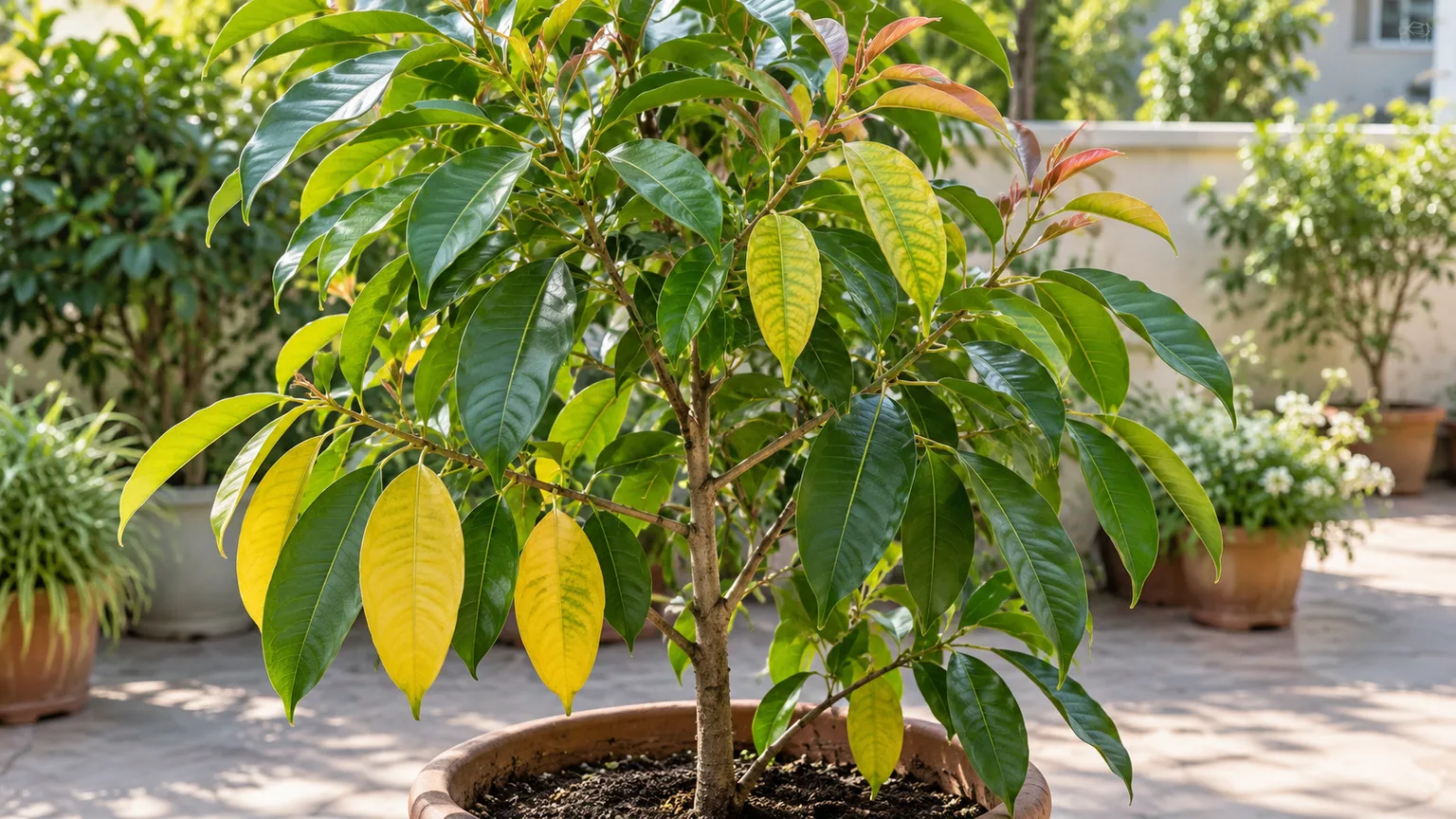
Yellow Leaves on Jamun: Causes, Checks & Fixes
This guide covers yellow leaves on Jamun. See also the general Yellow Leaves guide, watering, and light pages for this plant.
Yellow Leaves on Jamun: Causes, Checks & Fixes
Quick answer
Yellow leaves on Jamun (Syzygium cumini) most often trace to one of two container realities: the root ball sat too wet and feeder roots suffocated, or alkaline mix locked out iron so the newest leaves yellow between green veins. Extension guidance notes that yellowing and dropping leaves are commonly caused by overwatering, poor soil drainage, while yellow-green foliage on newer leaves points toward pH or micronutrient trouble — and potted Jamun delivers both scenarios regularly. For how yellowing works across houseplants in general, see our yellow leaves hub; on Jamun, the pattern usually shows up as older leaves yellowing from the base in soggy mix, or the pinkish young flush emerging pale with green veins in alkaline pots.
First, push a finger 3–5 cm into the mix and lift the pot. Heavy, cool, sour-smelling mix means stop watering and drain — the roots are drowning. Dry, light mix with green-veined young leaves means check pH and drainage before reaching for fertilizer. Each cause gets a different fix, so confirm before you act.
What yellow leaves look like on Jamun
Healthy Jamun carries a two-tone evergreen canopy — mature leaves are glossy dark green with a yellowish midrib, while the newest flush emerges pinkish before hardening off. That color contrast is your diagnostic background: genuine trouble yellowing looks wrong against it, whether it is whole older leaves fading to uniform pale yellow or young leaves turning yellow while their veins stay green.
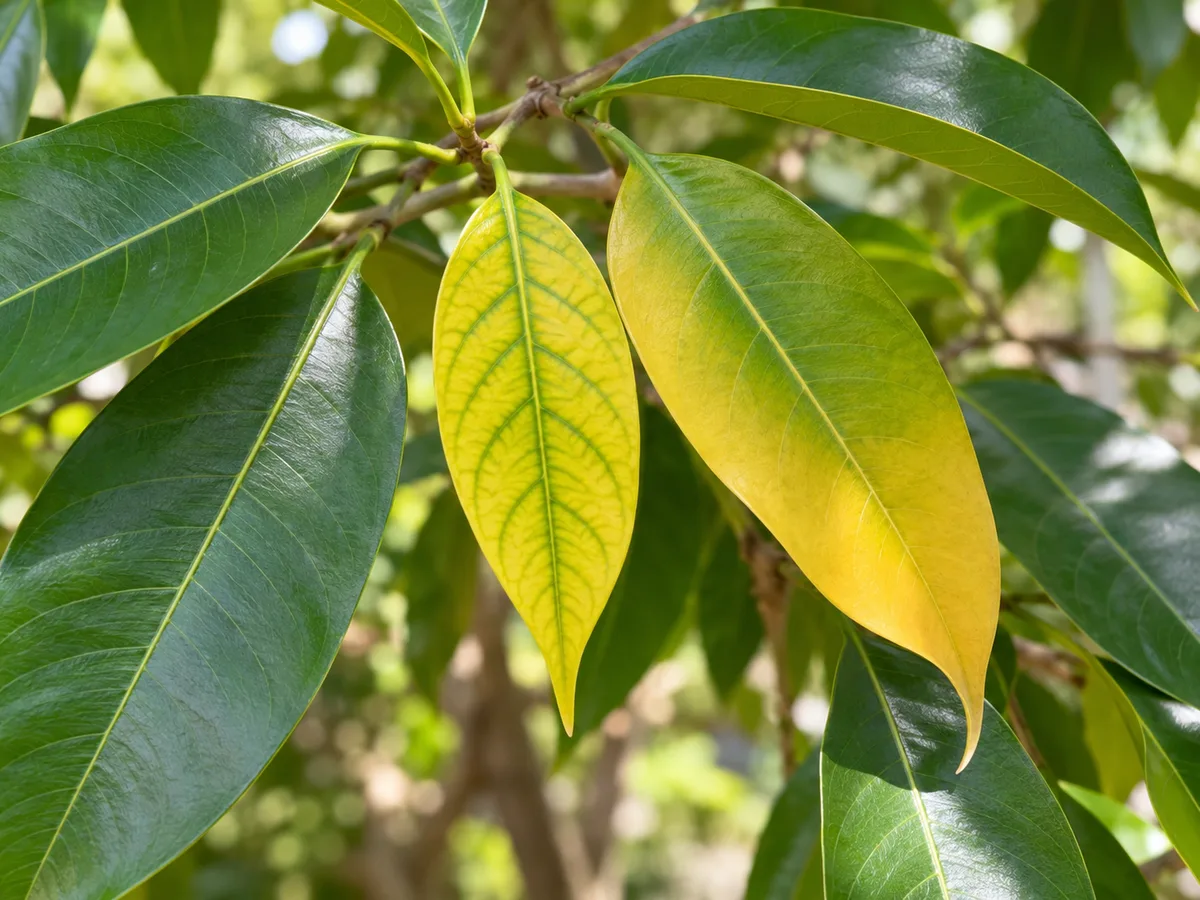
Yellow leaves on Jamun: uniform yellowing of older foliage versus green-veined young leaves — note which leaves yellowed first before choosing a fix.
Because Jamun is a fast-growing tree that can reach 12–30 m with a dense crown, a container specimen carries a lot of leaf area over a small root volume. Yellowing that starts on shaded lower interior leaves while the sunlit crown stays glossy usually reflects the root zone or natural turnover. Yellowing that hits the newest flush first, or races across the whole canopy within days, signals an active problem — waterlogging, nutrient lockout, pests, or monsoon fungus — that needs same-week action.
Why Jamun leaves turn yellow
Waterlogged container mix. Jamun is listed for Full Sun and Moderate Water, and established landscape trees tolerate brief flooding — but a pot with no drainage escape is a different environment. Roots sitting in stagnant mix cannot take up water or nutrients, so the canopy yellows even though the soil looks wet. Jamun-specific growing guidance describes exactly this signature: yellowing that begins at leaf bases combined with soft limp new growth and a sour smell near the root zone. If your tree flags (drooping young leaves, shedding older ones) days after watering while the pot still feels heavy, treat it as overwatering first via overwatering on Jamun and root rot on Jamun.
Iron chlorosis in alkaline mix. Jamun prefers mildly acidic to neutral soil around pH 6.0–7.5, and iron deficiency shows up most in alkaline, calcareous, or poorly drained soils where iron is present but roots cannot absorb it. Extension research explains the mechanism: iron is readily available between pH 5.0 and 6.5, but when the pH is 7.0 and above it shifts to an insoluble form trees cannot use. The signature is unmistakable — yellow-green leaves with green veins, hitting the youngest leaves first with no spots or lesions. Hard tap water and excess lime push container mix alkaline over time, so a Jamun fed and watered well that still yellows at the top is often starving in a full pantry.
Nitrogen hunger on a vigorous tree. Jamun grows moderately fast once warm and fills pots with roots quickly, so a hungry container tree rations nitrogen to new growth and sacrifices the old. Extension notes that weak growth with light green to yellow leaves may reflect a lack of nitrogen, showing first as uniform pale yellowing of older lower leaves while the crown keeps pushing. This is the slow, even fade — not the sudden canopy-wide yellowing of waterlogging — and it answers to feeding, not draining. Check the Jamun fertilizer guide before dosing; a stressed or waterlogged tree must be stabilized first.
Monsoon fungal leaf spot. In humid rainy-season weather, Jamun is prone to anthracnose and related leaf-spot fungi that yellow leaves around spreading brown lesions with yellow halos, often starting at leaf margins. Unlike deficiency yellowing, spotted leaves show defined lesions, water-soaked patches, or tissue death — and the disease damages fruit too during the monsoon. Keep the canopy open, avoid overhead irrigation, and remove heavily infected leaves rather than feeding the tree through an infection.
Sap-sucking pests and sooty mould. Mealybugs, aphids, scale, and spider mites drain Jamun leaves and leave yellowing, curl, and stunted flush in their wake. Honeydew from these insects grows a black powdery sooty mould coating that blocks photosynthesis and drives generalized decline when severe. Check leaf undersides, axils, and young stems for cottony masses, sticky residue, or fine webbing before assuming a nutrient problem — see mealybugs, aphids, and spider mites on Jamun.
Natural aging vs. stress. A few oldest shaded leaves yellowing and dropping while the crown pushes glossy new growth is ordinary turnover on an evergreen tree. Worry when yellowing spreads across multiple leaves and successive flushes, hits young growth first, or pairs with wilting, spots, or stalled growth.
How to confirm the cause
Work through these checks in order on a dry morning, before watering:
- Finger test at 3–5 cm. Wet and cool means water is the problem, not the shortage; dry and crumbly rules out waterlogging.
- Pot weight and smell. Heavy days after watering plus sour or stagnant odor confirms suffocating roots — inspect promptly.
- Which leaves yellowed first. Oldest lower leaves first suggests overwatering or nitrogen; youngest flush first with green veins means iron lockout; random leaves with spots mean fungus or pests.
- Vein pattern. Yellow tissue with green veins intact is chlorosis (iron/pH), not drowning. Uniform pale yellow without vein contrast is nitrogen or chronic overwatering.
- Pest and mould scan. Sticky residue, black powdery coating, cottony axil masses, or fine webbing redirect the diagnosis to insects before nutrients.
- Recent weather and water. Monsoon overhead wetting plus spotted halos points fungal; fixed-schedule watering through cool rainy weeks points to waterlogging; see the Jamun watering guide for the seasonal rhythm.
The first fix to try
Stop watering and open the drainage — but only if the mix is wet; if it is dry, water deeply instead.
Lift the pot off its saucer, empty all standing water, and confirm the drainage holes run freely. Move the tree where the mix can breathe in bright airy sun, and do not water again until the top 3–5 cm dries. This single pause separates drowning roots from every other cause: a waterlogged Jamun stops shedding within days once air returns to the root zone, while a deficiency or pest problem continues unchanged and tells you to move to step two. Do not fertilize, repot, or spray in the same week as this first fix.
Step-by-step recovery
Once the first pause (or deep drink) is done, match the follow-through to your confirmed cause:
For waterlogging: Keep the saucer empty and let the mix dry to the 3–5 cm mark between waterings, following the Jamun watering guide rhythm of every 3–5 days in heat and 7–14 days in cool months. If yellowing keeps spreading on wet soil or stems wilt despite dampness, unpot and inspect roots per the root rot guide — trim only mushy black tissue, keep firm pale roots, and repot to fit.
For iron chlorosis: Improve drainage and organic matter first, since stagnant alkaline mix is usually the lock rather than a true absence. Avoid excess lime, and in persistently alkaline pots apply chelated iron per label directions for the quick correction while the soil chemistry is fixed. Maintain the aerated loam-compost-mineral blend from the Jamun soil guide at moderately acidic to neutral pH for the long term.
For nitrogen hunger: Resume feeding only after watering is stable and new growth looks healthy. Feed lightly at container rates during active spring-summer growth per the Jamun fertilizer guide — orchard doses in a pot build the salt load that causes brown tips.
For fungal spots: Strip badly lesioned leaves, widen spacing for airflow, water at the base instead of overhead, and prune lightly for an open crown — the Jamun pruning guide covers structural cuts. Treat only persistent spreading infections; a few monsoon spots on an otherwise glossy canopy need airflow, not chemicals.
For pests and sooty mould: Treat the insects first — the mould cannot survive without their honeydew. Wipe small mealybug colonies with alcohol, spray neem on affected surfaces in the early morning, and recheck weekly. Wipe sooty coating off leaves afterward so photosynthesis resumes.
Remove only fully yellowed or dead leaves, and only after fresh growth confirms recovery — half-green leaves still feed the next flush.
Recovery timeline
Jamun grows moderately fast once warm, so stabilization is quicker than on slow houseplants. Expect shedding to stop within two to three weeks of the corrected routine, and the next flush to emerge pinkish and harden to glossy green without yellowing.
Signs you are winning: no fresh yellowing appears behind the old damage; newest leaves expand full-size with intact color; pot weight becomes predictable between waterings.
Signs of worsening: yellowing climbs from old leaves into the young flush; new leaves emerge pale, small, or scorched; canopy wilts while soil stays wet; spots spread with halos through humid weather. Any of these means re-check roots, pH, or pests rather than waiting another month.
Lookalike symptoms
| Pattern | What you see | Likely cause | Next step |
|---|---|---|---|
| Uniform yellow older leaves, shedding | Pale fade from leaf bases, heavy sour pot | Overwatering, poor drainage | This page — drain and dry-down; overwatering |
| Young leaves yellow, veins green | Interveinal chlorosis, no spots | Iron lockout, alkaline pH | This page — drainage, pH, chelated iron |
| Even pale old leaves, slow growth | Hungry fade, pot-bound ball | Nitrogen deficiency | Jamun fertilizer + slow growth |
| Yellow halos around brown spots | Defined lesions, humid weather | Fungal leaf spot | Strip, airflow, base watering |
| Crisp brown tips, green blade | Dry papery points, salt crust | Drought swings, salts, heat | Brown tips on Jamun |
| Wilt + yellowing on wet soil | Limp canopy, heavy pot | Root damage | Wilting → root rot |
| Drooping dull foliage | Flagging leaves, dry or wet | Water imbalance either direction | Drooping leaves |
| Sticky residue, black coating | Honeydew, sooty film, insects | Sap-sucking pests | Aphids, mealybugs, spider mites |
| Pale stretch, sparse canopy | Long internodes, small leaves | Too little light | Not enough light |
| Tiny flies, damp surface | Gnats hovering, algae | Chronically wet surface mix | Fungus gnats and mold on soil |
| Dry indoor yellowing | Dull leaves near vents | Low humidity stress | Low humidity |
When to use this page vs other Jamun guides
Use this page when the dominant symptom is yellowing leaves without tip-first burn or pest colonies leading the pattern. Move to a sibling when a different pattern leads:
- Dry brown tips or edges on otherwise green leaves → brown tips
- Wet heavy soil, limp canopy, or sour mix → overwatering first, then root rot if stems soften
- Bone-dry ball with flagging young leaves → underwatering for the full rehydration ladder
- Visible insects, webbing, or sticky honeydew → pest guides (spider mites, mealybugs, aphids)
- Care baselines → watering, soil, light, fertilizer, and the Jamun overview for scale and placement reality
Mistakes to avoid
Do not fertilize a yellowing Jamun before checking moisture and pH — feeding into waterlogged or alkaline mix deepens the damage. Do not repot, root-prune, spray, and relocate in the same week; pick the one fix matching your confirmed cause and read the response for two weeks. Do not mist the leaves and call it fixed — surface wetting does not drain a soggy root ball or unlock iron. Do not strip every yellowed leaf at once; damaged-but-partly-green leaves still photosynthesize for the recovering flush. And do not move a yellowing tree into deep shade to “rest” it; Jamun is a full-sun species and dim corners trade yellowing for weak stretched growth and leggy growth.
How to prevent it next time
Jamun thrives in full sun with moderate water in rich, moist, well-draining ground soil — in pots that translates to a heavy stable container with real drainage holes, the loam-compost-mineral mix from the soil guide, and deep watering only when the top 3–5 cm dries, with the saucer emptied every time. Feed at modest container rates during active growth and skip lime unless a soil test shows acidity. Repot or root-prune every two to three years before the ball turns to solid root, since a Jamun that dries within a day of watering swings between drowning and drought. Review the full problem list on the Jamun problems hub each season so small stresses get caught early.
Related Jamun guides
- Jamun overview — tree scale, sun placement, and container reality check
- Jamun watering — the 3–5 cm dry-down rhythm and seasonal intervals
- Overwatering on Jamun — heavy pots, sour mix, and the dry-down ladder
- Root rot on Jamun — mushy-root inspection and repot protocol
- Underwatering on Jamun — drought wilt vs. deficiency yellowing
- Brown tips on Jamun — tip-first burn from drought swings and salts
Yellowing on Jamun is almost always the pot talking, not the species failing: a big sun-loving tree asking for drainage, correct pH, or steadier water. Confirm with the finger test, apply one fix, and judge success by the next flush — pinkish leaves hardening to glossy green mean you read it right.
How we wrote and verified this guide: Recommendations were checked against UC IPM, K-State Extension, Singapore National Parks Board, and Jamun growing references cited inline. Author: sai-ananth. Reviewer: LeafyPixels Review Board. Methodology: plant problem guidance is reviewed against botanical references, extension resources, and LeafyPixels plant-care data before publication. Last reviewed: 2026-09-08.
Related tool
Use the Yellow Leaves Diagnosis Tool to narrow causes for yellow leaves on this plant before changing multiple variables at once.