Spider Mites on Jamun: Stippling, Webbing & Fixes
Quick answer
Spider mites on Jamun show as pale stippling on glossy leaves, dull bronzed patches, and fine webbing under shoot tips in hot, dusty weather. First step: isolate the tree and blast the undersides of all leaves with a forceful water spray, then re-check with a white-paper tap test in 3 days.
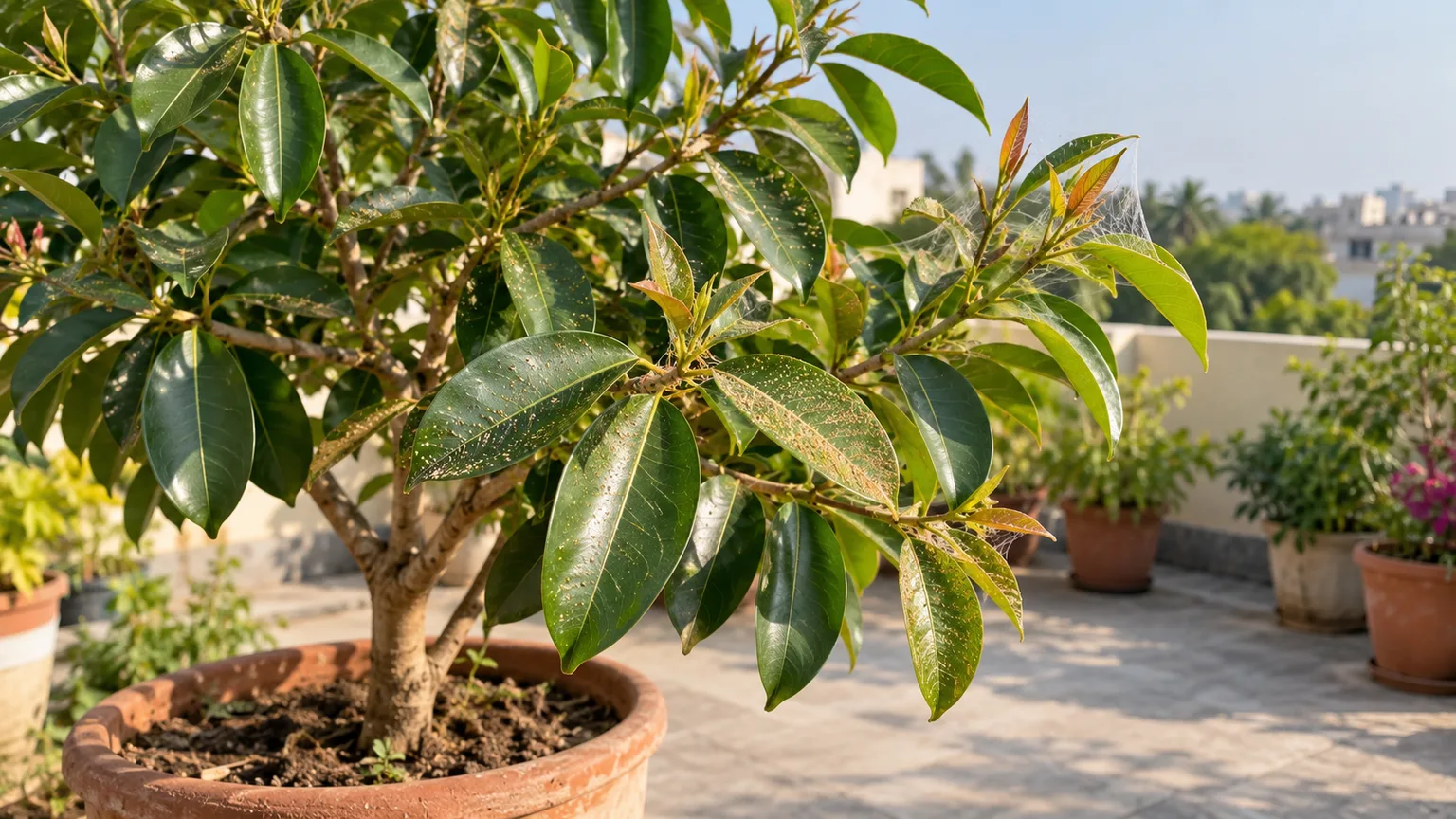
Spider Mites on Jamun: Causes, Checks & Fixes
This guide covers spider mites on Jamun. See also the general Spider Mites guide, watering, and light pages for this plant.
Spider Mites on Jamun: Causes, Checks & Fixes
Quick answer
Spider mites on Syzygium cumini (Jamun overview) look like tiny pale speckles scattered across the glossy upper leaf, turning dull, dusty, then bronzed as feeding continues. In advanced cases you will find fine silk webbing strung between shoot tips and the undersides of young leaves.
First step: isolate the tree from nearby plants and blast the undersides of every leaf with a forceful water spray, working from the lowest branches upward. For how spider mites feed and cycle in general, see our spider mites hub. On Jamun, the pattern usually starts on the dustiest lower leaves and the tender new flush, not evenly across the whole crown.
What spider mites look like on Jamun
Jamun leaves are thick, glossy, and held in opposite pairs, so early mite feeding stands out as a loss of shine: hundreds of pinprick pale dots (stippling from sucking cell contents from leaves) on an otherwise dark-green surface. As colonies build, patches merge into yellowed zones, then a scorched bronze cast, and heavily worked leaves drop early. Because mites live in colonies, mostly on the underside of leaves, the upper-surface speckling is the shadow of damage happening below.
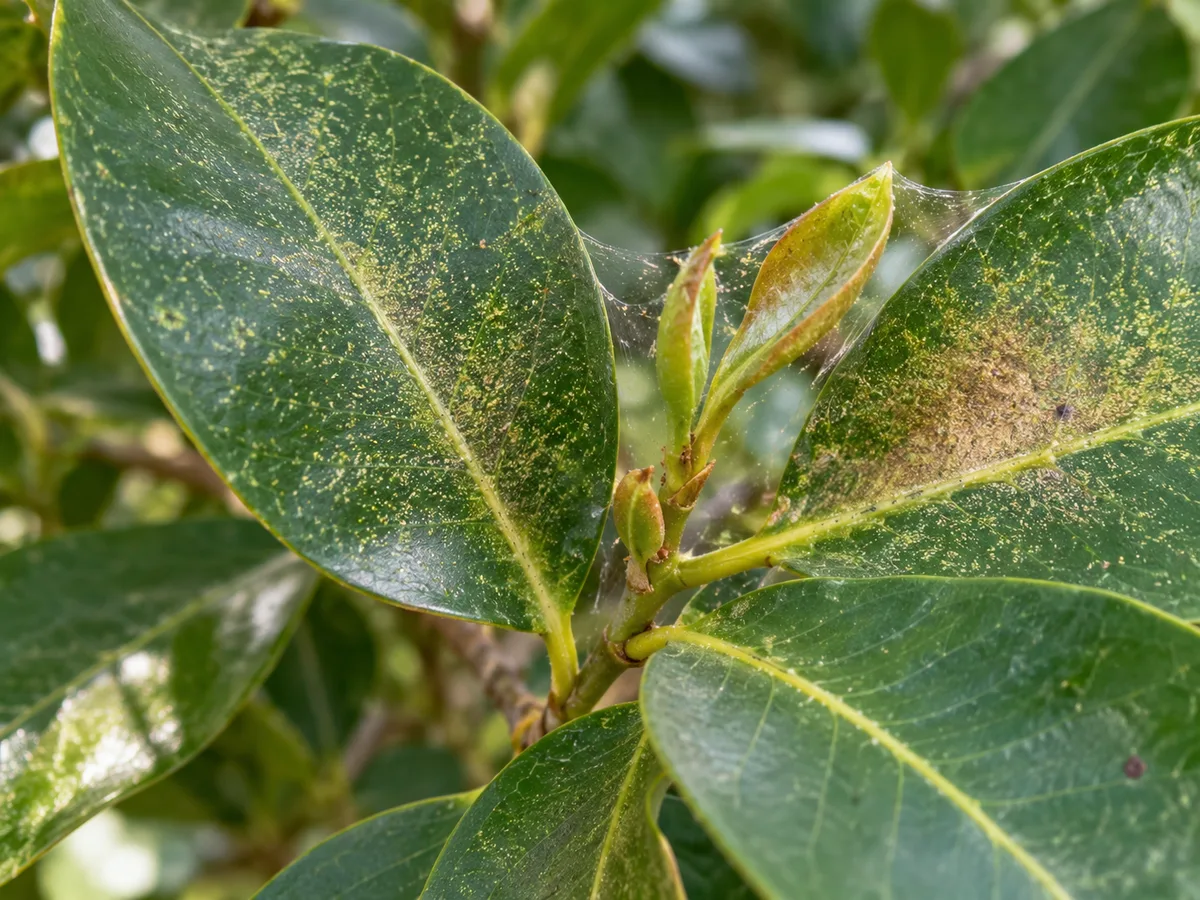
Pale stippling and bronzing on a Jamun leaf underside with fine webbing at the shoot tip, typical of an active spider mite colony.
Check the undersides with a 10x lens: mites look like slow-moving dust grains, pale green, tan, or reddish, each about 0.5 mm long. Eggs are tiny round translucent beads along the veins. Fine webbing at petiole joints and shoot tips is a late sign that numbers are high. Mites are roughly the size of a period on a printed page, so if you can clearly see a winged or leggy insect without magnification, you are probably looking at aphids or thrips instead.
Why terrace Jamun invites spider mites
A landscape Jamun is a 12–30 m evergreen with wind, rain, and predators interrupting mite colonies. A container Jamun on a hot terrace or courtyard keeps none of those advantages, and three conditions line up in summer.
First, Jamun wants full sun, so growers place pots on the hottest paved corner available. Reflected heat plus dry air shortens the mite life cycle from weeks to days, and damage peaks in exactly those hot, dusty conditions UC IPM warns about. A dusty film on the leaves both hides early stippling and favors the pest.
Second, the dense evergreen crown traps still air. Jamun pruned into a bushy sapling shape holds layer upon layer of overlapping leaves with warm, sheltered undersides. Mites spread outward from one infested branch in hot spots, exactly the pattern AHDB describes for glasshouse outbreaks, until a whole side of the sapling is bronzed while the far side still looks clean.
Third, drought stress on a root-bound pot accelerates collapse. Container Jamun dries fast in heat, and a tree that misses two deep waterings produces thinner, sap-concentrated flush that mites exploit. Water-stressed trees show faster yellowing and leaf drop under the same mite load, which is why the same colony barely marks a deep-rooted outdoor tree but defoliates a thirsty sapling.
How to confirm the cause
Inspect on a still, dry morning when webbing is visible and mites are settled:
- White-paper tap test. Hold white paper under a suspect shoot and tap sharply three times. Watch for 30 seconds: tiny specks that crawl are live mites. Still dust that brushes away is dust.
- Underside lens check. Flip the most stippled leaf and examine the veins and midrib with a lens. Moving dots, shed skins, and round eggs along veins confirm an active colony.
- Webbing location. Fine silk at shoot tips and between young petioles points to spider mites. Cottony wax that smears when pressed points instead to mealybugs on Jamun.
- Damage map. Mite stippling starts on lower, dustier leaves and spreads upward. Uniform yellowing after a wet spell points to overwatering on Jamun or yellow leaves, not mites.
- Neighbor check. Look at adjacent plants for the same speckling. Mites drift on air currents and clothing, so a second host with stippling strengthens the diagnosis.
- Rule out thrips. Thrips damage also silvers leaves, but leaves carry small black faecal specks on the pale areas. Mite damage has webbing and no black specks.
First fix for Jamun
Isolate the tree, then apply a forceful spray of water to the undersides of every leaf, starting low and working up, until foliage drips. Angle the nozzle upward so the jet hits the colony zone directly, and support young shoots with your free hand so they do not snap.
Water is the right first move on Jamun because it physically removes mites, eggs, webbing, and dust without coating the fruit or killing the predatory mites and ladybirds that suppress the next generation. Chemical sprays on day one scatter survivors deeper into the dense crown and burn drought-stressed foliage in heat.
Step-by-step recovery
After the rinse, work this sequence over three weeks:
- Repeat the rinse every 3 days. Mite eggs survive the first wash and hatch in days. Three to four rinses at 3-day intervals break the cycle. Rinse in the morning so Jamun’s foliage dries in sun before evening.
- Raise humidity around the pot, not the roots. Mulch the pot surface, group the Jamun away from reflective walls, and hose the paving around the pot to settle dust. Do not leave the pot standing in water; soggy mix invites root rot.
- Spot-spray only persistent hot spots. Where webbing returns after two rinses, coat the undersides thoroughly with insecticidal oil or insecticidal soap. Cover the whole underside until wet, treat in the cool of the evening, and never spray a wilted, water-stressed tree or in peak heat.
- Thin for airflow. Snip a few of the most bronzed, webbed shoot tips into a bag and bin them. Then open the crown lightly so rinses and sprays reach the undersides, following the structure in the Jamun pruning guide. Do not defoliate the sapling; Jamun refills on its own flush schedule.
- Hold fertilizer. Skip nitrogen until new growth emerges clean. Feeding during an active infestation pushes the soft flush mites prefer. Resume the normal rhythm from the Jamun watering guide once stippling stops spreading.
Avoid broad-spectrum pyrethroids and organophosphates: UC IPM notes they often kill mite predators and trigger worse rebounds.
Recovery timeline
Expect webbing to vanish after the first thorough rinse and fresh stippling to stop within a week if rinses are repeated. Bronzed, speckled leaves never turn glossy green again; they will either persist as marked foliage or drop. The real milestone is the next flush emerging clean and shiny, usually three to six weeks later in warm weather.
Keep tap-testing weekly for a month. If stippling keeps spreading after three rinse cycles plus one targeted soap or oil round, the reservoir may be a neighboring host plant or a dust source you have not removed. Photograph the undersides, the webbing, and the whole crown and consult your local extension service before escalating chemistry on a fruiting tree.
Lookalike symptoms
| What you see | Likely cause | Where to go |
|---|---|---|
| White cottony clumps that smear, sticky honeydew | Mealybugs on Jamun | Alcohol-dab protocol, not mite rinses |
| Green or black soft clusters on buds | Aphids on Jamun | Aphid wash and predator routine |
| Uniform yellowing after wet weather | Overwatering on Jamun or yellow leaves | Drainage fix, not pesticide |
| Wilting despite wet mix | Root rot | Root inspection before any foliar spray |
| Brown dry margins in dry air | Brown tips or low humidity | Humidity and watering correction |
| Pale stretched shoots, small leaves | Not enough light and leggy growth | Light relocation, not miticide |
What not to do
- Do not spray once and declare victory. Eggs hatch after every single treatment, which is why one-off sprays always seem to fail.
- Do not reach for a harsh insecticide first. It kills the predators doing free control and, on a flowering Jamun, exposes pollinators.
- Do not mist the canopy lightly and call it a rinse. Mites shelter on the undersides; a gentle overhead sprinkle never touches them.
- Do not repot, root-prune, and spray in the same weekend. Stacking stresses stalls the clean regrowth you are judging recovery by.
- Do not fertilize bronzed trees. Extra nitrogen during an active infestation grows more mite food, not faster healing.
Jamun care cross-check
Mites gain ground fastest on trees already off their culture. Confirm the basics in the Jamun overview: full sun on a terrace or in open ground, deep watering only when the top 3–5 cm of mix dries per the Jamun watering guide, and the aerated loam-compost-mineral blend from the Jamun soil guide. Trees starved of light stretch weak shoots (not enough light) while soggy pots stall roots (overwatering) and thirsty saplings stall and drop leaves (underwatering, wilting, drooping leaves). Fix any of these alongside the mite treatment or reinfestation follows the same dusty path back in.
How to prevent it next time
Quarantine every new nursery plant for two weeks; most terrace mite outbreaks walk in on a new purchase. Inspect the undersides of lower Jamun leaves weekly through hot months, when one missed colony becomes webbing in a fortnight. Rinse dust off the canopy monthly with a firm hose, keep irrigation at the root zone on schedule, and prune after harvest for an open crown that rinses and predators can reach. The Singapore record for Syzygium cumini places it in full sun with moderate water, and trees grown that way outgrow light pest pressure on their own.
When to worry
A few stippled leaves on one branch of a mature outdoor tree need no drama. Escalate when webbing sheets across multiple shoot tips, new flush emerges distorted, leaves yellow and drop faster than they expand, or a young container sapling stalls with wilting that does not match its watering. Dieback spreading from crowded branch forks after months of heavy pressure deserves an in-person diagnosis with photos of the undersides, webbing, and whole tree.
When to use this page vs other Jamun guides
- Jamun watering guide — Use when yellowing or drop follows wet or dry spells with no stippling, webbing, or moving specks.
- Jamun problems hub — Browse all 16 recorded issues on this species when the diagnosis is still open.
Related Jamun guides
- Jamun overview — Full-sun placement, container scale, and fruit-tree habit that shape every pest decision.
- Jamun watering — Deep-watering rhythm that keeps saplings vigorous without the drought stress mites exploit.
- Jamun light — Sun needs that harden new flush against sap-feeders.
- Jamun soil — Free-draining loam mix that prevents the root stress behind stalled, susceptible trees.
- Aphids on Jamun — Sister sap-feeder with overlapping stipple signs but a different treatment sequence.
- Mealybugs on Jamun — Cottony pest to rule out when white masses smear rather than crawl.
- Yellow leaves on Jamun — Watering and nutrient yellowing that mimics mite-weakened foliage.
- Jamun problems — Complete issue index for this tree.
Related tool
Use the Pest Identifier Tool to narrow causes for spider mites on this plant before changing multiple variables at once.