Jamun Light Needs: Full Sun, Windows & Grow Lights
Jamun Light Needs: Full Sun, Windows & Grow Lights
Jamun Light Needs: Full Sun, Windows & Grow Lights
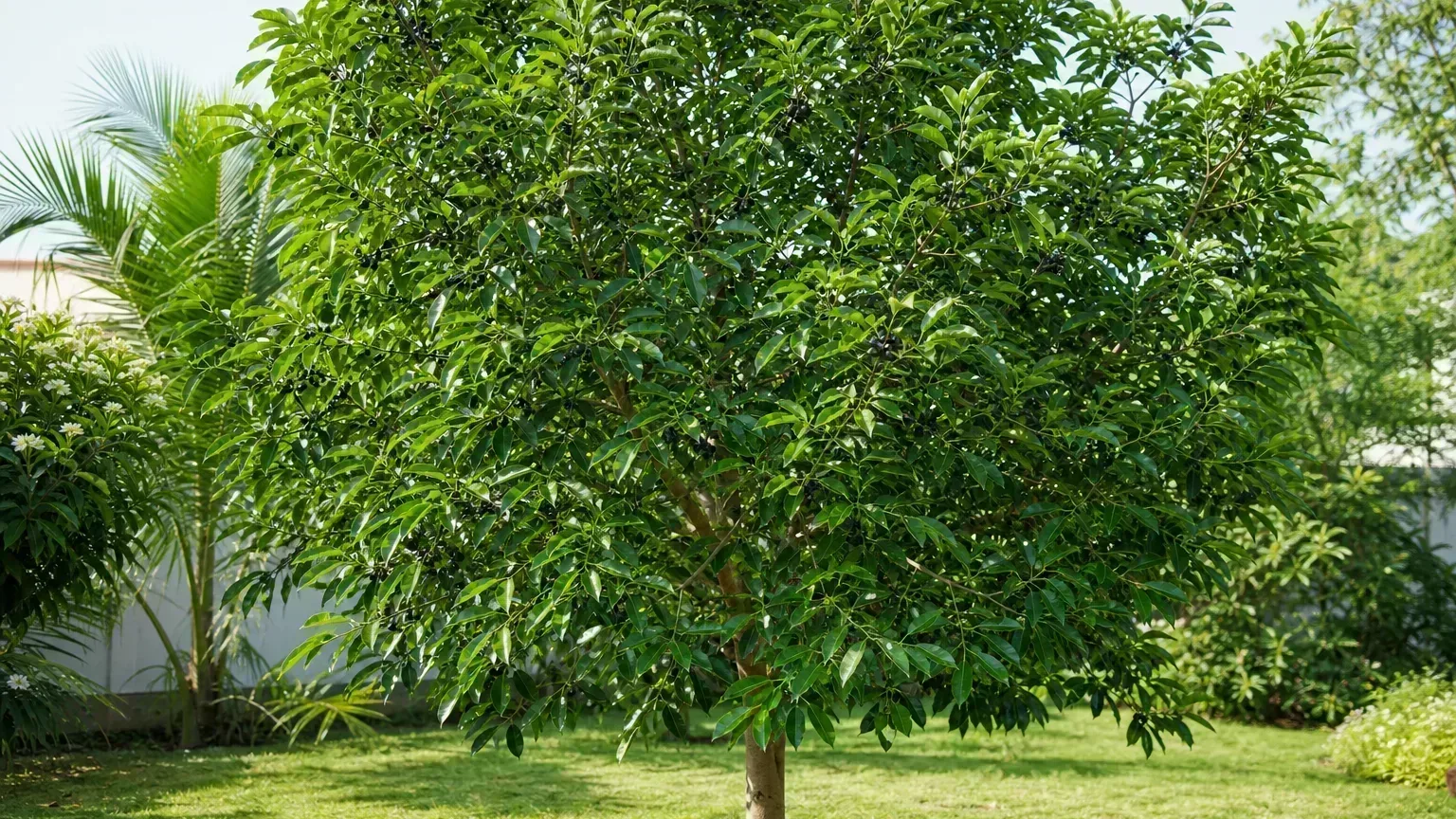
A Jamun seedling can stay green beside a bright window for a while, but that does not make Syzygium cumini an indoor foliage plant. Jamun is a large evergreen fruit tree whose dense crown, sturdy wood, flowering, and berry production all depend on strong outdoor light. In most Indian homes, the useful question is not “Is this room bright?” but “Can the canopy see open sky and receive several hours of unobstructed sun?”
Singapore National Parks lists Jamun’s light preference as Full Sun. Plants for a Future likewise notes that although the species prefers a sunny position, young plants are moderately shade-tolerant. That combination explains everyday care: give Jamun the sunniest suitable outdoor site from the start, use partial shade only as a short nursery or acclimation stage, and treat dim rooms as temporary holding spots rather than permanent homes.
How much light Jamun actually needs
Give Jamun at least 6–8 hours of direct sun on most clear days, with an open, all-day exposure preferred for a tree you expect to grow densely and eventually fruit. Count sun that reaches the leaves, not daylight somewhere on the balcony or in the room. A high wall, deep roof overhang, neighbouring tower, shade net, or larger tree can cut usable hours even when the space feels hot and bright.
For a garden tree, choose the sunniest suitable position and leave room for the eventual canopy. For a container specimen, prioritize light in this order: open outdoor sun; a sunny terrace or courtyard with a broad sky view; a large sun-facing window plus outdoor time; or a strong grow light only for a young plant under temporary indoor care. A normal ceiling lamp cannot replace sunlight for this species.
Surviving in shade versus thriving in sun
Jamun is often planted as a roadside or farmyard shade tree, which confuses beginners. Tamil Nadu Agricultural University notes that the tall evergreen is generally grown for shade and windbreak on roads and avenues. That landscape role means the mature tree casts shade; it does not mean a productive Jamun wants to live under another canopy.
Young plants can tolerate some filtered light while establishing, especially if moisture stays even. Plants for a Future reports that seedlings develop well in the sun when the soil is kept moist, while seedlings in shade may fail if the soil dries. Use that nuance carefully: temporary nursery shade can protect soft new leaves, but long-term shade usually produces thinner shoots, slower canopy fill, and a weaker path to flowering.
Why Jamun wants full sun
Kew’s Plants of the World Online describes Syzygium cumini as a tree of the wet tropical biome native across tropical and subtropical Asia to northern Queensland. Strong daily light matches that ecology better than a north-facing room or a permanently covered verandah. Full sun supports compact flushes, denser foliage, and the energy budget needed for fragrant flower clusters and fruit.
UF/IFAS notes that Java plum’s fast growth and dense canopy can shade out competing plants where the species naturalizes. That vigor is useful context for home growers: if the tree can dominate open sites outdoors, a dim balcony is unlikely to give you a balanced, fruiting specimen.
Native habitat and mature canopy size
Julia Morton’s Purdue monograph describes jambolan as a fast-growing tree that can reach about 100 ft (30 m) in India and Oceania, or roughly 40–50 ft (12–15 m) in Florida, often forking into multiple trunks near the ground. NParks similarly lists a maximum height of 12–30 m. Even a regularly pruned container tree still carries a woody crown that needs light from more than one angle.
Scale is the practical limit for indoor culture. A seedling may look manageable for a year or two, then outgrow any realistic window long before it becomes a productive fruit tree. Plan outdoor sun and structural pruning together rather than hoping a room will stay bright enough forever. Visit the Jamun overview for whole-plant size and placement fit before committing years to a pot.
Best outdoor placement in India and similar climates
In India and other tropical or subtropical climates, place Jamun where buildings and trees do not block the middle of the day. An open south, southeast, or southwest exposure is often reliable in the Northern Hemisphere, but compass labels matter less than clear-sky hours at the leaf surface. Track sun at morning, noon, and mid-afternoon before making a permanent planting decision.
Tamil Nadu Agricultural University recommends orchard pits at about 10 m spacing both ways, which is also a reminder of canopy room. Crowding young trees against a wall or under a mature neem may keep them alive while starving the crown of light and airflow. If the only garden pocket sits in permanent shade, a container on a sunnier terrace usually outperforms planting into that dark corner.
Dry weather at flowering and fruit set matters as much as total annual rain. TNAU notes that Jamun prefers tropical and subtropical climates and needs dry weather during flowering and fruit setting, with early rains in subtropical areas helping ripening. Keep the canopy in open light through that period instead of moving a pot under a solid rain shelter that also blocks the sky.
Terrace, balcony, and courtyard containers
Containers make placement adjustable but introduce heat. On a west-facing rooftop in a city such as Ahmedabad, Jaipur, Hyderabad, or Delhi, leaves may enjoy the sun while a black plastic pot and concrete floor overheat the roots. Use a light-coloured outer sleeve, raise the pot slightly for drainage, shade the container wall rather than the canopy, and check moisture more often. Do not solve a hot root zone by depriving the foliage of the light it needs.
Balcony success depends on sky view, not just direction. A south balcony with a deep overhang may receive only a short beam, while an east courtyard with open sky can outperform it. Keep the crown close to the brightest edge, rotate the pot a quarter-turn every week or two, and avoid parking the tree behind railings, shade cloth, or laundry lines that stay in place all season.
Can a Jamun tree grow indoors?
A Jamun can produce foliage indoors for a period, especially while young, but a normal room rarely supplies enough light or space for a productive adult tree. Indoor glass reduces and redirects outdoor light, and intensity drops sharply as the pot moves away from the window. University of Georgia Extension notes that an open sunny outdoor site can reach around 10,000 foot-candles, while many interior spots fall far below that outdoor range.
Treat indoor placement as seedling rearing or cold protection, not the default fruiting setup. If the tree must remain indoors for weeks, expect slower growth and little chance of useful flowering unless a conservatory or greenhouse provides intense sun, warmth, and canopy room. Moving a container outdoors during reliably warm weather is usually more effective than buying a small decorative lamp.
Best window for a temporary indoor plant
Use the largest unobstructed window that receives the longest direct beam. In the Northern Hemisphere, a south-facing window is the usual first choice; east can support a young plant with gentler morning sun, while west adds intensity but can create severe afternoon heat at the glass. Place the canopy close enough to receive direct light without letting leaves press against hot glazing.
Rotate regularly so one side does not dominate. Rotation evens the shape; it does not create energy, so a tree stretching hard toward the pane still needs a brighter position or outdoor time. If the window receives less than about four hours of direct sun, plan for a grow light or a move outdoors.
When a grow light is useful
Use supplemental light when the room has no direct sun, the plant must sit far from the window, or monsoon and winter conditions stall new growth for weeks. Oklahoma State Extension notes that very few plants tolerate dark corners and recommends artificial lighting where natural light is limited. Jamun sits at the high-light end of that decision, so weak ambient lamps are especially inadequate.
Choose a full-spectrum LED panel or bar with published plant-light output and enough coverage for the whole canopy. Start near the manufacturer’s high-light crop distance and run it on a timer for roughly 12–14 hours while the plant lacks outdoor sun. Watch the newest leaves: long internodes and leaning call for more intensity or closer placement, while bleaching directly beneath the fixture calls for more distance.
Direct sun and safe acclimation
An established outdoor Jamun wants full sun, but nursery plants are often held under shade cloth and can scorch after an abrupt move to a summer rooftop. Acclimate by increasing direct exposure over 7–14 days. Begin with morning sun and bright open shade, add an hour or two of later sun every few days, and pause if the newest leaves develop pale, papery patches.
This transition matters most for soft pinkish young flushes. Mature Jamun leaves are leathery and glossy; new leaves are thinner until they harden. Avoid moving a plant from a covered shop directly into all-day May sun, and do not combine that move with severe root disturbance or drought. Purdue notes young jambolan is sensitive to frost, so winter protection and sun planning often travel together for container trees in cooler inland districts.
Reflected heat can intensify excess light. White walls, metal railings, and pale tiled floors bounce radiation onto the canopy; glass can trap hot air on a sheltered balcony. Provide airflow, water from root-zone evidence, and use temporary midday screening during acclimation. Once firm new leaves form without bleaching, reduce the screening rather than keeping a fruit tree under permanent shade.
Seasonal light care
Jamun stays evergreen, but usable light changes with cloud, heat, day length, pollution haze, and surrounding vegetation. Reassess placement at least a few times a year instead of assuming one balcony behaves the same in every month.
Hot, dry months and flowering weather
Late winter through pre-monsoon spring often delivers strong light at a biologically important time. Keep flowering and fruiting containers in open sun rather than moving them into shade merely because afternoons are hot. Protect the root zone, maintain appropriate moisture, and preserve direct light on the canopy. Coordinate dry-down checks with the Jamun watering guide when heat and wind accelerate pot drying.
If a nursery plant arrives during a heatwave, acclimate it in morning sun first. Brown margins alone do not prove sunburn; dry roots, fertilizer salts, and hot wind can look similar. True scorch usually appears on the most exposed surfaces soon after a sudden placement change.
Monsoon cloud and dense growth
Monsoon weather can lower daily light while encouraging soft vegetative growth. Keep the tree in the most open position available, avoid crowding it behind rain shelters that also block the sky, and manage structure so the canopy does not permanently self-shade. Use the Jamun pruning guide for framework cuts rather than repeated hard shearing meant to “fix” light problems caused by a shady site.
Cloud is not a reason to add artificial shade. It is a reason to prevent self-shading and watch the wet root zone, because lower light and repeated rain slow container dry-down. Pair that response with the Jamun soil guide if water lingers despite drainage holes.
Cooler winter light
In northern and inland areas, protect young potted Jamun from cold while preserving as much light as possible. A sunny enclosed verandah beats a warm but dim interior room. If the tree comes indoors, put it directly at the brightest window and add a grow light rather than parking it deep in the room.
Return the plant outdoors gradually when warm weather stabilizes. Even after a few dim indoor weeks, foliage may need several days of increasing sun. In frost-free southern and coastal climates, leaving the tree outdoors generally maintains better light and airflow.
Warning signs of the wrong light
Use several clues together. Leaf colour alone is unreliable because flush age, nutrition, root health, and pests all influence appearance. Compare the new growth produced after a placement change with older leaves, and check the root zone before blaming light.
Low-light Jamun growth is often long, thin, and strongly angled toward the brightest opening. Internodes stretch, leaves sit farther apart, the canopy fills mostly on one side, and new flushes may be small or infrequent. Flowering is unlikely on an immature seedling anyway, so “no fruit” by itself is not a complete light diagnosis. Move the plant toward open sun in stages, then watch the next flush. Do not add fertilizer to force growth while the tree remains dim; more nutrients cannot substitute for photons. If you need to refresh a circling root ball after a light upgrade, use the Jamun repotting guide.
Excess sun or heat trouble usually follows an abrupt increase, restricted roots, or extreme reflected radiation. Look for sharply defined tan or pale patches on the sun-facing side, crisp tissue that appeared soon after relocation, or damage concentrated nearest hot glass. Move the plant back one acclimation step rather than into deep shade. Preserve bright open light, block the harshest reflected radiation temporarily, and ensure the pot did not dry completely. Damaged tissue will not turn green again; success appears as clean new leaves.
How light changes watering and fruiting
More light usually increases water use, especially in a leafy container exposed to hot wind. UGA Extension notes that plants under higher light transpire more water. Check a sunny Jamun more often, but still water from root-zone evidence rather than assuming it needs a daily drink.
After moving a tree into lower light, the same pot dries more slowly. Reduce watering frequency, not drainage quality, and empty any saucer or outer pot. Full sun supports flowering and fruit development, but light cannot overcome immaturity, unsuitable seedling genetics, poor pollination, damaging weather, or a chronically waterlogged root zone. A grafted or carefully managed container tree in open sun has a more realistic path than a seedling beside glass. Keep expectations proportional to canopy size and climate.
When to use this page vs other Jamun guides
- Use the Jamun overview to decide whether this large evergreen fruit tree fits your garden or container.
- Use the Jamun watering guide when stronger sun, monsoon rain, or indoor dimness has changed how fast the mix dries.
- Use the Jamun soil guide when water lingers despite adequate sun or the container mix needs better aeration.
- Use the Jamun fertilizer guide only after light and roots can support active growth.
- Use the Jamun pruning guide to open a dense crown and keep a container specimen manageable.
- Use the Jamun propagation guide when raising seedlings that will later need full outdoor sun.
Related Jamun guides
- Jamun care overview — whole-plant requirements and realistic size.
- Jamun watering — moisture checks as sun and season change.
- Jamun soil — drainage and root-zone structure for pots.
- Jamun fertilizer — feeding an actively growing, well-lit tree.
- Jamun repotting — container size, root checks, and timing.
- Jamun propagation — fresh seed and aftercare for young plants.
- Jamun pruning — canopy light, size control, and framework cuts.
Conclusion
Jamun light requirements are those of an outdoor tropical fruit tree: full sun as the default, with roughly 6–8 or more hours of direct exposure as a practical home-grower target. In India and similar warm climates, a sunny garden, courtyard, terrace, or rooftop usually beats any indoor room. Young plants can tolerate brief filtered light while establishing, but long-term shade is a survival setting, not a fruiting plan.
Use windows and grow lights for seedlings or temporary weather protection, not as an easy substitute for outdoor sun. Acclimate nursery foliage before all-day exposure, read new growth rather than old scars, and adjust watering whenever light changes. If the next flush is compact, evenly oriented, and free of scorch, the placement is working.