Underwatering on Jamun: Causes, Checks & Fixes
Quick answer
Underwatering on Jamun shows as drooping young leaves, dry brown leaf margins, and stalled new growth in a light, dry pot. Check the top 3–5 cm of mix and lift the pot: if both feel dry and light, give one slow deep soak until water drains freely, then resume watering whenever the upper mix dries.
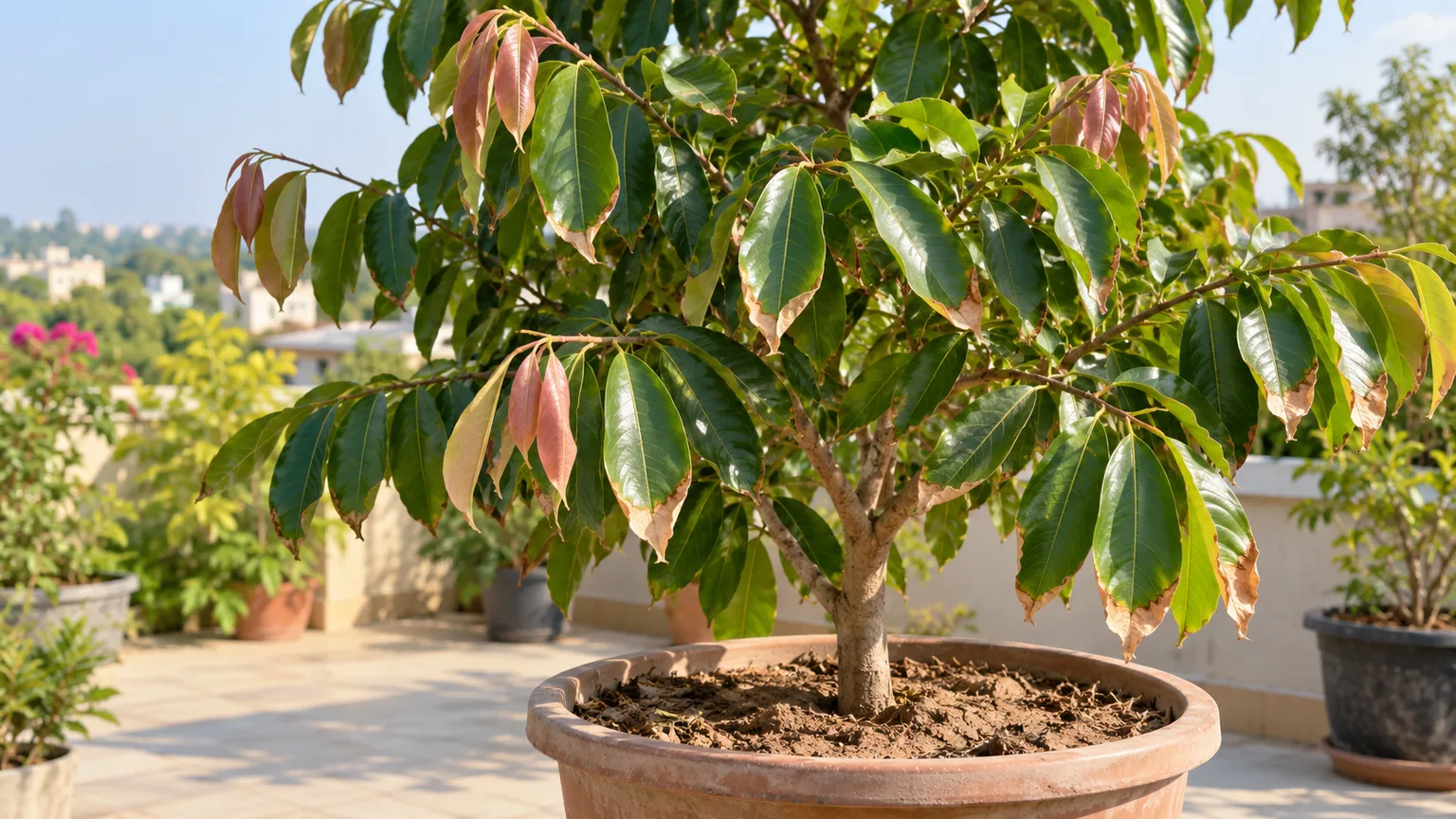
Underwatering on Jamun: Causes, Checks & Fixes
This guide covers underwatering on Jamun. See also the general Underwatering guide, watering, and light pages for this plant.
Underwatering on Jamun: Causes, Checks & Fixes
Quick answer
Underwatering on Jamun (Syzygium cumini) shows as drooping young leaves, dry brown leaf margins, and stalled new growth sitting in a feather-light pot. Jamun is a big evergreen fruit tree squeezed into a container, so a pot-bound root ball on a hot terrace can swing from moist to bone-dry within a day — and the farthest tissue from the roots flags first. For the general mechanics of drought wilt across houseplants, see our underwatering hub; on Jamun, the pattern usually shows up as a dull, flagging young flush with crisp brown edges on older glossy leaves, plus a pot that feels suspiciously light for its size.
First, push a finger 3–5 cm into the mix and lift the pot. Dry plus light means drought: give one slow deep soak until water drains freely, empty the saucer, and watch the young leaves. If the pot is heavy and damp instead, do not water — treat it as overwatering via overwatering on Jamun.
What underwatering looks like on Jamun
Jamun carries a dense evergreen crown of glossy dark-green mature leaves with a yellowish midrib, while the newest flush emerges pinkish before hardening off. Underwatering reads clearly against that two-tone canopy: the soft young pinkish-green leaves droop and dull first, because they have the thinnest cuticle and the weakest water column behind them. Older leaves follow with dry, papery brown margins starting at the edges, and growth stalls — no new flush, and any developing fruit may drop prematurely.
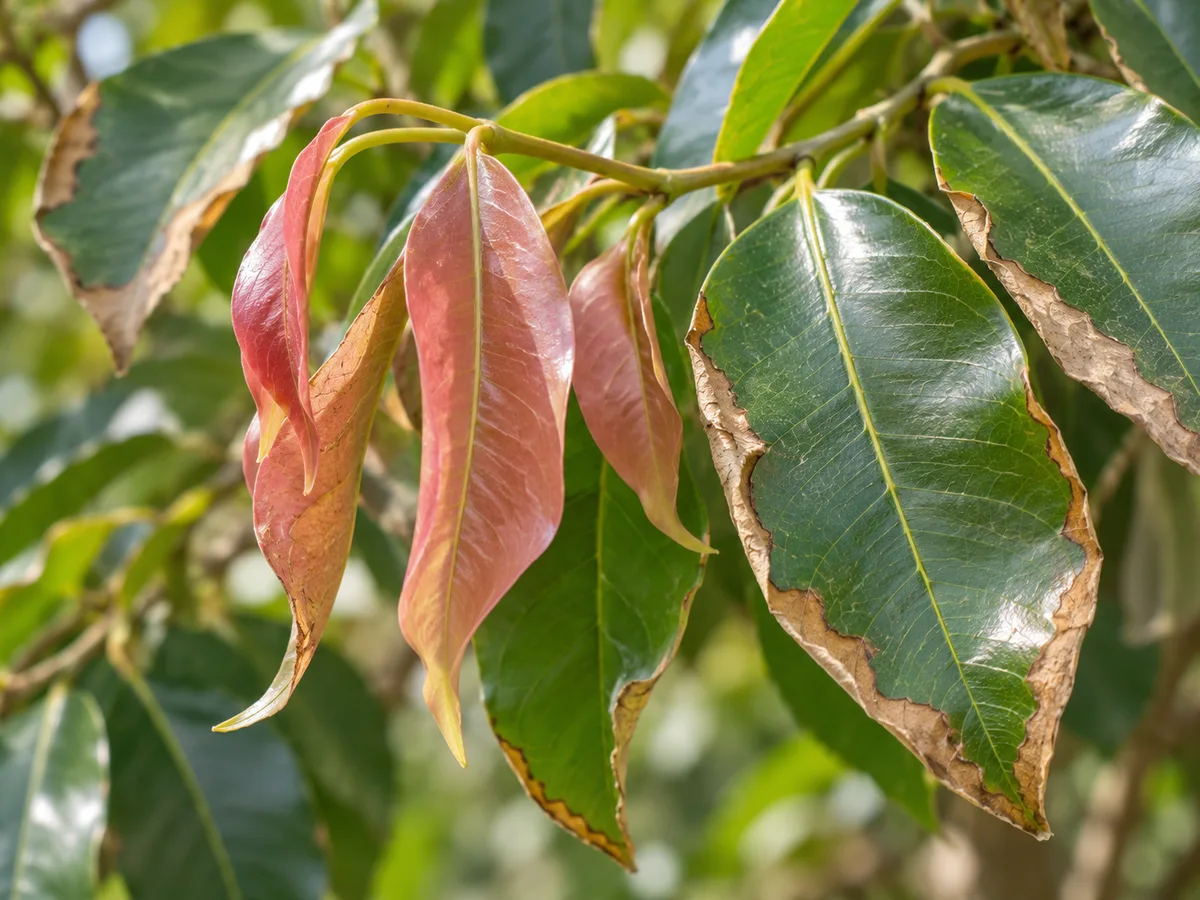
Underwatering on Jamun: flagging young flush with crisp brown margins on mature glossy leaves — check the finger test and pot weight before watering.
Because Jamun can reach 12 m to 30 m with a dense crown, even a pruned container specimen carries a lot of transpiring leaf area over a small soil reservoir. That ratio is the whole story: a large canopy pulling water through a cramped, sun-baked root ball. Leaves on the afternoon-sun and windward side crisp first, while shaded interior leaves stay glossy a little longer. Uniform all-over flagging points to the root zone running empty; one-sided scorch points to exposure outpacing supply.
Why Jamun gets underwatered
A tree-sized canopy over a pot-sized reservoir. Jamun is listed for Full Sun and Moderate Water, and it grows in full sun with moderate water in rich, moist, well-drained soil. In open ground that works beautifully — but a container removes the deep soil buffer. A vigorous Jamun fills its pot with roots, and a root-bound ball can dry within a day in warm weather. Calendar watering (a fixed weekly drink regardless of weather) guarantees alternating drought and flood, and feeder roots die back a little more with each dry crash.
Young and container trees have no drought reserve. Jamun tolerates drought and short-term flooding when established — note the qualifier. A newly planted or potted tree has none of that field-grown resilience; its roots occupy only the pot volume, and the top 3–5 cm of mix is the gauge that matters. New growers often treat a young Jamun like a mature landscape tree and water it sparingly. The Jamun watering guide keeps the distinction explicit: deep soak when the upper mix dries, steadier moisture for young and container trees, every 3–5 days in heat and 7–14 days in cool months.
Hydrophobic mix that sheds water. Peaty or compost-heavy mixes that dry out completely shrink from the pot walls and turn water-repellent. Water poured on top runs down the gap and out the drainage holes while the core of the root ball stays dry — the classic “I watered yesterday and it still wilted” case. If your soak drains suspiciously fast and the pot stays light, the water never entered the ball.
Terrace heat and fruit load. A potted Jamun on reflective paving faces radiated heat, drying wind, and full sun all at once — transpiration peaks exactly when the small reservoir empties fastest. A tree also carrying developing fruit has an extra water demand; premature fruit drop during a dry spell is Jamun redirecting scarce water away from the crop. Review placement and exposure in the Jamun light guide and the Jamun overview before blaming the variety.
Salt buildup mimicking drought. Fertilizer and hard-water salts accumulate in container media and can inhibit water uptake even when the mix looks damp — extension guidance notes brown tips follow excessively dry soil as well as salts and overfertilization. If margins brown despite regular watering and a white crust rims the pot, read brown tips on Jamun before pouring more water on a salt problem.
How to confirm the cause
Check on a dry morning, before watering, in this order:
- Finger test at 3–5 cm. Dry and crumbly through the full depth means the reservoir is empty. Damp and cool means water is not the shortage — look elsewhere.
- Pot weight. Lift it. Feather-light confirms drought; heavy days after watering confirms slow drainage, and watering more would drown roots. As one practical diagnosis guide puts it, check the root zone before watering: very dry mix points to underwatering, persistently wet mix to overwatering.
- Gap check. A visible gap between mix and pot wall, or water that races straight through to the saucer, means a shrunken hydrophobic ball — surface watering is not reaching roots.
- Leaf feel. Underwatered Jamun leaves feel thin, papery, and crisp at the edges; overwatered leaves feel soft, limp, and sometimes yellow through the whole blade. See drooping leaves on Jamun for the full either-direction comparison.
- New flush quality. The young pinkish flush tells the truth: flagging but unblemished young leaves mean recent drought; young leaves emerging already scorched mean the stress is ongoing or salts are involved.
- Soil surface. White crust plus recent feeding points to salt load; green algae or sour smell points to chronic wetness and possible root damage — inspect per root rot on Jamun.
Wilting alone never confirms drought. UC IPM notes that wilting is usually caused by underwatering but may also come from root decay, and advises inspecting root systems whenever wilting occurs. If the canopy flags while the mix is wet, unpot and look at the roots before adding a drop.
The first fix to try
Give one slow, deep corrective soak — but only if the mix is actually dry.
Set the pot where it can drain freely and water slowly in two or three passes until water runs clearly from the drainage holes. Empty the saucer within 30 minutes so the pot never stands in water. This single drink rehydrates the shrunken root ball and resets the moisture baseline; then stop and resume normal watering only when the top 3–5 cm dries again, following the Jamun watering guide.
If water races through a shrunken ball without wetting it, bottom-soak instead: stand the pot in a tub of water up to two-thirds of the pot height for 20–30 minutes until the surface glistens moist, then drain fully. Wilting happens because the plant loses internal turgor pressure — cells deflate like tiny water balloons — and a thorough saturation restores that pressure within hours in a recoverable plant.
If the pot is already heavy and wet, do the opposite: no water, empty the saucer, move the tree to bright airy sun, and follow overwatering on Jamun. Do not fertilize, repot, spray, or relocate in the same week as the first fix — one correction, then read the response.
Step-by-step recovery
Once the first soak is done, match the follow-through to your confirmed cause:
For simple drought: Switch from calendar watering to the finger-and-weight method — deep soak when the top 3–5 cm is dry, roughly every 3–5 days in hot weather and 7–14 days in cool months. Mulch the surface lightly with compost to slow evaporation. Review the full routine in the Jamun watering guide.
For a hydrophobic ball: After the rescue bottom-soak, water future drinks slowly in passes rather than one fast pour, and consider top-dressing with fresh compost to restore the mix surface. If the ball dries within a day of every watering even in mild weather, the pot is root-bound: repot or root-prune into the aerated loam-compost-mineral blend in the Jamun soil guide, ideally in late winter to early spring per the Jamun repotting guide.
For heat and wind exposure: Keep full sun — Jamun needs it — but buffer the extremes: set the pot on feet off heat-radiating paving, group pots for mutual shelter, and water early in the day so the canopy faces afternoon heat fully hydrated. Do not retreat a flagging Jamun into deep shade; dim corners trade wilt for leggy growth and slow growth.
For salt load: Withhold fertilizer for at least a month and flush the pot with plain water at two to three times the pot volume, draining fully between passes. Resume feeding at modest container rates from the Jamun fertilizer guide, not orchard rates.
Leaves that are fully crisped will not come back — trim dead tissue only after new growth confirms recovery, and never strip mostly-green leaves that still photosynthesize for the next flush.
Recovery timeline
Drought wilt is the fastest plant problem to read: drooping young leaves should perk up within hours of a proper soak. That perking is your confirmation — turgor restored means roots are alive and drinking. If the canopy stays flagged 24 hours after a thorough soak, suspect dead feeder roots or rot and inspect the root zone.
Over the next two to three weeks, no new margins should brown and the next flush should emerge pinkish and harden to glossy green with intact edges. Browned margins themselves stay brown — scars, not healing wounds. Signs of worsening (spreading crispness despite moist soil, stems softening, growth stalled through warm weather) mean re-check roots and salts via wilting on Jamun and root rot on Jamun rather than waiting another month.
Lookalike symptoms
| Pattern | What you see | Likely cause | Next step |
|---|---|---|---|
| Droop + light dry pot, perks after water | Flagging young leaves, crisp margins | Underwatering | This page — corrective soak, then finger-test routine |
| Droop + heavy wet pot, no perk | Limp canopy, damp sour mix | Overwatering, root damage | Overwatering → root rot |
| Wilt that confuses both directions | Flagging foliage, dull surface | Water imbalance either way | Wilting |
| Drooping leaves, dry or wet | Flagging foliage, dull surface | Water imbalance either direction | Drooping leaves |
| Whole leaves yellow then drop | Uniform yellowing, shedding | Overwatering, light stress | Yellow leaves on Jamun |
| Crisp brown tips, green blade | Dead points, thin yellow band | Drought swings or salts | Brown tips |
| Sticky residue, insects, sooty film | Honeydew, visible pests | Sap-sucking pests | Aphids, mealybugs, spider mites |
| Pale stretch, sparse canopy | Long internodes, small leaves | Too little light | Not enough light |
| Tiny flies over damp surface | Gnats, algae, wet top mix | Chronically wet surface | Fungus gnats and mold on soil |
| Dry air browning near vents | Crisp edges indoors, dusty leaves | Low humidity | Low humidity |
When to use this page vs other Jamun guides
Use this page when the dominant pattern is wilt or crisp margins in a dry, light pot that perks up after watering. Move to a sibling when a different pattern leads:
- Canopy flags while the mix stays wet and heavy → overwatering first, then root rot if stems soften or roots smell
- Whole leaves yellow and shed without tip-first burn → yellow leaves
- Tip-first burn with white crust or recent heavy feeding → brown tips
- Visible insects, webbing, or sticky honeydew → pest guides (spider mites, mealybugs, aphids)
- Care baselines → watering, soil, light, fertilizer, and the Jamun overview for scale and placement reality
- Full problem list → the Jamun problems hub each season so small stresses get caught early
Mistakes to avoid
Do not sprinkle a little water daily — light sprinkles wet only the surface while the root ball core stays dry, and they concentrate salts exactly where feeder roots drink. Do not flood a heavy wet pot “just in case”; if wilt sits in saturated mix, more water finishes the roots. Do not fertilize a drought-flagged Jamun to “push through it” — feeding dry roots burns them. Do not repot, root-prune, spray, and relocate in the same week; pick the one fix matching your confirmed cause and read the response for two weeks. And do not mist the leaves and call it fixed — surface wetting never rehydrates a dry root ball.
How to prevent it next time
Prevention is the finger-and-weight habit: deep water whenever the top 3–5 cm dries, empty the saucer every time, and check more often in heat, wind, and fruiting season. Pot a young Jamun in the heavy stable container and loam-compost-mineral mix from the soil guide so the reservoir matches the canopy, and repot or root-prune every two to three years before the ball turns to solid root. Feed at modest container rates and flush with plain water every couple of months in hard-water areas. A Jamun that needs water daily in mild weather is not thirsty — it is pot-bound, and the fix is root room, not a bigger watering can.
Related Jamun guides
- Jamun overview — tree scale, sun placement, and container reality check
- Jamun watering — the 3–5 cm dry-down rhythm and seasonal intervals
- Overwatering on Jamun — heavy pots, sour mix, and the wet-side mirror image
- Drooping leaves on Jamun — dry-vs-wet droop comparison
- Wilting on Jamun — wilt triage when the cause is unclear
- Brown tips on Jamun — tip burn from drought swings and salts
An underwatered Jamun is almost never a dying tree — it is a big sun-loving canopy asking for a steadier drink or more root room. Confirm with the finger test, apply one deep corrective soak, and judge success by the perk within hours and the next flush: clean pinkish leaves hardening to glossy green mean you read it right.
How we wrote and verified this guide: Recommendations were checked against Singapore National Parks Board, UC IPM, Iowa State Extension, PlantSolve, GrowPlants, and GrowWithRajeev references cited inline. Author: sai-ananth. Reviewer: LeafyPixels Review Board. Methodology: plant problem guidance is reviewed against botanical references, extension resources, and LeafyPixels plant-care data before publication. Last reviewed: 2026-09-06.
Related tool
Use the Plant Watering Calculator to set a pot-appropriate watering rhythm for underwatering recovery on this plant before changing multiple variables at once.