Mold on Soil on Jamun: Causes, Checks & Fixes
Quick answer
White or gray fuzz on Jamun soil is usually harmless saprophytic fungus feeding on damp organic mix, not a disease attacking the tree. First step: scrape off the top layer, let the top 3–5 cm dry fully, and move the pot toward stronger sun and airflow.
Mold on Soil on Jamun: Causes, Checks & Fixes
This guide covers mold on soil on Jamun. See also the general Mold on Soil guide, watering, and light pages for this plant.
Mold on Soil on Jamun: Causes, Checks & Fixes
Quick answer
Your Jamun (Syzygium cumini) has white or gray fuzz spreading over the potting mix, and you want to know whether to scrape it, repot, or worry. Start with what makes Jamun different from a typical indoor foliage plant: it is a full-sun fruit tree that expects fertile, well-drained loam and moderate water, not a constantly damp soil surface in still indoor air.
First step: scrape off the top half-inch of affected mix and let the top 3–5 cm dry completely before watering again. If stems stay firm, new leaves look glossy, and the mix smells earthy rather than sour, you are correcting a moisture imbalance, not rescuing a dying tree. Surface mold is usually harmless saprophytic fungus feeding on damp bark, compost, and coir. For how chronic wet mix damages roots in general, see our mold on soil guide. On Jamun, the pattern usually shows up as a sun-hungry young tree sitting too wet in an oversized pot of rich mix.
What mold on soil looks like on Jamun
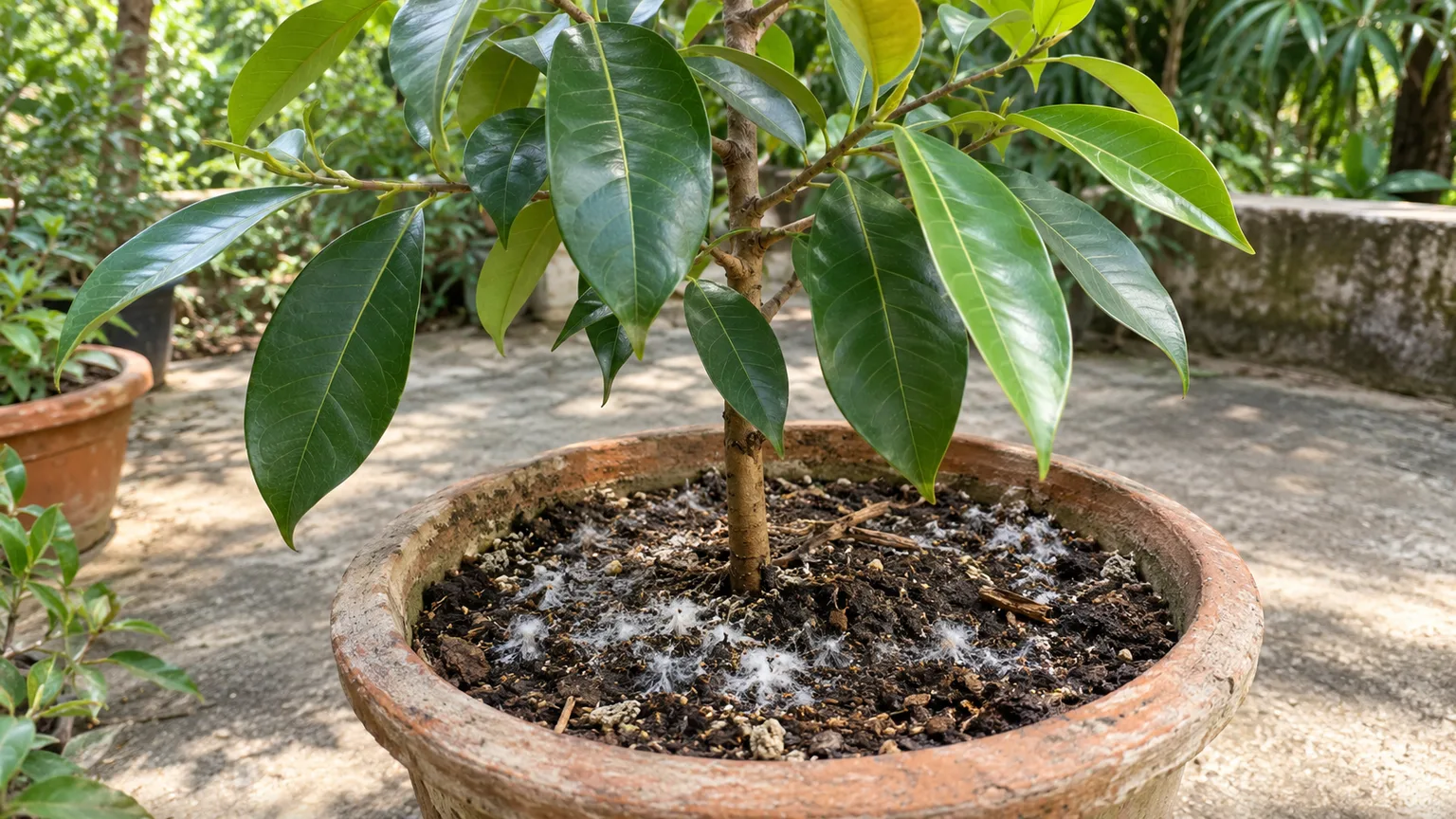
On a young container Jamun, mold appears as a soft white, gray, or faintly yellow fuzzy film across the soil surface, often starting near the trunk base or the pot rim where moisture lingers longest. It may look cottony and raised when fresh, or flat and web-like as it spreads outward in a coin-sized patch. Touch it and it collapses, unlike mineral crust, which feels gritty. Seedlings and small saplings show it most because their pots hold far more water than their small root systems can drink.
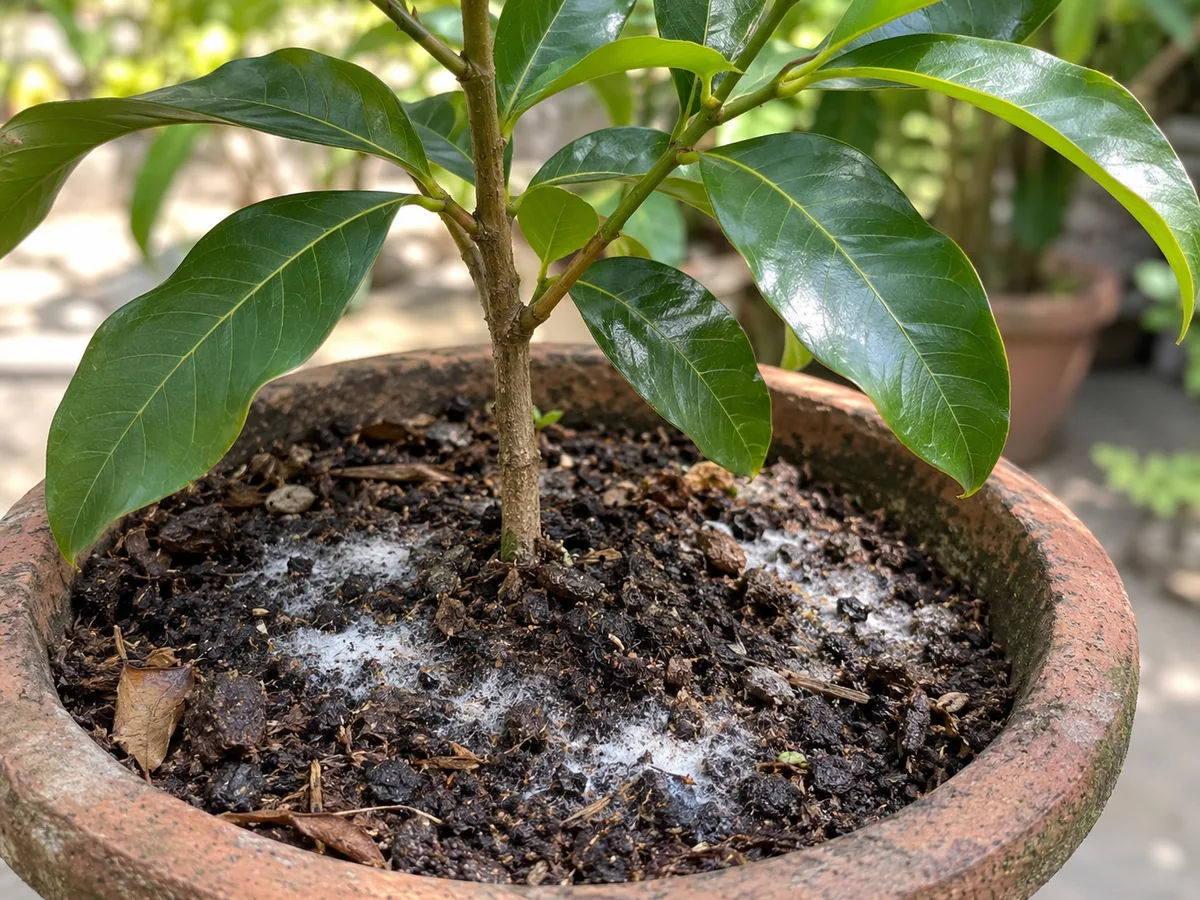
Close-up: soft white mycelium threading across damp potting mix. Fuzzy and collapsible means mold; hard and gritty means mineral salts.
Because Jamun grows into a dense-canopied evergreen, a bushy sapling shades its own soil surface, keeping it cool and damp even when the room feels warm. Fallen Jamun leaflets and, on fruiting-age specimens, dropped berries or flower debris often sit on that shaded surface and grow their own halo of fuzz. That debris-fed ring around the trunk is a classic Jamun presentation. The tree itself usually looks fine at first, which is exactly why growers ignore the signal until fungus gnats appear or growth stalls.
Why Jamun pots grow mold: a sun tree kept too wet
Three Jamun-specific habits combine to keep the soil surface damp long enough for spores to establish. Mold is a fungal growth that forms and spreads on damp or decaying organic matter, and a container Jamun supplies both sides of that equation generously.
A full-sun tree stuck in still, dim air
Jamun is listed for full sun with moderate water, and its watering rhythm assumes bright warmth that dries the top 3–5 cm between drinks. Move that same tree to a dim corner, a crowded balcony shelf, or indoors behind glass, and evaporation collapses while watering stays the same. Still air lets humidity pool right at the soil surface, and low light keeps the surface cool, so a mix that dried in three days on a sunny terrace stays soggy for a week inside. This is the single most Jamun-specific driver: a tree evolved for open sunshine held in conditions closer to a terrarium.
Compost-rich mix plus fallen leaf and fruit debris
The recommended Jamun container mix runs roughly half loam with a generous compost fraction, and growers often mulch the surface with dead leaves. Both are good horticulture, but both are also food for decomposers: potting mixes are made almost entirely of the material saprophytes eat, and decomposing leaves piled at the base encourage moldy soil. Jamun sheds leaflets continuously and drops fleshy fruit that smears sugars across the surface. A thick mulch layer over an already slow-drying pot, plus uncleared fallen fruit, turns the top inch into a compost heap with a trunk sticking out of it.
An oversized pot for a future 12–30 m tree
Because Jamun naturally becomes a large tree, growers often jump a seedling straight into a big container “to save repotting.” Container guidance instead says to start modestly and step up gradually, since rich but free-draining soil is essential and good drainage is non-negotiable in pots. Roots in an oversized pot cannot drink the volume of water the pot holds, so the lower half stays wet for weeks while the seedling sips from the top. That perched reservoir wicks upward, the surface never dries, and mold colonizes exactly the zone where a careful grower keeps checking moisture and concluding the plant “still looks wet.”
Is it mold, salt crust, mildew, or sooty mold?
Use this table before scraping, leaching, or spraying, because each white coating needs a different fix:
| What you see | Likely cause | Check | First action |
|---|---|---|---|
| Soft white/gray fuzz on soil; collapses when touched | Saprophytic surface mold on wet mix | Surface stays damp for days; earthy smell | Scrape top layer → dry-down → more sun and air |
| Hard white/yellow crust on soil and pot rim; gritty, not fuzzy | Fertilizer and tap-water salt buildup | Brown leaf margins alongside the crust | Scrape crust, leach the pot, review the fertilizer schedule |
| White dusty coating on leaves, not soil | Powdery mildew on foliage | Starts as small circular leaf patches that merge | Improve airflow, space plants, remove badly affected leaves |
| Black sooty film on leaves, often sticky underneath | Sooty mold on aphid or mealybug honeydew | Sticky leaves, ants, visible pests in leaf axils | Treat the insects per the aphid guide or mealybug guide, then wipe leaves |
| White fuzz plus tiny black flies rising when disturbed | Surface mold plus fungus gnats breeding in the same wet mix | Larvae in the top inch of damp mix | Dry the surface and follow the fungus gnat guide |
The salt-crust row matters for Jamun because container fruit trees are fed more heavily than foliage houseplants, so mineral accumulation is common. Salt crust feels crystalline and builds up over months rather than appearing in a few damp days. The sooty-mold row matters because Jamun’s fragrant flushes of new growth attract sap-sucking pests, and honeydew-grown sooty mold is a Jamun problem even when the soil itself is fine.
How to confirm the cause
Work through these checks in order on watering day, before the next drink:
- Finger and weight test. Push a finger 3–5 cm into the mix and lift the pot. If the top is still moist days after watering and the pot feels heavy, the surface never gets its dry window. This matches the overwatering pattern more than a thirsty tree.
- Debris audit. Look for fallen leaflets, spent flowers, or fruit skins matted on the surface. Mold radiating from debris rather than bare mix confirms a food-source problem.
- Drainage check. Water slowly and watch the base. Free flow within seconds is healthy; pooling on top or a saucer that stays full for hours means compacted mix, blocked holes, or no holes at all. Containers need several drain holes rather than a decorative sealed cachepot.
- Smell and root probe. Scratch aside the top inch. Earthy and crumbly is surface-only mold. Sour, rotten, or swampy means anaerobic conditions deeper down, so ease the root ball out and inspect: firm pale roots recover with drying, while dark mushy roots point to the root rot guide.
- Light and air audit. Note hours of direct sun and whether air moves around the pot. A shaded, crowded corner with wet soil and mold is a placement diagnosis, and the light guide sets the target to aim for.
The first fix for Jamun
Scrape the surface, clear debris, and start a true dry-down. Lift off the top half-inch of moldy mix with a spoon, pick up every fallen leaf and fruit scrap, and dispose of it all away from the pot rather than composting it back on top. Then do not water until the top 3–5 cm feels dry and the pot feels noticeably lighter, following the watering guide instead of a calendar schedule. Move the pot to the sunniest position available with moving air, and crack the surface gently with a fork so it does not seal into a crust.
If mold returns within a week despite real drying, the mix itself is the problem: old, compacted, or far more water-retentive than a sun tree needs. Repot into fresh loam-based mix amended with coarse sand, pumice, or perlite, in a pot only modestly larger than the root ball with open drainage holes. Decline in houseplant health is most commonly associated with improper watering, root disease, and poor sanitation, so this single repot corrects all three at once. A dusting of ground cinnamon over the fresh surface can slow regrowth while the new rhythm establishes, since cinnamon contains cinnamaldehyde with genuine antifungal properties, but treat it as a helper, not the cure.
Recovery timeline
Surface-only mold clears fast once conditions change: the scraped surface stays clean within one to two watering cycles, usually one to three weeks in warm weather. New Jamun flushes should emerge glossy and hold their color rather than yellowing or dropping, which distinguishes recovery from the yellow-leaves pattern. Fungus gnat numbers, if present, fall over the following two to four weeks as the top inch dries between drinks.
Slow recovery points to a deeper issue. If older leaves keep yellowing, shoots wilt despite wet mix, or the surface re-fuzzes within days, suspect root damage from the same chronic wetness and inspect per the root rot guide. Jamun is vigorous in warmth, so a young tree that stalls for more than a month after the fix deserves an unpotting and a hard look at the roots.
Mistakes to avoid
- Drenching with fungicide sprays. Chemical fungicides are overkill for surface soil mold and do not fix wet conditions, so the mold returns regardless of what is sprayed.
- Misting the canopy to “help” the tree. Misting wets the shaded surface further and raises local humidity without watering roots. Water the mix directly and let the surface breathe.
- Fertilizing a moldy, stressed pot. Salts accumulate in slow-drying mix and burn margins, converting a mold problem into a fertilizer-burn problem. Hold feed until the surface dries normally and new growth looks clean.
- Potting a seedling into its “forever” container. Oversized pots stay wettest longest. Size up gradually as roots fill each pot.
- Sealing the surface with thick mulch on a damp pot. A light mulch on a fast-draining sunny pot is fine; a heavy leaf layer over soggy mix is mold food in the dark.
Jamun care cross-check
Before calling this a one-off, align the routine with what a container Jamun actually needs. Water deeply only after the top 3–5 cm dries, and reduce frequency in cool or rainy spells when the mix dries slowly. Keep the soil fertile but open, with compost balanced by coarse drainage material rather than fine garden soil that compacts. Give the tree the sunniest terrace or courtyard position available, since dim rooms are a poor permanent home for this species. Clear fallen leaves and fruit weekly, and refresh or top-dress mix that has slumped into a dense, slow-draining mass.
When to use this page vs other Jamun guides
Stay on this page when the main symptom is fuzzy growth on the soil surface with a mostly healthy canopy. Switch to overwatering when leaves yellow and drop while the mix stays soggy, to root rot when stems soften or roots smell sour, and to fungus gnats when flies dominate the complaint. Use drooping leaves or wilting when the canopy, not the soil, is the presenting symptom, and not enough light when a dim position explains leggy, sparse growth alongside the mold.
FAQs
Is white mold on Jamun soil dangerous to the tree?
Harmless in itself: surface mold feeds on dead organic matter in the mix, not on living Jamun roots or leaves. The real risk is the persistently wet, airless conditions behind it, which can lead to fungus gnats and root stress if ignored.
How can I confirm mold on Jamun soil is not root rot?
Check the combination: surface fuzz plus firm stems, glossy new leaves, and sweet-smelling mix points to surface mold. A sour smell, yellowing or dropping leaves, and dark mushy roots mean rot instead, so unpot and follow the root rot guide.
What should I do first about mold on my Jamun’s soil?
Scrape first: lift off the top half-inch of affected mix and fallen debris, then let the top 3–5 cm dry before watering again. Make this one drying correction before repotting, feeding, or spraying anything.
When is mold on Jamun soil urgent?
Urgent when: mold returns within days of scraping, fungus gnats swarm the pot, seedlings damp off at the base, or leaves yellow while the mix stays soggy. Those signs mean the root zone is failing, not just the surface.
How do I prevent mold on Jamun soil long term?
Dry the surface routinely: right-size the pot, keep drainage holes open, clear fallen leaves and fruit, water only after the top 3–5 cm dries, and give the tree full sun with moving air. A fast-drying surface starves the fungus.
Related Jamun guides
- Jamun overview - full-sun fruit-tree care and container realities
- All Jamun problems - full problem index when symptoms overlap
- Watering - top 3–5 cm dry-down rhythm behind surface mold
- Soil - loam-based mix with compost plus coarse drainage
- Light - sun targets so the surface dries between drinks
- Fertilizer - feeding without building salt crust mistaken for mold
- Overwatering - primary cause behind recurring surface mold
- Root rot - when sour mix and mushy roots escalate past scraping
- Fungus gnats - companion pest breeding in the same wet surface
- Yellow leaves - canopy symptom that separates mold from decline
Related tool
Use the Plant Problem Diagnosis Tool to narrow causes for mold on soil on this plant before changing multiple variables at once.