Root Rot on Jamun: Container Causes, Root Check & Dry Repot
Quick answer
Root rot on container Jamun shows as yellowing older leaves, leaf drop, and wilt that persists even though the mix is wet — with brown, mushy feeder roots and often a sour smell from the drainage holes. First step: stop all watering and unpot the tree the same day to inspect the roots.
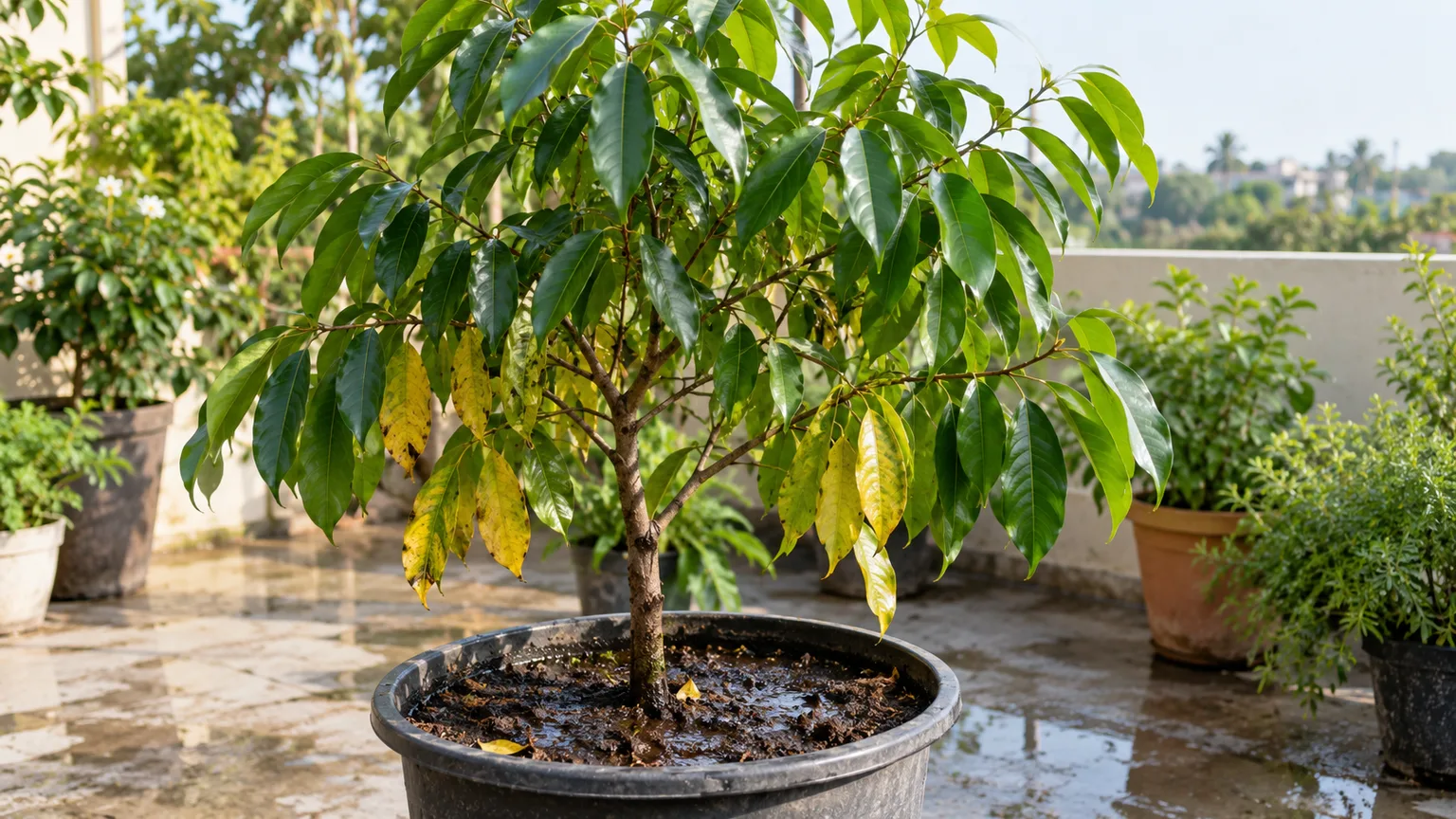
Root Rot on Jamun: Causes, Checks & Fixes
This guide covers root rot on Jamun. See also the general Root Rot guide, watering, and light pages for this plant.
Root Rot on Jamun: Causes, Checks & Fixes
Quick answer
A container Jamun (Syzygium cumini) with root rot looks thirsty while sitting in wet soil: older leaves yellow and drop, new flushes stall, and the canopy wilts even though the mix is damp. Underground, feeder roots have turned brown or black and mushy, and the pot often smells sour at the drainage holes. Jamun is a full-sun, moderate-water tree — it tolerates brief flooding in open ground, but a pot of stagnant mix removes that field-grown buffer entirely.
For how saturated mix destroys roots in general, see our root rot guide. On Jamun, the tell is a heavy pot days after watering, sour-smelling drainage holes, yellowing lower leaves, and soft dark feeder roots on unpotting — while the woody trunk may still look fine.
First step: stop all watering and unpot the tree the same day to inspect the roots. Do not fertilize, do not repot blindly into a bigger container, and do not “flush” the pot with more water first. One decisive inspection tells you whether a dry repot can save the tree.
When to use this page vs other Jamun guides
| Pattern | Read next |
|---|---|
| Heavy pot, yellow leaves, roots still firm and pale on unpotting | Overwatering — dry-down pause may be enough |
| Soft dark roots + sour smell on wet mix (this page) | Stay here for unpotting and root surgery |
| Light dry pot, drooping young leaves, brown dry margins | Underwatering |
| Whole canopy limp with firm roots and dry mix | Wilting |
| Lower leaves hanging despite correct watering | Drooping leaves |
| Small flies over damp mix, surface mold, firm roots | Fungus gnats or mold on soil — moisture alarms before rot sets in |
What root rot looks like on Jamun
Above ground, the earliest sign is a general loss of vigor that is easy to misread: growth stalls, older leaves turn yellow and drop, and the canopy wilts in warm afternoons without recovering overnight. Because Jamun is evergreen with dense foliage, owners often notice the leaf drop before the wilt — handfuls of yellowing leaves under a tree that was watered “on schedule.” In advanced cases the trunk base feels soft or looks darkened at the soil line, and twig tips die back from the top of the canopy downward.
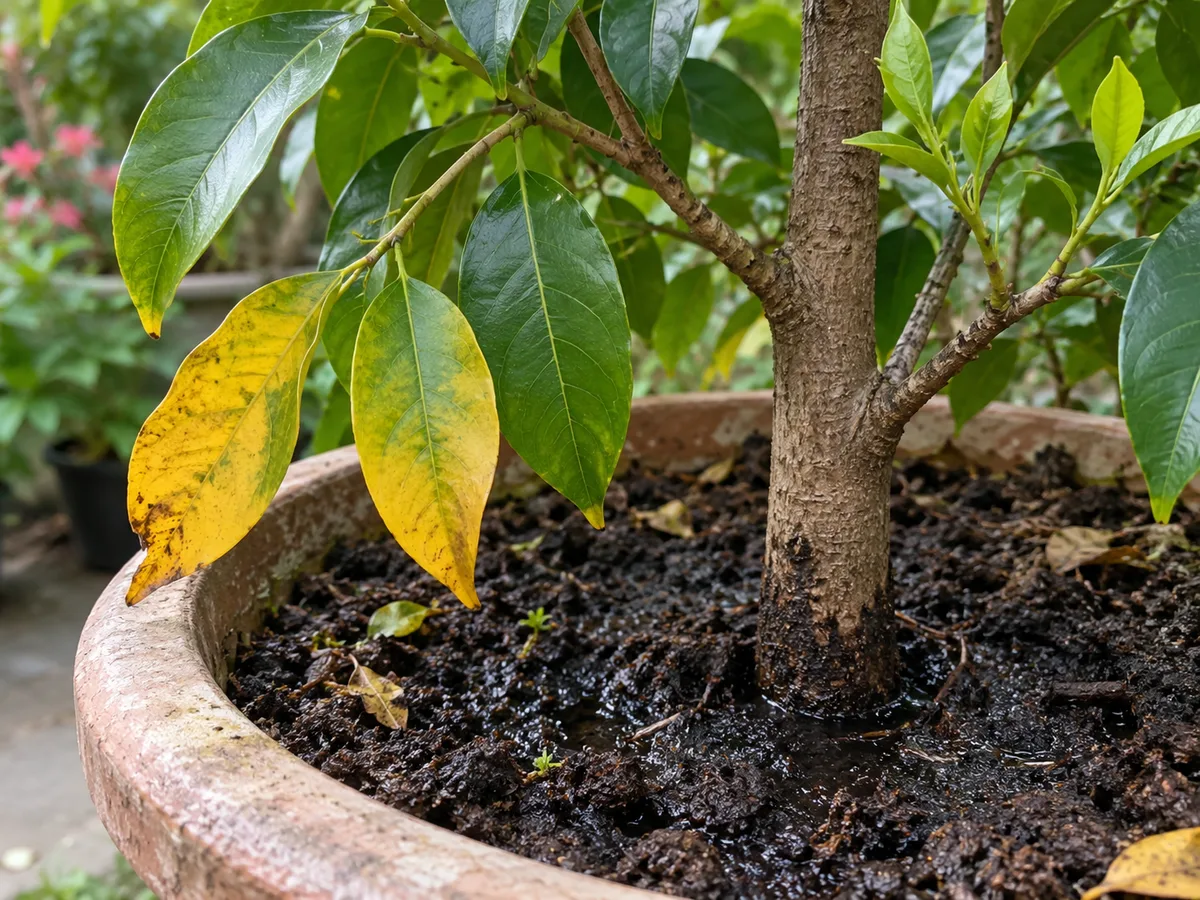
Root rot symptoms on Jamun: yellowing lower leaves and a dark, saturated soil line — compare with firm new growth on the same tree.
The confirmation is always underground. Healthy Jamun feeder roots are firm and pale; rotted ones are dark brown or black, mushy, and sometimes slough their outer sheath when touched. Soil that has sat too long without oxygen usually smells sour or rotten — that smell from the drainage holes is one of the most reliable Jamun field checks because the deep pot hides everything else.
Why container Jamun rots while landscape trees survive flooding
This is the Jamun-specific trap. In open ground, an established Jamun tolerates drought and even short-term flooding: deep soil drains, air returns, and a massive root system compensates for damaged sections. None of that applies in a pot. A container holds a small, enclosed root ball where one overwatering plus a blocked saucer keeps the entire root zone airless for days — and roots growing in waterlogged soil die because they cannot absorb the oxygen needed to function.
Three container factors stack the risk on Jamun in particular. First, young and establishing trees need steadier moisture than mature ones, so owners water generously — right into stagnant mix when cool or rainy weather slows drying. Second, Jamun grows fast in warm sun and quickly fills its pot, so a root-packed container dries unevenly: dry crust on top, saturated core around the taproot. Third, the standard failure mode is the cachepot-and-saucer combination on a terrace — decorative outer pots without drainage trap monsoon runoff exactly where the deepest roots sit. Water-mold pathogens such as Phytophthora cause root rot most often in soils that are periodically waterlogged, which describes a saucer-held Jamun pot in rainy season precisely.
How to confirm: the heavy-pot, sniff, and unpot check
Work in this order — each step takes a minute except the last:
- Lift the pot. A Jamun pot that still feels heavy several days after watering, while the top 3–5 cm of mix stays damp, is holding too much water. This is the core of the watering rhythm: water deeply only when the upper mix has dried and the pot feels light.
- Sniff the drainage holes. Crouch down and smell. Sour or swampy odor means the lower root zone has gone airless — soil that has been too long without oxygen smells sour or rotten.
- Check the trunk base and newest growth. Press the bark gently at the soil line — firm is good, soft or sunken is urgent. Compare with the newest flush: stalled, small, or yellowing new leaves on wet mix point below ground, while perky new growth with a few yellow old leaves may just be normal shedding.
- Unpot and look. Slide the root ball out and rinse mix away so you can see clearly. Firm pale roots mean overwatering without rot yet — dry down, no surgery. Brown or black mushy roots, especially with that sour smell, confirm rot and trigger the fix below.
The first fix to try
Stop all watering and unpot the tree today if the pot is heavy and smells sour. That single inspection decides everything: firm pale roots get a dry-down pause in the same pot with drainage fixed, while mushy dark roots get same-day surgery and a dry repot. Do not stack fertilizer, pruning, and repotting on the same day before you know which case you have.
Step-by-step root surgery and dry repot
When unpotting confirms mushy roots, treat it as surgery — chemical options are largely ineffective on an already infected plant, so cutting and culture carry the recovery:
- Rinse the root ball under clean running water until you can see every root.
- With sterilized shears, cut away every brown, black, or mushy root back to firm pale tissue. Be aggressive — leaving even a small pocket of rot lets decay recolonize healthy tissue.
- Re-sterilize the shears with rubbing alcohol between cuts when decay is extensive.
- If you removed more than roughly a third of the root system, prune back a matching portion of the canopy — thin crowded interior shoots and tip-prune long leaders so the reduced roots can support the foliage.
- Discard all old mix. Wash the pot with soap and a bleach solution, rinse well, or use a clean sterile container. Downsize if the root ball shrank — excess soil volume stays wet around small roots.
- Repot into fresh, aerated loam-based mix with compost and coarse drainage material (roughly 50/25/25 loam, compost, and pumice or perlite), following the soil guide. Set the trunk at the same depth, never deeper.
- Water lightly once to settle the mix, then let the top 3–5 cm dry before the next drink. Hold the tree in bright, stable conditions and allow the pot to drain completely — empty every saucer.
While it is regrowing roots, do not fertilize — salts stress damaged roots. Resume feeding only when a new flush holds firm green leaves.
Monsoon, saucers, and terrace placement: Jamun’s wet-season trap
Jamun’s natural home gets heavy seasonal rain in well-drained soils — water arrives and leaves. A terrace pot in the same downpour collects and keeps it. Prevention here is placement, not just scheduling:
- Keep the nursery pot out of decorative cachepots during rainy spells, or empty them within an hour of rain.
- Raise pots on feet so drainage holes breathe and never sit in saucer water.
- Move young trees under cover during consecutive rainy days; established landscape tolerance does not transfer to pots.
- After any accidental soaking, probe the full depth with a wooden skewer — surface dryness lies while the core stays saturated.
Full sun placement from the light guide doubles as rot prevention: sun drives transpiration that pulls the mix through its wet phase faster.
The young-tree window: seedlings and fresh repots rot first
Jamun seedlings and recently repotted trees are the highest-risk plants in any collection. Fresh seed germinates fast but produces a fleshy young taproot with limited reserves, and a newly disturbed root ball drinks slowly while its wounds are open to infection. Keep young trees evenly moist — never waterlogged — and schedule structural work for late winter to early spring before the strong new flush, when wounds close fastest, per the repotting guide.
If a seedling collapses with a blackened stem base and no firm roots left, do not attempt stem-cutting rescue the way you would on a succulent — Jamun is a woody tree and the practical restart is fresh seed sown promptly, since stored seed loses viability quickly.
Recovery timeline
Recovery is slow and not guaranteed — judge it by stabilization first, then new growth:
| Severity at unpotting | Expected course |
|---|---|
| Mostly firm roots, few mushy feeders | Stabilizes within 1–2 weeks; normal flush next growth cycle |
| Up to half the roots trimmed, canopy thinned to match | No new decline within 3–4 weeks; assessable new shoots in 6–8 weeks of warm sun |
| Crown soft at soil line, majority of roots black | Guarded — regrowth may take a full season, and failure often shows as renewed wilt within 2–3 weeks |
Dropped yellow leaves will not re-green, and trimmed feeder roots do not heal — recovery means the decline stops and the next flush emerges clean. If wilt resumes on correctly dried mix, unpot once more; a second round of decay usually means the crown itself is compromised.
Lookalike symptoms
| What you see | More likely | How to tell |
|---|---|---|
| Wilt on wet heavy mix + sour smell | Root rot (this page) | Mushy dark roots on unpotting |
| Wilt on light dry pot, recovers after watering | Underwatering | Dry mix, firm pale roots, young leaves droop first |
| Yellow leaves, heavy pot, roots still firm | Overwatering | Dry-down pause fixes it without surgery |
| Sudden wilt days after repotting, mix correct | Transplant adjustment, see repotting | Roots firm; stabilizes with stable care, not surgery |
| Flies + surface mold, canopy still vigorous | Fungus gnats / mold on soil | Moisture warning — fix before it becomes rot |
Mistakes to avoid
- Watering “a little every day” for a tree that needs deep, infrequent soaking with full dry-downs between.
- Upsizing into a bigger pot after rot — extra wet mix around trimmed roots restarts the cycle. Downsize instead.
- Fertilizing a root-trimmed tree to “help it recover.” Salts burn damaged roots; wait for a clean new flush.
- Burying the trunk deeper at repotting to “stabilize” it. Depth invites crown rot — keep the original soil line.
- Spraying fungicide on foliage for a root-zone problem and skipping the unpot inspection.
Jamun care cross-check
Rot is almost always a care-pattern problem, not bad luck. Reset the three foundations after surgery: the watering guide for the 3–5 cm check and seasonal slowdown, the soil guide for the aerated loam blend that drains yet holds moisture, and the light guide for the full-sun placement that keeps the mix cycling. Review the overview for scale and pot-size reality, and use the problems hub whenever a new symptom does not match this page.
When to worry
Treat as urgent when the trunk base softens at the soil line, leaves drop in clusters on wet mix, or unpotting shows mostly mushy roots with a sour odor — same-day surgery gives the only real chance. Salvage is unlikely when the crown is hollow, the taproot core is black throughout, or the tree re-wilts after a correct dry repot. In that case, discard the mix, sterilize the pot, and restart from promptly sown fresh seed rather than nursing a crown-rotted stump through another season.
Related Jamun guides
- Jamun overview — tree scale, pot reality, and full-sun placement
- Jamun watering — the 3–5 cm dry-down rhythm after recovery
- Jamun soil — aerated loam blend that drains without drying out
- Jamun light — sun levels that keep mix cycling and canopies dense
- Jamun repotting — late-winter timing and root-prune technique
- Overwatering on Jamun — dry-down pause before rot advances
- Underwatering on Jamun — the dry-pot lookalike with firm roots
- Wilting on Jamun — canopy-first triage when the cause is unclear
- Fungus gnats on Jamun — wet-mix companion pest and moisture alarm
- Mold on soil on Jamun — surface moisture signal before roots fail
- All Jamun problems — full symptom index for this tree
Conclusion
Root rot on Jamun is a container-drainage failure wearing a wilt disguise: heavy wet mix starves roots of oxygen, decay organisms follow, and the canopy yellows while sitting in water. Stop watering, confirm with the lift-sniff-unpot sequence, cut decisively to firm tissue, and repot dry into aerated loam with open drainage. Landscape Jamuns forgive floods; potted ones do not — so keep saucers empty, honor the 3–5 cm rule, and let full sun pull each watering through. When the next flush holds firm and green, the root zone has truly stabilized.
Related tool
Use the Root Rot Risk Checker to narrow causes for root rot on this plant before changing multiple variables at once.