Overwatering on Jamun: Causes, Checks & Fixes
Quick answer
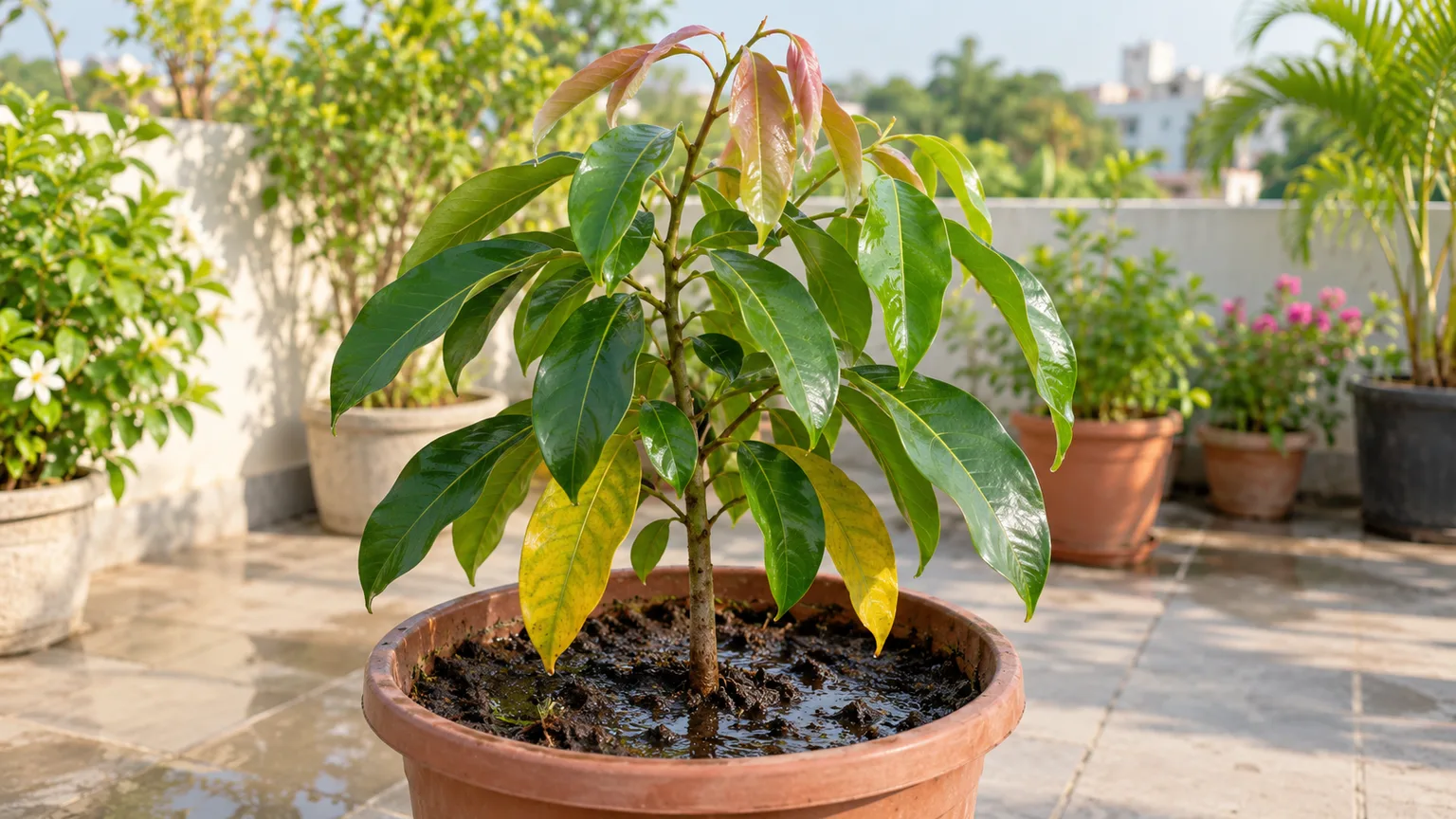
Overwatering on Jamun shows up as yellowing older leaves, a limp young flush, and a heavy pot that stays wet and sour days after watering — even though landscape Jamun tolerates brief flooding. First: lift the pot off its saucer, empty all standing water, and hold every drop until the top 3–5 cm of mix dries. If the canopy keeps wilting on wet mix, inspect the roots using the root-rot path.
Overwatering on Jamun: Causes, Checks & Fixes
This guide covers overwatering on Jamun. See also the general Overwatering guide, watering, and light pages for this plant.
Overwatering on Jamun: Causes, Checks & Fixes
Quick answer
Overwatering on Jamun (Syzygium cumini) rarely looks like a thirsty plant asking for more — it looks like a drowning one: older leaves yellow and drop, the young flush goes limp, and the pot stays heavy and sour days after watering. The confusion is understandable, because this species is listed for moderate water in full sun and established landscape trees survive drought and short-term flooding. For how chronic wet mix damages roots in general, see our overwatering guide. On Jamun, the pattern usually shows up as a waterlogged terrace pot — yellowing that begins at leaf bases, limp new growth, and stagnant mix — while the same tree planted in draining ground shrugs off the same rain.
First fix: lift the pot off its saucer, empty every drop of standing water, and give no more water until the top 3–5 cm of mix tests dry. One drainage-first pause tells you more than any fertilizer or spray: a merely soggy Jamun stops shedding within days once air returns, while a tree that keeps wilting on wet mix needs root inspection.
What overwatering looks like on Jamun
Healthy Jamun carries glossy dark-green mature leaves with a pinkish new flush, so overwatering yellowing reads clearly against that two-tone canopy. Expect older lower leaves to fade first — Jamun-specific growing notes describe yellowing that begins at leaf bases paired with soft, limp new growth and a sour smell near the root zone. Leaves feel soft and pliable rather than crisp, the flush stalls, and the pot stays noticeably heavy for days. You may also see surface algae, a musty saucer, or tiny fungus gnats hovering over mix that never dries.
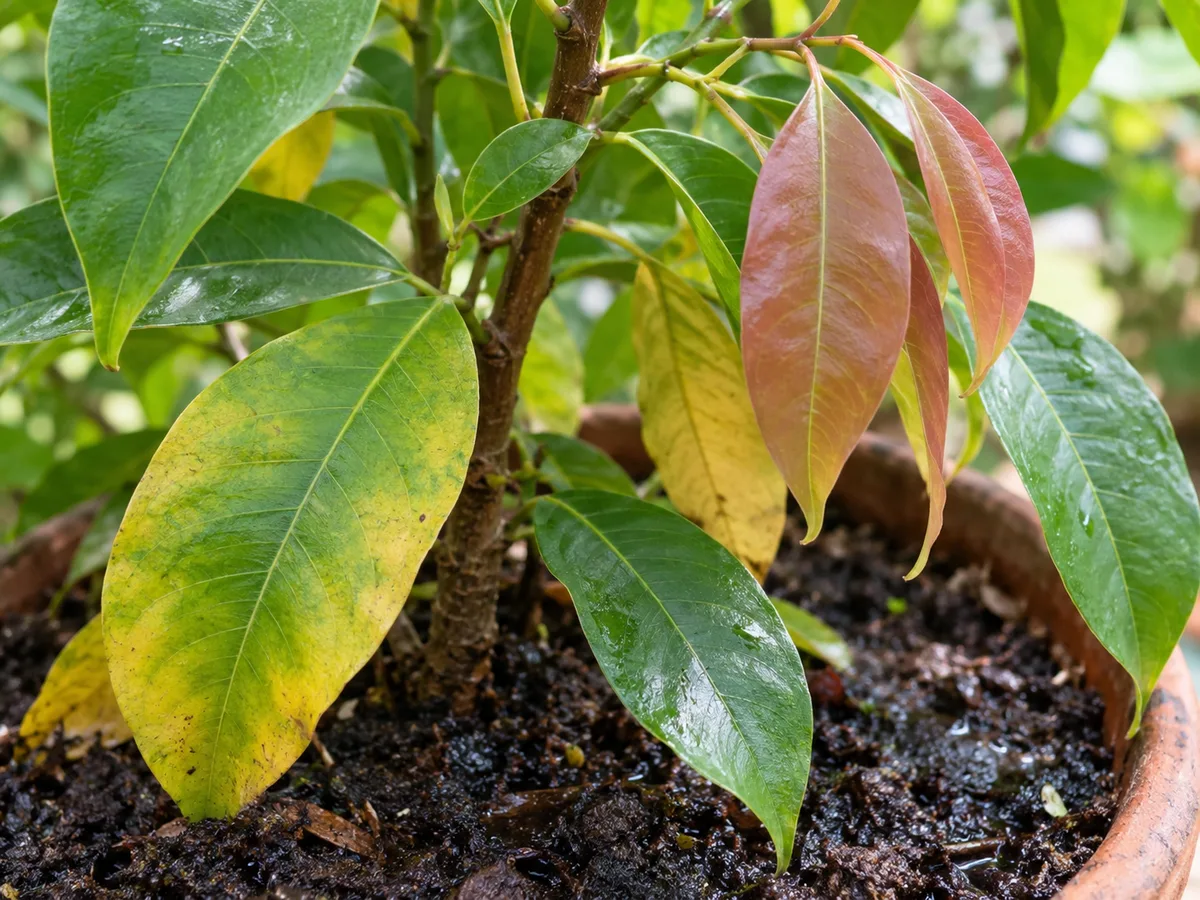
Overwatering on Jamun: soft yellowing from leaf bases with limp new growth — compare against the glossy green of healthy flush before deciding to water again.
Because a container Jamun carries a 12–30 m tree’s appetite for sun and air over a few litres of mix, symptoms escalate faster than on in-ground trees. A couple of oldest shaded leaves dropping while the crown pushes glossy growth is ordinary turnover. Whole layers yellowing from the base upward, limp morning foliage on a heavy pot, or shedding that continues a week after your last watering all point at the root zone, not the sky.
Why a flood-tolerant field tree still drowns in a pot
This is the section that separates Jamun from generic houseplant advice. In open ground, Jamun is genuinely tough around water: Tamil Nadu orchard guidance notes it grows on a wide range of soils but fruits best in deep loam and well-drained soil that holds moisture, while also tolerating salinity and waterlogged conditions when the water eventually moves away. World Agroforestry’s species profile matches this picture — best growth with rainfall over 1,000 mm annually in well-drained soils. A mature avenue tree explores metres of soil, rides out a short flood, then breathes again as the water table falls.
A 40–60 cm terrace pot offers none of that escape. Roof runoff, a sealed decorative cachepot, or fine cocopeat that slumped into sludge can hold the entire root ball airless for a week — the exact condition where, as Clemson Extension puts it, overwatering becomes the main cause of death of potted plants because roots need both water and oxygen. Jamun’s field tolerance describes a deep root system with somewhere to go; a container tree has nowhere to go. Treat “tolerates waterlogging” as a trait of planted orchards, never as permission to leave a pot standing in its saucer.
The usual causes on terrace and garden Jamun
Calendar watering through rain and cool spells. A fixed twice-a-week routine that suited May heat keeps running through monsoon weeks and cool cloudy stretches when the mix never dries. Young trees are the usual victims here: orchard schedules call for 8 to 10 irrigations a year for young trees and about half that for mature ones — a rhythm, not a timer. Check the Jamun watering guide for the seasonal version of this logic before assuming more water fixes limp leaves.
Blocked drainage and perched saucers. Drainage holes clogged with roots and silt, pots sitting flat on terrace floors, and saucers left full after every soak create a permanent shallow water table inside the pot. University of Wisconsin–Madison plant pathologists warn specifically against letting plants sit in drainage water, since root-rot fungi multiply fastest in exactly that stagnant layer — see their root rot factsheet. Lift the pot: if water films the saucer hours after watering, drainage has already failed.
Dense, slumped potting mix. Fine garden soil, exhausted cocopeat, or compost-heavy blends without mineral grit compact into an airless mass after a season or two of monsoon. The surface can look dry while the core stays saturated, which is why the finger test must go 3–5 cm deep and the pot’s weight must agree. The Jamun soil guide covers the aerated loam-compost-mineral structure that keeps water moving through a container.
Oversized containers and deep planting. A small sapling lost in a huge pot holds far more wet mix than its roots can drink, so the ball stays saturated between waterings. Similarly, burying the trunk flare under extra mix keeps bark damp and hides the true moisture line. Match pot volume to the root ball and keep the original nursery soil level at the surface, as covered in the Jamun repotting guide.
How to confirm overwatering on Jamun
Work through these checks on a dry morning, before any watering, in this order:
- Finger test at 3–5 cm. Cool, wet, clinging mix days after watering confirms excess; dry and crumbly rules waterlogging out. Test near the trunk and at the pot edge — disagreement between the two means uneven wetting, not uniform drought.
- Pot weight and saucer. Lift the pot: heavy days after watering plus standing or stale-smelling runoff means the roots are sitting in water. A light pot that wilts points the other way.
- Smell the drainage. Sour, stagnant, or rotten-egg odor from holes or saucer water is the signature of anaerobic mix. Healthy Jamun mix smells earthy, not sour.
- Read the leaf order. Older lower leaves yellowing from the base with limp new growth fits overwatering; crisp brown margins on otherwise firm leaves fits drought swings — compare with brown tips on Jamun.
- Check the flush, not just the fall. If the newest pinkish growth is soft and stalling while old leaves drop, roots are failing to feed the canopy. Firm glossy flush with a few shedding elders is usually turnover.
- Rule out the lookalikes. Sticky residue or cottony masses mean pests (mealybugs, aphids); tiny flies over damp mix mean fungus gnats riding the same wetness; defined spots with halos in humid weather mean leaf fungus rather than drowning alone.
Confirmed diagnosis: heavy sour pot + base-first yellowing + limp flush = overwatering. Suspected: wilt on wet mix without odor may still be early-stage saturation — give the dry-down a few days before unpotting.
The first fix to try
Drain first, water never — until the mix says otherwise.
Lift the nursery pot out of any cachepot, empty the saucer completely, and poke every drainage hole clear with a stick. Tilt the pot briefly so free water escapes, then set it on pot feet in bright airy sun where breeze reaches the surface. Do not water, fertilize, repot, or spray anything this week. This single intervention restores air to the feeder roots, and a merely overwatered Jamun answers it within days: shedding slows, the flush firms up, and the pot finally lightens on schedule.
What this fix deliberately skips: fertilizer (salts on damaged roots burn), repotting (tearing a stressed root ball before it has stabilized), and overhead misting (wet leaves while roots cannot drink). If the canopy keeps wilting after the mix has genuinely dried, move to root inspection rather than repeating the soak.
Step-by-step recovery
Reset the terrace pot for drainage
Keep the pot elevated and the saucer empty after every future watering. If monsoon roof runoff pours into the pot, shift it out of the drip line or rig a simple deflector — Jamun wants rain on its canopy, not a funnel into its root ball. Where pots dry slower than 7 days in warm growth weather, the mix is the problem: plan a refresh toward the aerated loam-compost-mineral blend in the Jamun soil guide once the tree stabilizes, and review container sizing in the Jamun repotting guide.
Young sapling versus established tree
A first- or second-year sapling has a nursery-sized root ball that saturates fast and dries fast — check it every few days in heat, but water only on the 3–5 cm test, since young Jamun is the age class most often killed by kindness. An established container specimen with a dense woody root mass tolerates a missed watering far better than a flooded week; lengthen intervals in cool or rainy months per the Jamun watering guide and never flood a mature pot “for fruit” the way orchards irrigate deep field soil in May–June.
When roots need inspection
Unpot only if wilt and yellowing persist on a mix you have already drained and rested, or if you smell rot from the holes. Healthy Jamun roots are firm and pale; dead ones are soft, brown, and foul-smelling — the University of Wisconsin–Madison describes plants that stay wilted, even though the soil is wet as the classic root-rot presentation. Trim only mushy black tissue with clean tools, keep every firm pale root, and repot to fit the remaining ball rather than the old oversized pot. Full protocol lives in the root rot guide.
Resume watering the Clemson way
Once the pot lightens and fresh checks read dry at depth, soak slowly until it runs out of every hole, then empty the saucer — Clemson’s houseplant guidance insists on exactly this soak-and-drain, never a saucer bath. The RHS notes that containers dry out more quickly than garden soil, so recheck below the surface rather than on a schedule, especially as monsoon breaks and heat returns.
Recovery timeline
Jamun grows moderately fast once warm, so a merely soggy tree rebounds quicker than a rotted one. Expect shedding to stop within two to three weeks of corrected drainage, and the next flush to emerge pinkish and harden to glossy green. Full canopy density on a young tree returns over one growing season; defoliated branches that stay brittle and leafless past the next flush are dead wood to prune per the Jamun pruning guide.
Signs you are winning: no fresh yellowing behind the old damage, new leaves expand full-size, and pot weight becomes predictable between waterings. Signs of worsening: yellowing climbs into the young flush, stems stay limp on drying mix, or the trunk base softens — escalate to the root rot guide and the wilting guide rather than waiting another month.
Lookalike symptoms
| What you see | Likely cause | Next step |
|---|---|---|
| Yellow older leaves, heavy sour pot, limp flush | Overwatering | This page — drain, dry to 3–5 cm, empty saucers |
| Wilt on wet mix, soft brown foul roots | Root rot | Root rot on Jamun |
| Bone-dry light pot, flagging young leaves, crisp margins | Underwatering | Underwatering on Jamun |
| Uniform pale old leaves, hungry slow growth | Nitrogen shortage | Jamun fertilizer + slow growth |
| Young leaves yellow with green veins | Iron lockout, alkaline pH | Yellow leaves on Jamun |
| Flagging dull foliage either direction | Water imbalance | Drooping leaves |
| Brown papery leaf tips, salt crust | Drought swings, salts | Brown tips on Jamun |
| Tiny flies over damp surface, algae | Chronically wet surface | Fungus gnats + mold on soil |
| Pale stretch, sparse small leaves | Too little light | Not enough light |
| Sticky residue, webbing, colonies | Sap-sucking pests | Spider mites, mealybugs |
| Dull leaves near dry vents | Dry-air stress | Low humidity |
When to use this page vs other Jamun guides
Use this page when the pot stays wet, the saucer smells stale, and yellowing climbs from older leaf bases with a limp flush. Move to a sibling when a different pattern leads:
- Soft brown roots, trunk-base softening, or decline on drained mix → root rot
- Dry crumbly ball with crisp margins and flagging youth → underwatering
- Yellow canopy with green-veined young leaves and no sourness → yellow leaves
- Routine moisture decisions without symptoms → watering, soil, light, and the Jamun overview for scale and placement reality
Mistakes to avoid
Do not water a wilting Jamun before lifting the pot — wet-soil wilt means roots cannot drink, and another soak deepens the damage. Do not fertilize a soggy tree; salts on oxygen-starved roots burn, so feed only after watering stabilizes and new growth looks healthy per the Jamun fertilizer guide. Do not repot, root-prune, spray, and relocate in the same week; pick the drainage fix matching your confirmed cause and read the response. Do not mist the canopy and call it care — surface wetting never drains a saturated root ball. And do not hide a struggling tree in deep shade to “rest” it; Jamun is a full-sun species, and dim corners trade waterlogging for stretched weak growth and leggy growth.
How to prevent it next time
Prevention is plumbing plus rhythm. Give every Jamun a heavy stable pot with open holes, pot feet, and an empty saucer after each soak; use the aerated loam-compost-mineral mix from the soil guide so water exits within minutes. Water deeply only when the top 3–5 cm tests dry — every 3–5 days in hot growth weather, stretching to 7–14 days when cool — and pause timers entirely when monsoon rain does the job. Keep the tree in full sun so the canopy actually uses the water you give it, and revisit the full problem list on the Jamun problems hub each season so small stresses get caught early.
Related Jamun guides
- Jamun overview — tree scale, sun placement, and container reality check
- Jamun watering — the 3–5 cm dry-down rhythm and seasonal intervals
- Jamun soil — aerated loam-compost-mineral mix and drainage fixes
- Root rot on Jamun — mushy-root inspection and repot protocol
- Underwatering on Jamun — drought wilt vs. saturation wilt
- Yellow leaves on Jamun — deficiency yellowing vs. drowning yellowing
An overwatered Jamun is almost never a thirsty tree asking for more — it is a big sun-loving tree asking for air at its roots. Drain first, confirm with the finger test and pot weight, and judge success by the next flush: pinkish leaves hardening to glossy green mean you read it right.
How we wrote and verified this guide: Recommendations were checked against Singapore National Parks Board, Tamil Nadu Agricultural University, World Agroforestry, Clemson Extension, UW-Madison Extension, and RHS container guidance cited inline. Author: sai-ananth. Reviewer: LeafyPixels Review Board. Methodology: plant problem guidance is reviewed against botanical references, extension resources, and LeafyPixels plant-care data before publication. Last reviewed: 2026-09-08.
Related tool
Use the Plant Watering Calculator to set a dry-down rhythm for overwatering recovery on this plant before changing multiple variables at once.