Aphids on Jamun: Causes, Checks & Fixes
Quick answer
Aphids on Jamun cluster on soft new shoot tips and the undersides of young leaves, leaving sticky honeydew that ants farm and sooty mold colonizes. First, blast colonies off with a strong jet of water, then check for tending ants and re-inspect the next flush before reaching for any spray.

Aphids on Jamun: Causes, Checks & Fixes
This guide covers aphids on Jamun. See also the general Aphids guide, watering, and light pages for this plant.
Aphids on Jamun: Causes, Checks & Fixes
Quick answer
Aphids on Jamun gather on the softest tissue available: new shoot tips, unfurling leaves, and flower buds. They are sap-sucking insects 1 to 7 mm long that feed on soft, new plant growth, so a Jamun pushing a spring flush or regrowth after pruning is the prime target, not the leathery mature canopy. Colonies also build with startling speed because aphids reproduce parthenogenetically during the growing season, with females giving birth to live daughters without mating (NC State Extension). First fix: blast the colonies off with a strong jet of water, aimed at leaf undersides and shoot tips, then check for ants running up the trunk. Repeat the blast every few days and inspect each new flush; only escalate to insecticidal soap on persistent clusters. For how aphids behave on plants in general, see our aphids guide. On Jamun specifically, the pattern shows up as curled flush leaves plus sticky honeydew on the foliage below.
What aphids look like on Jamun
Jamun carries broad, glossy evergreen leaves on a woody tree frame, so aphid damage reads differently than on a soft herb. Colonies pack onto tender shoot tips and the undersides of the youngest leaves, where the tissue is still pale green and flexible. You will see small pear-shaped insects in green, black, yellow, or mottled shades, often mixed with tiny white cast skins they shed as they grow. New leaves emerge curled, puckered, or stunted, and shoot tips may stall instead of extending.
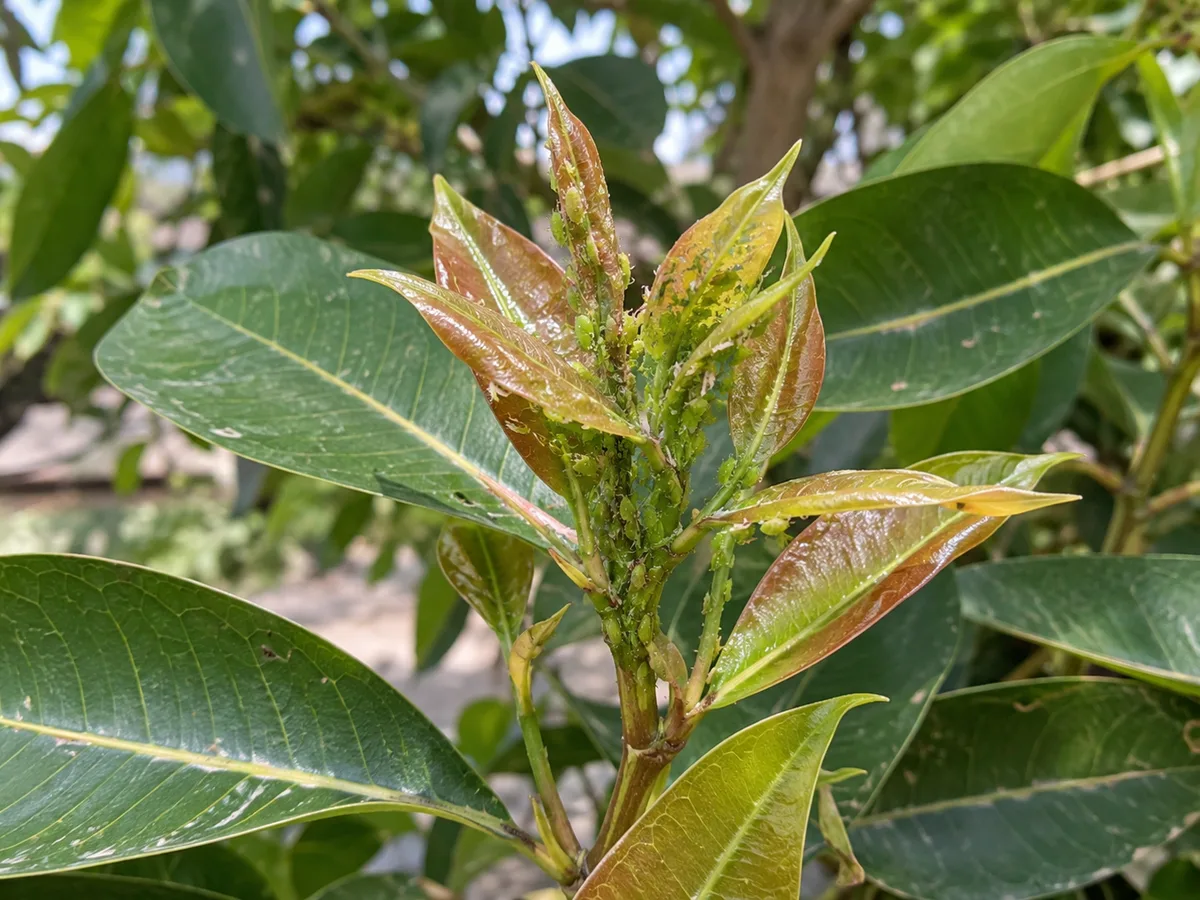
Clustered aphids and sticky honeydew on a Jamun shoot tip — check leaf undersides and unfurling leaves, not mature foliage.
The giveaway on a big tree is what lands below the colony. Aphids suck more sap than they can use and exude honeydew onto leaf surfaces, so mature leaves under an infested flush feel tacky and shine in the sun. That stickiness then grows a black sooty coating that grows on the surface of plants covered by honeydew, dulling Jamun’s normally glossy canopy. A line of ants marching up stems toward the shoot tips is a near-certain pointer: ants farm aphids for honeydew and guard them.
Why Jamun gets aphids
Three Jamun traits set the table. First, this is a vigorous tree that pushes bold flushes of soft growth in warm weather, especially after the structural pruning container specimens need. Every flush is a fresh aphid buffet, and colonies build fastest exactly when the tree looks its most promising. Second, Jamun is typically grown in fertile loam enriched with compost, and extra nitrogen pushes exactly the sappy, nitrogen-rich tissue aphids multiply on. Third, Jamun’s fragrant flowers attract insects, and the dense flower panicles give aphids a sheltered feeding site right where pollinators also work — which is why spray timing around bloom matters so much on this tree.
Weak or stressed trees get hit harder. A Jamun stuck in dim conditions stretches out leggy growth with prolonged soft stems, and a tree on the wrong watering rhythm keeps pushing uneven flushes instead of hardening off firm growth. Full-sun placement per the Jamun light guide hardens new tissue faster and exposes colonies to the predators that clean them up.
How to confirm the cause
Work from the shoot tips inward, in this order:
- Inspect the newest 10–15 cm of every active shoot. Part unfurling leaves and look underneath. Aphid colonies sit on the undersides and stem joints; if the damage is only on old leaves with nothing underneath, suspect something else.
- Touch the mature leaves below. Sticky film confirms honeydew from sap feeders above. Dry, non-sticky curl points toward water stress or thrips instead — compare with wilting and drooping leaves.
- Watch for ants. Sit near the tree for a minute and trace any ant highway. Ants going purposefully up to the shoot tips mean a tended colony; no ants with similar curl could mean mealybugs deeper in bark crevices or past aphids already eaten by predators.
- Shake-test one shoot. Hold white paper under a shoot tip and tap it. Aphids drop as slow-moving specks; whiteflies fly up in a puff and thrips look like dark slivers that run.
- Check bark crevices on woody stems. Fruit-tree aphids commonly overwinter as eggs laid in bark crevices, so on a Jamun with repeat spring attacks, scan rough bark near last year’s shoot bases for the source population.
The first fix for Jamun
Blast the colonies off with a strong jet of water. A hose nozzle or a firm spray bottle stream aimed up into leaf undersides and shoot tips physically removes most aphids without touching the rest of the tree’s insect life. Spraying aphids off with a strong stream of water is the recommended nonchemical first step because it works on sturdy plants and preserves the lady beetles, lacewings, and parasitic wasps that finish the job. Do this early morning so foliage dries by midday, and repeat every two to three days for two weeks — one blast rarely ends it because Jamun keeps unfurling new sheltered tissue.
Do only this first. Do not prune, fertilize, and spray on the same day; you need to see whether the water routine plus ant control is already working before adding chemicals to a fruiting tree.
Step-by-step recovery
- Water-blast every colony as above, covering shoot tips, leaf undersides, and flower buds (use a gentler jet on open flowers).
- Snip the worst shoot tips if a flush is badly curled and coated. Bag the clippings; do not compost them. Keep cuts light — this is triage, not the structural session in the Jamun pruning guide.
- Cut the ant highway. Ants protect aphids from natural enemies, so a tended colony survives water blasts far longer. Block trunk access with a sticky barrier band or manage the nest at the base, and the colony usually collapses within days.
- Spot-treat survivors with insecticidal soap. On clusters that persist after a week of blasting, coat the insects directly with a labeled insecticidal soap or horticultural oil in the cool of the evening. These work by smothering, so thorough contact matters and curled leaves shielding aphids should be pruned first. Never spray a drought-stressed tree or in hot midday sun.
- Pause nitrogen. Hold high-nitrogen feeds until clean growth resumes; review the schedule in the Jamun fertilizer guide and favor slow-release, balanced nutrition, since limiting excess nitrogen and control the amount of nitrogen added to the garden is a core aphid-suppression practice.
- Re-inspect each new flush for three weeks. Eggs hatch over time and winged aphids recolonize; the battle is won on the second and third flush, not the first.
Ants, honeydew, and sooty mold on Jamun
On Jamun this trio matters more than the aphids alone. The tree’s big evergreen leaves catch and hold honeydew for weeks, and the resulting black sooty film cuts the light reaching the leaf — the mold itself grows on honeydew and shades out photosynthesis, which stunts the very flushes the tree just spent energy pushing. A container Jamun on a terrace shows this as a dull, gray-black cast over the lower canopy plus sticky paving or furniture underneath.
Treat the chain, not just the insect: remove aphids, exclude ants, and the sooty film weathers off with rain and new growth — no fungicide needed. If black coating persists months after honeydew stops, suspect scale or whitefly as the current honeydew source and work through the lookalike table below.
Aphids on Jamun flowers and young fruit
Jamun blooms in dense, insect-visited panicles, and aphids readily colonize buds and flower stalks, distorting blossoms and dripping honeydew onto developing berries. This is the one place to be conservative: do not apply broad-spectrum insecticides on or near open bloom. The flowers need their pollinators, and Jamun’s crop depends on them. Use the water jet gently on buds, hand-crush small clusters, and save any soap application for after petal fall, applied in the evening when bees are off the tree. Honeydew-stained young fruit usually sizes up fine once the colony is gone; wash harvested berries well.
Lookalike symptoms on Jamun
| What you see | Likely cause | How to tell it apart |
|---|---|---|
| White cottony tufts in leaf axils and stem joints | Mealybugs | Waxy cotton masses that stay put when prodded; see mealybugs on Jamun |
| Fixed brown or waxy bumps on stems, no moving insects | Scale | Bumps scrape off with a nail and leave a pit; honeydew without visible colonies |
| Tiny pale specks plus fine webbing on leaf undersides | Spider mites | Webbing and stippled bronzing, worst in hot dry air; see spider mites on Jamun |
| Silvery scarring and black specks on young leaves | Thrips | Damage looks scratched or silvery rather than curled; insects are fast dark slivers |
| Uniform yellowing of older leaves, no stickiness | Nutrient or water issue | No insects, no honeydew, no ants; compare yellow leaves on Jamun and the watering guide |
| Seedlings or shoots stretching with sparse small leaves | Low light | Whole-plant stretch, not clustered colonies; see not enough light on Jamun |
Mistakes to avoid
- Fogging the whole tree with broad-spectrum insecticide on day one. You kill the lady beetles and parasitic wasps that were about to solve the problem, and winged aphids recolonize a predator-free tree fastest.
- Spraying open Jamun bloom. Bee kills during flowering cost fruit; keep sprays off flowers entirely.
- Feeding a nitrogen blast to “help it recover.” Soft forced growth is aphid food. Resume the normal schedule in the fertilizer guide only once new growth comes in clean.
- Hard-pruning the canopy mid-infestation. Heavy cuts trigger exactly the succulent regrowth aphids want. Limit yourself to infested tips now; save shaping for the dormant-season session in the pruning guide.
- Chasing the sooty mold with fungicide. The mold is a symptom of honeydew, not an infection of the leaf. End the honeydew and the black film stops spreading.
Recovery timeline
Small colonies on one or two shoots usually collapse within one to two weeks of water-blasting plus ant exclusion. Curled leaves from the attack keep their shape, but the next flush should unfurl flat and clean within three to four weeks in warm weather. Honeydew stickiness fades within days of colony removal; the black sooty film takes longer, weathering off over several weeks as coated leaves are replaced. If fresh honeydew keeps appearing after three weeks of consistent treatment, re-check for ants or a second pest such as scale rather than repeating the same spray harder.
How to prevent it next time
Build the routine around Jamun’s flush cycle. Inspect every new flush in its first week — colonies found on a 5 cm shoot tip are a two-minute hose job; the same colony three weeks later is a sooty-mold cleanup. Keep the tree in genuine full sun with open airflow so tissue hardens fast and predators patrol freely; the Jamun overview covers placement for both terrace pots and open ground. Feed steadily rather than heavily, refresh mulch instead of piling nitrogen, and time structural pruning so regrowth hardens before peak aphid weather. A sticky ant barrier on the trunk of a container tree, checked monthly, prevents most tended-colony disasters. For the full pest watchlist, browse open-ground and container issues from the Jamun problems hub.
When to use this page vs other Jamun guides
Use this page when you find clustered insects on shoot tips plus sticky honeydew, ants, or sooty film — the sap-feeder signature. If leaves yellow with no insects or stickiness, start with yellow leaves on Jamun and overwatering on Jamun instead. If growth is slow and pale with no pests at all, slow growth on Jamun fits better. White cottony masses mean the mealybugs guide; fine webbing means the spider mites guide.
Related Jamun guides
- Jamun overview — full-sun placement, container scale, and fruit-season expectations
- Jamun problems hub — every diagnosed issue on this tree in one place
- Mealybugs on Jamun — cottony lookalike with wax-covered colonies
- Spider mites on Jamun — stippling and webbing in hot dry spells
- Yellow leaves on Jamun — when discoloration has no pest behind it
- Not enough light on Jamun — stretch and weak flushes that invite pests
- Leggy growth on Jamun — prolonged soft stems after dim spells or hard pruning
- Jamun watering guide — deep-watering rhythm that hardens flushes
- Jamun fertilizer guide — balanced feeding without nitrogen surges
- Jamun pruning guide — timing structural cuts so regrowth hardens cleanly
Sticky shoot tips with ant traffic and curled new leaves is the aphid pattern on Jamun. Blast colonies off with water, cut the ant highway, spot-treat only survivors, and judge success by the next flush coming in flat, glossy, and honeydew-free.
Related tool
Use the Pest Identifier Tool to narrow causes for aphids on this plant before changing multiple variables at once.