Jamun Propagation: Seed, Budding & Grafts
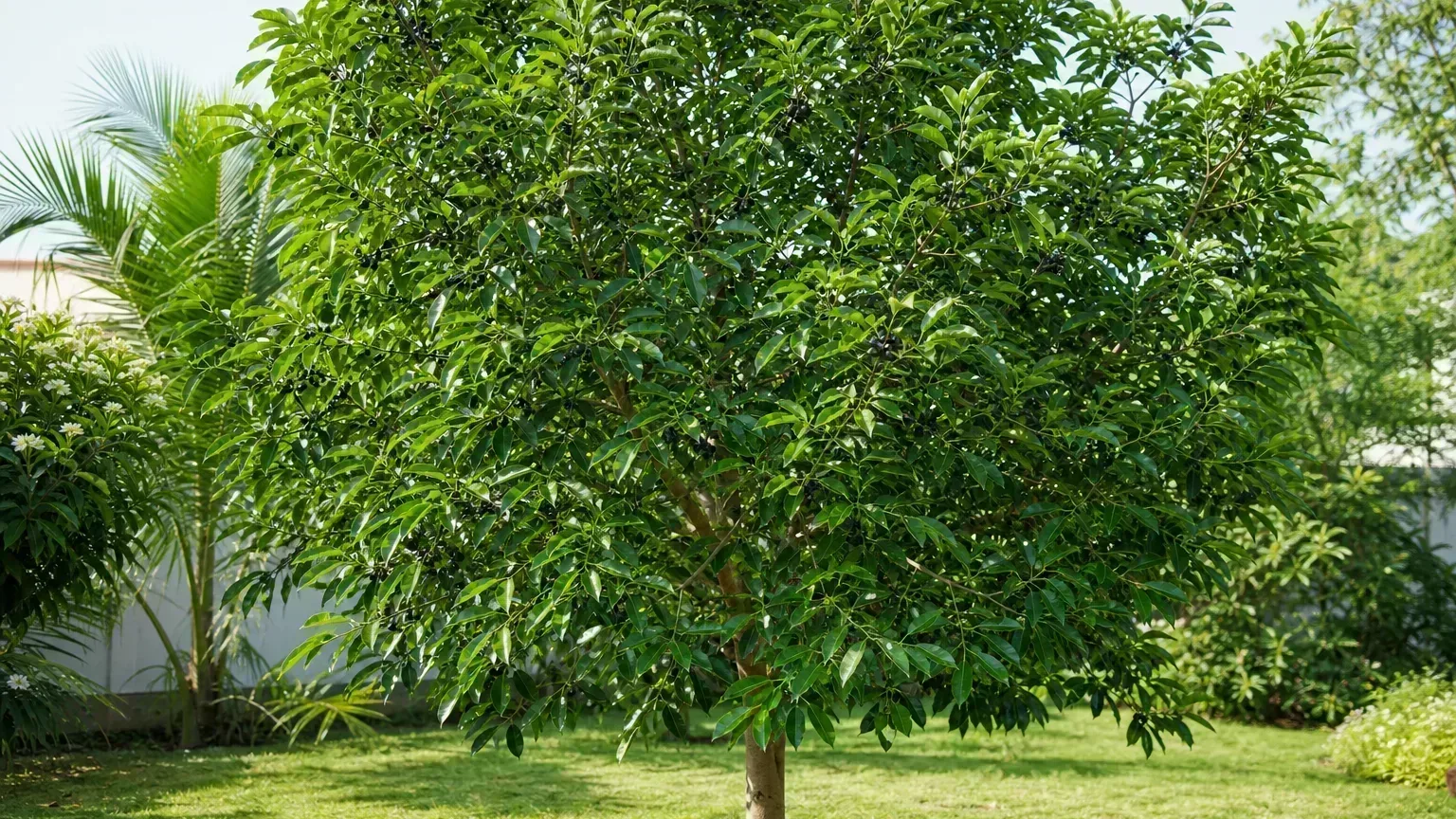
Jamun Propagation: Seed, Budding & Grafts
Jamun Propagation: Seed, Budding & Grafts
Jamun propagation starts with one hard rule: Syzygium cumini seed is recalcitrant. Fresh seed from ripe purple-black fruit germinates quickly; dried or stored seed collapses in viability and is the most common reason a “jamun from seed” project never sprouts (Singapore National Parks Board; World Agroforestry Centre).
This guide covers fresh-seed sowing for home growers in India and similar climates, what seed variability actually means for fruit quality, and the vegetative options—budding, grafting, cuttings, and air layering—that clone a known tree. Use it when you are making new plants. For everyday water, light, and soil once a seedling is growing, use the sibling care pages instead of stretching this into a full care manual.
Why Jamun Propagation Differs From Easy Houseplant Cuttings
Jamun is a large evergreen fruit tree in the myrtle family (Myrtaceae), not a soft indoor vine that roots from any node in a jar. NParks lists mature landscape size in the multi-storey range and names seed and stem cutting as propagation methods, with an explicit warning that seeds must be sown soon after collection because they do not dry or store well (Singapore National Parks Board). World Agroforestry describes seed storage behaviour as recalcitrant: seeds germinate well when fresh, but viability is lost within about two weeks of open storage at room temperature (World Agroforestry Centre).
Recalcitrant seed and large-tree biology
That biology shapes every practical choice. Seed is the most accessible home method when you can get ripe fruit. Vegetative methods matter when you want earlier fruiting or a clone of a superior cultivar. Julia Morton’s classic NewCROP summary records seedling bearing in about 8–10 years, with grafted trees often bearing in roughly 4–7 years, and notes that semi-hardwood cuttings, budding, veneer grafting, Forkert budding, inarching, and air layering have all been tried with uneven success rates (Purdue NewCROP — Morton).
Fresh Seed First—Recalcitrant and Short-Lived
If your goal is a living Jamun tree for shade, wildlife fruit, or a long-term landscape specimen, fresh seed is still the default home path. Treat every seed like perishable food, not like a packet of dry annuals.
Clean ripe fruit and sow promptly
Harvest fully ripe berries that have turned glossy purple-black. Pulp is purple or white and usually wraps a single oblong seed, though some fruits hold several compressed seeds and some forms are seedless (Purdue NewCROP — Morton). Rinse the pulp off thoroughly; leftover fruit flesh invites mold in a warm nursery tray.
Sow the same day or within a day or two. Tamil Nadu Agricultural University notes that jamun seeds have no dormancy, fresh seed can be sown directly, and germination takes about 10–15 days (TNAU Horticulture — Jamun). World Agroforestry recommends sowing freshly collected seed at about 2–2.5 cm depth during the rainy season, with germination in 2–4 weeks at rates of roughly 20–90% depending on seed quality (World Agroforestry Centre). Plant in a free-draining, moisture-retentive nursery mix—similar in spirit to the loam-plus-compost blends used for young trees in the Jamun soil guide—and keep the medium evenly moist, never swampy.
Do not sun-dry seeds on a windowsill “for later.” Do not refrigerate them for months. Recalcitrant seed physiology is why NParks and World Agroforestry both insist on prompt sowing (Singapore National Parks Board; World Agroforestry Centre).
Germination timeline and nursery care
Expect sprouts in roughly one to three weeks when seed is fresh and warm. Cool nights, poorly cleaned pulp, or seed that already dried will stretch that window or produce nothing.
Keep trays in bright light with protection from harsh midday scorch while seedlings are soft. Water to keep the upper mix from crusting dry, then drain—young Jamun wants steady moisture, not a sealed anaerobic pot. Crowded, constantly wet flats invite damping-off, where seedlings collapse at the soil line from fungi such as Pythium and Rhizoctonia; clean media, sensible spacing, airflow, and good light are the prevention basics (NC State Extension — Damping-off).
Morton notes that seedlings grow slowly the first year, then faster, and may reach about 3.5 m in two years under good conditions before the long wait to bearing (Purdue NewCROP — Morton). World Agroforestry likewise reports seedlings may reach about 4 m in two years under favourable conditions (World Agroforestry Centre). Pot on into deeper containers once roots fill the nursery cell, matching the Jamun repotting rhythm rather than leaving a vigorous taproot trapped in a cup.
Seed Variability—What You Can and Cannot Expect
This is the section that saves disappointment. TNAU reports polyembryony in jamun and says seedlings can come relatively true to the parent through seed (TNAU Horticulture — Jamun). That does not mean every seed from a market fruit will give you identical, superior dessert fruit on a predictable schedule.
Polyembryony, bearing age, and fruit quality
In practice, seedling lots still vary. Fruit size, astringency, sweetness, seediness, and tree habit differ among common Indian types and named forms such as large sweet “Ra Jaman” styles versus smaller acid types (Purdue NewCROP — Morton). TNAU itself notes that seed propagation is still preferred in many areas but is not advisable when early bearing is the goal (TNAU Horticulture — Jamun). A seed may also produce more than one shoot when multiple embryos are present; keep the strongest seedling and remove weak extras once they are clearly established.
Use seed when you want a hardy tree, shade, or fruit for processing and you accept variation. Use vegetative propagation when you need a named cultivar, a known fruit quality, or a shorter wait to bearing. TNAU records seedling trees typically beginning to bear around 8–10 years, while grafted or budded trees often begin around 6–7 years (TNAU Horticulture — Jamun). Morton’s range for grafted trees is similar, sometimes a bit earlier at 4–7 years (Purdue NewCROP — Morton).
Vegetative Methods for True-to-Type Trees
Vegetative methods clone scion wood onto a seedling rootstock or root a piece of the mother plant. They are how nurseries deliver cultivars. Home success depends on clean tools, active growth, and humid, warm conditions—general cutting and grafting hygiene still applies (Virginia Cooperative Extension).
Budding onto seedling rootstocks
Budding is the most widely recommended commercial vegetative route for jamun in India. Raise vigorous seedling stocks for about a year until stems are roughly pencil-thick (about 10–14 mm). TNAU describes shield (T), patch, and Forkert budding as successful, with Forkert often reported as especially reliable compared with shield budding, and timing commonly July–August in lower-rainfall areas or earlier (May–June) where rains start early and are heavy (TNAU Horticulture — Jamun).
Morton notes that budding onto seedlings of the same species has been successful and that a modified Forkert method may be more feasible than some alternatives (Purdue NewCROP — Morton). For most home growers, buying a nursery-budded plant of a named type is smarter than improvising budwood unless you already manage rootstocks.
Softwood grafting and inarching
Softwood and veneer grafting are used to multiply jamun cultivars on young seedling stocks. Morton reports about 31% survivors with veneer grafts of spring-flush scions in the work he cites, and notes that approach-grafting and inarching are practiced in India (Purdue NewCROP — Morton). TNAU describes inarching with pot-grown year-old seedlings joined to mother-tree shoots on wooden stands during June–July, though it is not widely adopted commercially (TNAU Horticulture — Jamun).
These methods need practice, matching cambium, and aftercare under shade and humidity. They are worth learning if you are cloning a favorite tree; they are overkill if you only want any jamun seedling for a courtyard.
Stem cuttings and air layering
NParks lists stem cutting as a valid method alongside seed (Singapore National Parks Board). In practice, cuttings are the harder home path. Morton cites semi-hardwood cuttings treated with growth hormones giving only about 20% success in the sources he summarizes (Purdue NewCROP — Morton). TNAU notes better rooting under intermittent mist with semi-hardwood material treated with IBA, but even then results remain modest compared with soft wetland herbs (TNAU Horticulture — Jamun).
Air layering is more forgiving for a single valuable branch. Morton reports roughly 60% rooting when air layers were treated with 500 ppm IBA in spring, with poorer summer container survival in the work he cites (Purdue NewCROP — Morton). TNAU likewise records about 60% air-layer success with 500 ppm IBA in lanolin paste when layering is done in spring rather than the rainy season (TNAU Horticulture — Jamun).
If you try cuttings, take semi-hardwood pieces from healthy spring flush, strip lower leaves, wound lightly if recommended for your hormone product, stick into a sterile free-draining mix, and keep high humidity without stagnant water. Expect lower success than seed and do not judge the species by one failed jar of woody sticks.
Best Season for Home Growers in India
Match the method to the monsoon calendar. Sow cleaned seed as soon as ripe fruit is available—often late spring into the rains depending on region—so warmth and moisture support the quick germination window (World Agroforestry Centre; Purdue NewCROP — Morton). Budding and softwood work usually track active cambium and humid weather: May–August in many Indian horticulture schedules, with local rainfall deciding whether you start early or wait for July–August (TNAU Horticulture — Jamun).
Avoid cold North Indian snaps for soft grafts and cuttings. Avoid baking unprotected nursery trays in peak May sun without shade. Young plants need the full-sun adult placement described in the Jamun light guide once roots are established, but soft new tissue still wants a buffer from scorch and windburn.
Aftercare Until Young Trees Establish
For the first months, prioritize roots and canopy balance over fertilizer. Keep the mix evenly moist after the upper few centimetres dry—the same logic as the Jamun watering guide for young and container trees. Hold strong feeding until new flush is clear and roots hold the pot; then follow a light, seasonal plan from the Jamun fertilizer page.
Give seedlings and young grafts the sunniest terrace or garden spot you can. Jamun is not a low-light indoor plant. Stake if wind rocks a tall, under-rooted stem. When the plant outgrows its starter pot, step up container size or plant into open ground during a cool, moist window—details live in Jamun repotting. Structural shaping belongs in the pruning guide once the framework is set.
Success looks like firm new leaves, thickening stems, and steady root fill. Failure looks like no germination from dried seed, soft collapse at the soil line, graft unions that dry out, or cuttings that blacken without roots. Diagnose method and moisture first before adding more products.
Common Failures and Fixes
Dried or stored seed. Recalcitrant seed loses viability quickly (Singapore National Parks Board; World Agroforestry Centre). Fix: sow only freshly cleaned seed; source ripe fruit again if the batch failed.
Seedlings collapse at the soil line. Likely damping-off in crowded wet flats (NC State Extension — Damping-off). Fix: clean mix, thinner sowing, more airflow and light; restart rather than nursing a rotten tray.
Expecting identical fruit from random seed. Seedling variation and long juvenile periods remain real even where polyembryony is reported (TNAU Horticulture — Jamun; Purdue NewCROP — Morton). Fix: buy a budded or grafted cultivar for dessert fruit quality and earlier bearing.
Cuttings with no mist or hormone and woody, dormant wood. Reported cutting success is already modest (~20% in older summaries) even with hormone help (Purdue NewCROP — Morton). Fix: try air layering a valued branch, or use seed/nursery grafts instead.
Graft or bud failure from dry unions or off-season work. Cambium must match and stay humid while the union heals (Virginia Cooperative Extension). Fix: retake during the monsoon budding window with clean, plump budwood on vigorous stocks.
When to use this page vs other Jamun guides
Use this page when you are making new plants—sowing seed, budding, grafting, layering, or attempting cuttings. Switch to Jamun watering when established seedlings wilt, yellow, or sit in sour mix. Use Jamun light when young trees stretch thin or stall despite moisture. Use Jamun soil when drainage or mix texture is the real nursery problem. Use Jamun fertilizer only after roots and new flush are active. Use Jamun repotting when a seedling needs a deeper pot rather than another sowing. For species identity, size, and placement, start at the Jamun overview.
Related Jamun guides
- Jamun overview — identity, mature size, and care map
- Jamun watering — moisture rhythm for young and container trees
- Jamun light — full-sun placement once seedlings harden
- Jamun soil — free-draining, fertile mixes for nursery and pots
- Jamun fertilizer — light feeding after establishment
- Jamun repotting — potting on and root-space management
- Jamun pruning — structure once a young tree is growing
Conclusion
Propagating Jamun is mostly about respecting recalcitrant seed and choosing the right tool for your goal. Fresh, cleaned seed sown promptly is the reliable home start for a living tree; dried seed is a dead end. Seedling fruit quality and timing still vary, so budding or grafting is the honest path when you need a cultivar clone and earlier bearing. Cuttings and air layers can work with hormones and humidity, but they are secondary for most balcony and courtyard growers. Once sprouts or unions take, graduate young plants into your normal sun, water, and soil routine and let the rest of the Jamun cluster handle long-term care.