Jamun Watering Guide for Pots and Indian Seasons
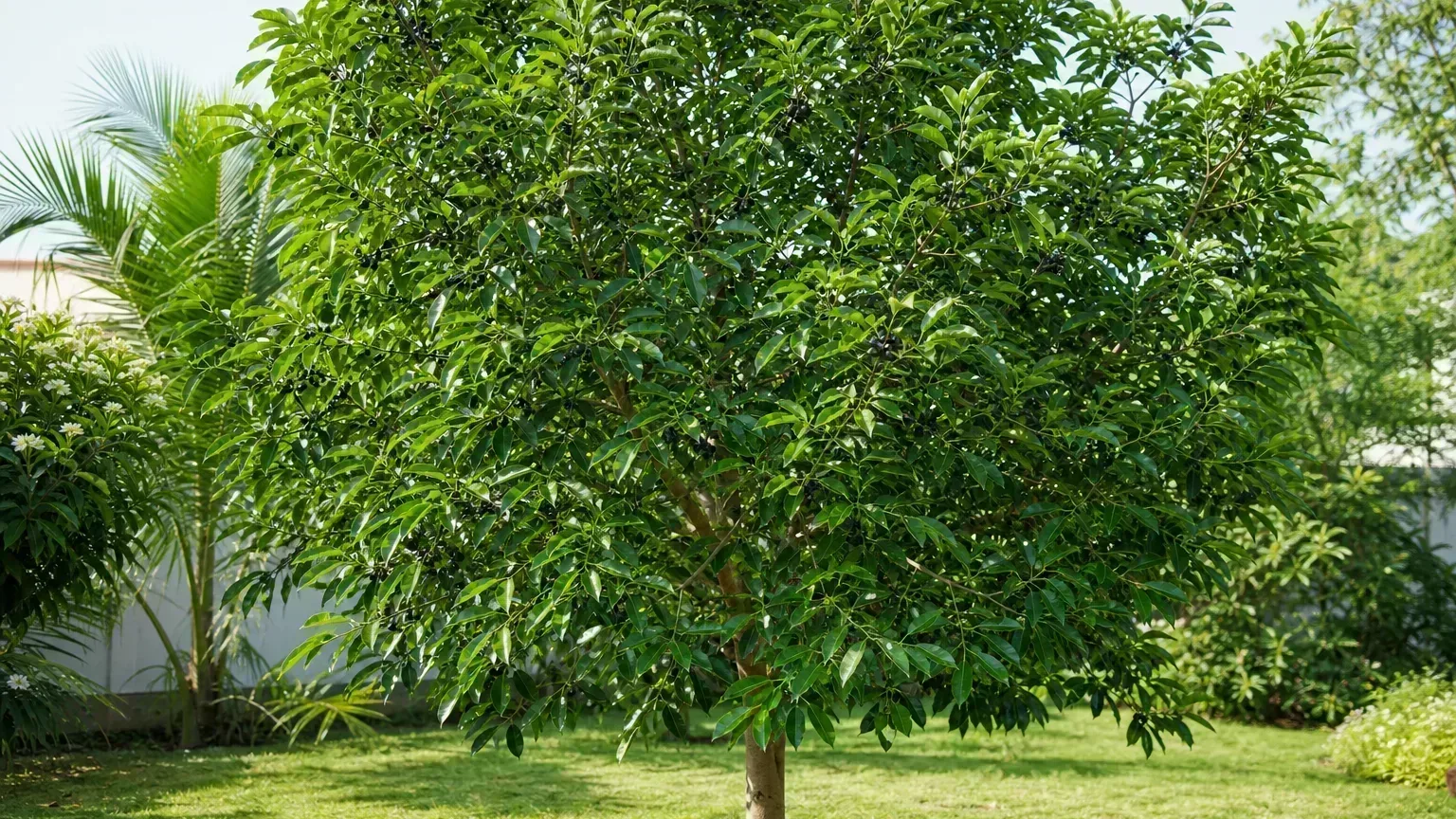
Jamun Watering Guide for Pots and Indian Seasons
Jamun Watering Guide for Pots and Indian Seasons
Jamun watering is not a once-a-week routine. A sapling in its first Indian summer, a mature avenue tree entering fruit ripening and a compact specimen in a terrace pot have different root volumes and different risks. The useful rule is to water according to root-zone moisture, tree age, weather and crop stage, then adjust after each rain or heatwave.
Syzygium cumini is a tropical evergreen fruit tree in the myrtle family, not a permanently thirsty indoor foliage plant. Singapore’s National Parks Board lists it for moderate water in full sun, and notes that established trees can tolerate drought and short-term flooding. A mature ground-grown tree can explore far more soil than a nursery sapling or container tree. That difference explains why young and potted Jamun need close checks while established landscape trees often suffer more from habitual irrigation than from a short dry interval.
The quick answer: water the root zone, not the calendar
For a potted Jamun, push a finger or wooden skewer about 3–5 cm into the mix. Water when that upper layer is dry and the pot feels noticeably lighter, then soak the entire root ball until water runs freely from every drainage hole. Do not leave the pot standing in a saucer of runoff.
For a young tree in the ground, check beneath the surface near the original root ball, not just loose soil several feet away. Water slowly enough to wet that root zone, then allow air to return before irrigating again. Tamil Nadu Agricultural University’s jamun production guidance matches this pattern: young trees need frequent irrigations while establishing, then much longer intervals once the tree is settled.
A mature, established tree is different. Water during a genuinely prolonged dry period—especially while fruit is ripening in hot weather—not because the surface looks dusty at noon. Avoid shallow daily splashes: they wet only the topsoil, encourage surface rooting and can keep the trunk collar unnecessarily damp.
Why Jamun watering changes with age and site
A newly planted Jamun has a canopy that loses water but a root system still confined to its nursery-sized ball. Consistent moisture supports establishment, yet saturation excludes air from that same small root zone. World Agroforestry notes that the species grows best with rainfall over 1,000 mm annually and in well-drained soils, while also tolerating waterlogging in field conditions. That field flexibility is not a licence to leave a pot waterlogged.
Once established, Jamun becomes comparatively conservative with water. NParks classifies the root zone as drought tolerant and able to handle waterlogged soils that drain, and TNAU adds that jamun can grow under salinity and waterlogged conditions in suitable soils. Use those facts as context for mature in-ground trees, not as a reason to ignore drainage on a terrace.
How to decide whether your Jamun needs water
Judge the soil before judging the leaves. Mid-afternoon droop during a very hot day can be temporary, while roots in saturated soil can also cause a wilted canopy because damaged roots cannot supply water. Check moisture, drainage and the next day’s weather before adding more.
Check a container Jamun
Use three signals together: dryness 3–5 cm down, the pot’s weight and the condition of the drainage holes. A dry surface alone can mislead when the centre remains wet, especially in a large decorative pot. Conversely, a root-bound Jamun may feel light and wilt soon after watering because water is escaping around a shrunken root ball rather than soaking through it.
The RHS notes that containers dry out more quickly than garden soil and recommends checking moisture below the surface before you water. If water rushes straight down the sides, apply it in two or three slow passes a few minutes apart. If the mix stays wet for many days despite warm, bright conditions, inspect drainage and review the mix in the Jamun soil guide instead of reducing each watering to a token sip.
Check a Jamun planted in the ground
Scrape back mulch and test the soil 10–15 cm deep at two points beneath the canopy, including near the original root ball on a recently planted tree. A dry crust over cool, moist soil does not call for irrigation. A dry root zone, limp morning foliage and a light young root ball do.
Rainfall totals can also mislead. A brief shower may wet only the top few centimetres, while monsoon rain on compacted ground may run away before penetrating. Dig a small inspection hole after rain; the visible moisture profile is more useful than an app’s millimetre total. The RHS similarly advises watering less often but thoroughly, allowing the surface to dry, and directing water to the soil above the root zone.
How to water deeply without leaving roots wet
Apply water slowly at soil level. For a pot, continue until the whole profile is moist and runoff appears; empty the tray afterward. For a ground tree, move the hose or drippers across the active root area rather than pouring every litre against the trunk.
Morning is the easiest time to assess and irrigate because evaporation is lower and wet surfaces can dry during the day. Keep water off flowers and ripening fruit where possible so you are not creating a constantly wet canopy during humid weather.
Mulch helps moderate heat and evaporation in the ground, but keep it several centimetres away from the trunk. A 5–8 cm organic layer over the root area is useful; a wet mound pressed against bark is not. In a container, do not let decorative stones hide continuously soggy mix.
Jamun watering by season in India
India does not have one jamun calendar. Coastal Kerala, humid Kolkata, semi-arid Hyderabad and a north Indian terrace differ in rainfall, evaporation and fruiting date. Use this seasonal pattern as a decision framework, not a fixed schedule.
| Season or condition | Young or potted Jamun | Established ground tree |
|---|---|---|
| Hot, dry, windy weather | Check frequently; water deeply when the tested layer dries | Irrigate when deeper soil is drying, especially as fruit approaches ripeness |
| Dependable monsoon | Pause automatic watering; confirm the pot or planting site drains | Usually pause irrigation; divert standing water and watch low spots |
| Cooler dry months | Check less often, but do not let a small root ball become bone-dry | Occasional irrigation only when soil is truly dry |
| Flowering and fruit set | Maintain a stable, airy root zone; avoid abrupt drought-to-flood swings | Prefer dryish weather at bloom; resume careful moisture as fruit develops |
Hot pre-monsoon and dry summer weather
Terrace pots can dry fast in April and May because heat radiates from walls and paving. Check them daily, but water only after the root-zone test; “check daily” does not mean “water daily.” Shade the container itself, group it away from hot exhausts and water thoroughly in the morning while keeping the canopy in the full sun Jamun needs—see the Jamun light guide if reflected heat or shade is distorting drying rates.
Ground-grown young trees may need one or more deep irrigations each week in a rainless heat spell, while a well-established tree in deep soil may need far less. TNAU’s orchard schedule concentrates most mature-tree irrigations in May and June when fruit is ripening, which is a useful home-garden cue for bearing trees in hot plains.
Monsoon and humid rainy periods
Stop timer-based irrigation when monsoon rain is doing the job. Check pots under balconies and trees in wall rain-shadows, because they may receive less water than the open garden.
The urgent monsoon task is often drainage, not watering. Raise pots on feet, clear blocked holes and redirect roof runoff away from trunks. Even though established Jamun can tolerate brief flooding, a young sapling or a sealed container can still decline when water stands for days. If water pools around a tree after rain, improve surface drainage rather than waiting for yellow leaves and dieback.
Cooler dry months and winter
Evaporation slows, so containers take longer to reach the same dryness threshold. Continue checking because an evergreen Jamun still uses water, especially in warm southern India, but lengthen the interval naturally. TNAU recommends only occasional irrigation in autumn and winter when the soil is dry—useful restraint for north Indian winters and any cool, cloudy stretch.
Watering a newly planted or young Jamun
Water immediately after planting to settle soil around the roots. During the first weeks, inspect often and irrigate whenever the root ball begins to lose even moisture. Over the next months, transition toward less frequent, deeper applications so roots move into surrounding soil; do not keep a permanent muddy basin.
TNAU states that young jamun trees may need 8 to 10 irrigations a year, while mature trees need roughly half that number. Treat those counts as orchard averages for Indian field conditions, not as a weekly timer for every terrace pot. A small container in May may need more frequent soaks than a young tree planted into deep monsoon-moist soil.
The first two to three years deserve closer attention during rainless periods because the root system is still expanding. Remove competing weeds and maintain mulch over, not against, the root area. For broader establishment choices—including pot timing and root handling—use the Jamun repotting guide and Jamun propagation guide rather than solving every growth problem by watering more.
Watering Jamun in a container on a terrace
A container Jamun has no access to deeper reserves, so it needs more frequent observation than a tree in the ground. Field drought and short-flood tolerance do not protect a pot that sits in a tray of stagnant water. Keep drainage holes open, elevate the pot and empty saucers after every soak.
Water in slow passes until the whole root ball is wet. If a large pot takes a week or longer to lose moisture in hot active growth, suspect an oversized container, blocked drainage or a dense mix. If it dries within a day, the roots may fill the pot; review root space instead of watering tiny amounts repeatedly.
Coordinate moisture with feeding through the Jamun fertilizer guide: never apply concentrated fertilizer to a bone-dry root ball, and do not “flush” a chronically waterlogged pot with still more water. A regularly pruned container specimen stays manageable; unrestricted seedlings quickly outgrow the water buffer of any home pot.
Watering during flowering and fruit ripening
Jamun prefers comparatively dry weather at flowering and fruit set in subtropical climates, while early rain can help fruit size and finish once development is underway, according to TNAU climate notes. For a home tree, that means avoiding automatic heavy irrigation during bloom if the root zone is already moist, then supporting developing fruit when heat and drought coincide.
On a healthy mature bearing tree, concentrate deep irrigations in the hot ripening window rather than watering lightly all year. Do not impose deliberate drought on a recently planted tree, a weak tree or a small container whose entire root ball can dry in a day. Once fruit is sizing, aim for stable, moderate root-zone moisture and keep irrigation at soil level.
Do not assume every dropped fruit means drought. Jamun sets far more flowers than mature fruit, and wind, pollination, pests and cultivar also affect retention. Check moisture before changing the routine, and use the Jamun overview to separate normal crop thinning from a whole-tree care problem.
Overwatering, underwatering and the first action
Overwatering is likely when the soil remains wet, leaves yellow or fall, new flushes stall, roots smell sour, or water stands in the pot or planting basin. University of Wisconsin–Madison Extension notes that root rots thrive when soil stays excessively wet for too long, which is exactly the risk for a sealed terrace pot in monsoon. Underwatering is more likely when the tested root zone is dry, the pot is light, leaves remain limp in the morning, margins crisp and a new flush aborts. Either condition can produce wilt, so leaves alone are not a diagnosis.
When unsure, do not add water until you check below the surface. If wet, stop irrigation, empty trays, clear drainage and protect the root zone from more rain. If dry, water slowly and completely, then recheck penetration; repeated emergency sips are less useful than one thorough application followed by observation.
If the soil is moist but the canopy continues to wilt or branches die back, inspect roots and drainage and rule out disease or physical root injury. A persistent mismatch between a wet root zone and a thirsty canopy needs investigation, not a shorter timer interval.
When to use this page vs other Jamun guides
Use this page to decide when and how to irrigate. Use the Jamun light guide when a terrace tree dries unusually fast because of reflected heat or grows weakly in shade, and the Jamun soil guide when the pot stays wet for too long. The fertilizer page covers nutrients, while the Jamun repotting guide covers root crowding and exhausted container structure.
Related Jamun guides
Start with the complete Jamun care overview for placement, mature size and safety context. Then use the Jamun soil guide for drainage, the Jamun fertilizer guide for feeding during active growth, and the Jamun pruning guide when you are keeping a container canopy in scale with its root volume.
Conclusion
Good Jamun watering is a sequence of observations: test the active root zone, account for rain and heat, identify the tree’s age and crop stage, water thoroughly, and let drainage restore air. Young and container Jamun need the closest attention; established trees need restraint outside genuine drought and the hot fruit-ripening window. In India, pause automatic irrigation during dependable monsoon rain, monitor pots through pre-monsoon heat, and treat mature-tree drought and flood tolerance as field traits—not as permission to leave a pot standing in water.