Slow Growth on Jamun: Causes, Checks & Fixes
Quick answer
Slow growth on Jamun usually means a full-sun tree is short of light, root space, or nutrients in its pot — not a plant that needs daily fussing. First step: move the tree to a position with 6 or more hours of direct sun and check whether roots are circling the drainage holes; fix light and space before reaching for fertilizer.
Slow Growth on Jamun: Causes, Checks & Fixes
This guide covers slow growth on Jamun. See also the general Slow Growth guide, watering, and light pages for this plant.
Slow Growth on Jamun: Causes, Checks & Fixes
Quick answer
Slow growth on Jamun (Syzygium cumini) is rarely a mystery disease — it is almost always a full-sun tree running out of light, root room, or nutrition in its container. Jamun is a Myrtaceae evergreen fruit tree that reaches 12–30 m in open ground and is listed for Full Sun with moderate water, so a potted specimen parked in shade or left in the same small pot for years simply idles. First step: move the tree to 6 or more hours of direct sun and check the drainage holes for circling roots — correct light and space before feeding anything.
For how chronic stagnation works across plants in general, see our slow growth hub. On Jamun, the decisive check is whether the shoot tips pushed a fresh flush of full-sized glossy leaves during the last warm month — not whether the older canopy still looks green from across the terrace.
When to use this page vs other Jamun guides
This page covers the stall without collapse — a firm, green tree that stops extending and holds the same canopy for months. Use the table to route lookalikes before you act, since feeding a misdiagnosed stall usually makes things worse.
| What you see | Likely cause | Where to go |
|---|---|---|
| Long bare stem sections, sparse small leaves, lean toward light | Stretch from shade, not a stall | Leggy growth or not enough light |
| Whole canopy pale with no extension | Light deficit plus hunger | This page first, then the fertilizer guide |
| Uniform yellowing of older leaves, wet heavy pot | Soggy mix shutting roots down | Overwatering or yellow leaves |
| Limp foliage that perks up after watering | Water shortage pausing flushes | Underwatering or wilting |
| Soft dark stem base, sour mix, sudden drop | Root damage, not patience | Root rot immediately |
| Crisp brown leaf margins on firm growth | Dry air or watering swings | Brown tips |
| Full problem index when symptoms overlap | Multiple issues at once | All Jamun problems |
What slow growth looks like on Jamun
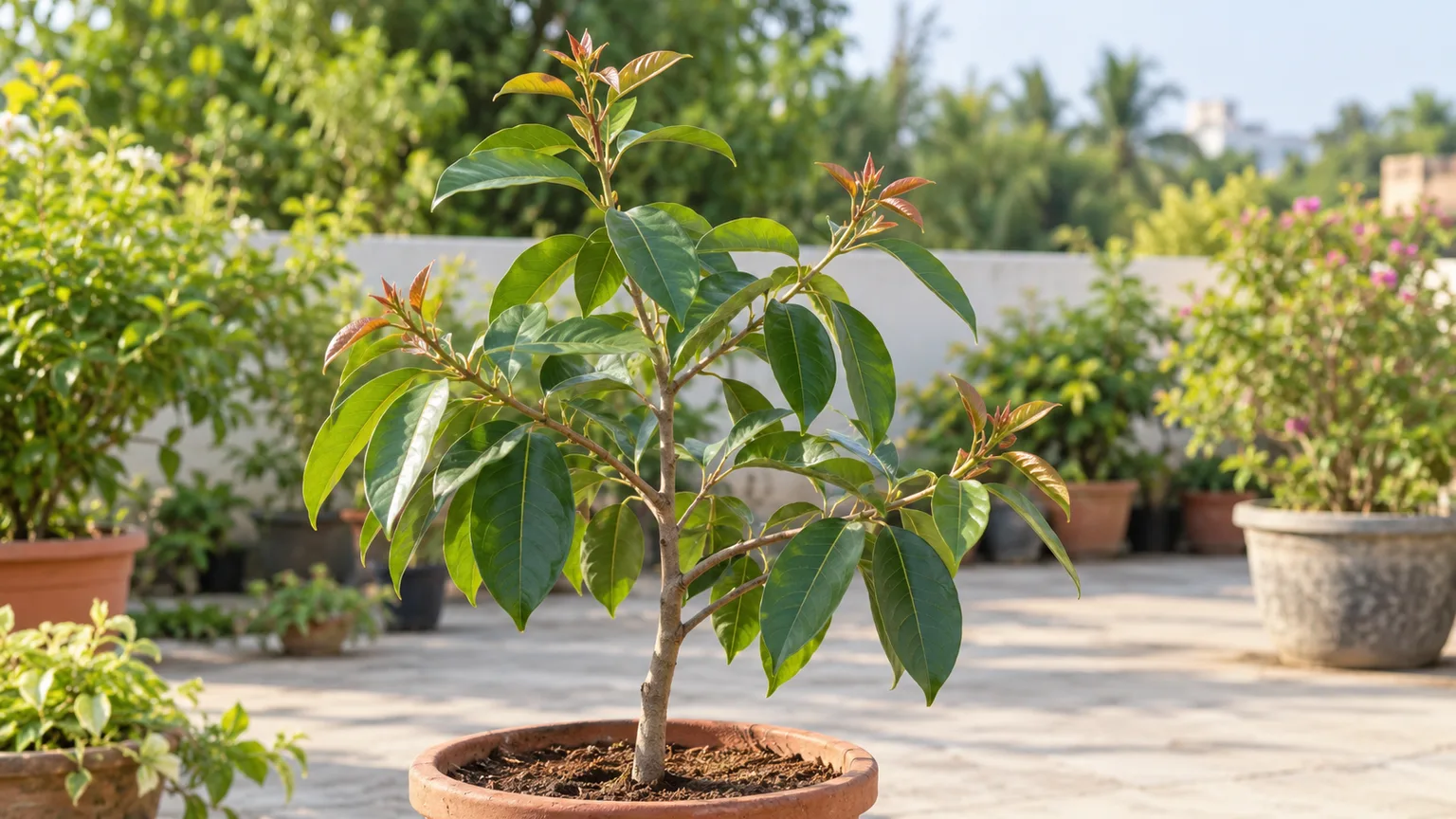
A healthy young Jamun in active growth pushes regular flushes: shoot tips extend, new leaf pairs emerge reddish-green, then expand to full-sized glossy elliptic leaves held in opposite pairs on firm upright shoots. A stalled tree freezes that rhythm while the old canopy stays deceptively green:
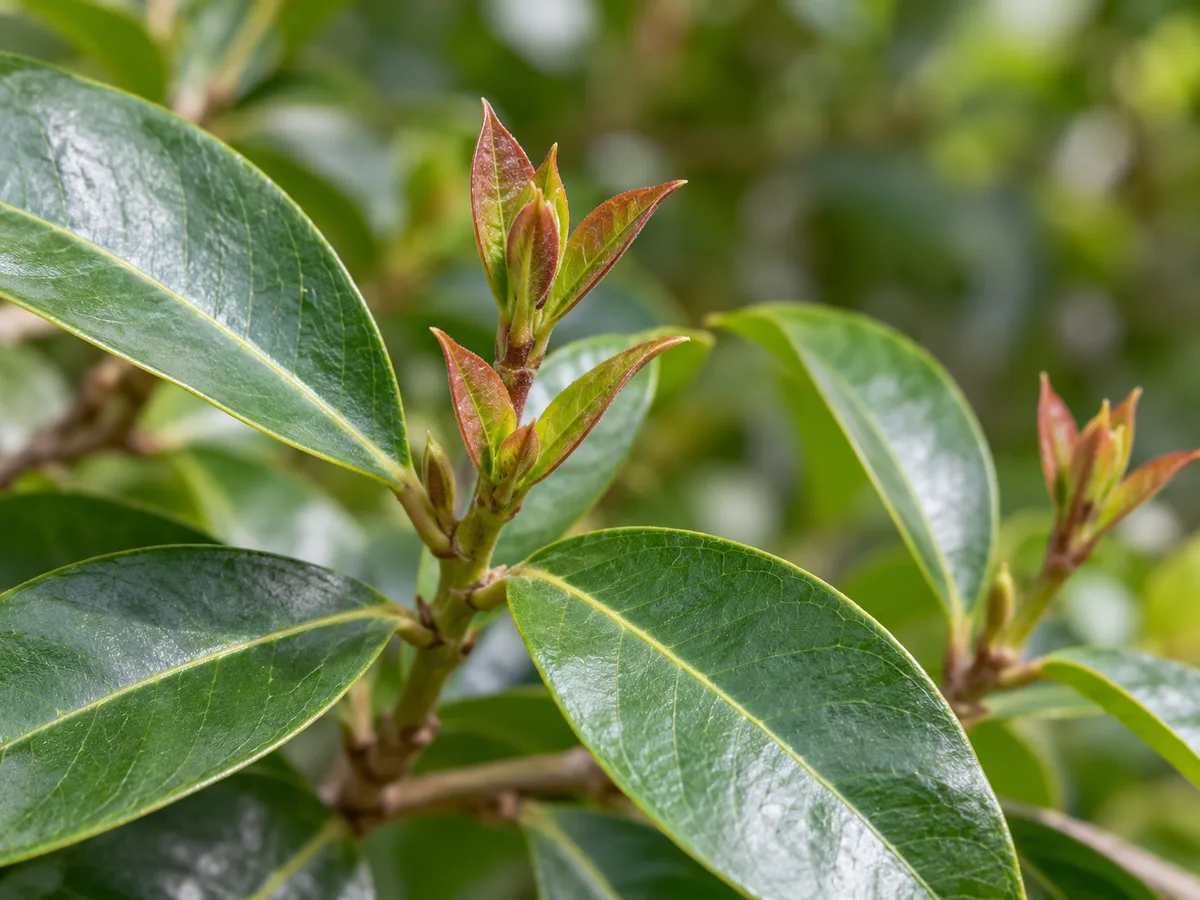
Stalled shoot tips: older glossy Jamun leaves hold firm but no fresh flush extends at the tips — compare with a sun-grown sapling pushing full-sized new leaf pairs each warm month.
- No shoot-tip extension through an entire warm month despite firm green foliage
- New leaf pairs stay small — each flush emerges noticeably smaller than the previous season’s leaves
- Same canopy month to month — the crown neither adds shoots nor drops leaves evenly; it simply sits
- Thin, sparse crown on a woody stem — leggy-looking but without the directional lean of true etiolation (see leggy growth to separate the two)
- Roots circling the drainage holes or surfacing on the mix while top growth idles
- Pale new leaves without size gain — hunger layered on top of the stall, not the stall itself
This differs from seasonal slowing: Jamun naturally pauses or eases off when cool weather arrives, then resumes with warmth. Judge a stall by a missed flush in weather warm enough for growth, not by a quiet December.
Jamun-specific: seedling patience vs a true stall
This section would be meaningless on a pothos — it belongs to a long-lived fruit tree grown from seed. Jamun seed is recalcitrant and sown fresh, and a first-year seedling spends much of its energy building a deep taproot before it shows much top growth. A seedling under 30 cm that looks quiet for months in its first year, with firm stems and healthy small leaves, is often establishing roots rather than failing. Container guides for seed-grown Jamun stress the full journey from seed to a healthy potted tree precisely because the early phase tests growers’ patience.
Set expectations by origin. A seedling may take several years of steady vegetative growth before it even thinks about flowering, so “no fruit yet” on a two-year-old seedling is normal biology, not slow growth. The stall that needs action is different: a sapling past its establishment year that produced full-sized flushes last season and now produces miniature leaves or nothing at all under the same care. Compare this year’s flush size to last year’s on the same tree — that personal baseline beats any generic growth chart.
Jamun-specific: the pot is the bottleneck
A Jamun wants to become a 12–20 m tree; every year in a container is a negotiation over root space. Young trees need repotting or root-pruning every two to three years, and a vigorous sapling can fill its pot far sooner. When roots circle the walls and mat across the drainage holes, water runs down the gap between root-ball and pot while the core stays dry, and nutrient uptake collapses — top growth stalls even though you water and feed on schedule. Extension planting guidance makes the general point that trees need adequate rooting space with no obstructions, since twisted circling roots never support a stable tree; in a pot, the pot wall itself is the obstruction.
Read the pot before blaming anything else. Lift it: surprisingly light right after watering means the root-ball is so dense that water bypasses it. Look underneath: white tips circling the holes confirm the diagnosis. Slide the root-ball out once on a dry-soil day — a solid mat of roots holding the mix shape with little soil visible means the tree is pot-bound and no amount of fertilizer will restart it. Plan one size up, or root-prune and refresh the mix if the tree has reached its final container, timed for late winter to early spring before the strong new flush.
Why container Jamun stalls
Too little sun for a full-sun tree
The single most common cause. Jamun is documented as a fast-growing tree in warm tropical conditions — but that speed assumes open sun. Container growers are advised to give full sunlight of at least 6–8 hours daily and a minimum of six hours of direct sun each day for potted specimens. A seedling on a shaded balcony, behind grilles, or under a building overhang receives a fraction of that energy and simply cannot manufacture enough carbohydrate to extend shoots. The fix is positional, not chemical: no fertilizer compensates for shade on this species. Cross-check placement against the light guide.
Exhausted or compacted mix
Jamun grows best in deep, well-drained loamy soil, avoiding heavy clays or light sandy soils, with pH near neutral, and orchard guidance targets pH 6.0–7.5 in soil rich in organic matter. In a pot, that loam-compost-mineral blend breaks down within a couple of seasons into a dense, airless mass. Compacted mix starves roots of oxygen, dry-down becomes unpredictable, and flushes shrink year over year. If water ponds on the surface or the pot stays heavy for days after watering, the mix is spent — refresh it per the soil guide rather than feeding through it.
Missed feeding on a hungry young tree
A fast-growing juvenile tree in a container exhausts the mix’s nitrogen and micronutrients quickly, and small pale new leaves on an otherwise firm tree point here. But feeding is corrective, never the opening move: fertilizer pushed into a shaded, pot-bound, or waterlogged tree burns roots or forces soft weak growth. Confirm sun and root space first, then feed through the warm growing months per the fertilizer guide.
Water extremes pausing flushes
Young and container-grown Jamun need steadier moisture than established landscape trees — soak when the top 3–5 cm dries, then let excess escape. Both directions stall growth: chronic dryness aborts new flushes and drops young leaves, while persistent waterlogging suffocates roots. Container guides warn that poor drainage stunts growth and causes root rot even though field trees tolerate brief flooding. If the stall follows a watering change, rule out overwatering and underwatering before anything else.
Pests and disease draining vigour
Jamun is susceptible to sap-feeders such as whitefly, leaf-eating caterpillars, leaf rollers, and to anthracnose leaf spot with die-back in neglected trees, as documented in tropical fruit-tree references. A heavy sap-feeder load or repeated defoliation diverts the energy that would build the next flush. Inspect shoot tips and leaf undersides with a magnifier — sticky residue, webbing, or chewed distorted new leaves mean pests, not patience. Route confirmed infestations to aphids, mealybugs, or spider mites.
How to confirm the cause
Work through these checks in order on a bright morning, before changing anything:
- Count direct-sun hours. Watch how many hours of unfiltered sun actually strike the leaves. Fewer than 6 hours on a Jamun points to light as the primary bottleneck.
- Lift the pot and inspect the holes. Light right after watering, or roots circling the drainage holes, means the tree has outgrown its container.
- Compare flush sizes. Hold this season’s newest leaf pair against last season’s mature leaves. Same size means patience; clearly smaller means an active constraint.
- Test the mix. Push a finger 3–5 cm deep a day after watering. Soggy points to drainage failure; bone-dry with a light pot points to bypass watering through a root mat.
- Check shoot tips and undersides. Sticky film, webbing, or distorted buds implicate pests — treat the infestation, not the stall.
- Review the calendar. A stall through cool months with firm stems is seasonal rest; the same stall through a full warm month with good sun needs the pot and feeding reviewed.
| Observation | Likely cause | First direction |
|---|---|---|
| Shade position, small full-sized leaves, no lean | Light bottleneck without stretch | Move to full sun; see not enough light |
| Roots circling holes, water runs straight through | Pot-bound | Repot one size up or root-prune |
| Heavy wet mix days after watering | Compacted or waterlogged mix | Refresh mix per soil; rule out root rot |
| Pale miniature new leaves, firm roots, good sun | Hunger | Feed per fertilizer guide |
| Sticky leaves, webbing, chewed tips | Sap-feeder load | Pest guides, starting with spider mites |
| Stall only in cool months, firm stems | Seasonal rest | Maintain steady watering; wait for warmth |
The first fix to try
Move the tree into full sun — 6 or more hours of direct sun on the leaves — and leave everything else unchanged for two weeks.
That single change comes before feeding, repotting, or pruning, because every other correction depends on the tree having the energy to respond. Shift gradually over 5–7 days if the tree has lived in shade, building from morning sun to full exposure so shade-grown leaves do not scorch. If the tree already stands in genuine full sun, skip the move and go straight to the root-space check in the next section — the sun test is already answered.
Step-by-step recovery
Once the tree sits in full sun, work this sequence with a week or more between steps so you can read the response:
- Verify the pot. On a dry-soil day, slide the root-ball out. If roots mat the surface and circle the walls, repot one size up into fresh loam-based mix, or root-prune and refresh if the container is final — see repotting.
- Reset watering. Soak deeply when the top 3–5 cm dries and let excess drain fully, per the watering guide. Never leave the pot standing in a saucer of water.
- Restart feeding. Only after sun and root space are correct, resume warm-season feeding per the fertilizer guide. Hold all feed if the tree is stressed, freshly repotted, or heading into cool weather.
- Prune for structure. Once a healthy flush hardens, pinch or head back the dominant leader to force side branches, per the pruning guide. A compact branched crown converts sun into growth far better than one struggling whip.
- Clear pests. If inspection found sap-feeders, treat the infestation on its own week — never stack a hard prune, a repot, and pest treatment on the same day.
Recovery timeline
Jamun answers on a flush cycle, not a houseplant clock. In warm weather with the bottleneck removed, expect the shoot tips to swell within 2–4 weeks and the first full-sized flush to expand and harden over the following 6–10 weeks. Seedlings repotted in late winter typically break strongly with the spring flush.
Judge progress by new leaf pairs emerging at last season’s full size with normal spacing — not by old leaves changing. Existing small leaves never enlarge after the fact; recovery shows only on fresh extension. If two full warm months pass with no new flush after sun, space, and feeding are all corrected, unpot and inspect the root core for dead brown mush versus firm white tips, and review whether a shaded parapet or a changed sun angle quietly removed the light again.
Mistakes to avoid
- Fertilizing a shaded, pot-bound tree. Extra nitrogen without sun and root room forces soft weak tissue or burns stressed roots — fix energy and space first.
- Repotting into a far larger pot. A huge soil volume around a small root system stays wet and stalls the tree indirectly; go one size up only.
- Moving from deep shade to harsh noon sun in one step. Shade-grown Jamun leaves scorch badly in sudden May–June heat — harden off over several days.
- Stacking repot, hard prune, and pest treatment together. Three shocks at once can finish a weakened sapling; separate them by weeks.
- Expecting flowers or fruit as recovery. Vegetative flushes are the recovery signal; seed-grown trees fruit on their own multi-year clock.
- Watering on the old calendar after moving outdoors. A sun-positioned pot dries far faster than a shaded one — recheck the top 3–5 cm rather than repeating the old rhythm.
Jamun care cross-check
Stalls that return after correction usually trace to drift: the sun angle shifts behind a building and the “full sun” spot becomes three hours, the loam mix compacts in year three, or feeding stops once the tree looks fine. Cross-check against the light, soil, and watering guides each season, and keep the pot draining freely — field tolerance of brief flooding never applies to a container. Young trees intended as long-term container specimens belong on a steady fertilizer plan only while they hold compact growth in real sun.
How to prevent it next time
Raise Jamun the way the tree expects from day one: sow fresh seed promptly, give seedlings full sun from the start, and nursery guidance to raise seedlings with adequate sunlight and spacing before transplanting applies equally to pots on a terrace. Pot up promptly as the sapling grows, refresh the loam-based mix every two to three years, and prune structurally each late winter so the crown stays compact. Log each season’s flush size — a shrinking trend is the earliest warning, visible a full year before the tree visibly stalls.
When to worry
Most slow Jamun trees recover fully with sun, space, and feeding corrected in the right order. Treat it as urgent if stem bases soften and darken, the mix smells sour, or leaves drop suddenly in quantity — that is root damage overlapping the stall, and the root rot guide takes priority. If mold on soil or fungus gnats signal chronic wetness alongside the stall, fix the waterlogging first; a suffocating root system cannot push new flushes no matter how good the light is.
Related tool
Use the Plant Problem Diagnosis Tool to narrow causes for slow growth on this plant before changing multiple variables at once.
Related Jamun guides
- Jamun overview — full care profile for this tree, including why containers need sun and pruning.
- Jamun problems hub — browse all diagnosed issues when symptoms overlap.
- Leggy growth on Jamun — use when stems stretch with wide internodes rather than stalling.
- Not enough light on Jamun — use when the whole plant pales but keeps pushing weak tissue.
- Wilting on Jamun — use when limp tissue suggests water stress alongside or instead of the stall.
- Jamun light guide — placement targets that prevent recurrence.
- Jamun repotting guide — timing and root-pruning for container trees.