Leggy Growth on Jamun: Causes, Checks & Fixes
Quick answer
Leggy growth on Jamun almost always means a young full-sun tree is starved of light indoors or on a shaded balcony. First step: move the seedling or potted tree to the sunniest outdoor position you have, then prune stretched stems back to a healthy node once it settles.
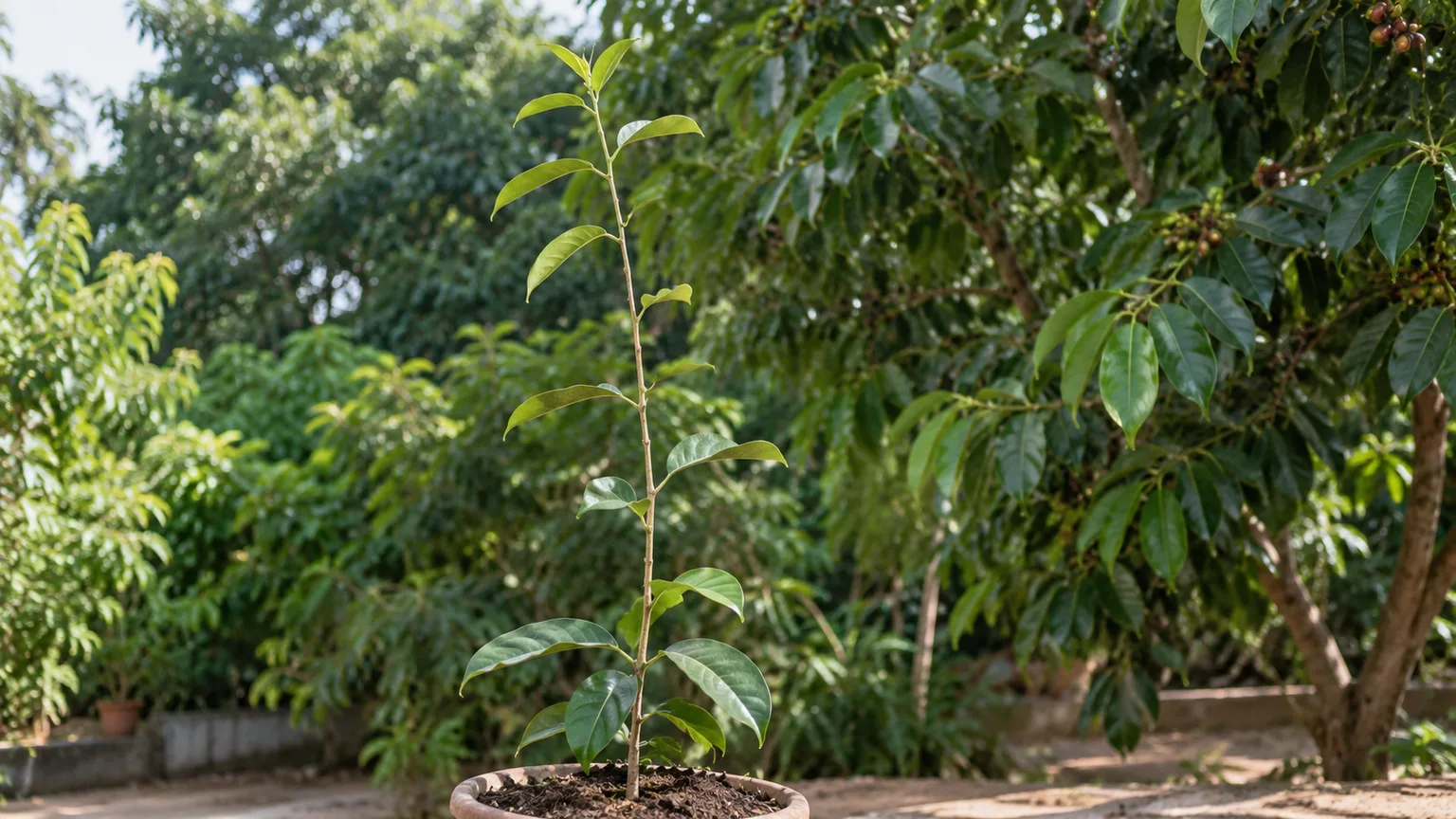
Leggy Growth on Jamun: Causes, Checks & Fixes
This guide covers leggy growth on Jamun. See also the general Leggy Growth guide, watering, and light pages for this plant.
Leggy Growth on Jamun: Causes, Checks & Fixes
Quick answer
Leggy growth on Jamun almost always means a young full-sun tree is starved of light indoors or on a shaded balcony. Jamun (Syzygium cumini) is an evergreen fruit tree that reaches 12–30 m in open ground, so a seedling stretching on a windowsill is not growing fast — it is etiolating. First step: move the plant to the sunniest outdoor position you have, such as a terrace or courtyard, and let it settle before you cut anything.
For how etiolation works in general, see our leggy growth guide. On Jamun, the pattern usually shows up as a single tall whip with long bare internodes, small pale leaves, and a hard lean toward the light — very different from the dense crown a sun-grown sapling builds.
What leggy growth looks like on Jamun
A light-starved Jamun seedling or sapling grows one dominant stem with wide gaps — often several centimetres — between leaf pairs, and the newest leaves emerge noticeably smaller and paler than the older glossy foliage. Because Jamun carries opposite, elliptic leaves on upright woody shoots, the stretch reads clearly: bare woody-looking sections between sparse leaf pairs, with the shoot tip bending toward the brightest window or balcony edge.
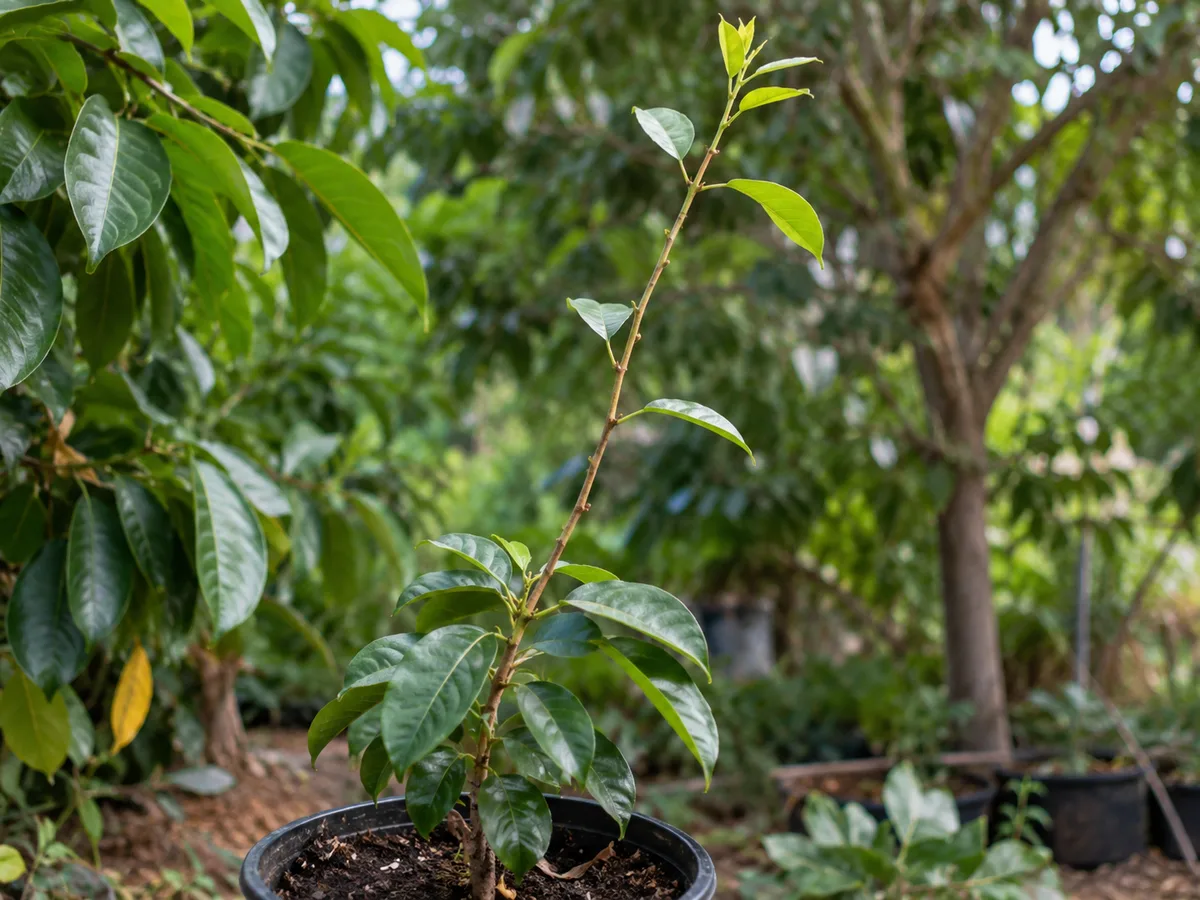
Close-up: long bare internodes with small, pale Jamun leaves — classic light-starvation stretch, not healthy juvenile vigour.
Lower leaves may yellow and drop, leaving a bare pole with a tuft at the top. That tuft fools growers into thinking the plant is thriving, but the tissue is weak: thin stems, poor branching, and a canopy that cannot support the dense crown Jamun wants to build.
Why a full-sun tree stretches indoors
This is the Jamun-specific core of the problem. Singapore’s National Parks Board lists Jamun for Full Sun with moderate water, and field trees handle deep shade-free avenues and farm boundaries across India, growing 12–20 m tall in full sun to light shade. A seedling started on a desk, in a dim room, or on a north-facing balcony receives a fraction of that energy — so it burns reserves elongating toward whatever light exists instead of building compact woody tissue.
Three Jamun-specific drivers stack up:
- Seed-starting indoors. Jamun seed is recalcitrant and sown fresh in warm conditions, which is exactly when growers keep trays inside “until they are bigger.” Warmth plus dim light produces the fastest, weakest stretch.
- The balcony trap. A seedling can begin life in a pot, but a shaded balcony or a bright-looking room is still deep shade to a tree evolved for open sun. Glass, grilles, and overhangs cut far more light than the eye perceives.
- No structural pruning. Container Jamun depends on regular structural pruning to stay a manageable tree. An unpruned sapling pours everything into one apical shoot, so low light plus apical dominance equals a single leggy whip instead of a branched crown.
Feeding a dim Jamun makes it worse: excess nutrients in low light drive further weak, elongated growth rather than dense foliage, so hold all fertilizer until the light is fixed and compact growth resumes.
Fast juvenile growth vs true etiolation
Not every tall young Jamun is leggy, so separate normal vigour from stretch before you act. A sun-grown juvenile Jamun grows fast but keeps leaf pairs close together, leaves full-sized and glossy deep green, and stems firm and upright. True etiolation shows the opposite signature: internodes 3–10× longer than the plant’s earlier growth, leaves smaller and paler, and a strong directional lean — the classic phototropic bend described in etiolation research.
If your Jamun grew 30 cm in a month with tight glossy leaf pairs in full terrace sun, that is healthy juvenile vigour — do not prune it. If the same 30 cm has three sparse pale leaf pairs and leans sideways, that is light starvation. Check your watering rhythm too: steady moisture supports firm growth, while a seedling that is both dim and drought-stressed stretches and wilts at once.
How to confirm the cause
Work through these checks in order on a bright morning:
- Measure the light honestly. Count hours of direct sun hitting the leaves, not the room. Fewer than 4–6 hours of direct sun on a Jamun seedling points to light as the cause.
- Read the lean. A stem bending toward one window or balcony edge confirms directional light-seeking. Uniform upright paleness with no lean suggests the whole position is dim rather than one-sided.
- Compare internodes. Look at the lowest (oldest) stem section versus the newest. If gaps between leaf pairs widen toward the tip, conditions worsened as the plant grew — typical of a seedling moved further from light or shaded by summer grilles.
- Feel the stem. Firm but thin means pure stretch; soft, dark, or sour-smelling base means rot has joined in — check our root rot and overwatering guides before pruning.
- Check the newest flush. Tiny white-green leaves that stay small confirm ongoing starvation. If the newest pair looks fuller and darker after a recent move outdoors, the plant has already started answering.
The first fix for Jamun
Move the plant to full sun — that single change comes before pruning, feeding, or repotting. Shift the seedling or potted tree to the sunniest terrace, courtyard, or garden position available, hardening it off over 5–7 days (a few hours of morning sun, building to full exposure) if it has lived indoors, so leaves do not scorch. For seedlings started under cover, supplemental lighting positioned close above the trays is the indoor equivalent until they can move outside.
Do not prune on moving day. A freshly relocated Jamun needs a week or two in real light to stabilize; cutting immediately stacks two stresses at once.
Step-by-step recovery
Once the plant has spent 1–2 weeks in strong light and new growth looks firmer:
- Pick the cut point. Choose a healthy node with a visible bud on the stretched stem, ideally where the stem is still green and firm. This mirrors the standard tree-seedling protocol of cutting a leggy central stem back to force branching, as used for leggy avocado seedlings.
- Cut cleanly. Use sharp, clean secateurs and cut just above the node at a slight angle. On a woody Jamun stem, a ragged tear invites dieback further down the stem.
- Leave enough leaf. Keep at least two to three healthy leaf pairs below the cut so the plant can photosynthesize while it breaks new buds.
- Rotate weekly. Turn the pot a quarter-turn each week so regrowth does not lean one-sided toward the light again.
- Water to the root zone. Soak when the top 3–5 cm of mix dries and let excess drain, per our watering guide — steady moisture, never standing water.
Expect two or more buds below the cut to break within a few weeks in warm weather. Select the strongest, best-placed shoots and rub out overcrowded extras later, during routine pruning work.
Structural pruning for a container Jamun
This section would be nonsense on a pothos — it belongs to a 20-metre tree living in a pot. Container Jamun only stays compact through deliberate structural pruning: heading back the dominant leader, selecting 3–4 well-spaced scaffold branches, and pinching soft new tips to force side shoots, repeating the pinch on laterals until the canopy fills. Without this regime, every Jamun sapling reverts to a single upward whip, and any dim spell turns that whip leggy again.
Time major structural cuts for late winter to early spring, before the strong new flush, when the tree rebounds fastest. Never remove more than about a third of the canopy at once on a young tree. And remember the fixed biology: elongated internodes never shorten after light improves — pruning is the only way to replace a bare stretched section with compact branches, so plan cuts rather than waiting for the old stem to “fill in.”
Recovery timeline
Jamun responds on a flush cycle, not a weekly houseplant clock. In warm growing weather, buds below a corrective cut usually break within 2–4 weeks, and the first compact flush hardens over the following 6–10 weeks. Judge progress by new leaf pairs emerging closer together, full-sized, and glossy — not by any change to the old stretched section, which stays as it is.
Seedlings moved to full sun without pruning often show improved new growth within one flush while the old whip remains bare; that split appearance is normal and confirms the diagnosis. If two full flushes pass with no compact regrowth, revisit light (is a parapet shading the pot by noon?), root space (is the tree root-bound?), and feeding.
Lookalike symptoms
| What you see | Likely cause | Where to go |
|---|---|---|
| Tall but tight glossy leaf pairs, firm upright stem | Normal juvenile vigour in sun | Keep the light as is; shape with routine pruning |
| Sparse pale growth plus stalled new leaves | Starvation compounded by poor nutrition or cool shade | This page first, then slow growth |
| Stretch plus soft limp leaves | Dim light plus water stress | Check wilting and drooping leaves |
| Stretch plus yellowing older leaves | Light deficit plus soggy mix | Rule out overwatering and yellow leaves |
| One-sided lean only, spacing normal | Pot never rotated | Rotate weekly; see not enough light for placement targets |
Use the scope notes: this page covers stretch with wide internodes on a woody Jamun stem. If leaves are full-sized and the issue is colour or spots instead, start with yellow leaves or brown tips.
Mistakes to avoid
- Pruning before fixing light. Cuttings taken in the same dim corner regrow just as leggy. Light first, secateurs second.
- Fertilizing a stretched seedling. Extra nitrogen in low light pushes softer, longer growth. Resume feeding only when compact leaves return.
- Repotting on the same day. Root disturbance plus a hard prune plus a sun move is three shocks stacked. Repot only if the tree is genuinely root-bound, and on a different week.
- Moving from dark room to harsh noon sun in one step. Hardening off over several days prevents scorch on shade-grown leaves — a particular risk in May–June heat.
- Expecting the bare stem to leaf out. Bare nodes on an old stretched section rarely refill; plan the replacement canopy from lower buds instead.
Jamun care cross-check
Leggy regrowth after correction usually traces to one of these drifting off-spec: light dropping as the sun angle changes behind a building, watering swinging between soggy and bone-dry, or a loam mix compacting so roots cannot support dense growth. Cross-check against the light, watering, and soil guides, and confirm the pot still drains freely — established Jamun tolerates brief flooding in the field, but a container has no such buffer. Seedlings intended as long-term container trees should be on a fertilizer plan only once they hold compact growth in full sun.
How to prevent it next time
Raise Jamun the way the tree expects: sow fresh seed promptly in a warm, free-draining medium placed in bright outdoor light from germination, and give every seedling full sun from the start — they do not need a dim nursery phase. Keep pots in the sunniest terrace or courtyard position, rotate weekly, and pinch the leading shoot early to build branches rather than height. Plan container size and structural pruning from year one: a vigorous evergreen that wants to become a 12–20 m tree (field size reference) will always stretch if confined in shade and left unpruned. For young trees establishing through hot weather, steady moisture per the watering guide keeps new flushes firm instead of soft and drawn.
When to worry
Most leggy Jamun seedlings recover fully with light plus a well-timed cut. Treat it as urgent if the stem flops flat and cannot stand, new leaves emerge white and fail to expand, or the stem base darkens and softens — that last sign points to rot rather than simple stretch. If pests or soil issues (mold on soil, fungus gnats signalling chronic wetness) appear alongside the stretch, fix the waterlogging first; a rotting root system cannot push compact regrowth no matter how good the light is.
Related tool
Use the Plant Problem Diagnosis Tool to narrow causes for leggy growth on this plant before changing multiple variables at once.
Related Jamun guides
- Jamun overview — full care profile for this tree, including why containers need sun and pruning.
- Jamun problems hub — browse all diagnosed issues when symptoms overlap.
- Not enough light on Jamun — use when the whole plant pales but stems have not yet stretched.
- Slow growth on Jamun — use when new flushes stall entirely rather than stretching.
- Wilting on Jamun — use when limp tissue suggests water stress alongside or instead of stretch.
- Jamun light guide — placement targets that prevent recurrence.
- Jamun pruning guide — structural cuts and timing for container trees.