Not Enough Light on Lettuce: Causes, Checks & Fixes
Quick answer
Pale, stretched growth with wide gaps between lettuce leaves usually means too little light. First, move the container or tray to a brighter cool-season spot — or bring the grow light closer overhead — then judge the fix by the next new leaves.
Not Enough Light on Lettuce: Causes, Checks & Fixes
This guide covers not enough light on Lettuce. See also the general Not Enough Light guide, watering, and light pages for this plant.
Not Enough Light on Lettuce: Causes, Checks & Fixes
Quick answer
If your lettuce is pale, loose, and stretching upward with wide gaps between leaves, it is almost certainly short of light — not short of fertilizer. NC State Extension describes lettuce as suited to full sun to partial shade, so a plant reaching sideways or growing tall and floppy is telling you its position is too dim for a cool-season leaf crop.
First fix: give it more light today — move the pot or tray to a brighter spot, or bring the grow light closer directly overhead. Change nothing else yet. Judge the fix by the next new leaves from the centre: they should come in shorter, greener, and more tightly spaced within one to two weeks.
For how dim conditions weaken plants in general, see our not-enough-light guide. On lettuce, the pattern usually shows up as an open rosette that never firms up, seedlings that topple, and heading types that stay loose instead of filling in.
What low light looks like on a lettuce rosette
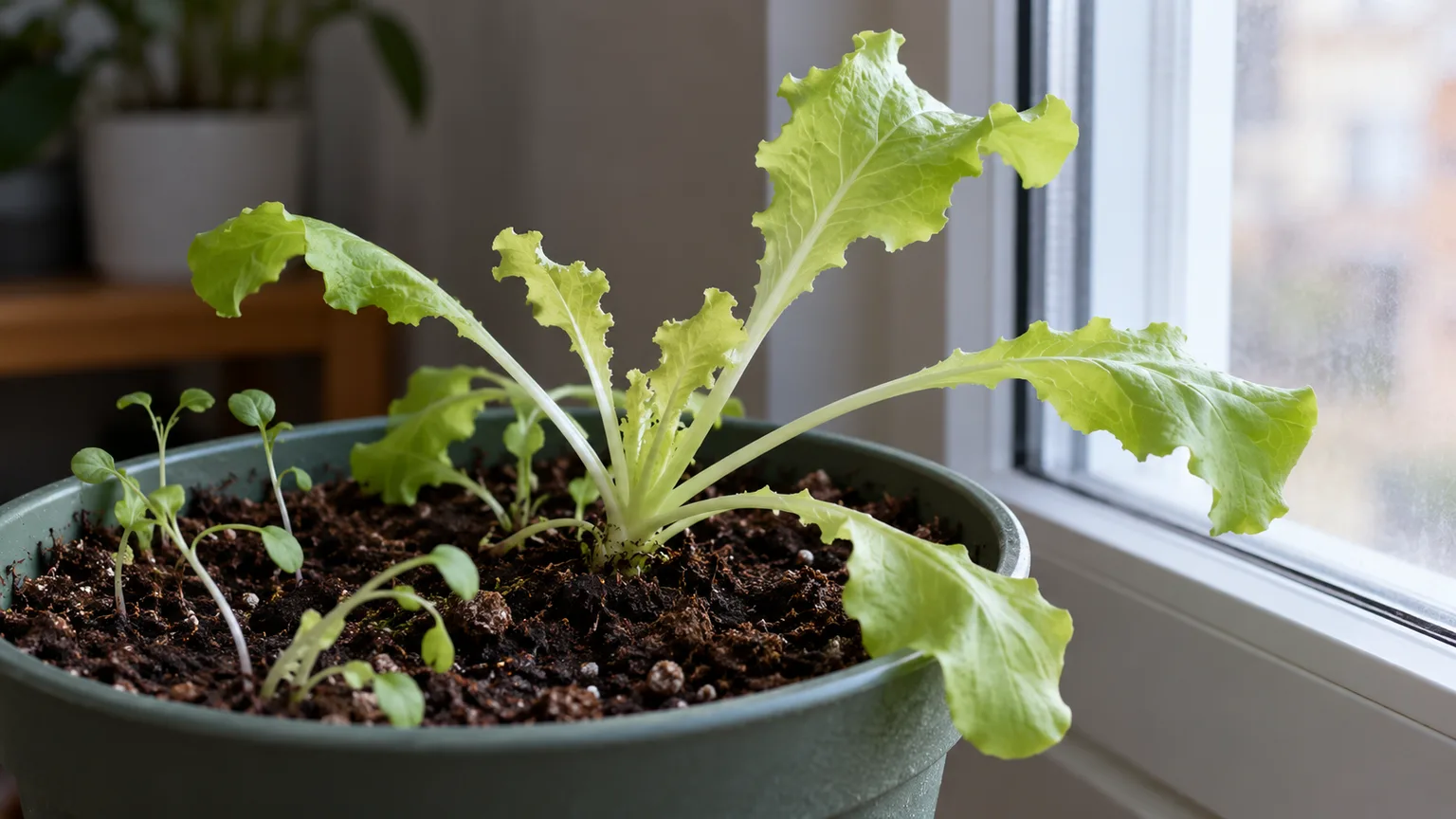
On lettuce, low light stretches the whole rosette at once. Leaf stalks lengthen, gaps widen between successive leaves, and new centre leaves emerge smaller and paler than the outer ones. The plant may lean toward the nearest window, and looseleaf types look thin and see-through instead of forming a dense cluster. Seedlings are the most dramatic: a pale, thread-like stem holds the first leaves far above the soil line, and weak seedlings may flop over within days of emerging.
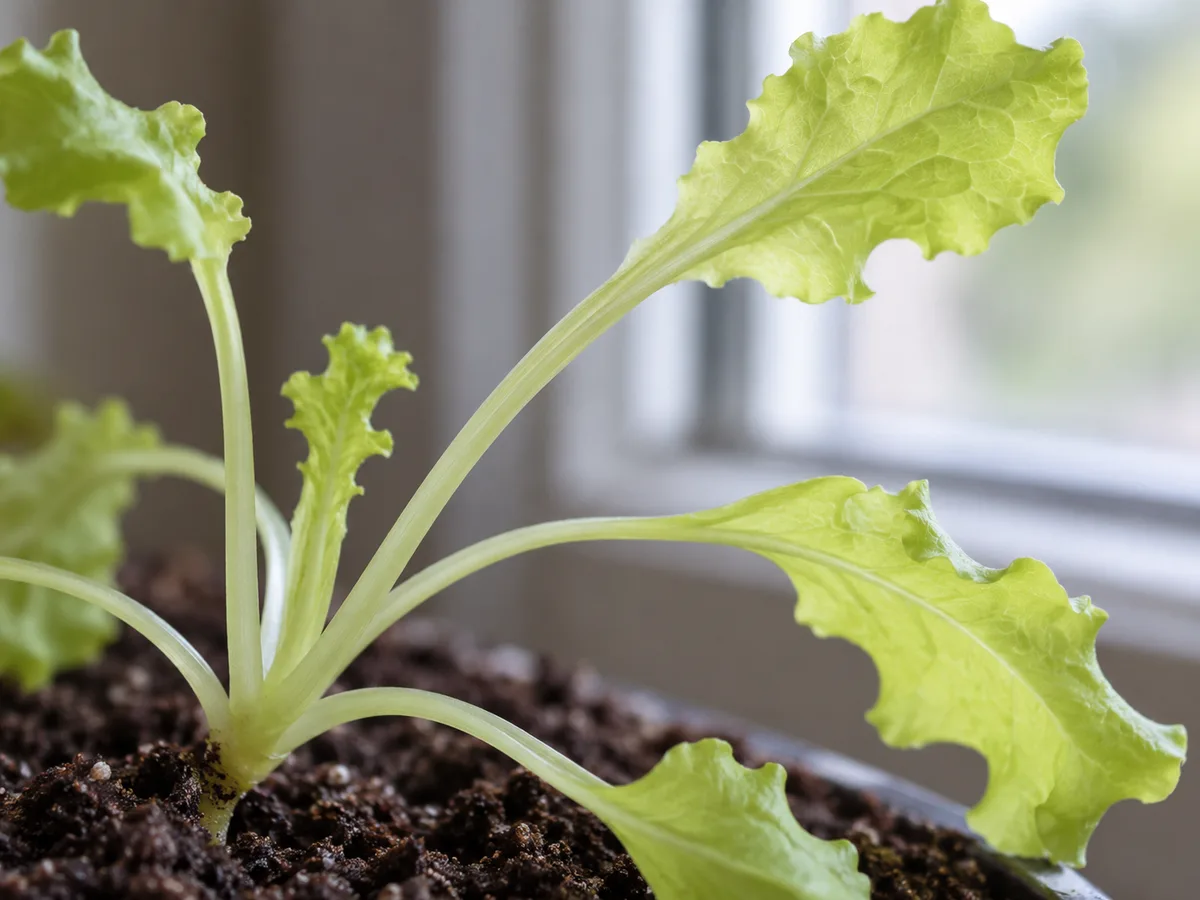
Pale, widely spaced young lettuce leaves with elongated stalks — compare with compact new growth from the centre after light improves.
Heading types tell the same story differently. Butterhead, romaine, and crisphead lettuces in dim positions stay open and never develop the firm heart the seed packet promised. Do not confuse this with a spacing problem alone: even well-spaced plants stretch when the light itself is inadequate. Check the lettuce overview if you are unsure what shape your cultivar should form — a looseleaf plant harvested young looks very different from a crisphead that simply never headed.
Why lettuce runs short of light
Lettuce is a cool-season annual built for fast leafy growth in open sun. Utah State University calls it a cool-season vegetable that prefers sunny locations, maturing best before summer heat. When you place that plant on a shaded balcony, several feet back from a window, or under a weak lamp, photosynthesis cannot keep up with the rapid growth the species attempts — so stems elongate searching for light.
Indoor and winter positions are the usual trap. Ordinary room brightness falls off sharply with distance from glass, and a tray that looks bright to human eyes may deliver a fraction of outdoor light. Short winter days compound the problem: growth pushed out under weak seasonal sun emerges stretched and pale even when temperatures suit lettuce. Seedlings started indoors without overhead light almost always stretch, because side light from a window pulls them sideways instead of holding them compact.
Crowding shades lettuce from itself. Lettuce sown thickly and never thinned forms a miniature canopy where each seedling robs its neighbours of light. Overlapping leaves in a plug tray or a packed container stretch just as surely as a plant in a dark corner. This is why thinning and final spacing matter as much as the position itself.
Fear of heat causes over-shading. Many growers who watched a summer crop bolt respond by parking the next sowing in deep shade. The RHS instead recommends a sunny site with light shade only during the hottest part of summer — shade as a heat tool, not a full-season address. Deep all-day shade in cool weather simply trades bolting risk for weak, stretched plants, as the lettuce light guide explains.
How to confirm low light is the cause
Work through these checks in order on a bright morning:
- Read the rosette shape. Even stretching across the whole plant with pale, small new leaves points to light. Damage confined to one side suggests a directional light gap instead.
- Measure the light honestly. Note how many hours of direct sun reach the leaves, how far the tray sits from glass or lamp, and whether walls, overhangs, or taller plants block the sky. Epic Gardening notes lettuce prefers at least 12 hours of full to partial sun per day outdoors — a north-facing indoor corner rarely comes close.
- Feel the upper 1–2 cm of soil. Dim positions dry slowly. If the mix is still moist days after watering, the plant is using little water because it photosynthesizes little — consistent with low light. Use the lettuce watering guide before changing your schedule.
- Check the stem base. A firm base with stretched but intact tissue means light hunger. A soft, pinched, or collapsed base at soil level means damping-off or rot, not simple dimness.
- Rule out bolting. A tall central stalk with bitter leaves in warm weather is flowering, not stretching for light — see the lookalike table below.
Confirmed diagnosis: uniform pale stretching plus slow growth in a position with clearly limited direct light. Suspected: stretching in a spot that seems bright — track actual sun hours for two days before treating, since perceived brightness misleads indoors.
First fix: give it brighter light, nothing else
Move the container or tray to the brightest cool position available today — an unobstructed east-facing spot, the sunniest cool windowsill, or outdoors if nights stay above freezing. Indoors under a lamp, lower the fixture toward the manufacturer’s recommended seedling distance so light falls directly overhead and covers the whole canopy.
Do not fertilize, repot, or prune at the same time. Extra nitrogen on a light-starved lettuce plant produces even softer growth, and repotting a stretched annual wastes its short productive life. One variable, then watch the centre of the rosette.
Step-by-step recovery for stretched lettuce
Seedlings with mildly stretched stems: move them under strong overhead light immediately, thin so no two seedlings touch, and add gentle air movement from a nearby fan or open window. Stems already elongated will not shorten, but the first true leaves can still develop compactly if light arrives promptly.
Transplants and young rosettes: relocate to the brighter position, rotate the container a quarter turn every couple of days if side light is all you have, and keep watering matched to the new drying rate — brighter spots dry faster. Check soil with the method in the lettuce watering guide rather than the old routine.
Indoor crops under grow lights: use a broad-spectrum white LED sold for seedlings or edible crops, on a timer with a regular dark period. Epic Gardening notes that LED grow lights work well for indoor lettuce because the crop dislikes harsh direct light. Keep the lamp overhead rather than off to one side, illuminate the whole canopy, and raise or lower it from plant response: continued leaning means weak delivery, while bleaching directly under the fixture means it sits too close.
Heading types that never headed: if the plant is otherwise healthy and weather stays cool, improved light plus correct spacing per the lettuce soil guide can still produce a usable heart on young plants. A mature plant that has already elongated its stem in persistent warmth is usually past rescue — harvest the usable outer leaves and sow again.
Recovery timeline
Expect the stretching to stop within days of the move. New centre leaves should emerge visibly greener and tighter within one to two weeks under genuinely better light. Seedlings started fresh under strong overhead light develop sturdy true leaves from the start.
Old stretched tissue never compacts again — judge everything by new growth. If two weeks of clearly brighter conditions produce no improvement, the position is still too dim, the root zone is waterlogged, or heat has pushed the plant toward bolting rather than leaf growth.
Lookalike symptoms on lettuce
| What you see | Likely cause | Key check |
|---|---|---|
| Even pale stretching, loose rosette | Low light (this page) | Whole plant affected; improves with brighter position |
| Tall central stalk, bitter leaves in warm weather | Bolting / heat stress | Stem elongates from the centre; research confirms high-temperature stress can accelerate bolting in leaf lettuce |
| Repeated midday collapse, recovery by evening | Heat or water stress, not dimness | See wilting on lettuce |
| Yellow outer leaves in wet soil | Overwatering | Mix stays soggy; see overwatering on lettuce |
| Limp leaves that do not recover after cooling | Underwatering | Upper mix bone dry; see underwatering on lettuce |
| Slow pale growth even in good light | Nutrient or root problem | Check the lettuce fertilizer guide and slow growth on lettuce |
| Seedlings collapsing at soil line | Damping-off | Pinched brown stem base; see lettuce propagation for clean-start practice |
Bolting deserves emphasis because growers confuse it with light hunger. Etiolation stretches the whole young plant evenly in dim conditions; bolting drives a single flower stalk up from the centre of a mature plant in warm or long-day conditions. Shade cannot reverse bolting, and extra light will not fix it either.
Mistakes to avoid
- Feeding before fixing light. Fertilizer cannot replace photosynthesis on lettuce, and excess nitrogen makes stretched tissue softer. Correct the position first, then feed only actively growing compact plants per the lettuce fertilizer guide.
- Moving a heat-stressed crop into deeper shade permanently. Temporary afternoon protection helps in warm spells — suspended shade cloth that does not touch summer leafy greens is the correct technique — but parking lettuce in a dark corner for the whole season guarantees weak growth.
- Chasing the sun with a hot windowsill. A pane that overheats leaves in the afternoon bleaches tissue. Filter the harshest beam or move the tray slightly back rather than pressing leaves against hot glass.
- Stacking fixes on a short-lived annual. Lettuce gives you weeks, not years. One clear light correction plus correct watering beats a same-day bundle of repotting, pruning, and feeding that masks which change worked. The lettuce problems hub helps you pick the single most likely cause before acting.
- Nursing hopeless seedlings. Re-sowing into strong overhead light usually beats weeks of coaxing floppy, toppled seedlings that never form a rosette.
Lettuce care cross-check
Recheck the basics that interact with light. Containers should drain freely and hold the organically rich, moisture-retentive mix described in the lettuce soil guide — waterlogged mix in a dim spot invites rot that looks like light failure. Space looseleaf types so leaves barely touch and give heading types room to develop; crowded plants shade each other regardless of position. UF/IFAS recommends winter as the lettuce-growing season in warm climates — in much of India that means the coolest practical sowing window, when open sun is an ally rather than a threat. For sowing depth and transplant timing, the lettuce propagation guide pairs with this page.
How to prevent it next time
Sow in the season when your location can offer bright, cool conditions, and start seedlings under overhead light from the day they emerge. Thin promptly so neighbouring seedlings never shade each other. Give established plants full or nearly full sun while weather stays genuinely cool, shifting to morning sun with afternoon protection only as heat builds. Indoors, keep the lamp centred over the canopy on a timer and rotate trays for even coverage. Succession-sow every couple of weeks in suitable weather so no single ageing plant has to carry the whole harvest.
When to worry
Toppled seedlings with pinched brown stem bases, a soft or foul-smelling crown, or rapidly spreading collapse need immediate action beyond light correction — remove affected seedlings, improve air movement, and start fresh in clean mix. A mature plant sending up a bitter central stalk in persistent heat has entered flowering; harvest what is usable and re-sow in cooler weather rather than fighting it with shade.
When to use this page vs other lettuce guides
- Use this page for pale, stretched, loose growth caused by too little light.
- Use leggy growth on lettuce when stem elongation is the main entry symptom you searched for.
- Use yellow leaves on lettuce when yellowing dominates rather than stretching.
- Use lettuce light for routine sun, shade, window, and grow-light planning.
- Browse the lettuce problems hub when several symptoms overlap and you need to triage.
Related lettuce guides
- Lettuce overview — cultivar types, season, and whole-crop context
- Lettuce light — sun, shade, windows, and grow lights
- Lettuce watering — moisture checks as exposure changes
- Lettuce soil — drainage, mix, and spacing
- Lettuce fertilizer — feeding compact, actively growing plants
- Lettuce propagation — sowing, thinning, and seedling light
- Leggy growth on lettuce — when stretching is the headline symptom
- Slow growth on lettuce — when poor progress persists in good light
- Yellow leaves on lettuce — when colour change leads the diagnosis
- Lettuce problems — browse all issues on this crop
Conclusion
Low light on lettuce is straightforward once you read the rosette: even, pale stretching means the plant needs a brighter position, not more fertilizer or a bigger pot. Move it to stronger cool-season sun or correct the overhead lamp, keep water matched to the new drying rate, and let the next centre leaves prove the fix. Separate heat-driven bolting from light hunger early, and re-sow weak seedlings rather than nursing them — lettuce grows fast enough that a fresh start in good light usually wins.
Related tool
Use the Plant Problem Diagnosis Tool to narrow causes for not enough light on this plant before changing multiple variables at once.