Alocasia Black Velvet Care Guide: Light, Humidity, Soil
Alocasia reginula
Complete guide to Alocasia Black Velvet (Alocasia reginula). Learn how to keep your jewel alocasia thriving — from corm-safe watering and velvet-leaf humidity tips to dormancy care, propagation by division, and fixing yellow leaves, crispy tips, and spider mites.
Alocasia Black Velvet Care Guide: Light, Humidity, Soil
Start with wateringThe most common care mistake for Alocasia Black VelvetWatering guide →Alocasia Black Velvet care essentials
Light
bright indirect light
Water
Water when the top 2–3 cm of soil is dry; reduce sharply in winter dormancy. Avoid overwatering — the corm rots fast in wet mix.
Soil
Chunky, well-draining aroid mix with perlite and orchid bark; never use dense peat-heavy mix alone.
Humidity
65–80% — higher than many alocasias
Temperature
18–26°C (65–80°F)
Fertilizer
Stop fertilizing, reduce watering to roughly every 3–5 weeks (just enough to keep the corm from desiccating), and keep the pot warm with bright indirect light.
About Alocasia Black Velvet
Alocasia Black Velvet is native to Borneo (Eastern Kalimantan), typically reaches 20–40 cm tall indoors; leaves 8–15 cm indoors, with slow to moderate growth. Alocasia Black Velvet has a upright growth habit and part of the Araceae family. It is also known as Black Velvet Elephant Ear, Jewel Alocasia, and Little Queen.
| Detail | Information |
|---|---|
| Also known as | Black Velvet Elephant Ear, Jewel Alocasia, Little Queen |
| Native region | Borneo (Eastern Kalimantan) |
| Mature size | 20–40 cm tall indoors; leaves 8–15 cm |
| Growth rate | Slow to moderate |
| Growth habit | Upright |
| Scientific name | Alocasia reginula |
| Family | Araceae |
Alocasia Black Velvet Care Guide: Light, Humidity, Soil
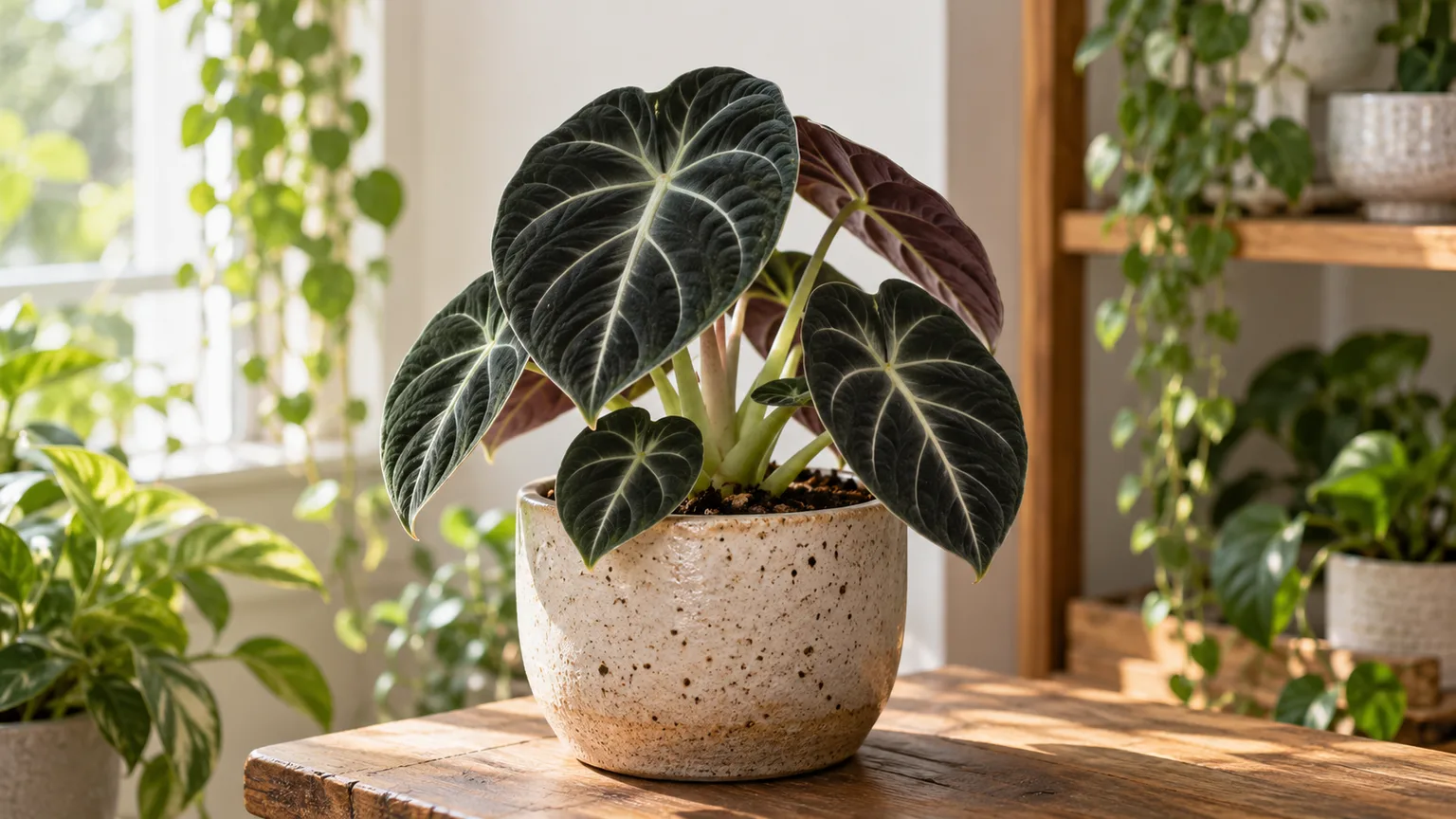
Alocasia Black Velvet is not a beginner plant, but neither is it impossibly demanding. It occupies a specific middle ground: exacting about humidity, intolerant of wet feet, and absolutely stunning when the conditions align. The leaves are the giveaway — deep black velvet blades with stark white veins that look almost painted on, making this one of the most recognisable jewel alocasias in cultivation. Match light, watering, humidity, and soil to a tropical understorey environment, and the plant rewards you with a steady stream of new leaves. Get any one of those badly wrong, and the same plant can sulk for months. This guide covers everything that actually matters, with specific numbers, primary-source references, and the failure modes most common with Alocasia reginula.
Species Profile: Alocasia reginula
Alocasia Black Velvet is recognised for its deep black velvet leaves with contrasting white veins — the matte, fuzzy leaf surface traps dust and holds water droplets, so never mist directly onto the foliage. Native to Borneo, it reaches 20–40 cm tall indoors with leaves 8–15 cm across, growing at a slow to moderate pace when light, humidity, and drainage align. Like all alocasias, it grows from an underground corm that stores energy through seasonal slowdowns — see the dormancy section below before assuming leaf drop means the plant is dead.
Native Range and Botanical Status
Alocasia reginula was formally described in 2011 by botanists A. Kurniawan and Peter C. Boyce, based on cultivated material from Eastern Kalimantan, Indonesian Borneo, and published in Acta Phytotaxonomica et Geobotanica (Kurniawan & Boyce 2011). The species belongs to the Araceae family (the arum family, alongside peace lilies, Monstera, and philodendrons). It has not been confirmed in the wild at scale, and most plants sold as ‘Black Velvet’ are the selected cultivar rather than the type species. Two sibling cultivars, ‘Silver Dragon’ and ‘Green Dragon’, come from the same species with distinct foliage colours but identical care requirements. Aroid specialists often discuss A. reginula in connection with limestone or ultramafic substrates, which is why a chunky, mineral-leaning mix performs so much better than a peat-heavy one.
Growth Habit and Mature Size
Indoors, Alocasia Black Velvet stays compact at 20–40 cm tall with a similar spread. The leaves are stiff, bullate (puckered), and held on short petioles, giving the plant a low, clumping form. NC State Extension notes that alocasias are herbaceous perennials grown for their striking foliage, and this compact species is one of the smallest in cultivation. Growth is slow to moderate — expect a new leaf every few weeks during active growing season, with the plant maintaining a fan of four to six leaves at maturity. Older leaves yellow and drop naturally as new ones emerge; this is normal leaf turnover, not a sign of trouble.
Why Velvet-Leaf Alocasias Need Different Care
The bullate, hair-covered leaf surface is what gives Black Velvet its iconic look — and it changes how you water, clean, and humidify the plant. Never mist directly onto velvet foliage: water droplets sit in the hairs, encourage fungal spotting, and can leave permanent marks. Raise humidity with a humidifier, pebble tray, or glass cabinet instead. When dust accumulates, wipe gently with a barely damp microfiber cloth, supporting the leaf from underneath. Avoid leaf shine products entirely — they clog stomata and ruin the matte finish.
The puckered surface also increases the effective leaf area, which raises transpiration and moisture demand. The matte, leathery cuticle slows water loss compared with thin-leaved alocasias such as Alocasia amazonica ‘Polly’, but the plant still needs steady humidity above 60% to keep leaf edges from crisping. The RHS alocasia growing guide notes that alocasias contain irritant compounds and recommends gloves when handling — sensible advice on a plant whose sap can sting skin.
Light: Bright, Indirect, and Stable
Black Velvet is an understorey plant, and it wants the light conditions an understorey plant expects. Bright, indirect light is the target: strong enough to read a book in the leaf shadows at midday, but not direct sun on the leaves themselves. The RHS alocasia guide recommends bright but not direct light for all alocasias, with strong sun risking scorch.
The 5,000–26,000 Lux Range Explained
Published grower figures put the useful range at roughly 5,000–26,000 lux. The lower end (around 5,000–10,000 lux) is what you get one to two metres back from a bright east window or directly in front of a bright north window. The upper end (20,000–26,000 lux) is closer to the plant’s position right at the edge of an east window with some morning sun, or under a moderate grow light. Most home growers find a comfortable medium around 10,000–15,000 lux.
Best Window Placement
An east-facing window with gentle morning sun, a north-facing window with bright ambient light, or a west window filtered through a sheer curtain is usually the safest placement. Direct sun shows up fast as bleached patches, brown crisp edges on the sun-facing side, or sudden leaf collapse after a move. Too little light shows up more slowly as long, weak petioles, smaller new leaves, and a plant that holds only one or two leaves at a time. Rotate the pot a quarter turn each week to keep growth symmetrical, because the leaves lean toward the strongest light source.
Grow Light Guidance
If you use grow lights, full-spectrum LED panels at 30–60 cm above the canopy for 10–12 hours a day are a good starting point. Watch the leaf temperature: if the surface feels warm to the touch, raise the light. Alocasia leaves do not cool themselves like a human does, so any warmth you feel is real heat stress.
Watering: Corm-Safe Rhythm
The single most common cause of death for Alocasia ‘Black Velvet’ is overwatering. The rule is simple: water when the top 2–3 cm of the mix is dry, water thoroughly, and never let the pot sit in runoff (Proven Winners). In active growth this typically means every 7–14 days, but pot size, light, temperature, and humidity all change that interval, so test the actual pot rather than following a calendar.
When and How to Check
Stick a finger, chopstick, or moisture meter to the second knuckle. If the top 2–3 cm of mix is dry and the deeper mix is just approaching dry, water. If the deeper mix is still damp, wait. When you do water, do it thoroughly: soak the entire root ball until water runs from the drainage holes, then empty the saucer or cachepot. A small daily sip is the worst pattern because it keeps the top of the mix wet and the bottom of the pot bone dry.
Pot-Weight and Chopstick Method
Pot weight is faster than any moisture meter once you learn it. Lift the pot immediately after a thorough watering and note the weight. Lift it again the next day, and the day after. By the time the pot feels distinctly light and the top of the mix is dry to the touch, the plant is ready for water. A chopstick works the same way: push a clean wooden chopstick to the bottom of the pot, leave it for 30 seconds, pull it out. Dry chopstick means time to water; damp chopstick with dark mix clinging means wait.
Underwatering is more recoverable than overwatering. A Black Velvet that has dried out will show curled leaves and crispy edges, and a thorough soak usually brings it back. One that has been sitting in a wet, anaerobic mix for weeks will have mushy, dark, smelly roots, and recovery is much harder.
Humidity: 65–80% Is the Target
Humidity is the variable that most often separates a Black Velvet that thrives from one that merely survives. The target is 65–80% relative humidity, which is well above what most heated or air-conditioned homes provide in winter (typically 30–50%). NC State Extension notes that alocasias benefit from high humidity, and specialist growers consistently recommend a humidifier, especially in dry months. A bathroom with bright natural light is a natural fit if the light is adequate.
Why Not to Mist Velvet Leaves
Misting raises the relative humidity around the leaf for a few minutes at most, and it leaves the leaf surface wet — which on a textured leaf like Black Velvet can invite fungal spotting. A humidifier is the most reliable solution. Grouping plants together, placing the pot on a pebble tray above the water line, and growing the plant in a glass cabinet or terrarium are all real, measurable improvements. If you use a humidifier, run it on a hygrometer rather than a fixed setting; overshooting 85% RH in a poorly ventilated room creates its own fungal risks.
Temperature: 18–27 °C
Temperature should sit between 18 and 27 °C (65–80 °F) during active growth. Black Velvet tolerates a slow drift down to around 13 °C (55 °F) without dying, but prolonged exposure triggers dormancy, and below about 10 °C (50 °F) you risk permanent damage. The RHS alocasia growing guide gives the same floor: above 10 °C in winter, well above 16 °C during the active growing season, and never in a cold draught.
The two indoor locations that cause the most problems are the windowsill in winter (cold glass meets cold draught) and the spot directly under an AC vent in summer (cold dry air blown across the leaves). Both can push the plant out of its comfort zone in hours.
Soil Mix: 1:1:1 Aroid Recipe
Alocasia reginula is, in the wild, rooted in well-drained rocky clay and lateritic soils. The indoor mix should imitate that combination of drainage and air around the roots. Standard houseplant potting mix is too dense on its own — it compacts within months and is the fastest path to root rot. The target pH is mildly acidic, around 5.5–6.5.
A Reliable 1:1:1 Recipe
A simple, well-documented mix is 1 part coco coir (or peat-free houseplant compost), 1 part perlite, and 1 part orchid bark, by volume. The coco coir holds a thin film of moisture around the roots without staying soggy; the perlite creates air pockets and prevents compaction; the orchid bark gives larger pores that let water run through fast.
Common adjustments: add a small amount of horticultural charcoal to buffer pH and keep the mix fresher; substitute pumice for perlite if you want a heavier mix; or add a thin top layer of sphagnum moss to slow surface evaporation. Do not add sand to “improve drainage” — fine sand fills the air gaps between larger particles and makes the mix worse. Do not use garden soil, and do not use a peat-heavy tropical mix on its own.
Fertilizer and Repotting
Alocasia ‘Black Velvet’ is a slow, modest feeder. A balanced water-soluble houseplant fertilizer at one-quarter to one-half of the label rate, applied every four to six weeks during active growth (spring through early autumn), is sufficient. Stronger doses risk burning the fine root hairs. Always apply fertilizer to already-moist soil so the solution moves through the root zone without burning. Pause feeding during dormancy, for the first month after repotting, and any time the plant is recovering from a pest or root issue.
Repot every one to two years, or when the pot dries much faster than usual, roots circle the drainage holes, or water runs straight through without soaking in. Go up only one pot size (about 2 cm of additional diameter). A pot that is too large holds too much water for the slow root system — the most common cause of root rot after repotting. Spring is the best time, when the plant can recover quickly.
Propagation: Division and Corms
Alocasia ‘Black Velvet’ cannot be propagated from leaf or stem cuttings. The two reliable methods are division of offsets from the mother plant and corm propagation of the small bulb-like storage organs that develop around the root system, as documented by Proven Winners. Both methods are best done in spring or early summer.
For division: unpot the parent plant, shake off loose mix, and gently tease the root ball apart. Each division needs at least one growth point, some roots, and ideally one or two healthy leaves. Pot into fresh aroid mix at the same depth, keep in bright indirect light, and maintain humidity above 60% until you see new growth. Do not fertilize for the first month.
For corm propagation: unpot the plant and feel through the mix near the root mass for small, firm, marble-to-pea-sized corms. Healthy corms are pale and firm; discard any that are soft or mushy. Gently peel the brown outer tunic off each corm (optional but speeds rooting), then place the corm on top of moist sphagnum moss in a small container with the top exposed. Seal the container in a clear bag to create a mini-greenhouse, place it in bright indirect light at 24–27 °C (75–80 °F), and open the bag once a week for fresh air. Roots usually appear in two to four weeks, with a new shoot following in another two to six weeks.
Do not harvest every corm from a single plant. The mother plant relies on them as a water and energy reserve, especially through dormancy. Leave at least half in place.
Dormancy: Why the Pot Looks Empty
This is the issue that panics new Black Velvet owners more than any other. In late autumn or winter, with shorter days and cooler nights, a perfectly healthy plant can drop every leaf, leaving a pot of bare mix with a corm below the surface. This is dormancy, not death — it is the same behaviour the plant uses in its native range during the dry season. The RHS alocasia growing guide notes that alocasias should be kept cooler and drier in winter when dormant. Black Velvet tolerates shorter days and cooler nights better than some alocasias, but it can still go dormant when the daylength drops below about 10 hours or the temperature sits below 13 °C (55 °F) for extended periods.
During dormancy, stop fertilizing, reduce watering to roughly once every three to five weeks (just enough to keep the corm from desiccating), and keep the pot in a warm, stable spot with bright indirect light. Resist the temptation to repot, divide, or “rescue” the plant by overwatering. New growth usually appears in spring when temperatures and daylength both rise. If new growth does not appear by mid-spring, gently unpot and check that the corm is still firm; if it is, repot, water lightly, and keep waiting.
Common Problems and How to Diagnose
Most Black Velvet problems are environmental, and they show up as specific leaf symptoms. The diagnostic order matters: check moisture first, then light, then pests.
Yellow leaves. A single older leaf yellowing while new growth looks healthy is normal leaf turnover. Widespread yellowing or yellowing of new leaves is almost always overwatering or a mix that holds too much moisture. The fix is a chunkier aroid mix and reduced watering frequency. Less common causes are nutrient deficiency, low light, or mineral-heavy tap water.
Leaf curl. Leaves that curl inward (sometimes called “taco leaves”) are usually responding to underwatering, very low humidity, or both. If the soil is moist and the leaves are still curling, check for cold draughts, recent light changes, or heat stress from a grow light placed too close.
Brown leaf tips and edges. These almost always point to low humidity, salt buildup in the mix, or hard tap water. Flushing the pot with plain, low-mineral water every few months moves the salts through, and switching to filtered or distilled water removes the chlorine and fluoride the plant is most sensitive to.
Spider mites. The most common pest, and the bullate leaf surface makes them harder to spot than on smooth-leaved plants. Look for fine webbing along the veins on leaf undersides, tiny moving dots, and a stippled appearance on the upper leaf surface. Dry indoor air and dusty leaves favour outbreaks. Isolate the plant, rinse the foliage thoroughly, manually wipe off visible webbing, then apply insecticidal soap or a 1% neem oil solution every five days for two to three rounds. Raising humidity above 60% suppresses mite reproduction.
Root rot. Almost always caused by overwatering, a dense mix, or a pot without drainage. Early signs are yellowing leaves, soft stems at the base, and a sour smell from the mix. If you suspect rot, unpot, cut away mushy roots with sterilised blades, repot into fresh dry mix, hold off watering for a few days, and keep the plant in bright indirect light with high humidity.
Toxicity to Pets and People
Every part of Alocasia reginula is toxic to cats, dogs, horses, and humans if chewed or ingested. The toxic principle is insoluble calcium oxalate in the form of needle-like raphide crystals. The ASPCA lists Alocasia spp. as toxic to dogs, cats, and horses, with clinical signs including oral irritation, pain and swelling of the mouth, excessive drooling, vomiting, and difficulty swallowing.
If a pet or child has chewed on a Black Velvet, call the ASPCA Animal Poison Control Center at (888) 426-4435 or your veterinarian immediately. Do not induce vomiting unless specifically instructed. For households with pets or small children, place the plant on a high shelf or in a closed terrarium out of reach.
Buying Tips and the First 30 Days
A healthy Black Velvet should have firm, deeply bullate leaves with clear white veining, no visible webbing or sticky residue on the undersides, and a pot of mix that does not smell sour. A small amount of cosmetic damage on an older leaf is normal; a plant with collapsed crowns, mushy petioles, or yellow new growth is not. Specialist aroid growers are generally safer bets than generic big-box listings.
In the first 30 days, do not repot, do not fertilize, and do not propagate. Quarantine the plant away from your other houseplants for at least two weeks. Watch the pot dry-down carefully to learn the rhythm of your specific container. If the plant drops a leaf in the first week, that is usually a stress response — the corm below will push a new leaf once the plant settles, provided you do not overcompensate with water.
Conclusion
Alocasia Black Velvet asks for three things that no other jewel alocasia combines in quite the same way: bright but filtered light, steady humidity above 60%, and a mix that dries predictably between waterings. The velvet leaf is the plant’s defining feature and its biggest constraint — it punishes dry air faster than glossy-leaved alocasias, and it cannot be misted like a fern. Treat watering, humidity, and dormancy as one interconnected system rather than separate tasks, and the plant will reward you with the kind of slow, deliberate growth that makes every new unfurling leaf an event. No other jewel alocasia tests a grower’s humidity discipline quite like Alocasia reginula, and no other punishes overwatering quite as fast. Get the balance right, and Black Velvet earns every bit of its “little queen” reputation.
How to care for Alocasia Black Velvet?
How much light does Alocasia Black Velvet need?
bright indirect light
- bright indirect light - bright indirect light.
When should you water Alocasia Black Velvet?
Water when the top 2–3 cm of soil is dry; reduce sharply in winter dormancy. Avoid overwatering — the corm rots fast in wet mix.
- Finger or chopstick to 2–3 cm depth - Water when the top 2–3 cm of soil is dry; reduce sharply in winter dormancy.
- lift pot to gauge weight — a dry pot feels noticeably lighter - Water when the top 2–3 cm of soil is dry; reduce sharply in winter dormancy.
- Drain excess water - Water when the top 2–3 cm of soil is dry; reduce sharply in winter dormancy.
What soil works best for Alocasia Black Velvet?
Chunky, well-draining aroid mix with perlite and orchid bark; never use dense peat-heavy mix alone.
- perlite - Chunky, well-draining aroid mix with perlite and orchid bark; never use dense peat-heavy mix alone.
- orchid bark - Chunky, well-draining aroid mix with perlite and orchid bark; never use dense peat-heavy mix alone.
- peat-free potting mix - Chunky, well-draining aroid mix with perlite and orchid bark; never use dense peat-heavy mix alone.
Grower notes for Alocasia Black Velvet
Dormancy and the corm
Alocasia Black Velvet may drop all leaves in winter while the underground corm stays alive. Reduce watering to every 3–5 weeks, stop fertilizer, and wait for spring growth — do not discard a pot that looks empty.
Velvet leaf care for Alocasia Black Velvet
The fuzzy bullate leaf surface traps water and dust. Never mist foliage directly — use a humidifier instead. Wipe leaves gently with a damp microfiber cloth when dusty; avoid leaf shine products that clog stomata.
What matters most with Alocasia Black Velvet
Alocasia Black Velvet is easiest to grow when you judge the whole plant: new growth, root-zone moisture, light exposure, and how quickly the pot dries after watering. The care checkpoint is bright indirect light paired with chunky aroid mix in a snug pot — this compact species rots faster than larger alocasias when overpotted or overwatered.
Best placement in a real home
Alocasia Black Velvet belongs where bright indirect light is realistic for most of the day. Water when the top 2–3 cm of soil is dry; reduce sharply in winter when dormancy is likely. Humidity target: 65–80% — higher than many alocasias. Temperature comfort zone: 18–26°C (65–80°F). A humid bathroom with good light is often ideal.
Before you buy this plant
Choose Alocasia Black Velvet with firm bullate leaves, clear white veining, clean leaf undersides, and soil that does not smell sour. Be cautious if you see collapsed crowns, mushy petioles, or a pot that stays wet in poor light. Also sold as Jewel Alocasia and Little Queen — verify the velvet black leaf, not a mislabeled Polly.
First month after bringing it home
Do not repot Alocasia Black Velvet on day one unless the mix is failing or pests are obvious. Quarantine it, learn how fast the pot dries, and keep care boring while it adjusts. If a leaf drops in week one, the corm below may still be fine — resist overwatering an empty-looking pot.
Is it pet safe?
Alocasia Black Velvet contains insoluble calcium oxalate crystals causing oral irritation, drooling, and vomiting if ingested. Keep out of reach of pets and children. If your pet ingests any part of the plant, remove plant material from the mouth, rinse gently with water, and contact your veterinarian or the ASPCA Animal Poison Control hotline immediately.
Watering Alocasia Black Velvet
For Alocasia Black Velvet, finger or chopstick to 2–3 cm depth; lift pot to gauge weight — a dry pot feels noticeably lighter and water every 7–10 days in summer; every 2–4 weeks in winter. Reduce watering 60–70% in autumn/winter when dormancy is likely; keep corm from drying out.
| Detail | Information |
|---|---|
| How often | Every 7–10 days in summer; every 2–4 weeks in winter |
| How to check | Finger or chopstick to 2–3 cm depth; lift pot to gauge weight — a dry pot feels noticeably lighter |
| Seasonal changes | Reduce watering 60–70% in autumn/winter when dormancy is likely; keep corm from drying out |
Signs of overwatering
- yellow leaves
- mushy petioles
- soggy soil
- root rot
Signs of underwatering
- drooping leaves
- dry crispy edges
- slow growth
Soil & potting for Alocasia Black Velvet
Use a mix of perlite, orchid bark, peat-free potting mix, coarse sand for Alocasia Black Velvet. Fast-draining; corm must never sit in saturated soil. Target soil pH around 5.5–6.5. Repot every 1–2 years, ideally in spring.
| Detail | Information |
|---|---|
| Recommended mix | perlite, orchid bark, peat-free potting mix, coarse sand |
| Drainage | Fast-draining; corm must never sit in saturated soil |
| Soil pH | 5.5–6.5 |
| Repotting frequency | Every 1–2 years |
| Best season to repot | Spring |
Signs it needs repotting
- roots circling pot
- rapid soil drying
- stunted growth
Humidity & temperature for Alocasia Black Velvet
Alocasia Black Velvet prefers 65–80% — higher than many alocasias, though normal home humidity is usually fine. Keep temperatures around 18–26°C (65–80°F).
| Detail | Information |
|---|---|
| Humidity | 65–80% — higher than many alocasias - normal home humidity is fine. |
| Ideal temperature | 18–26°C (65–80°F) |
Fertilizer & pruning for Alocasia Black Velvet
Use stop fertilizing, reduce watering to roughly every 3–5 weeks (just enough to keep the corm from desiccating), and keep the pot warm with bright indirect light. for Alocasia Black Velvet.
| Detail | Information |
|---|---|
| Fertilizer type | Stop fertilizing, reduce watering to roughly every 3–5 weeks (just enough to keep the corm from desiccating), and keep the pot warm with bright indirect light. |
Common problems on Alocasia Black Velvet
Yellow Leaves
MediumLikely cause: Common on this plant type; confirm with recent watering, light, and root checks.
Quick fix: Inspect the plant and correct the most likely care stressor before stacking treatments.
Full fix guide →Brown Tips
MediumLikely cause: Common on this plant type; confirm with recent watering, light, and root checks.
Quick fix: Inspect the plant and correct the most likely care stressor before stacking treatments.
Full fix guide →Root Rot
MediumLikely cause: Common on this plant type; confirm with recent watering, light, and root checks.
Quick fix: Inspect the plant and correct the most likely care stressor before stacking treatments.
Full fix guide →Overwatering
MediumLikely cause: Common on this plant type; confirm with recent watering, light, and root checks.
Quick fix: Inspect the plant and correct the most likely care stressor before stacking treatments.
Full fix guide →Underwatering
MediumLikely cause: Common on this plant type; confirm with recent watering, light, and root checks.
Quick fix: Inspect the plant and correct the most likely care stressor before stacking treatments.
Full fix guide →Spider Mites
MediumLikely cause: Common on this plant type; confirm with recent watering, light, and root checks.
Quick fix: Inspect the plant and correct the most likely care stressor before stacking treatments.
Full fix guide →Mealybugs
MediumLikely cause: Common on this plant type; confirm with recent watering, light, and root checks.
Quick fix: Inspect the plant and correct the most likely care stressor before stacking treatments.
Full fix guide →Aphids
MediumLikely cause: Common on this plant type; confirm with recent watering, light, and root checks.
Quick fix: Inspect the plant and correct the most likely care stressor before stacking treatments.
Full fix guide →Leggy Growth
MediumLikely cause: Common on this plant type; confirm with recent watering, light, and root checks.
Quick fix: Inspect the plant and correct the most likely care stressor before stacking treatments.
Full fix guide →Slow Growth
MediumLikely cause: Common on this plant type; confirm with recent watering, light, and root checks.
Quick fix: Inspect the plant and correct the most likely care stressor before stacking treatments.
Full fix guide →Wilting
MediumLikely cause: Common on this plant type; confirm with recent watering, light, and root checks.
Quick fix: Inspect the plant and correct the most likely care stressor before stacking treatments.
Full fix guide →Drooping Leaves
MediumLikely cause: Common on this plant type; confirm with recent watering, light, and root checks.
Quick fix: Inspect the plant and correct the most likely care stressor before stacking treatments.
Full fix guide →Low Humidity
MediumLikely cause: Common on this plant type; confirm with recent watering, light, and root checks.
Quick fix: Inspect the plant and correct the most likely care stressor before stacking treatments.
Full fix guide →Not Enough Light
MediumLikely cause: Common on this plant type; confirm with recent watering, light, and root checks.
Quick fix: Inspect the plant and correct the most likely care stressor before stacking treatments.
Full fix guide →Fungus Gnats
MediumLikely cause: Common on this plant type; confirm with recent watering, light, and root checks.
Quick fix: Inspect the plant and correct the most likely care stressor before stacking treatments.
Full fix guide →Mold on Soil
MediumLikely cause: Common on this plant type; confirm with recent watering, light, and root checks.
Quick fix: Inspect the plant and correct the most likely care stressor before stacking treatments.
Full fix guide →Curling Leaves
MediumLikely cause: Common curling leaves pattern on Alocasia Black Velvet under indoor care stress.
Quick fix: Inspect roots, watering, light, and pests; adjust one variable and monitor new growth.
Full fix guide →Brown Leaves
MediumLikely cause: Common brown leaves pattern on Alocasia Black Velvet under indoor care stress.
Quick fix: Inspect roots, watering, light, and pests; adjust one variable and monitor new growth.
Full fix guide →Black Spots
MediumLikely cause: Common black spots pattern on Alocasia Black Velvet under indoor care stress.
Quick fix: Inspect roots, watering, light, and pests; adjust one variable and monitor new growth.
Full fix guide →Holes in Leaves
MediumLikely cause: Common holes in leaves pattern on Alocasia Black Velvet under indoor care stress.
Quick fix: Inspect roots, watering, light, and pests; adjust one variable and monitor new growth.
Full fix guide →Pale Leaves
MediumLikely cause: Common pale leaves pattern on Alocasia Black Velvet under indoor care stress.
Quick fix: Inspect roots, watering, light, and pests; adjust one variable and monitor new growth.
Full fix guide →Distorted Leaves
MediumLikely cause: Common distorted leaves pattern on Alocasia Black Velvet under indoor care stress.
Quick fix: Inspect roots, watering, light, and pests; adjust one variable and monitor new growth.
Full fix guide →Scale Insects
MediumLikely cause: Common scale insects pattern on Alocasia Black Velvet under indoor care stress.
Quick fix: Inspect roots, watering, light, and pests; adjust one variable and monitor new growth.
Full fix guide →Thrips
MediumLikely cause: Common thrips pattern on Alocasia Black Velvet under indoor care stress.
Quick fix: Inspect roots, watering, light, and pests; adjust one variable and monitor new growth.
Full fix guide →Whiteflies
MediumLikely cause: Common whiteflies pattern on Alocasia Black Velvet under indoor care stress.
Quick fix: Inspect roots, watering, light, and pests; adjust one variable and monitor new growth.
Full fix guide →Leaf Miners
MediumLikely cause: Common leaf miners pattern on Alocasia Black Velvet under indoor care stress.
Quick fix: Inspect roots, watering, light, and pests; adjust one variable and monitor new growth.
Full fix guide →Caterpillars
MediumLikely cause: Common caterpillars pattern on Alocasia Black Velvet under indoor care stress.
Quick fix: Inspect roots, watering, light, and pests; adjust one variable and monitor new growth.
Full fix guide →Nitrogen Deficiency
MediumLikely cause: Common nitrogen deficiency pattern on Alocasia Black Velvet under indoor care stress.
Quick fix: Inspect roots, watering, light, and pests; adjust one variable and monitor new growth.
Full fix guide →Iron Deficiency
MediumLikely cause: Common iron deficiency pattern on Alocasia Black Velvet under indoor care stress.
Quick fix: Inspect roots, watering, light, and pests; adjust one variable and monitor new growth.
Full fix guide →Magnesium Deficiency
MediumLikely cause: Common magnesium deficiency pattern on Alocasia Black Velvet under indoor care stress.
Quick fix: Inspect roots, watering, light, and pests; adjust one variable and monitor new growth.
Full fix guide →Potassium Deficiency
MediumLikely cause: Common potassium deficiency pattern on Alocasia Black Velvet under indoor care stress.
Quick fix: Inspect roots, watering, light, and pests; adjust one variable and monitor new growth.
Full fix guide →Calcium Deficiency
MediumLikely cause: Common calcium deficiency pattern on Alocasia Black Velvet under indoor care stress.
Quick fix: Inspect roots, watering, light, and pests; adjust one variable and monitor new growth.
Full fix guide →