Perfect Alocasia Black Velvet Soil: Prevent Root Rot
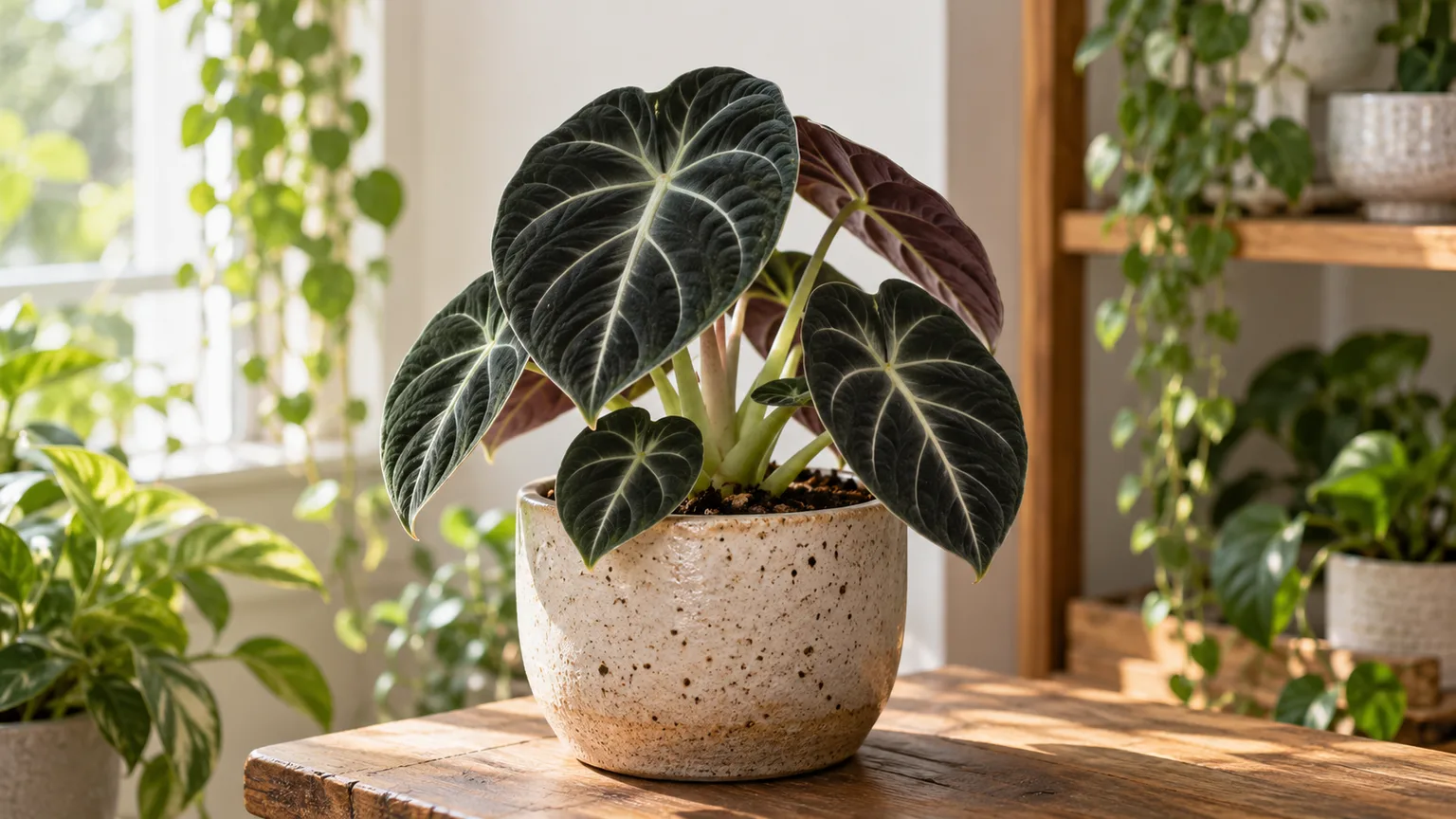
Perfect Alocasia Black Velvet Soil: Prevent Root Rot with This DIY Recipe
Perfect Alocasia Black Velvet Soil: Prevent Root Rot with This DIY Recipe
Alocasia Black Velvet has roots that want two things at once: a steady drink of moisture and a constant flow of oxygen. Standard houseplant soil delivers the first and starves them of the second, which is why the same plant that looks bulletproof in a greenhouse can collapse in a living room six months after purchase. The fix is a chunky aroid mix you can either build yourself in a bucket or buy off the shelf in a single bag.
This guide breaks down exactly what Black Velvet needs from its substrate, the components that make the mix work, the recipe most home growers settle on, the pH window the roots actually use, the store-bought options that come closest, how to troubleshoot soil problems, and how to refresh old soil. Every factual claim is grounded in extension service guidance, botanical garden references, and widely cited aroid-grower practice.
Why Alocasia Black Velvet Needs a Chunky, Well-Draining Aroid Mix
Alocasia reginula is a Jewel Alocasia from the limestone-influenced understory of Borneo Kurniawan & Boyce 2011. In the wild it grows in shallow rainforest debris — leaf litter, bark, moss, and mineral fragments — that holds moisture after rain and re-aerates within hours. The substrate never sits in standing water, and it never goes bone-dry for long. Replicating that balance indoors is the entire job of an aroid mix.
The Missouri Botanical Garden describes Alocasia generally as preferring “organically rich, moist, well-drained soils,” a one-line summary that captures the same tension the chunky-mix recipe tries to solve in a pot. NC State Extension’s plant toolbox entry for Alocasia echoes the same wording, adding that the plant wants a “slightly acidic, moist, well-drained, humus-rich, fertile loam.” The RHS Alocasia Black Velvet entry specifies “loam” with “moist but well-drained” conditions and “acid or neutral” pH, which matches the 5.5–6.5 target most home growers aim for.
The root biology behind the “chunky” rule
Black Velvet roots are thick, white, and slow-growing compared to a pothos or a spider plant, and they store energy in corms that sit just under the substrate surface. Those corms rot in a few days if the medium around them stays anaerobic. Air-filled porosity — the literal gaps between particles — is what keeps the roots alive between waterings. Chunkier components create larger, longer-lasting gaps; finer components collapse and seal those gaps off. That is the entire reason every credible aroid recipe lists bark, perlite, or pumice as a non-negotiable ingredient, a structural principle the Clemson University Home and Garden Information Center and University of Wisconsin Extension on healthy houseplant roots both echo for indoor plants generally.
A useful mental model: think of the substrate as a sponge with marbles in it. The sponge holds water, the marbles hold air. A pot of pure sponge (regular potting soil) holds a lot of water and very little air. A pot of pure marbles (orchid bark) holds a lot of air and very little water. The mix is the blend that does both at once.
What “well-draining but moisture-retentive” actually means
“Fast-draining” and “moisture-retentive” sound like opposites, but in substrate terms they describe two different timescales. A fast-draining mix lets excess water leave the pot within a few seconds of pouring, so the roots are never sitting in a puddle. A moisture-retentive mix, in the hours after draining, holds onto enough water in its organic component to keep the root zone from going dry before the next watering. The goal is “evenly damp with air available, then a slight dry-down, then water again.” That rhythm is what Black Velvet evolved for.
The Core Components of a Black Velvet Soil Mix
Every reliable aroid mix is built from the same four categories of ingredient: a moisture base, an aerator, a structural chunk, and a small dose of biological or chemical amendments. You can substitute within each category, but skipping a category is what produces compacted, root-rotting soil.
Coco coir or peat moss — the moisture reservoir
Coco coir is the sustainable, pH-neutral, re-wetting-friendly modern default. It holds roughly eight to ten times its weight in water, releases it slowly, and breaks down far more slowly than peat. Sphagnum peat moss works as a substitute, is more acidic on its own, and tends to repel water once it dries out completely, which is one reason coco has largely replaced it in contemporary aroid recipes. Either is fine for Black Velvet.
A note on coco: rinse it before use if it is buffered with calcium or potassium nitrate, since those salts can push fertilizer levels higher than a Jewel Alocasia wants. To rinse buffered coir, place the dry brick in a bucket and cover with lukewarm water. Let it expand fully (about 15 minutes), then drain and flush with fresh water two or three times, squeezing the coir between flushes. Taste a small pinch — if it still tastes salty, flush again. This step is worth the five minutes it takes.
Perlite vs pumice — the aeration workhorse
Perlite and pumice do the same job, with trade-offs. Perlite is lighter, cheaper, and easier to find; it creates lots of air pockets and drains fast. The downside is that perlite floats to the top of the pot over time and breaks down into dust after a year or two of watering. Pumice is heavier, more stable, and lasts longer in the mix, but it costs more and can be harder to source locally. For Black Velvet, both are acceptable, and the choice usually comes down to pot weight preference and budget. A common compromise is a 50/50 blend of the two.
| Property | Perlite | Pumice |
|---|---|---|
| Weight | Very light | Moderate, helps anchor the plant |
| Drainage speed | Fast | Fast, slightly more even |
| Longevity in mix | Breaks down in 12–18 months | Holds structure for 2+ years |
| Cost | Low | Moderate to high |
| Best for | Budget mixes, propagation | Long-term houseplant mixes |
Pine bark or orchid bark — the structural backbone
Bark is what gives an aroid mix its “chunky” texture and what stops it from collapsing into mud. Orchid bark is graded and usually a bit larger and cleaner; pine bark fines are smaller, cheaper, and sold in bigger bags. For a small Jewel Alocasia in a four- or five-inch pot, medium-grade orchid bark or small pine bark fines both work well. Avoid large chunks over half an inch across — they create voids that fine Black Velvet roots cannot colonize, and they dry out unevenly, leaving wet pockets in the middle of the pot.
The RHS guide to growing media for houseplants categorises bark as an “aerator” that creates air pockets and improves drainage, and notes that roots need air — when the growing medium is too compacted or waterlogged, they cannot get oxygen and they die.
Horticultural charcoal, worm castings, and other small additions
These are the 10 percent of the recipe where most of the personality lives. Horticultural (activated) charcoal is optional but useful: it buffers pH swings, adsorbs impurities from tap water, and keeps the mix smelling fresh. Worm castings add a slow trickle of nutrients and beneficial microbes, but keep them to 10 percent or less — fresh castings are potent and can burn sensitive roots. A small amount of dolomitic lime is sometimes added to replicate the calcium-rich soils of Borneo, and a handful of mycorrhizal inoculant at potting time can help roots establish faster, though the data on inoculation in already-rich mixes is mixed.
What does not belong: garden soil, sand as a major component, moisture-retaining crystals, water-absorbing polymer beads, and most “cactus and succulent” mixes straight out of the bag. Each of these either compacts the mix, locks out air, or swings the water balance too far in one direction.
Best DIY Aroid Soil Mix Recipe
If you only want one recipe to remember, this is the one. It is the same ratio that the International Aroid Society describes as a standard epiphytic aroid blend, adapted here for Black Velvet’s specific moisture and aeration needs, and it adapts cleanly to whatever you can actually buy locally.
The 40-30-20-10 baseline ratio
Ingredients (by volume):
- 40 percent coco coir or peat moss — pre-moistened so it mixes evenly and does not steal moisture from the other ingredients.
- 30 percent perlite or pumice — or a 50/50 blend of both.
- 20 percent pine bark fines or medium orchid bark — sifted to remove dust if you are particular about texture.
- 10 percent total of: horticultural charcoal (about half), worm castings (about a quarter), and either dolomitic lime or a small mycorrhizal scoop (the remaining quarter). Worm castings alone can substitute for the entire 10 percent if that is all you have.
Method:
- Pour the coco coir into a clean mixing tub or five-gallon bucket and break up clumps with your hands. Pre-moisten it until it feels like a wrung-out sponge.
- Add the perlite and pumice. Mix with a trowel or your hands until the white and gray particles are evenly distributed.
- Add the bark. Mix again. At this point the texture should already feel loose and gritty rather than heavy and uniform.
- Add charcoal, worm castings, and any optional amendments. Mix one final time until the color is consistent throughout.
- Pot up your Black Velvet into a clean nursery pot with drainage holes, water thoroughly, and let the excess drain. The mix is ready to use immediately.
A single 8-quart batch fills roughly two standard six-inch pots. For most home growers with a handful of Jewel Alocasias, a 16-quart batch is a useful size and stores for several months in a dry bucket with a loose lid.
How to adjust the recipe for a dry or humid home
The 40-30-20-10 mix is a starting point, not a prescription. Two environmental factors shift the balance.
- Dry indoor air (under 45 percent humidity) or heated winter homes: Increase coco coir to 45 or 50 percent, drop bark to 15 percent, keep perlite/pumice at 30 percent, and add a tablespoon of vermiculite per quart of mix. This holds moisture long enough that you are not watering every two days.
- Humid homes (60 percent and up) or cool, low-light rooms: Drop coco to 35 percent, increase bark to 25 percent, increase perlite/pumice to 35 percent, and add an extra handful of charcoal. This keeps the mix from staying damp for more than a few days after watering.
A practical test: water the freshly potted plant thoroughly, then lift the pot. Water again only when the pot feels noticeably lighter, which usually lines up with the top one to two inches of mix feeling dry to the touch. If it takes longer than five to seven days in summer, the mix is too moisture-retentive. If it takes less than two days, it is too dry.
Target pH for Alocasia Black Velvet
Alocasia Black Velvet grows best in slightly acidic substrate, with a target pH of 5.5 to 6.5. The University of Maryland Extension notes the importance of pH for indoor plant root health, and the RHS classifies Alocasia Black Velvet’s preferred soil as “acid or neutral”, which aligns with the 5.5–6.5 range. The NC State Extension entry for Alocasia describes the plant’s preferred soils as “slightly acidic” without specifying a number. The UNH Extension confirms that in this range, iron, manganese, and zinc stay chemically available to the plant — below 5.5, some micronutrients leach out; above 6.5, the same micronutrients lock up and the plant shows pale new growth even when fertilizer is plentiful.
Coco coir sits at roughly pH 5.5 to 6.5 on its own, peat moss runs more acidic (around 3.5 to 4.5), and pine bark is mildly acidic. A mix built around coco coir, perlite, and bark usually lands inside the target window without adjustment, which is one more reason coco has become the default base. Peat-based mixes need a small amount of dolomitic lime added during mixing to keep pH from drifting too low University of Maryland Extension.
Test the pH of the runoff water every few months with a simple probe meter. If the reading is creeping above 6.5, the most common cause is alkaline tap water — switching to filtered, distilled, or rainwater usually pulls it back into range within a few watering cycles. If it drops below 5.5, a light top-dress of dolomitic lime at the next repot will stabilize it.
Why Standard Potting Soil Fails for Black Velvet
Standard indoor potting mix is engineered to hold water for general-purpose foliage plants like pothos, peace lily, and dieffenbachia. For Black Velvet, it fails on three specific counts.
- Compaction: The fine peat or coir in bagged mixes settles into a dense matrix within a few watering cycles. Air-filled porosity drops below the roughly 15–20 percent that aroid roots need, and corm rot follows within weeks NC State Extension.
- Water retention: The same fine particles that compact also hold a lot of water. A two-inch pot of standard mix can stay wet at the bottom for ten days, long past the point where Black Velvet roots are still healthy.
- pH drift: Many standard mixes run neutral to slightly alkaline, especially if they contain composted forest products or starter fertilizer. That pulls the substrate out of the slightly acidic range Black Velvet needs.
A common workaround — adding a handful of perlite to a bag of standard mix — is better than nothing, but it does not fix the underlying structure. The bark component, the coco coir base, and the right ratio of aeration are what turn the substrate into a working aroid mix, and they cannot be retrofitted into a fine-particle soil.
Best Pre-Made Aroid Mixes Worth Buying
For growers who would rather not stock four separate ingredients, several commercial aroid mixes come close to a good Black Velvet blend out of the bag. None is perfect for every home, and most benefit from a small amendment.
- FoxFarm Ocean Forest Potting Mix: Widely available, pH 6.3–6.8 right in the target window, with a base of sphagnum peat, perlite, and earthworm castings. It is rich and a touch dense for direct use, so most aroid growers cut it 50/50 with extra perlite and orchid bark.
- The Plant Runner Aroid Mix: A purpose-built blend of pine bark, coco coir, perlite, and horticultural charcoal in roughly the proportions recommended above. Ready to use straight from the bag for a Jewel Alocasia, though a small handful of extra perlite does not hurt in humid homes.
- Miracle-Gro Tropical Potting Mix: A budget option with coco coir, perlite, and a slow-release fertilizer. Slightly finer texture than purpose-built aroid mixes, so amend with extra orchid bark or perlite if you are in a humid climate.
- Black Gold All Purpose or Rosy Soil Houseplant Mix: A solid peat-and-perlite base. Cut it with extra bark and pumice for a Black Velvet, and rinse through once to leach any built-up salts.
A quick rule: if the bag’s first three ingredients are peat, perlite, and forest products, you are looking at a fine-grade general mix that needs amending. If you see pine bark or coco coir as a primary ingredient, you are closer to ready-to-use.
Quick Troubleshooting: What Your Soil Is Telling You
| Symptom | Likely cause | What to do |
|---|---|---|
| Water runs straight through the pot without being absorbed | Mix has broken down or is too coarse; roots may be circling the pot | Repot with fresh aroid mix; check for rootbound conditions |
| Soil stays wet for more than a week after watering | Too much fine material; not enough bark or perlite | Unpot, mix in extra bark and perlite (aim for 30–35 percent drainage components), and repot |
| White crust on soil surface or pot rim | Salt buildup from fertilizer or tap water | Leach with three pot volumes of distilled water; switch to filtered or rainwater |
| Surface dries fast but lower half stays wet | Overpotting — pot too large for root system | Downsize to a snugger pot; refresh any soggy mix |
| Soil smells sour or musty | Anaerobic conditions; corm rot likely started | Unpot immediately, cut away rotted tissue, repot in fresh dry mix and delay watering for 3–4 days |
| Leaves turn pale or new growth looks small | pH may be drifting above 6.5, locking up iron | Test runoff pH; switch to distilled water; add sulfur or acidic amendment if needed |
| Fine roots visible on top of the mix | Surface roots are healthy but indicate the mix may be compacting below | Top-dress with fresh aroid mix (1–1.5 inches), being careful not to bury the corm |
Refreshing and Replacing Old Alocasia Soil
A Black Velvet does not need a full repot every year, but its substrate does need attention on a predictable schedule. The most useful interval is to refresh the top layer every spring and fully repot every 12 to 18 months, ideally in mid-spring as the plant wakes up. Repotting during the cool, low-light months of late fall and winter is a common mistake — root regrowth slows dramatically and corm rot risk rises. After repotting, water sparingly for the first week and refer to the Alocasia Black Velvet watering guide for post-repot moisture management.
Signs that the mix is past its useful life and a full repot is overdue: water runs straight through the pot with very little absorption, the surface stays dry while the lower half stays wet, the substrate has visibly compacted, white salt crust appears on the surface, or roots are circling the bottom of the pot. None of these means the plant is dying; they just mean the air pockets have closed up.
For a partial refresh without disturbing the roots, gently remove the top 1.5 inches of old mix with a spoon or small trowel, taking care not to damage the corm sitting just below the surface, and replace it with fresh aroid mix. This buys several months of better aeration and is a good option for mature, stable plants. For a full repot, slide the plant out, shake off as much old mix as possible, trim any soft or black roots with sterilized scissors, dust the cut ends with cinnamon or a dry fungicide, and pot into a clean container one size up.
If a white salt crust is the only problem, leaching the pot with three times its volume of distilled water often resets the substrate chemistry well enough to skip a full repot for another season. Let the plant drain thoroughly afterward and resume normal watering only once the top inch dries out.
Common Soil Mistakes That Kill Black Velvet
Most lost Black Velvets come down to a small set of substrate errors. Each one is easy to avoid once you know what it looks like.
- Using cactus and succulent mix as-is. Cactus mix is engineered to dry out fast and stay dry. Black Velvet roots cannot keep up with that pace, and the plant drops leaves and stops growing within weeks. If cactus mix is all you have, blend it 50/50 with coco coir and pine bark before using.
- Skipping the bark and going heavy on perlite. A mix of coco coir and perlite alone looks chunky in the bag and collapses into a fine sponge within a few months because there is no structural component to hold the air pockets open.
- Adding too much worm castings or fresh compost. Both are potent and can burn the fine white roots of a Jewel Alocasia. Keep them inside the 10 percent allocation and never let them sit in direct contact with the corm.
- Repotting into a much larger pot. A pot that is two sizes up holds a lot of soil that the roots have not grown into yet, and that unused soil stays wet. Black Velvet prefers a snug fit; size up by one inch at most. The UAEX Black Velvet Alocasia guide — written by retired Extension Horticulturist Gerald Klingaman — notes that the plant should be transplanted about once a year with the pot size kept as small as possible.
- Watering on a schedule instead of by feel. Even the perfect mix will rot if you water it every third day regardless of whether the top inch is dry. Always check moisture with a finger or moisture meter before watering.
- Forgetting that corms sit shallow. The rhizome is often less than an inch below the surface. Heavy top-dressing with dense soil or moss can trap moisture against it and start a rot pocket that the rest of the mix never shows.
A brief safety note: while the soil components listed here are generally safe for handling, coir dust and fine perlite particles can irritate airways — wear a dust mask when mixing dry ingredients. Wash hands after handling worm castings and keep bags of soil amendments out of reach of pets and children.
Conclusion
A working Alocasia Black Velvet soil mix is chunky, slightly acidic, drains fast, and stays evenly damp between waterings. The 40-30-20-10 blend of coco coir, perlite or pumice, pine or orchid bark, and a small dose of charcoal plus worm castings hits that balance in a single bucket for a few dollars per pot. The pH window is 5.5 to 6.5, the substrate should be refreshed at the top every spring and fully replaced every 12 to 18 months, and the plant should sit in a snug pot with reliable drainage.
Two practical defaults will carry a new Black Velvet owner a long way. First, when in doubt, add more bark and pumice rather than less — Black Velvet forgives a slightly too-dry mix far more easily than it forgives a compacted one. Second, test the pH of the runoff water a couple of times a year, because tap water quality is the single most common reason a perfectly good mix slowly drifts out of the slightly acidic range the plant needs. With those two habits, the substrate stops being a problem and starts being the quiet foundation that lets the rest of the plant do its job.
When to use this page vs other Alocasia Black Velvet guides
- Alocasia Black Velvet overview — Start here for whole-plant context before deep-diving this topic.
- Alocasia Black Velvet problems hub — Jump to symptom-specific fix guides when this care topic does not resolve the issue.
- Root Rot on Alocasia Black Velvet — Escalate here when soil adjustments are not enough.
- Mold on Soil on Alocasia Black Velvet — Escalate here when soil adjustments are not enough.