Root Rot on Alocasia Black Velvet: Causes, Checks & Fixes
Quick answer
Root rot on Alocasia Black Velvet means the corm and shallow roots are decaying in saturated mix—limp velvet leaves on wet soil and mushy petioles are the giveaway. First step: stop watering, unpot the plant, and squeeze the corm; a firm corm with rotten roots is salvageable; a soft mushy corm means propagate any firm offsets instead.
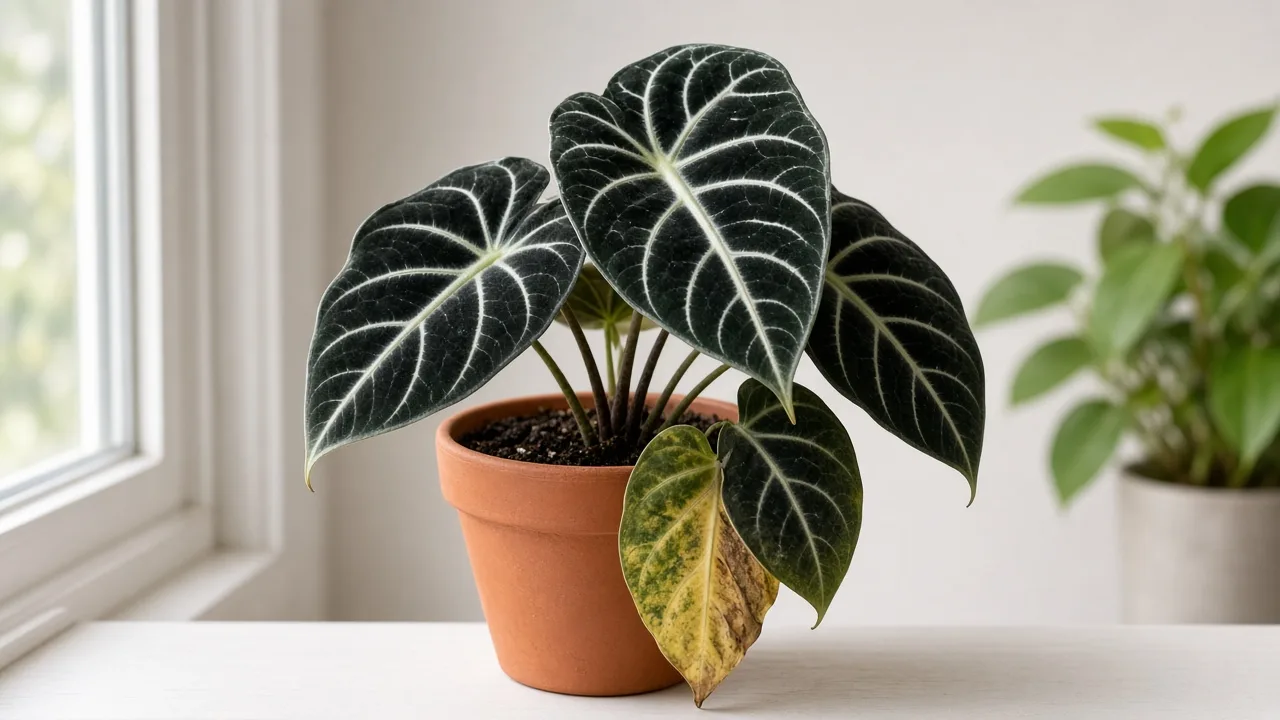
Root Rot on Alocasia Black Velvet: Causes, Checks & Fixes
This guide covers root rot on Alocasia Black Velvet. See also the general Root Rot guide, watering, and light pages for this plant.
Root Rot on Alocasia Black Velvet: Causes, Checks & Fixes
Quick answer
Root rot on Alocasia Black Velvet (Alocasia reginula ‘Black Velvet’) is decay of the corm and shallow root system in soil that has stayed too wet too long—not a mysterious airborne disease. On this compact jewel alocasia, rot usually starts underground while the velvet crown still looks acceptable for a few days. The signature trap: limp, yellowing leaves on wet, heavy soil—wet-wilt—while the fuzzy bullate foliage makes the plant look merely thirsty.
First step: stop watering and unpot the plant today. Rinse old mix from the roots, inspect every root and the corm at the soil line, and decide salvageability by corm firmness—not leaf count. A firm corm with mushy roots is the rescue case: trim, air-dry, repot dry into a snug pot, hold water. A soft, foul-smelling corm means focus on any firm offsets—see Alocasia Black Velvet propagation.
For how chronic wet mix damages roots in general, see our root rot guide. On Black Velvet, the pattern usually shows up faster than on larger alocasias because the corm is smaller, the root system is shallow, and an oversized pot holds days of excess moisture around tissue that cannot tolerate it.
Caught wet soil before roots turned mushy? Start with overwatering on Alocasia Black Velvet—early saturation rescue is simpler than full rot surgery.
What root rot looks like on Alocasia Black Velvet
Root rot is a progression from oxygen-starved roots to pathogen colonization to corm failure. On Black Velvet’s compact rosette—typically 20–40 cm tall with only a handful of velvet leaves—symptoms often climb from the bottom up while the crown still looks intact briefly.
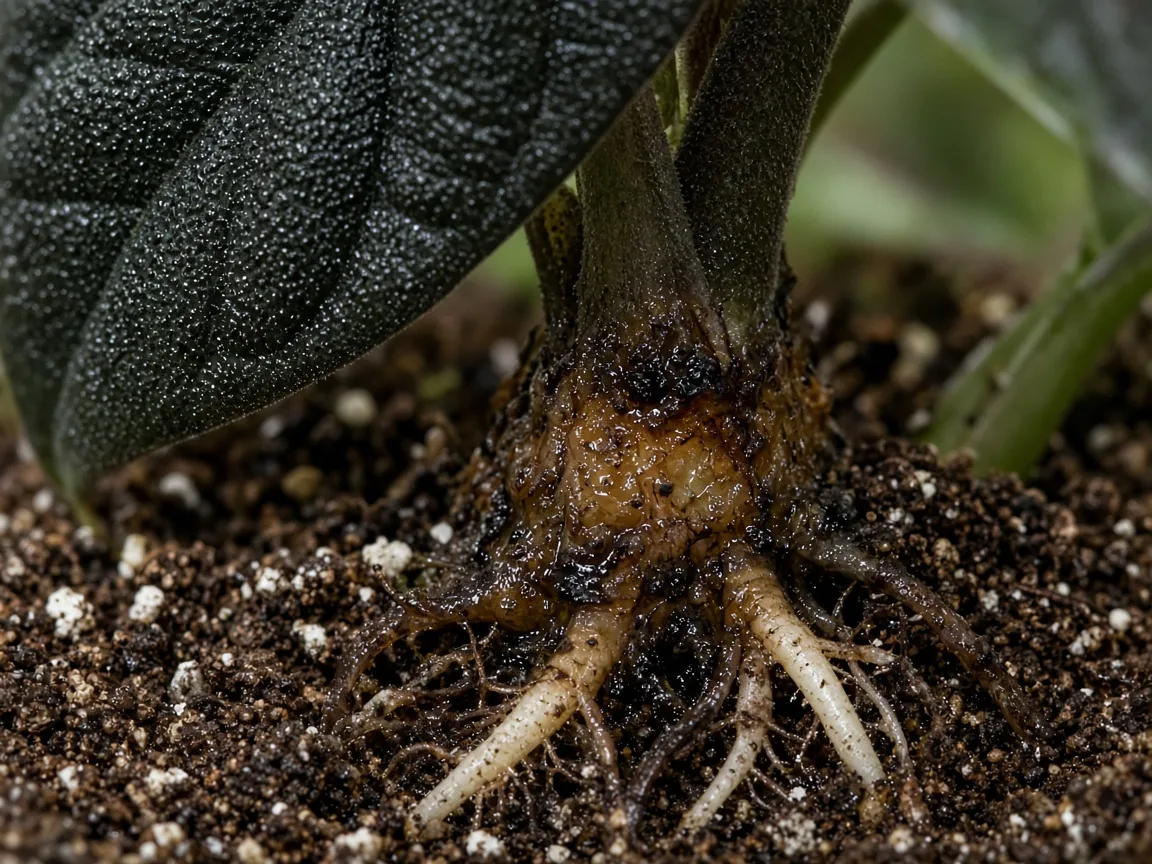
Root rot symptoms on Alocasia Black Velvet — compare mushy tissue at the soil line with firm healthy corm flesh.
Early signs (still time to act)
- Soil stays wet 5+ days after a normal watering in a pot that should dry faster
- Yellow lower leaves while mix remains damp—not the single aging leaf Black Velvet naturally sheds
- Faint sour or swampy smell when you lift the pot or disturb the surface
- Limp velvet leaves despite wet soil—wet-wilt; functional roots are failing
- Fungus gnats hovering over the pot—wet substrate attracts them
- Leaf count stuck at 1–2 when the plant should carry 3–5 leaves in adequate light
- New leaves emerging smaller, thinner, or paler than the previous velvet blade
Advanced signs (confirmed rot)
- Brown, slimy, or translucent roots when you unpot—healthy roots are pale tan to white and firm
- Mushy tissue at petiole bases or the soil line where velvet stems meet mix
- Corm softening, discoloration, or foul odor at the soil line
- Multiple leaves yellowing and collapsing within days with no firm new growth
- Petioles turning brown and collapsing despite moist soil
Compare with underwatering: a light dry pot, crispy brown leaf edges, and leaves that perk after one thorough soak point away from rot. Compare with wilting for the wet-soil versus dry-soil fork before you unpot.
Why Alocasia Black Velvet gets root rot
The small corm makes rot fast—and salvage possible
Black Velvet is a leaf-and-corm system, not a deep-rooted foliage plant. The underground corm—a starchy storage organ smaller than on Alocasia Polly—holds water and energy for the next velvet leaf. When soil stays saturated, water displaces oxygen from pore spaces, fine roots die, and pathogens like Pythium and Phytophthora colonize weakened tissue. The corm suffocates after roots fail.
That biology creates an asymmetry rescue teams rely on: underwatering is recoverable because the corm holds reserves; overwatering and rot attack the corm directly. A firm corm with rotten roots is salvageable. A mushy corm is not. Judge survival by squeezing the corm, not by whether the last velvet leaf still looks dark.
Snug pots, slow roots, and the overpotting trap
Black Velvet prefers a snug container—often 10–15 cm diameter for a mature plant. An oversized pot surrounds a small root ball with wet, oxygen-poor soil that never dries at the bottom even when the top 2–3 cm feels acceptable. NC State Extension notes that alocasias need moist, well-drained soil—dense or waterlogged mix at the bottom of an oversized pot fails that requirement even when you water carefully.
Velvet leaves hide wet-wilt longer than glossy alocasias
The bullate, hair-covered leaf surface traps moisture on the blade and can make a stressed plant look merely dull rather than obviously collapsed. Do not interpret slight leaf droop as thirst when the pot is heavy. Lift the pot and check the corm before adding water—calendar watering on velvet alocasias is how rot reaches the corm before surface symptoms spread.
Dormancy, cool rooms, and the empty-pot trap
In fall and winter, Black Velvet often slows or drops every leaf while the corm rests below the surface. A dormant plant pulls very little water while cool rooms slow evaporation—soil stays wet for weeks on a summer schedule. The RHS Alocasia growing guide warns that overwatering especially while dormant can rot roots. Combined with temperatures below 16 °C, prolonged moisture creates ideal conditions for rot to reach the corm before you notice anything above soil. See the Alocasia Black Velvet watering guide for winter dormancy protocol—and do not confuse a bare dormant pot with rot until you check corm firmness.
Heavy mix, blocked drainage, and cachepots
Dense peat-heavy mix holds water at the bottom while the top inch dries—finger tests lie. Blocked drainage holes and cachepots without drainage turn every watering into a standing-water event. Bottom-watering is fine when you empty saucers promptly; a pot sitting in runoff is a rot setup on a plant whose roots cannot outgrow wet zones quickly.
Root rot vs. overwatering on Alocasia Black Velvet
These pages overlap because overwatering is the usual cause and root rot is the result—but the action differs.
| Stage | Soil | Roots on inspection | Corm | What to do |
|---|---|---|---|---|
| Early overwatering | Wet 4+ days; sour smell possible | Mostly firm pale roots; maybe a few brown tips | Firm | Stop water; let top 2–3 cm dry—see overwatering guide |
| Intermediate rot | Wet; multiple yellow leaves | Mix of firm and mushy roots | Firm | Unpot, trim mushy roots, repot dry—this page |
| Advanced rot | Wet; petioles mushy at base | Mostly brown, slimy roots | Soft spots or softening | Aggressive trim or offset salvage |
| Corm lost | Wet or dry; collapsed plant | No firm roots remain | Mushy throughout | Propagate firm offsets or discard—see propagation |
Escalate from overwatering to rot surgery when you smell sour soil, see wet-wilt spreading to multiple leaves, or find any brown slimy roots on a spot check. Waiting for “more proof” is how small corms are lost.
How to confirm root rot
Unpot and inspect roots
Tip the pot on its side and work the root ball loose gently—Black Velvet’s shallow roots tear easily. Rinse or shake off old mix so you can see roots and the corm clearly. Healthy Alocasia roots are pale tan to white and firm—they snap cleanly when trimmed. Rotted roots are brown, black, translucent, or jelly-like; they may smell sour or like rotting vegetation. Wilting with moist soil often means roots cannot absorb water because they are decaying—do not interpret that as thirst.
Trim a suspicious root: cut until you reach firm white tissue. If every cut stays brown and mushy, rot is advanced.
The corm firmness test
Brush soil from the base of the petioles. A healthy Black Velvet corm feels firm, slightly waxy, and potato-like—uniform tan-brown color. Press gently with a thumb:
- Firm corm + mushy roots → salvageable; proceed with trim-and-repot below
- Small soft spots on otherwise firm corm → carve back to firm flesh, dust cuts, air-dry
- Soft, sunken, or foul-smelling corm → main plant unlikely to recover; search for firm daughter corms in the mix
- Papery, collapsed corm → dead; dispose of mix and sterilize the pot
This test matters more on jewel alocasias than on most houseplants because the corm—not just roots—determines whether new velvet leaves can ever push again.
The first fix to try
Stop watering immediately. Move the pot to bright indirect light—not deep shade, which slows drying. Empty any saucer water. If the corm is still firm and only a few roots look brown, you may stabilize by letting the top 2–3 cm of mix dry and monitoring for 3–5 days.
If soil smells sour, multiple leaves are yellowing on wet mix, or any root is mushy on a spot check—unpot today. Do not wait for more leaves to collapse. Do not fertilize. Do not mist heavily onto velvet foliage—stagnant water on bullate leaves invites fungal spotting while roots are failing. The first correct action is inspection, not another treatment stack.
Step-by-step recovery (firm corm required)
This sequence assumes the corm is mostly firm after inspection. If the corm is mushy throughout, skip to when to propagate instead.
Step 1: Unpot and rinse. Remove all old mix from roots and corm. Work under lukewarm running water or in a basin so you can see every root and any small daughter corms.
Step 2: Trim all rotted tissue. With sterile scissors or a blade, cut away every brown, mushy, or foul-smelling root back to firm white tissue. If the corm has soft spots, carve them out until you reach solid flesh. Sterilize blades between cuts with rubbing alcohol if rot is extensive. Wear gloves—alocasia sap can irritate skin.
Step 3: Dust cuts and air-dry. Dust trimmed roots and corm cuts with ground cinnamon (a mild natural antifungal) or a powdered fungicide labeled for ornamentals. Lay the plant on a paper towel in bright indirect light for 12–24 hours so cut surfaces callus.
Step 4: Repot into fresh airy mix in a snug pot. Use a chunky aroid blend—see the Alocasia Black Velvet soil guide for proportions (roughly equal parts peat-free compost, perlite, and orchid bark). Scrub reused pots with dilute bleach solution and rinse thoroughly, or use a clean pot sized to the trimmed root mass—not two sizes up. Plant the corm shallowly—top of corm at or just below the soil surface, never buried deep in wet mix. See repotting for depth and pot sizing.
Step 5: Hold water 7–10 days. Cut roots need oxygen to heal. Resist soaking “to help recovery.” After the hold, give a light watering—about half your normal amount—only when the top 2–3 cm is dry.
Step 6: Warmth and humidity. Target 21–24 °C with ambient humidity around 65–80%—a clear bag with air holes or a humidity dome works short term. Use a humidifier rather than misting velvet leaves directly. Bright indirect light; avoid direct sun on a stressed plant.
Step 7: Hold fertilizer until new growth. Wait until at least one new velvet leaf has fully unfurled before resuming half-strength balanced feed. Salt stress on healing roots delays recovery.
Recovery timeline and what to expect
| Severity | What you did | Stabilization | New roots / shoot | Full new leaf |
|---|---|---|---|---|
| Mild — few mushy roots, firm corm | Trim + repot + hold water | 3–7 days without spread | 2–4 weeks | 2–4 months |
| Moderate — 30–70% roots removed, firm corm | Full surgery above | 1–2 weeks | 2–6 weeks | 2–4 months |
| Severe — most roots gone, firm corm | Aggressive trim + warmth | 2+ weeks; may drop all leaves | 4–8 weeks | 4+ months |
Damaged velvet leaves rarely re-green. Yellow or collapsed foliage will not regain turgor or restore the matte finish. Judge success by corm firmness and a new leaf from the center—not by saving old blades. Trim fully collapsed leaves only after the plant pushes one healthy new leaf.
Signs of improvement: corm stays firm; no new sour smell; first new petiole or velvet leaf tip emerging from the center.
Signs of failure: corm softens further; black tissue climbs petioles; sour smell returns after repot despite dry hold period.
Lookalike symptoms
| Symptom pattern | Pot / soil | Roots if checked | Likely cause |
|---|---|---|---|
| Wet-wilt, sour smell, mushy roots | Heavy, wet | Brown, slimy | Root rot (this page) |
| Wet soil, limp leaves, firm roots | Heavy, wet | Mostly pale and firm | Early overwatering—act before rot |
| Dry wilt, crispy edges, light pot | Light, dry | Shriveled but firm | Underwatering |
| Limp after repot, moist fresh mix | Medium | Firm; disturbed | Transplant shock—hold normal rhythm 1–2 weeks |
| All leaves dropped, bare mix, winter | Lightly moist | Firm corm below surface | Dormancy—reduce water, do not repot |
| Gradual petiole sag over weeks | Varies | Often firm until late | Drooping leaves—slower posture change |
| Lower yellow leaves, firm corm, drying mix | Medium | Firm | Yellow leaves—may be light or age, not rot |
What not to do
- Do not keep watering because velvet leaves look wilted when soil is already wet. Watering a wilted plant with rotting roots makes the problem worse.
- Do not repot into dense garden soil or a pot without drainage.
- Do not bury the corm deeper during emergency repot—shallow planting is critical on Alocasia.
- Do not overpot into a large container “to give roots room”—excess wet soil kills slow Black Velvet roots.
- Do not mist velvet foliage as a humidity fix during rot recovery—use a humidifier instead.
- Do not reuse rotted mix or skip pot sterilization—pathogens persist in old substrate.
- Do not fertilize a recovering plant until new growth proves roots are working again.
- Do not assume green leaves mean a healthy corm—inspect underground tissue directly.
How to prevent root rot next time
- Water when the top 2–3 cm of mix feel dry—not on a calendar. The RHS recommends checking the top 5 cm before watering in the growing season.
- Use airy aroid mix and refresh it every 1–2 years before compaction traps moisture at the bottom—see soil guide.
- Size pots to the root ball—snug containers dry predictably; oversized pots hold excess wet soil.
- Empty saucers within 15 minutes after every watering.
- Reduce winter watering sharply when growth pauses; let the top half of mix dry between sparse drinks.
- Keep temperatures above 16 °C during the growing season and avoid drenching cool dormant plants. Proven Winners notes that overwatering in winter is the most common alocasia killer.
- Log pot weight weekly—a sudden heavy feel after your normal interval is an early warning before roots turn mushy.
When to propagate instead
Propagation is the salvage path when the main corm is lost but firm daughter corms or offsets remain.
Propagate when:
- Corm is mushy throughout after trimming—no firm tissue left
- All leaves collapsed and main corm is hollow or foul-smelling
- You find a firm smaller corm in the mix while the parent rots
Do not propagate when:
- The only corm is soft—offsets pulled from a dying plant rarely establish
- You have not sterilized tools and fresh mix—re-infection is common
See the Alocasia Black Velvet propagation guide for corm and offset protocol. A firm rescued corm in fresh mix often outperforms a marginal offset from a severely rotted parent.
When to worry
Act today when multiple leaves wilt on wet soil, the corm softens, petioles are mushy at the base, or most roots are slimy on inspection.
Patience is reasonable when you caught sour smell early with a firm corm, only one lower leaf yellowed, or you just completed trim-and-repot and are in the 7–10 day dry hold.
A hollow corm with no firm tissue after corrected care is an honest stopping point—not a failure of effort, but a biology limit on a slow-growing jewel alocasia.
Related Alocasia Black Velvet guides
- Alocasia Black Velvet watering — rhythm, dormancy, and detailed rot prevention
- Overwatering — early wet-soil rescue before roots turn mushy
- Wilting — wet-wilt vs dry-wilt fork
- Repotting — emergency repot depth and snug pot sizing
- Soil — chunky aroid mix for recovery
- Propagation — corm salvage when the main plant is lost
- Underwatering — dry wilt and crispy edges
- Fungus gnats — wet-soil early warning pest