Yellow Leaves on Alocasia Black Velvet: Velvet Leaf Checks
Quick answer
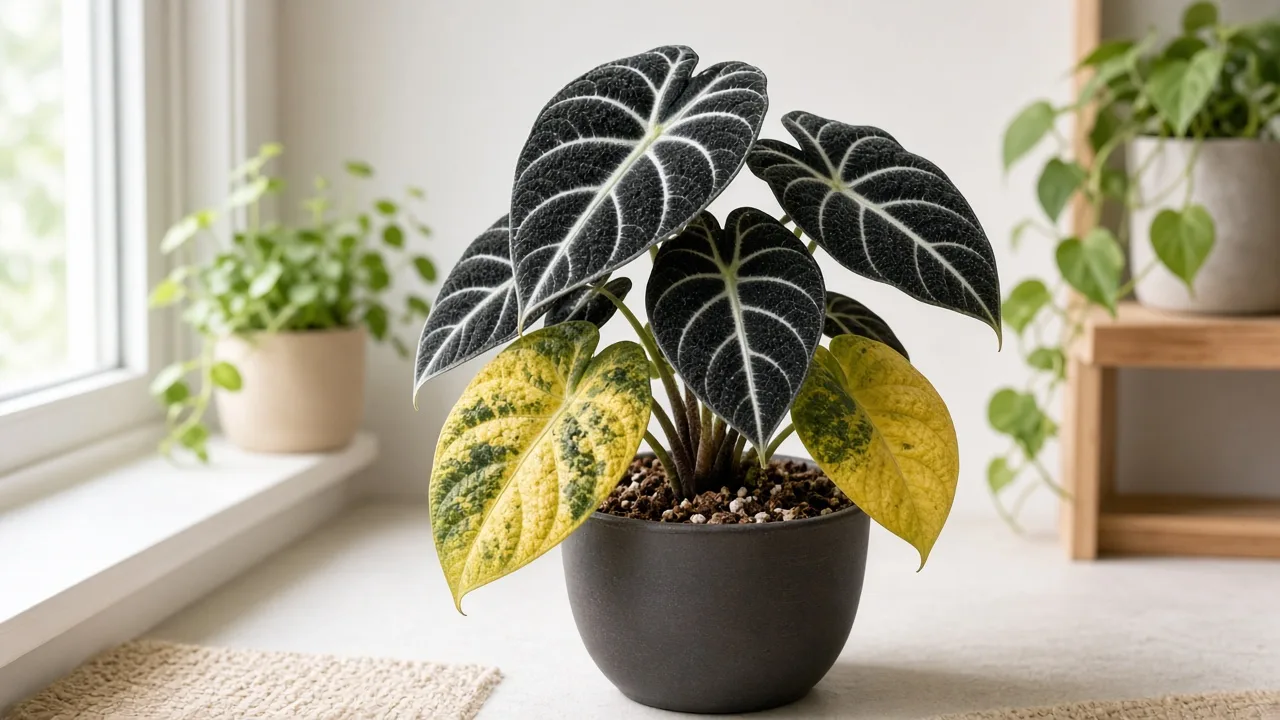
Yellow leaves on Alocasia Black Velvet usually start on the oldest lower bullate blades—often with dull gray-green veining—while a firm underground corm may still push new velvet foliage. First step: lift the pot and probe whether the top 2–3 cm of mix is dry or still damp before you water, feed, or repot.
Yellow Leaves on Alocasia Black Velvet: Causes, Checks & Fixes
This guide covers yellow leaves on Alocasia Black Velvet. See also the general Yellow Leaves guide, watering, and light pages for this plant.
Yellow Leaves on Alocasia Black Velvet: Causes, Checks & Fixes
Quick answer
Yellow leaves on Alocasia Black Velvet are a pattern problem on bullate velvet foliage, not a single diagnosis. Black Velvet holds slow, compact clumps of matte black leaves with stark white veining on short stiff petioles; trouble usually starts on the oldest lower bullate blades closest to the soil line—or spreads across several lowers when a heavy wet pot sits in a dim room where this jewel alocasia barely uses moisture.
For how chlorosis develops on houseplants in general, see our yellow leaves hub. On Black Velvet, the decisive split is pot weight plus which velvet blades yellow—and whether new crown growth still carries crisp white veining, not whether one leaf aged out while the corm still looks fine.
First step: lift the pot and probe whether the top 2–3 cm of mix is dry or still damp. If the upper layer is wet while lower bullate leaves yellow, do not add water. That single pause lets you read wet-corm stress versus normal senescence before repotting, fertilizer, or pesticide.
When to use this page vs other Black Velvet guides
This page is the symptom-first entry for yellow velvet foliage on a jewel alocasia.
| Pattern | Read next |
|---|---|
| Heavy wet pot + several yellow lower bullate leaves | Overwatering |
| Soft corm + sour mix + mushy roots | Root rot |
| Light dry pot + crisp curled margins | Underwatering |
| Fading white veins + long bare petioles in shade | Not enough light |
| Uniform pale oldest lowers, smaller new blades | Nitrogen deficiency |
| Yellow between veins on old bullate leaves | Magnesium deficiency |
| Yellow new crown blade with green veins | Iron deficiency |
| Brown crispy edges, adequate moisture | Low humidity |
| Every leaf yellows then drops, firm corm below | Winter dormancy—stay here |
| One bottom bullate leaf only while white-veined flush unfurls above | Normal aging—stay here |
| Long-term dry-down rhythm after recovery | Watering guide |
What yellow leaves look like on Alocasia Black Velvet
Healthy Black Velvet holds matte black bullate leaves with stark white veining on short stiff petioles in a tight 20–40 cm clump. Yellowing changes that signature in ways that map to root zone, light, humidity, or age.
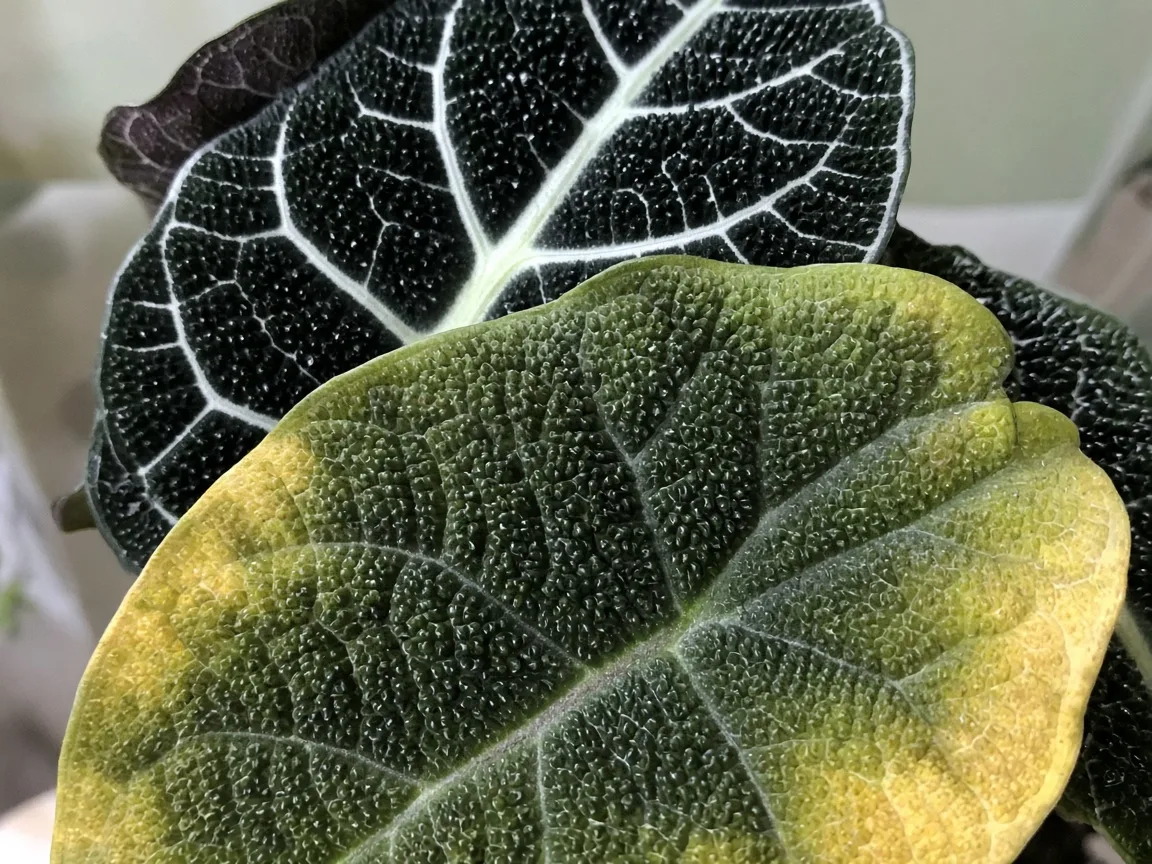
Yellow lower bullate blade at the soil line—compare dull gray-green veining with the crisp white-veined velvet leaf still emerging at the crown.
Typical signs:
- Bottom-up pattern — oldest lowers yellow first, often while upper velvet blades still look acceptable
- Vein wash-out — white veining dulls to flat gray-green before the blade turns fully yellow
- Limp on wet soil — bullate leaves hang on a heavy pot; this is wet-root stress, not thirst
- Pale overall clump — entire plant washes lighter green-yellow when light is too dim
- Whole-plant fade before leaf drop — every blade yellows in sequence during autumn dormancy while the corm stays firm below
Black Velvet carries only three to five leaves at a time. One yellow lower leaf can look dramatic on such a small plant—even when the corm is healthy.
How bullate velvet leaves show stress differently
The hair-covered bullate surface that makes Black Velvet iconic also changes how yellowing reads. On thin-leaved alocasias, chlorosis often looks evenly pale. On velvet foliage, white veining fades first—the contrast between vein and blade softens to gray-green before the matte black dulls to yellow-green.
That matters because owners sometimes wait for obvious yellow patches while the diagnostic clue was already visible in the veins. Do not mist bullate leaves to “help” fading foliage—water droplets sit in the hairs, leave permanent marks, and do not fix root-zone problems. Raise humidity with a humidifier instead.
When new growth emerges with crisp white veining on deep matte black, the corm is usually functioning. When the newest unfurling blade opens pale with weak vein contrast, look at light and root moisture together—not fertilizer first.
The compact leaf-count light meter
Black Velvet in adequate bright indirect light typically holds three to five velvet leaves at once. A plant that chronically keeps only one or two small pale blades in a dim corner is telling you it cannot photosynthesize enough to sustain a full crown—lower leaves yellow and drop because the corm cannot support them.
This is not the same as a healthy plant shedding one old lower leaf while pushing a new white-veined blade. The light-stress pattern adds small new growth, long thin petioles, and an overall washed-out look across multiple leaves. Moving closer to filtered window light often stabilizes yellowing within one growth cycle—without any repot.
Dormancy yellowing vs. sick yellowing
Black Velvet may drop every leaf in late autumn or winter while the underground corm stays alive. During dormancy, reduce watering to a minimum—overwatering while dormant can cause roots to rot Leaves yellow in sequence, then detach, leaving bare mix with a firm corm below.
Dormancy clues:
- Timing aligns with shorter days and cooler room temperatures
- Yellowing climbs through all leaves over weeks, not overnight
- Corm still firm when you press at the soil line
- No sour smell from drain holes
- Overwatering in winter is the most common alocasia killer—not the leaf loss itself
Sick-corm clues:
- Rapid yellowing on chronically wet mix in any season
- Mushy petioles at the soil line
- Sour or musty odor from drainage holes
- Soft corm when pressed gently
If dormancy is likely, stop fertilizing, reduce water to every 2–4 weeks only when the top 2–3 cm has fully dried, and wait for spring. Do not repot an empty-looking pot mid-winter.
Why Alocasia Black Velvet gets yellow leaves
Overwatering (most common)
Yellowing leaves on alocasias can occur from overwatering Black Velvet’s underground corm and fine roots rot quickly in saturated chunky aroid mix—especially in an oversized pot or cachepot that traps water.
Pattern: lower bullate leaves yellow first, white veining dulls, pot feels heavy, mix stays dark and cool for days. Limp leaves on wet soil are the classic trap—owners water again because foliage looks thirsty.
See the dedicated overwatering guide for wet-corm recovery steps.
Underwatering
Extended dry-down shrinks roots and stresses the corm. Lower leaves yellow and crisp at the margins; the pot feels light; top 2–3 cm of mix is dusty dry. Yellowing can also result from too little water
Underwatering yellow is usually paired with drooping leaves and dry pale mix—not a heavy damp pot.
Insufficient light
Inadequate light can yellow alocasia foliage Black Velvet tolerates slightly lower light than thin-leaved elephant ears, but chronic shade produces pale yellow-green blades, weak vein contrast, and a crown that never fills out.
Low light plus wet mix is especially dangerous—the plant uses less water while roots stay saturated. Leggy growth on damp soil is a dual warning.
Low humidity
Dry indoor air below 50% rarely yellows velvet leaves alone, but it often pairs with brown crispy edges on the same blade. If yellowing spreads with intact margins and adequate moisture, humidity is probably not the primary cause—check the root zone first.
Nutrient deficiency
Mobile nitrogen deficiency shows on older lowers first—uniform pale yellow without wet-soil clues. If new velvet blades are also small and washed out after months without feed, see nitrogen deficiency. Do not fertilize a stressed corm on wet soil to “green up” yellow leaves.
Pests
Alocasias are prone to spider mites Mites are harder to spot on dark bullate leaves—look for fine stippling, pale dots, and webbing between petioles. Pest stress yellows leaves unevenly, often with distorted new growth. Check spider mites on Black Velvet before assuming a watering problem.
Normal old-leaf senescence
One lowest bullate blade yellowing while a firm corm pushes crisp new velvet growth is normal. Black Velvet sheds older leaves to redirect energy. Remove the fully yellow blade at the petiole base once it detaches easily—do not pull living tissue.
How to confirm the cause
Work through these checks in order:
- Lift the pot. Heavy and cool with yellowing lowers points to wet mix. Light with dry top layer points to underwatering.
- Probe the top 2–3 cm. Damp soil plus yellow lowers confirms excess moisture—not thirst.
- Read the vein contrast. Dull gray veining on lowers with crisp white veins on new growth suggests aging or early wet stress. Washed veins on new blades too points to light or nutrient issues.
- Press at the soil line. Firm corm with one yellow lower leaf is low urgency. Soft corm needs root inspection immediately.
- Count the leaves. Three to five healthy blades suggest adequate light. One or two pale small leaves in shade suggest not enough light.
- Check the calendar. Autumn/winter whole-plant yellowing on firm corm may be dormancy—not rot.
If soil is wet and leaves look thirsty, trust the roots—not the foliage. Wilting with moist soil often means rotting roots cannot take up water
The first fix to try
Stop watering and lift the pot before you fertilize, repot, prune heavily, or mist velvet leaves. Black Velvet’s most common yellow-leaf trigger is wet mix in a snug or oversized pot—not a missing nutrient.
If the top 2–3 cm is still damp and lowers are yellowing, let the mix dry down. For a firm corm with early lower-leaf yellow on wet soil, that single dry-down pause often stops spread within one to two weeks. Resume only when the top layer has dried and the pot weight has dropped noticeably.
Only after you have read moisture should you adjust light or inspect roots. One variable at a time on a three-leaf plant.
Step-by-step recovery by likely cause
Wet mix, firm corm, early lower-leaf yellow:
- Stop watering until top 2–3 cm dries
- Empty cachepot standing water
- Move to bright indirect light with airflow—still within comfort range
- Resume on dry-down check only; see watering guide
Dry mix, light pot, crispy yellow edges on lowers:
- Soak until runoff, then empty saucer within 30 minutes
- Do not leave the pot sitting in water
- Monitor petiole firmness over 48 hours
Pale overall clump, weak new vein contrast, dim location:
- Move closer to filtered east or north window light
- Adjust watering after light improves—brighter spots dry faster
- Hold fertilizer until new growth looks healthy for two weeks
One lowest leaf only, firm corm, crisp new velvet blade:
- Remove the fully yellow leaf when it detaches easily
- No repot or feed needed—monitor the next growth cycle
Soft corm, mushy petioles, sour smell:
- Follow the root rot salvage guide immediately
- Accept that yellow bullate blades will not re-green
Autumn dormancy fade, firm corm:
- Reduce water to every 2–4 weeks when top layer is fully dry
- Stop fertilizer until spring growth returns
- Do not discard the bare pot
Recovery timeline
One yellow lower leaf on firm mix often needs no intervention beyond removing the spent blade—new white-veined growth may appear within two to four weeks in active season.
Wet-root stress on a firm corm typically stops new yellowing within 7–14 days once the mix dries properly. Limp bullate leaves on chronically wet soil may take two to four weeks to stabilize—or may not recover if the corm was damaged.
Judge recovery by:
- Firm corm at the soil line
- No new petiole mush at the base
- Fresh velvet leaves with crisp white veining from the crown
- Pot weight dropping between waterings on a predictable rhythm
Lower yellow leaves will not turn matte black again. Success is stopped spread and clean new growth—not re-greening old bullate tissue.
Lookalike symptoms
| What you see | More likely cause | Where to go |
|---|---|---|
| Yellow lowers, heavy pot, wet top 2–3 cm | Overwatering | Overwatering |
| Yellow lowers, light pot, dry mix | Underwatering | Underwatering |
| Rapid whole-plant flop, wet soil | Root uptake failure | Wilting |
| Limp blades, wet vs. dry split unclear | Moisture confusion | Drooping leaves |
| Pale small clump, weak veins, dim room | Low light | Not enough light |
| Yellow + brown crispy edges | Low humidity | Low humidity |
| Uniform pale oldest lowers, no wet-soil smell | Nitrogen deficiency | Nitrogen deficiency |
| All leaves yellow then drop, firm corm, winter timing | Dormancy | This page—reduce water |
| One bottom leaf only, crisp new growth | Normal aging | Monitor; no action needed |
Mistakes to avoid
- Watering because bullate leaves look limp without checking whether the pot is already heavy
- Misting velvet foliage instead of fixing root-zone moisture or using a humidifier
- Fertilizing yellow leaves on wet soil to push growth—confirm diagnosis first
- Repotting into a larger pot while roots are stressed on damp mix
- Discarding a bare winter pot with a firm corm below the surface
- Treating every yellow lower leaf as an emergency when only one oldest blade is senescing
How to prevent yellow leaves next time
Water when the top 2–3 cm of chunky aroid mix has dried—use finger, chopstick, or pot-weight change as your trigger. Black Velvet prefers a snug well-drained pot and should never sit in standing water.
Maintain 65–80% humidity with a humidifier rather than misting bullate leaves. Place the plant in bright indirect light so it actually uses the water you give it. Reduce watering 60–70% in autumn and winter when dormancy is likely.
Plants in waterlogged soil may die because roots cannot absorb oxygen—prevention is matching drinks to how fast this pot dries in your room.
When to worry
Treat as urgent if the corm feels soft, petioles are mushy at the base, several leaves yellow within days on wet mix, or drain holes smell sour. Black Velvet’s small leaf count means you have little buffer—advanced root rot can kill the plant before owners connect yellowing to watering.
A single aging lower leaf on firm mix with normal dry-down is low urgency. Monitor two weeks before escalating to repot or feed.
Related Alocasia Black Velvet guides
- Alocasia Black Velvet overview — full light, water, humidity, and dormancy baseline
- Alocasia Black Velvet watering — top 2–3 cm dry-down rhythm and pot-weight checks
- Overwatering on Alocasia Black Velvet — wet corm, heavy pot, dull veining on lowers
- Root rot on Alocasia Black Velvet — soft corm, mushy petioles, sour smell
- Not enough light on Alocasia Black Velvet — pale clump, weak vein contrast, few leaves
- Alocasia Black Velvet problems — browse all common issues on this species
Conclusion
Yellow leaves on Alocasia Black Velvet are a pattern read on bullate velvet foliage—not a reason to stack treatments on day one. Lift the pot, probe the top 2–3 cm of mix, and note whether white veining on new growth still looks crisp. Most cases trace to wet roots, dim light, or one aging lower blade on a firm corm. Recovery shows up as firm corm tissue and fresh matte black leaves with stark white veins—not as every yellow bullate blade turning green again.
Related tool
Use the Yellow Leaves Diagnosis Tool to narrow causes for yellow leaves on this plant before changing multiple variables at once.