Not Enough Light on Alocasia Black Velvet: Velvet Sheen
Quick answer
Not enough light on Alocasia Black Velvet shows as washed-out metallic veining on bullate leaves, a crown holding only one or two small blades, stretched petioles leaning toward a window, and potting mix that stays damp for weeks. First step: move the pot to the brightest filtered indirect spot you can offer—within one to three feet of an east or north window, or add a timed grow lamp—before changing water, fertilizer, or pot size.
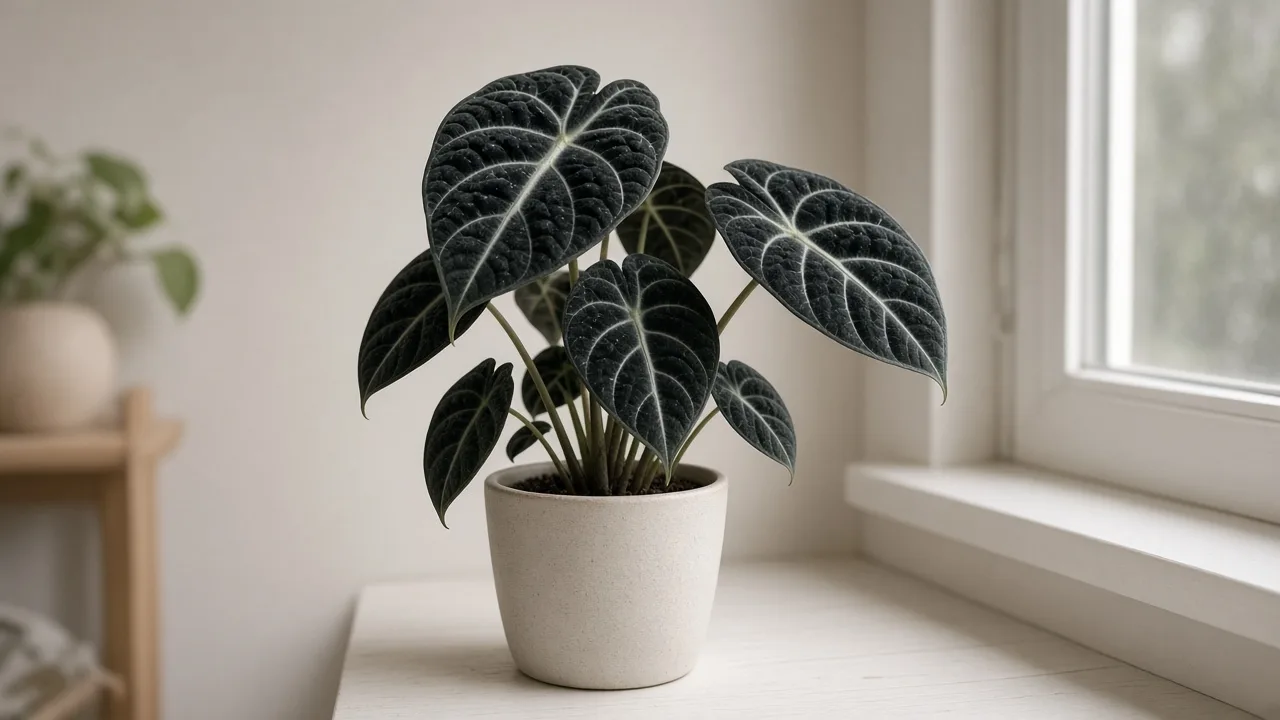
Not Enough Light on Alocasia Black Velvet: Causes, Checks & Fixes
This guide covers not enough light on Alocasia Black Velvet. See also the general Not Enough Light guide, watering, and light pages for this plant.
Not Enough Light on Alocasia Black Velvet: Causes, Checks & Fixes
Quick answer
Alocasia reginula ‘Black Velvet’ is a slow jewel alocasia from Bornean lowland forest whose bullate leaves evolved to harvest filtered canopy light—not to thrive on a dim shelf six feet from glass. The RHS alocasia guide notes that while alocasias can survive lower light, growth becomes much slower, plants lean toward the brightest direction, and winter dormancy is more likely when photons run short.
For how chronic low light limits houseplant growth in general, see our not enough light hub. On Black Velvet, the decisive clues are washed metallic veining on bullate blades, a crown holding only one or two small leaves, petioles stretching toward a single window, and chunky mix that stays damp for weeks because the corm is barely photosynthesizing.
First step: move the pot to the brightest filtered indirect location you can offer today—typically within one to three feet of an east- or north-facing window, or several feet back from sheer south or west glass—and add a timed full-spectrum grow lamp if no window delivers usable daylight at leaf level. Window placement detail lives in our light guide.
When to use this page vs other Alocasia Black Velvet guides
This page is the symptom-first entry for shade-stressed Black Velvet—dull velvet sheen, stalled leaf production, wet mix in dim rooms, and seasonal decline that looks like the plant is dying.
| Pattern | Read next |
|---|---|
| Long bare petioles with tiny crown leaves | Leggy growth |
| Washed-out green without dramatic stretch | Pale leaves |
| Yellow lower leaves on heavy wet pot | Overwatering or root rot |
| No new leaves but light seems adequate | Slow growth |
| Bare pot, firm corm, cold season | Overview dormancy section — often normal |
| Placement, foot-candles, grow lights | Light guide |
| Water schedule after a dim move | Watering guide |
| Full problem index | All Black Velvet problems |
What not enough light looks like on Alocasia Black Velvet
Healthy Black Velvet builds a compact jewel crown: matte black bullate leaves with embossed white veins on short upright petioles, typically three to five firm blades at once indoors. Shade stress on this cultivar often hides behind the dark foliage longer than on pale-variegated houseplants—the plant still reads “black velvet” from across the room while already failing.
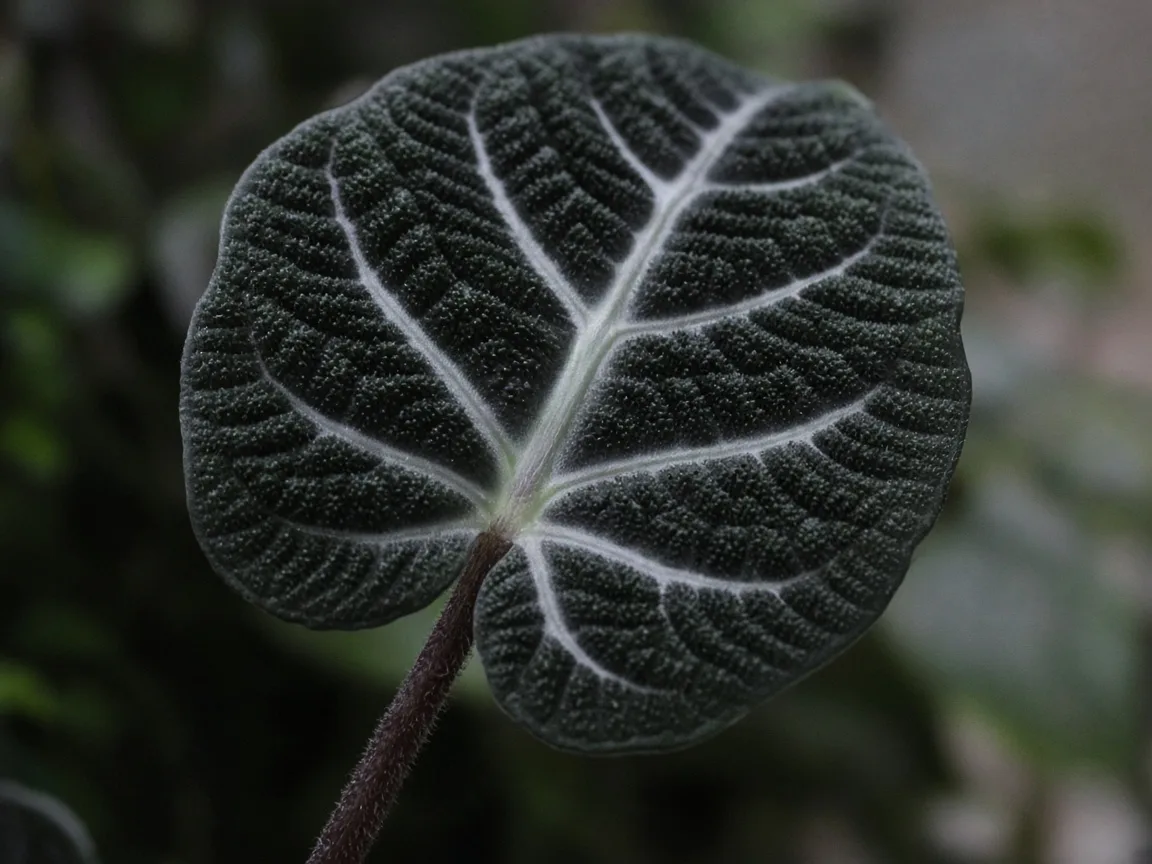
Metallic vein contrast collapsed on a new bullate blade—compare the flat white lines here with the crisp embossed veining on healthy Black Velvet in brighter filtered light.
Typical signs on this species:
- Washed metallic veining — The dark green leaf field stays matte black, but white veins look smeared or flat instead of reptilian. This is often the earliest low-light signal before obvious stretch.
- One or two small velvet blades on long petioles — In adequate filtered light Black Velvet maintains a fuller crown; shade-stressed plants hold fewer leaves that each look undersized.
- Lean toward the brightest gap — New petioles and unfolding blades orient toward a window crack, monitor glow, or doorway light; the small pot may angle with the stretch.
- No new unfurling leaf across a warm indoor season — Black Velvet is naturally slow, but zero new bullate blades for eight or more weeks in a heated room points to insufficient usable light or coupled root stress.
- Pot stays heavy ten to twenty-one days after watering — Dim light reduces transpiration; owners who keep a summer watering calendar in a darker corner often trigger yellow lower leaves and corm stress.
- Seasonal leaf drop that starts in a dim spot — Persistent low light plus short winter days can push dormancy—yellowing, drooping, then bare mix with a firm corm below.
NC State Extension describes alocasia light as dappled sunlight or partial shade—filtered brightness, not a closed interior hallway or a desk lamp used ten minutes a day.
Metallic vein contrast: Black Velvet’s light meter
The fastest diagnostic on this cultivar is not a lux number—it is the contrast between the dark green leaf field and silvery white veins on the newest unfurling blade. When filtered light is adequate, those veins look embossed, almost reptilian. When photons run short, the sheen washes out and the leaf reads as flat dark green before petioles stretch dramatically.
| What you see on Black Velvet | What it usually means | First adjustment |
|---|---|---|
| Veins look flat; bullate texture still present | Early shade stress | Brighter filtered spot; measure at leaf height |
| Smaller new blade on longer petiole | Active etiolation for photons | Move closer to window or add grow lamp |
| One leaf only, mix wet ten+ days | Shade slowed water use | Brighten light and extend dry-down before next water |
| All leaves dull in interior room | Below productive light band | Timed LED ten to twelve hours daily; do not fertilize first |
| Crisp embossed veins return on next two leaves | Diagnosis confirmed | Hold new placement; adjust watering to match |
If dulling appears with sticky new growth and insects, inspect for aphids or spider mites before blaming light alone.
Why Alocasia Black Velvet gets not enough light
Black Velvet is not a deep-shade plant despite its dark foliage. The bullate cuticle evolved under a Bornean rainforest canopy to capture filtered photons—not to live on a bookshelf far from glass. When light runs short, the compact corm allocates energy toward reach and survival rather than the dense jewel crown collectors expect. Alocasias in lower light grow much slower and become lopsided unless rotated; on Black Velvet that slowdown shows up as duller new leaves, fewer blades, and longer petioles.
Black Velvet-specific triggers:
- Misreading “compact = low light.” Black Velvet stays small, but small does not mean dim. A shelf six feet from a window often keeps the corm alive while metallic veining fades over months.
- Deep interior placement. Indoor light falls off quickly with every foot from glass. A spot that prevents scorch is not always a spot that prevents shade stress.
- Winter daylight drop without supplemental light. Short days plus a north window can land below the upper medium light band Black Velvet needs for active leaf production—even when the thermostat stays warm.
- One-sided window light. Velvet leaves on the shaded side grow longer petioles; the pot develops a permanent lean the RHS recommends preventing by rotating at each watering.
- Overwatering in shade. NC State Extension notes alocasias need moist, well-drained soil—not saturated mix that never dries. Less light means less water use; yellow lower leaves on wet soil plus dull new growth need root-zone checks, not just a brighter window.
- Fertilizer without photons. Proven Winners warns that overwatering in winter is the most common alocasia killer; pushing fertilizer on an under-lit Black Velvet can salt-stress the corm while leaves stay dull.
Wet mix in dim rooms: the Black Velvet light–water trap
Jewel alocasias in dark rooms follow a predictable failure loop: less light → slower photosynthesis → slower water uptake → mix stays wet → corm rots → more yellow leaves.
Black Velvet owners often water when the top two to three centimetres of mix dry—sound advice in a bright bathroom or east window. After the same plant moves to a dim corner, that top layer may take two to three weeks to dry while the underground corm sits in stale moisture. This species rots faster than larger alocasias when overpotted or overwatered in shade.
Black Velvet-only check: lift the pot or probe near the corm. If you are still on a weekly pour schedule but the container feels heavy day ten while new leaves look dull, assume light dropped before you assume the plant “needs” more water. Fix placement first; then let the top two to three centimetres dry fully before the next irrigation.
Velvet petiole spacing vs winter dormancy
The hardest call on Black Velvet is whether you are seeing chronic under-lighting or winter dormancy—two very different patterns on the same slow-growing corm.
| Signal | Shade stress (needs light) | Winter dormancy (often normal) |
|---|---|---|
| Season | Spring through summer warm months | Late autumn through early spring |
| Leaves present | One or two small dull blades on long petioles | Zero leaves — bare mix with firm corm below |
| Vein contrast | Flat white lines on newest leaf | None until days lengthen |
| Lean | Clear tilt toward one window | No lean — nothing above soil to stretch |
| Soil rhythm | Mix may stay damp longer in dim rooms | Dries very slowly; reduced watering correct |
| Corm feel | Firm when you gently probe near surface | Firm; do not discard an empty-looking pot |
If every leaf dropped in November and the corm is still firm, hold reduced winter care per our watering guide—do not chase stretch that is not there. If one or two long-petioled dull leaves lean all summer, that is under-lighting and needs a light fix within weeks.
How to confirm the cause
Work through these checks in order:
- Light reading at leaf height — Use a phone lux meter pointed toward the brightest source, or the soft-shadow test from the light guide. Repeated readings under roughly 150 foot-candles (about 1,600 lux) at the canopy strongly support shade stress on actively growing Black Velvet.
- Vein contrast on newest leaf — Compare the unfolding bullate blade to an older firm leaf from a brighter period. Flat white veining plus smaller blade size points to low light.
- Leaf-count trend — Count active velvet blades. Drop from three or four leaves to one or two over a warm season, with duller new tissue, confirms under-lighting.
- Pot dry-down speed — Note days until the top two to three centimetres feel dry. Stretching past fourteen days in a heated interior often pairs with dim placement.
- Growth direction — If petioles lean or new bullate blades emerge on the side facing one window, Black Velvet is actively seeking light.
- Rule out lookalikes — Yellow lower leaves only on a soggy pot → overwatering. Dramatic bare petioles → leggy growth. Uniform pale wash without stretch → pale leaves. Fine stippling on undersides → spider mites.
If filtered daylight is clearly adequate and new leaves still fail, move to root health, pests, or cold drafts—not more shade.
First fix for Alocasia Black Velvet
Move the pot to the brightest filtered indirect location in your home.
Practical targets for jewel alocasia from our light guide:
- East-facing window — One to three feet from the glass; Black Velvet typically handles the full indirect day without scorch
- North-facing window — Often workable for compact growth; pull slightly closer in winter or add supplemental LED
- Bright bathroom — Good humidity plus filtered light is ideal if the window is genuinely bright—not a frosted interior room
- South or west window — Stay three to six feet back or behind sheer curtains; never place velvet leaves in hot direct rays
If no window passes a two-week leaf test, add a full-spectrum LED grow light six to twelve inches above the crown for ten to twelve hours daily.
Acclimate over seven to fourteen days if Black Velvet lived in very deep shade—sudden harsh sun can scorch bullate foliage and leave permanent marks on velvet hairs.
Do not fertilize, repot, or heavily prune on the same week you fix light. After the move, pause watering until the top two to three centimetres of mix dry on the new schedule. A brighter Black Velvet uses water faster; a dim one needs less.
Step-by-step recovery
Once brighter filtered light is in place:
- Week 1 — Hold position; let the top two to three centimetres of mix dry before watering; remove only mushy lower leaves.
- Weeks 2–4 — Watch for a new bullate flush. Embossed white veining and tighter petiole spacing on the next leaf confirm photons were the bottleneck.
- Weeks 4–8 — Two to three firm new leaves with readable metallic contrast mean stable improvement.
- If petioles are very stretched — After new growth looks stable, shorten the worst shoots per the pruning guide. Brighten first, then shape.
- Ongoing — Re-measure light after seasonal changes; rotate the pot at each watering so the crown does not lean and become unstable.
Recovery timeline
Black Velvet is a slow jewel alocasia, so recovery is measured in new leaves, not days.
- 2–4 weeks — First new velvet leaf after a light upgrade often looks smaller than ideal but should show sharper white veining than the last dull flush.
- 6–10 weeks — Two to three new leaves with improved metallic contrast indicate stable improvement.
- 3+ months — Old dull or stretched petioles remain unless pruned; the crown should hold more blades again over one or two growing seasons.
Worsening signs: progressive yellowing on a still-wet pot, soft corm tissue, new leaves that emerge smaller and weaker after a light move, or brown crispy patches on sun-exposed blades after a sudden jump to direct sun—pull back from glass and re-check roots before adding fertilizer.
Existing dull bullate tissue will not fully regain its reptilian sheen—judge recovery on compact new growth instead.
Lookalike symptoms
| Symptom pattern | Likely cause | Where to go |
|---|---|---|
| Flat veins, long petioles, window lean | Low light / etiolation | This page + leggy growth |
| Washed green, compact crown | Early shade or nutrient drift | Pale leaves |
| Yellow lower leaves, sour wet mix | Overwatering in dim room | Overwatering |
| Bare pot, firm corm, cold season | Winter dormancy | Overview |
| Fine webbing, stippled blades | Spider mites | Spider mites |
| Bleached patches on leaf faces | Too much direct sun | Light guide — pull back from glass |
Mistakes to avoid
- Keeping a summer water schedule after moving Black Velvet into a darker room — the fastest path to corm rot in shade.
- Fertilizing a dim, wet plant — salts accumulate when growth is minimal; fix light and dry-down first.
- Jumping to direct south or west sun to “fix” shade — velvet leaves scorch in hot direct rays; use filtered brightness, not raw afternoon beams.
- Misting bullate foliage to “help” a dull plant — stagnant water on velvet hairs invites fungal spotting. Use a humidifier per our low humidity guidance instead.
- Repotting into a larger container — a bigger wet root zone is the wrong response to shade on this rot-sensitive species.
- Discarding a bare winter pot — firm corm, zero leaves, cold season is often dormancy—not death.
- Judging health from across the room — dark velvet foliage hides dull veins until you inspect the newest crown flush.
How to prevent not enough light next time
- Site Black Velvet where bright filtered indirect light is realistic all year—not only where the velvet pot complements the room.
- Re-check brightness after furniture moves, outdoor tree shade, or grimy winter windows.
- Add a grow lamp in dark winters on a timer rather than accepting perpetual stagnation.
- Pair every light downgrade with a watering downgrade until the top two to three centimetres of mix dry on schedule.
- Scout the newest bullate leaf monthly — metallic vein crispness fails before the whole plant looks sick.
- Keep the plant in a snug pot with chunky aroid mix so roots and light stay in balance.
Judge success by a compact crown with three to five firm velvet leaves and crisp embossed veining, not height.
Related Alocasia Black Velvet guides
- Light requirements — foot-candle bands, window placement, and grow-lamp setup after you confirm shade stress
- Watering — dry-down checks that must slow when light drops
- Leggy growth — when stretched petioles, not just dull veins, are the main pattern
- Pale leaves — color wash without dramatic stretch
- Slow growth — compact pace vs abnormal stall
- Black Velvet overview — baseline care and dormancy expectations
Related tool
Use the Plant Problem Diagnosis Tool to narrow causes for not enough light on this plant before changing multiple variables at once.