Slow Growth on Alocasia Black Velvet: Corm & Season Checks
Quick answer
Slow growth on Alocasia Black Velvet is often normal winter dormancy, dim filtered light, or a wet corm—not a fertilizer shortage. First step: confirm the underground corm is firm, then check season and leaf count—if it is warm season with only one or two small leaves and no new flush in six weeks, move to brighter filtered indirect light and verify the top 2–3 cm of mix dries between waterings.
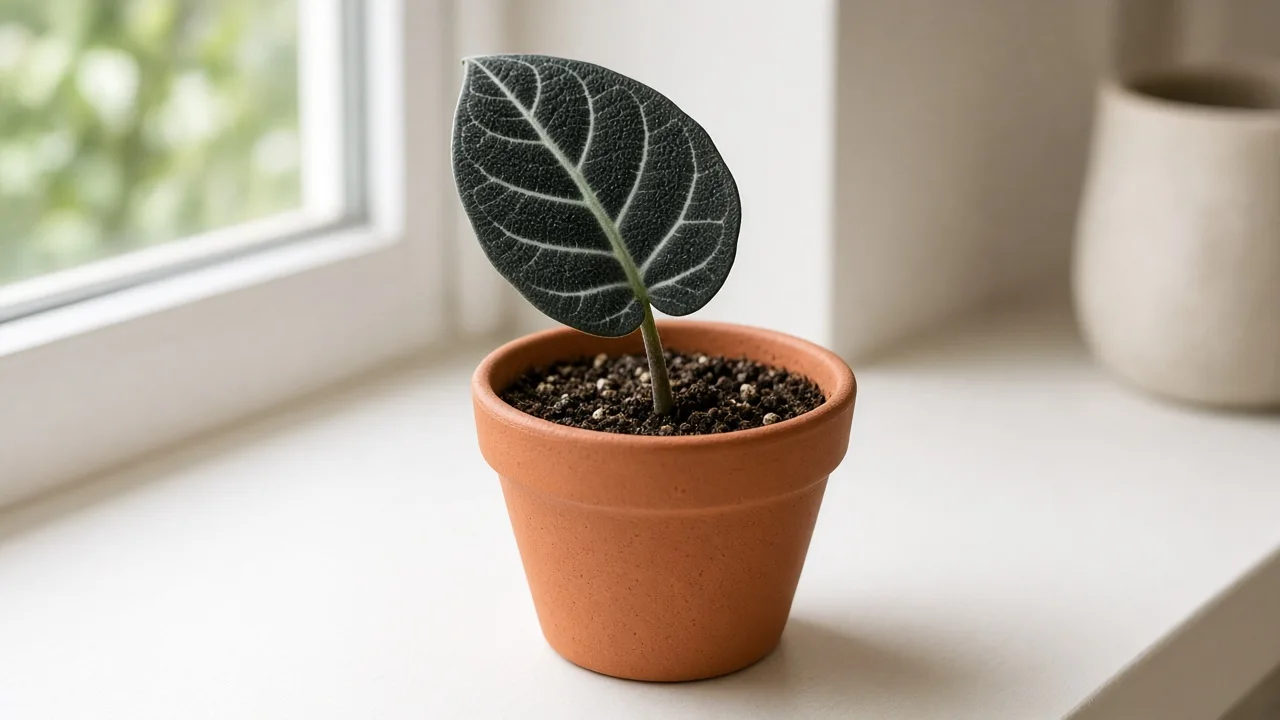
Slow Growth on Alocasia Black Velvet: Causes, Checks & Fixes
This guide covers slow growth on Alocasia Black Velvet. See also the general Slow Growth guide, watering, and light pages for this plant.
Slow Growth on Alocasia Black Velvet: Causes, Checks & Fixes
Quick answer
Slow growth on Alocasia reginula ‘Black Velvet’ is often normal for this species—a compact jewel alocasia with a small underground corm and a slow to moderate growth rate compared with taller hybrids like Alocasia × amazonica. In warm months you might see one new velvet leaf every three to six weeks when light, humidity, and drainage align. In winter, alocasias need a period of dormancy in cooler, drier conditions and may drop every leaf while the corm rests below the surface.
For how chronic stagnation works across plants in general, see our slow growth hub. On Black Velvet, the clock runs on corm firmness, seasonal dormancy, leaf count in the crown, filtered light intensity, and whether the top 2–3 cm of mix dries between waterings—not on a pothos-style weekly leaf flush.
First step: gently probe the soil surface for a firm corm, then read season and leaf count. If it is late autumn through early spring with zero leaves and a firm corm, hold reduced winter care per our watering guide—do not fertilize or repot. If it is warm season with only one or two small leaves and no new flush in six or more weeks, move the pot to brighter filtered indirect light and confirm the top 2–3 cm of mix dries before the next soak.
When to use this page vs other Alocasia Black Velvet guides
This page is the pace-and-stall entry when growth feels stuck—not when petioles stretch long toward a window.
| Pattern | Read next |
|---|---|
| Long bare petioles, lean toward light, tiny leaves | Leggy growth |
| Dim room but crown still compact, not stretched | Not enough light |
| Bare mix, zero leaves, firm corm in cold months | Overview dormancy section — often normal |
| Yellow lower leaves on wet mix that never dries | Overwatering or root rot |
| Crisp brown edges, dull velvet before stall | Low humidity or brown tips |
| Drooping blades, not just quiet growth | Drooping leaves |
| Window placement and seasonal light shifts | Light guide |
What slow growth looks like on Alocasia Black Velvet
Healthy Black Velvet in warm months maintains a compact jewel crown: matte black bullate leaves with crisp white veins on short upright petioles, typically 20–40 cm tall with blades 8–15 cm across. Slow growth is not always a crisis—it is the species temperament when conditions are merely adequate. Abnormal stall breaks that rhythm:
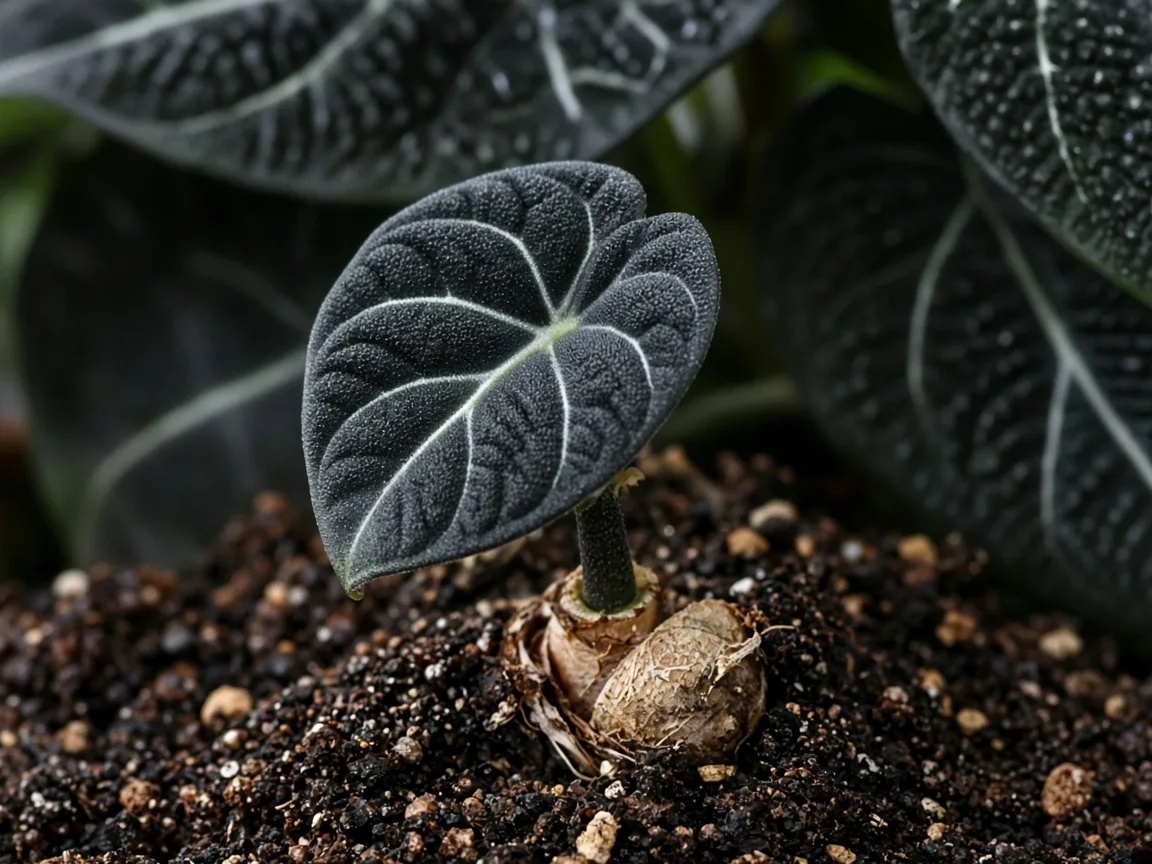
One firm velvet leaf held for months with no second flush at the crown—compare the stalled crown with the tight spacing you expect when Black Velvet is actively growing.
Typical signs on this species:
- One or two small leaves held for six or more weeks in spring or summer with no new unfurling blade at the crown
- Long gaps between velvet leaf flushes even when room temperature stays in the 18–26°C (65–80°F) comfort band
- Smaller newest leaves than older blades from when the plant sat in a brighter spot—without the long petioles of leggy growth
- A firm corm below bare mix in winter with zero leaves for weeks—often seasonal dormancy, not failure
- Mix that stays damp ten or more days while the crown produces nothing new—roots may be suffocating
- Quiet crown after repotting for three to six weeks while the corm rebuilds root tips in fresh mix
What slow growth usually does not look like on Black Velvet: long thin petioles leaning toward a window (leggy growth—a light-stretch problem), sudden whole-plant collapse on soggy soil (root rot—urgent), or three to five firm velvet leaves unfurling on a steady rhythm (that is healthy compact growth, not a stall).
Leaf count as Black Velvet’s growth speedometer
Black Velvet gives you a simple crown check that larger alocasias do not: how many velvet leaves the plant keeps at once, and how fast that number turns over. This is a Black Velvet-specific diagnostic because the compact corm limits how much foliage the plant can sustain.
- Three to five firm bullate leaves, new blade every three to six weeks in warm months — Adequate filtered light and drainage for this jewel species.
- Two small leaves, no new flush for six or more weeks in summer — Early stall; audit light and dry-down before fertilizing.
- One tiny leaf held for months while the pot sits far from glass — Light or root-zone bottleneck; move closer to filtered light and check whether mix dries.
- Zero leaves, firm corm, cool short days — Likely winter dormancy—hold reduced watering, not rescue feed.
- Leaves present but mix wet ten or more days — Dim light slowed transpiration; pair with watering checks before assuming hunger.
This leaf-count logic does not apply to fast-growing Alocasia Polly or vining pothos—it is about how many bullate velvet blades a compact corm can produce and hold in your actual room conditions.
Corm dormancy vs active-season stall
The hardest call on Black Velvet is whether you are seeing normal winter dormancy or an active-season stall—two very different patterns on the same slow-growing corm.
| Signal | Winter dormancy (often normal) | Active-season stall (needs a fix) |
|---|---|---|
| Season | Late autumn through early spring | Late spring through early autumn |
| Leaves present | Zero — bare mix, firm corm below | One or two small blades, no new unfurling leaf |
| Corm feel | Firm when you gently probe near surface | Firm or soft—soft means escalate to root check |
| Soil rhythm | Dries very slowly; water every 2–4 weeks | Stays damp ten or more days between intended waterings |
| Light | Shorter days; growth pause expected | Filtered light may be too weak for warm-month flush |
| New growth | None until days lengthen | Should see a new blade within weeks once fixed |
Alocasias in lower light grow much slower, but dormancy is a full pause driven by cooler, drier winter conditions—Proven Winners notes alocasias often go dormant in winter, ceasing feed and needing sharply reduced water while the corm lives on stored energy. Do not discard a bare winter pot with a firm corm. Do not treat a summer crown holding one leaf for months as patience when light and drainage are clearly off.
Why Alocasia Black Velvet grows slowly
Black Velvet evolved as a compact understorey plant in Borneo—not a weekly leaf machine. NC State lists Alocasia reginula at up to 1.5 feet tall with thick textured dark leaves—a fraction of giant elephant ear species that mature over hundreds of days in ideal outdoor conditions. Expecting Monstera-speed growth on a jewel corm sets up false alarms.
Plant-specific triggers for abnormal stall:
- Winter dormancy mistaken for death — Leaves drop; corm stays firm. Extra water and fertilizer on a sleeping corm cause more harm than waiting.
- Filtered light too weak in warm months — Black Velvet survives dim corners but holds only one or two leaves. See not enough light when the crown is compact but sparse—not stretched.
- Chronic overwatering in a slow pot — Less transpiration in dim rooms means mix stays wet longer. Overwatering in winter is the most common alocasia killer; the same wet-foot pattern stalls summer growth before rot becomes obvious.
- Fresh repot or division — The small root system pauses while corm energy goes to root tips in new chunky aroid mix. Three to six weeks of quiet crown is common.
- Low humidity on velvet foliage — Dry indoor air (<50%) stresses bullate leaves; the plant may hold existing blades without pushing new ones. See low humidity.
- Cold draughts or temperatures below 16°C (60°F) — RHS recommends keeping alocasias above 16°C during the growing season; chill slows or triggers dormancy out of season.
- Oversized pot — A large wet root zone relative to a small corm keeps soil saturated and roots sluggish.
- Spider mites in dry air — Pests drain energy from a plant that already carries few leaves; inspect velvet undersides and petiole axils.
How to confirm the cause
Work through this order before changing three variables at once:
- Corm check — Gently probe near the soil surface. Firm tan or pale tissue is healthy. Soft, mushy, or sour-smelling tissue needs root rot care, not more waiting.
- Season and temperature — Bare pot in November with a firm corm is likely dormancy. One leaf held all July is not.
- Leaf count and spacing — Three to five firm blades with steady turnover is healthy slow growth. One leaf for two months in summer is a stall.
- Light trace — Can you read comfortably without a lamp where the pot sits? Black Velvet wants bright filtered indirect light per our light guide—not a dark shelf.
- Dry-down test — Stick a finger or chopstick 2–3 cm into the mix. If it is still damp ten days after your last watering, the plant is not using water fast enough—reduce volume or improve light before the next soak.
- Pest scan — Fine webbing, stippling, or cottony clusters on velvet undersides can stall new flushes. Check spider mites and mealybugs before assuming cultural care alone.
The first fix to try
If the corm is firm and it is warm season with leaves present but no new flush in six or more weeks: move the pot to the brightest filtered indirect location you can offer today, then verify the top 2–3 cm of mix dries before the next watering.
That single correction addresses the two most common active-season stalls on Black Velvet—weak filtered light and a wet root zone that matches a slow transpiring crown. Place within one to three feet of an east- or north-facing window, or several feet back from south or west glass behind sheer fabric. Do not repot, fertilize, or prune on the same day.
If the pot is bare with a firm corm in winter, the first fix is opposite: hold reduced watering (every 2–4 weeks or less), stop fertilizer, and wait for spring—do not soak a dormant corm.
Step-by-step recovery
After the first fix, read the crown for two to four weeks:
Warm-season stall path
- Relocate to brighter filtered indirect light as above.
- Water only when the top 2–3 cm is dry; lift the pot—dry mix feels noticeably lighter.
- Run a humidifier to 65–80% if air is dry; do not mist velvet foliage.
- When a new blade begins unfurling with tighter spacing and deeper black color, resume half-strength feed per our fertilizer guide—not before.
- If no new growth after four weeks in clearly brighter light with correct dry-down, inspect roots for mushy tissue.
Winter dormancy path
- Keep the pot above 10°C (50°F) per RHS winter guidance.
- Water sparingly—just enough that the corm does not desiccate.
- No fertilizer until new growth appears in spring.
- When the first velvet leaf emerges, return to normal watering rhythm gradually.
Post-repot pause
If you repotted within the last six weeks, keep bright light and correct dry-down but expect quiet crown while roots establish. Avoid a second repot unless mix is failing or roots are mushy.
Recovery timeline
Judge progress by new velvet leaf flushes, not by old blades enlarging.
| Situation | Typical timeline | Sign recovery is working |
|---|---|---|
| Light-limited stall, roots firm | 2–4 weeks after brighter placement | New petiole emerges; white veining crisp on unfurling blade |
| Winter dormancy | 8–12+ weeks until spring | First small leaf above firm corm when days lengthen |
| Post-repot pause | 3–6 weeks | New root tips visible on gentle unpot; first flush after |
| Overwatering corrected early | 3–5 weeks | Mix dries on schedule; no new yellowing |
Existing small leaves do not enlarge dramatically—recovery shows as the next unfurling velvet blade with better color and spacing. Missouri Botanical Garden notes recovery is judged on new growth, not on reversing old tissue.
Escalate if petioles soften at the base, the corm turns mushy, or yellowing spreads on damp mix—those patterns need root intervention, not another month of patience.
What not to do
- Fertilizing a dormant or stressed corm — Stored energy and root function matter more than nitrogen on a sleeping or waterlogged plant.
- Overwatering a bare winter pot — The most common way to rot a firm dormant corm.
- Repotting into a larger container to “encourage growth” — Oversized pots stay wet; Black Velvet prefers a snug home.
- Misting velvet leaves to speed growth — Water trapped in bullate hairs invites spotting; use a humidifier.
- Discarding a bare pot in January — Firm corm plus cold season is often normal dormancy.
- Confusing slow growth with leggy stretch — Long petioles toward a window need light correction for structure, not the same diagnosis as a compact one-leaf stall.
- Stacking repot, feed, and relocation on one weekend — You will not know which change helped.
How to prevent slow growth next time
Place Black Velvet where bright filtered indirect light is realistic through all seasons—not only where the dark velvet pot looks striking on a shelf. Pair that light with chunky aroid mix in a snug pot and a humidifier instead of misting.
Seasonal habits that keep the crown turning over:
- Reduce watering 60–70% in autumn before dormancy; stop fertilizer when growth slows
- Move slightly closer to filtered light or extend grow-light hours when days shorten
- Re-check dry-down after any room change—brighter light increases water use
- Divide or repot only in spring when the corm is actively flushing
- Inspect velvet undersides monthly in dry indoor air
Judge success by steady leaf turnover and three to five firm blades in warm months, not by forcing a compact species to match faster alocasia hybrids.
Related Alocasia Black Velvet guides
- Leggy growth — long petioles and stretch vs compact stall
- Not enough light — dim-room diagnosis when the crown is sparse
- Light requirements — filtered placement and seasonal adjustments
- Watering — dry-down rhythm and winter reduction
- Root rot — soft corm and mushy roots
- Black Velvet overview — baseline care and dormancy expectations
- Problems hub — all Black Velvet symptom guides
Related tool
Use the Plant Problem Diagnosis Tool to narrow causes for slow growth on this plant before changing multiple variables at once.