Mealybugs on Alocasia Black Velvet: Velvet Axil Checks &
Quick answer
Mealybugs on Alocasia Black Velvet settle in petiole axils, along burgundy leaf undersides, and at the soil line near the corm—white wax tufts stand out against matte black velvet. First step: isolate if needed, wear gloves, and dab every visible cottony cluster with a cotton swab soaked in 70% isopropyl alcohol before spraying anything.
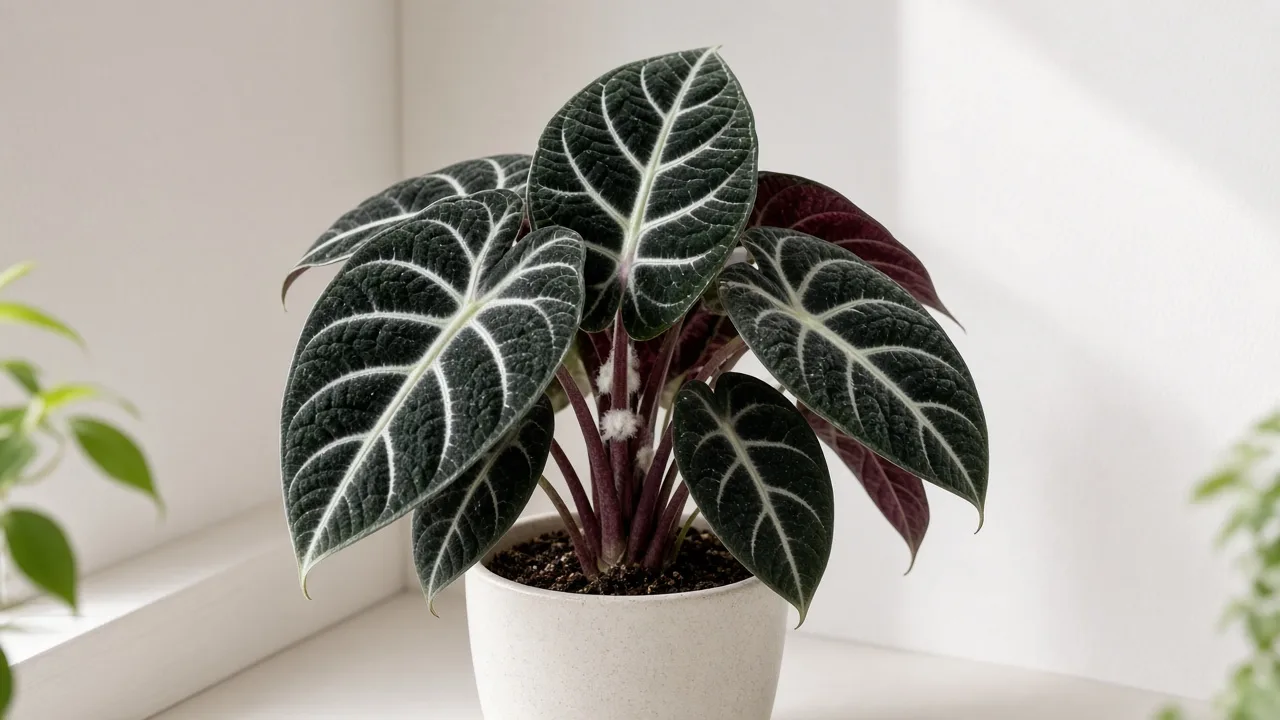
Mealybugs on Alocasia Black Velvet: Causes, Checks & Fixes
This guide covers mealybugs on Alocasia Black Velvet. See also the general Mealybugs guide, watering, and light pages for this plant.
Mealybugs on Alocasia Black Velvet: Causes, Checks & Fixes
Quick answer
Mealybugs on Alocasia reginula ‘Black Velvet’ are small, soft, wax-covered insects that look like tiny white cotton balls tucked into petiole axils, along burgundy leaf undersides, and at the soil line near the corm. They suck sap, leave sticky honeydew that can feed sooty mold, and thrive in the protected pockets of a compact jewel alocasia where the dark matte surface facing the window hides colonies on the maroon leaf back.
For how mealybugs reproduce, why ants defend them, and when alcohol dabs work in general, see our mealybugs pest guide. On Black Velvet, the practical pattern is white cottony tufts in petiole axils and on burgundy undersides, sticky shine trapped in bullate velvet grooves, and extra urgency because this species often carries only three to five leaves at a time—losing one infested axil is a large fraction of the whole plant.
First step: isolate the plant if other aroids sit nearby, put on gloves, and dab every visible cottony cluster with a cotton swab soaked in 70% isopropyl alcohol—then re-inspect in three days before spraying anything.
When to use this page vs other Alocasia Black Velvet guides
This page is the pest-first entry for white cottony sap feeders in petiole axils.
| Pattern | Read next |
|---|---|
| Soft pear-shaped insects on unfurling spears | Aphids |
| Fine webbing and stippling on dark velvet | Spider mites |
| Silvery scarring on velvet blades | Thrips |
| Flat brown or tan bumps without cotton | Scale insects |
| Tiny flying white insects when disturbed | Whiteflies |
| Distorted new leaves without confirmed insects | Distorted leaves |
| Yellow lower leaves, wet mix, mushy petioles | Overwatering or root rot |
What mealybugs look like on Alocasia Black Velvet
Mealybugs are oval, segmented insects covered with wax, often gathered in colonies in somewhat protected areas of the plant. On Black Velvet they settle where the compact crown creates sheltered pockets:
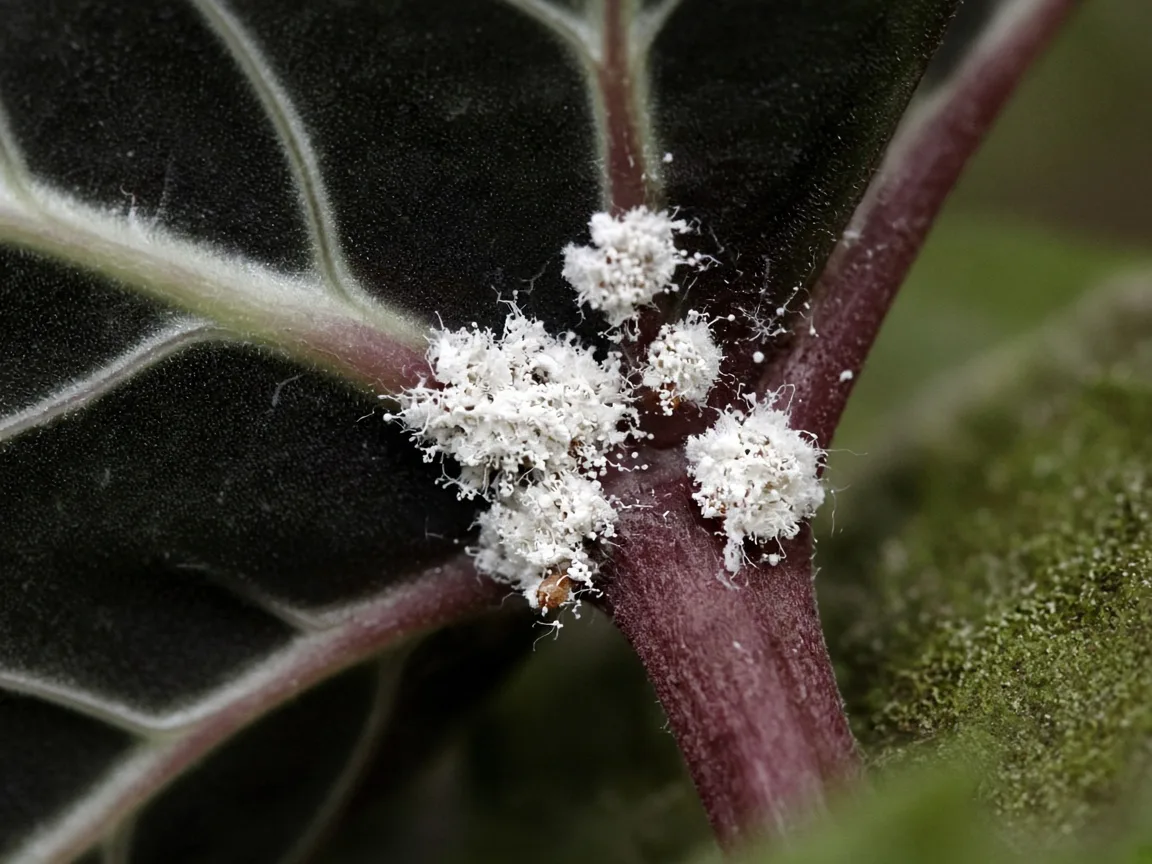
Cottony mealybug masses in a petiole axil where the burgundy underside meets the corm—compare with firm matte black blades above.
- White cottony tufts in petiole axils — Wax-covered clusters where each thick velvet leaf meets the corm
- Sticky shine on burgundy undersides — Honeydew collects on the maroon leaf back and in bullate velvet grooves where hairs trap residue
- Black sooty coating on lower matte leaves — Fungus growing on dried honeydew, not black spots from fungal leaf disease
- Ant trails on the pot rim or shelf — Ants harvest honeydew and protect colonies from lady beetles and lacewings
- Yellowing or stunted unfurling spears — Heavy feeding on soft new blades while mature lower leaves stay firm
- Pale crawlers before wax builds — Newly hatched nymphs are mobile and orangish until they settle and produce cottony coating
Healthy Black Velvet leaves are thick, bullate, matte black with stark white veins and burgundy undersides. Mature lower blades can look perfect while petiole axils are infested—do not assume the plant is clean because the dark velvet surface facing the room looks fine.
NC State Extension notes that alocasias are prone to spider mites and should be monitored for aphids and mealybugs. Black Velvet is not exempt because it is a collector plant—it is often grown in the same warm, humid cabinets that mealybugs love.
Where mealybugs hide on velvet leaf axils and the unfurling spear
Alocasia reginula is a compact jewel alocasia with a small underground corm and a short crown. Mealybugs follow the slowest, most protected tissue on the plant, not the firm matte blades you see from across the room.
Petiole axils where leaves meet the corm are the highest-value feeding site. Colonies tuck into the fold between each thick petiole and the crown, often on the burgundy side facing the window or the leaf that grew fastest last season.
The central unfurling spear is the next priority—the rolled leaf still wrapped around itself at the center of the crown. Mealybugs colonize the soft burgundy inside before the blade opens flat, similar to aphid colonies but with white wax instead of soft pear-shaped bodies.
Bullate velvet grooves on the leaf back trap honeydew and dead mealybugs in the hairy surface. What looks like dust on a matte black blade may be sticky cottony residue when you run a finger along the burgundy underside.
Soil line and corm surface hold stem-feeding and root-feeding mealybugs when mix stays damp in dim corners. Mealybugs often live near stems close to soil or in the crown of a plant. Check where petioles meet chunky mix, especially if fungus gnats signal chronic surface moisture on a rot-prone corm.
Cabinet and terrarium neighbors share warm humid air. Mealybugs can walk from other aroids on the same shelf—quarantine new Black Velvet plants before placing them beside established jewels.
Inspect every leaf separately, including the one still unfurling. One cottony axil beside three clean mature blades means a localized outbreak, not a whole-plant care failure.
Why white cotton shows up so clearly on matte black velvet
The contrast between mealybug wax and Black Velvet foliage makes this one of the easier pest diagnoses on dark-leaved aroids—if you flip the leaves.
White cottony tufts against burgundy undersides are visible at arm’s length once you know to look there. On the matte black top, the same colonies can be nearly invisible until honeydew dulls the velvet sheen or sooty mold spreads.
Sticky honeydew also collects in bullate hair grooves on the leaf back. The residue looks like fine dust until you touch it and feel tackiness—different from the dry crisp edges of low humidity stress.
Because Black Velvet carries only three to five leaves at a time, even a small colony on one axil is visually obvious once you inspect the burgundy side. That same small colony would be easy to miss on a sprawling pothos with dozens of blades.
Why losing one axil matters on a three-leaf Black Velvet
Most healthy Black Velvet plants in good light carry three to five leaves at a time. Unlike a sprawling pothos, this species does not mask pest damage with dozens of blades.
When mealybugs colonize the only unfurling spear or every petiole axil at once, you may lose the plant’s entire new growth cycle for the month. A sticky velvet leaf stays visible for weeks because jewel alocasias grow slowly and drop older leaves seasonally.
Heavy feeding on soft tissue can also weaken the corm if the plant is already stressed from overwatering or winter dormancy. A firm corm below the surface can still push clean growth in spring—but only if you stop the colony before it spreads to every axil.
Treat early colonies as urgent on this species not because mealybugs are uniquely deadly, but because each leaf is a large fraction of the whole plant.
Alcohol dabs on bullate velvet without burning the leaf
Black Velvet’s fuzzy bullate surface changes how you treat mealybugs. Never mist foliage directly—water droplets sit in the hairs, encourage fungal spotting, and can leave permanent marks on matte velvet.
For small colonies, UC IPM recommends dabbing a 70% or less isopropyl alcohol solution directly on mealybugs with a cotton swab, after testing on a small part of the plant first for leaf burn. On Black Velvet:
Test one burgundy underside corner first. Wait 24 hours. Some aroids are sensitive to alcohol on soft unfurling tissue.
Dab each cottony cluster—not the whole leaf. Saturate the wax mass until it turns translucent, then wipe dead insects with a clean swab. Work petiole axils where colonies cluster out of reach of sprays.
Wear gloves before handling infested leaves. Alocasias contain irritant compounds and broken petioles can release sap that stings skin.
Blot any alcohol runoff from bullate grooves with a dry microfiber cloth the same day. Trapped moisture in velvet hairs after treatment is worse than the mealybugs were.
Do not pour alcohol into the soil around a rot-prone corm. Keep treatment on foliage and petioles only.
Repeat dabs every three to five days while live cottony clusters remain on inspection. The waxy coating of adult mealybugs makes contact insecticides less effective—direct dabs reach insects that sprays miss in axil pockets.
Why Alocasia Black Velvet gets mealybugs
Protected petiole axils and crown pockets. Mealybugs feed in somewhat protected areas such as branch crotches, crowns, and stems near soil. Black Velvet’s compact crown concentrates those hiding spots on a small plant.
Warm humid growing conditions. Black Velvet wants 65–80% humidity—often supplied by cabinets, terrariums, or bathroom shelves. Stable room temperatures let mealybug populations build year-round without the natural enemies that curb them outdoors.
Indoor stability without predators. Houseplant collections lack the lady beetles, lacewings, and mealybug destroyer beetles that normally curb mealybug numbers outdoors. A single crawler can start a new colony in the next petiole axil.
Ant protection. Ants on pot rims or window sills defend honeydew sources on petiole bases, keeping colonies larger than they would be outside.
Nitrogen-rich soft shoots. Over application of nitrogen combined with regular irrigation stimulates tender new growth where mealybugs prefer to lay eggs. Cross-check the fertilizer guide if colonies exploded right after feeding.
Neighboring infested plants. Mealybugs are often introduced on new plants or tools. Quarantine new jewels and inspect shared window shelves weekly.
How to confirm the cause
Work through these checks before you treat:
- Location on the plant — White cottony masses in petiole axils and on burgundy undersides suggest mealybugs. Fine webbing on the same tissue suggests spider mites. Soft pear-shaped clusters on unfurling spears suggest aphids.
- Crush test — Mealybugs smear pink or orange when crushed. Scale insects leave a hard shell. Thrips leave silvery scars without cotton.
- Honeydew test — Sticky burgundy undersides that feel tacky point to sap feeders. Dry crispy edges without insects point to low humidity.
- Leaf comparison — One cottony axil vs every axil affected separates localized mealybugs from a whole-plant stress pattern tied to not enough light.
- Ant activity — Ants climbing the pot or nearby wall often appear before you spot colonies on the burgundy underside.
- Soil line check — White wax near the corm surface may indicate root-zone mealybugs. Unpot only if multiple axils stay clean but the plant keeps declining—see root rot before assuming pests alone caused mushy petioles.
If you see only a few tufts and mealybug destroyer larvae or parasitized mummies nearby, confirmation may mean monitor rather than spray immediately.
First fix for Alocasia Black Velvet
Isolate the plant if other aroids are nearby, then dab every visible cottony cluster with a cotton swab soaked in 70% isopropyl alcohol—working petiole axils and burgundy undersides while wearing gloves—and re-inspect in three days with a magnifier before spraying anything.
Test alcohol on one small burgundy corner first. Dab each wax mass until it clears, wipe dead insects, and blot bullate grooves dry with a microfiber cloth. Keep alcohol off the soil line around the corm.
This single step targets mealybugs where sprays cannot reach without stacking chemicals on day one. Repeat every three to five days while live cottony clusters remain on inspection.
Do not reach for insecticidal soap, horticultural oil, or systemic products on day one if colonies are small and natural enemies are visible nearby.
Step-by-step recovery if dabs are not enough
If live mealybugs remain after two dab cycles:
- Prune heavily infested petioles — When colonies hide inside curled axil tissue contact sprays cannot reach, remove the worst petiole rather than let wax spread to every leaf base. On Black Velvet, sacrifice one sticky axil rather than lose the whole crown.
- Apply insecticidal soap or horticultural oil — These products can reduce younger nymphs with less wax accumulation when applied thoroughly to burgundy undersides. Test one leaf first—some aroids are sensitive to oils on soft velvet.
- Manage ants — Sticky traps on pot rims or ant baits away from the plant help natural enemies reach colonies.
- Hold fertilizer — Do not feed a stressed jewel alocasia while pests are active. Resume at half strength only after two clean new leaves unfurl.
- Scout weekly — Check petiole axils and burgundy undersides until you see two consecutive clean inspections.
Avoid broad-spectrum sprays that kill lady beetles and lacewings. Indoor plant pest guides emphasize starting with the least toxic option that reaches the pest.
If colonies coat every axil, honeydew drips onto the soil, and dabs fail after three weeks, consider discarding the plant before mealybugs spread to cabinet neighbors—heavy infestations are hard to control completely with insecticides alone.
Recovery timeline
Mild cases often stabilize within two to three weeks after the first thorough dab cycle, judged by clean petiole axils and an unfurling spear with crisp white veining.
Sticky velvet blades from heavy honeydew usually keep dull marks or sooty coating until the plant drops them naturally. Success means the next spear opens normally, not that old tissue polishes back to perfect matte black.
If the corm is firm and you see a new speck of growth within three to four weeks after treatment, the plant is recovering. A soft mushy corm with no new spear past mid-spring suggests deeper stress—cross-check root rot before assuming mealybugs alone caused the decline.
During winter dormancy, when Black Velvet may drop all leaves, mealybug pressure usually drops too. Resume scouting when spring growth returns.
Mistakes to avoid
- Misting velvet foliage to “wash” mealybugs — Trapped water in bullate hairs causes spotting; use targeted alcohol dabs or a damp cloth instead.
- Spraying only the dark matte leaf top — Colonies live on burgundy undersides and in petiole axils.
- Flooding the corm while rinsing — Saturated mix after repeated sprays mimics overwatering on a rot-prone species.
- Fertilizing during an active infestation — Soft nitrogen-rich shoots attract more mealybugs.
- Stacking repotting, pruning, and pesticide on the same day — Make one correction, wait a week, read the response.
- Assuming an empty winter pot means mealybugs are gone — Inspect again when the corm pushes spring growth.
How to prevent mealybugs next time
Scout petiole axils and burgundy undersides weekly during spring and summer—the same season Black Velvet adds leaves in bright indirect light per the light guide.
Quarantine new plants for two weeks before placing them in a cabinet with established jewels. Inspect shared shelves and window benches, not just the Black Velvet itself.
Manage ants on pot rims so natural enemies can reach colonies. Lady beetles and lacewings feed on mealybugs when ants are not protecting honeydew sources.
Avoid heavy nitrogen fertilizer that pushes soft lush spears. Feed lightly at half strength during active growth only, as described in the fertilizer guide.
Keep the plant in chunky aroid mix that dries predictably—the soil guide pairs with proper watering so new growth is firm, not weak and mealybug-prone.
Related Alocasia Black Velvet guides
| Guide | When to use it |
|---|---|
| Overview | Whole-plant culture, dormancy, and leaf-count expectations |
| Problems hub | Browse all Black Velvet issue pages |
| Watering | Dry-down checks so treatment runoff does not mimic chronic wet mix |
| Aphids | Soft pear-shaped insects on unfurling spears with honeydew |
| Spider mites | Fine webbing and stippling on dark velvet—common in dry air |
Related tool
Use the Pest Identifier Tool to narrow causes for mealybugs on this plant before changing multiple variables at once.