Low Humidity on Alocasia Black Velvet: Causes, Checks &
Quick answer
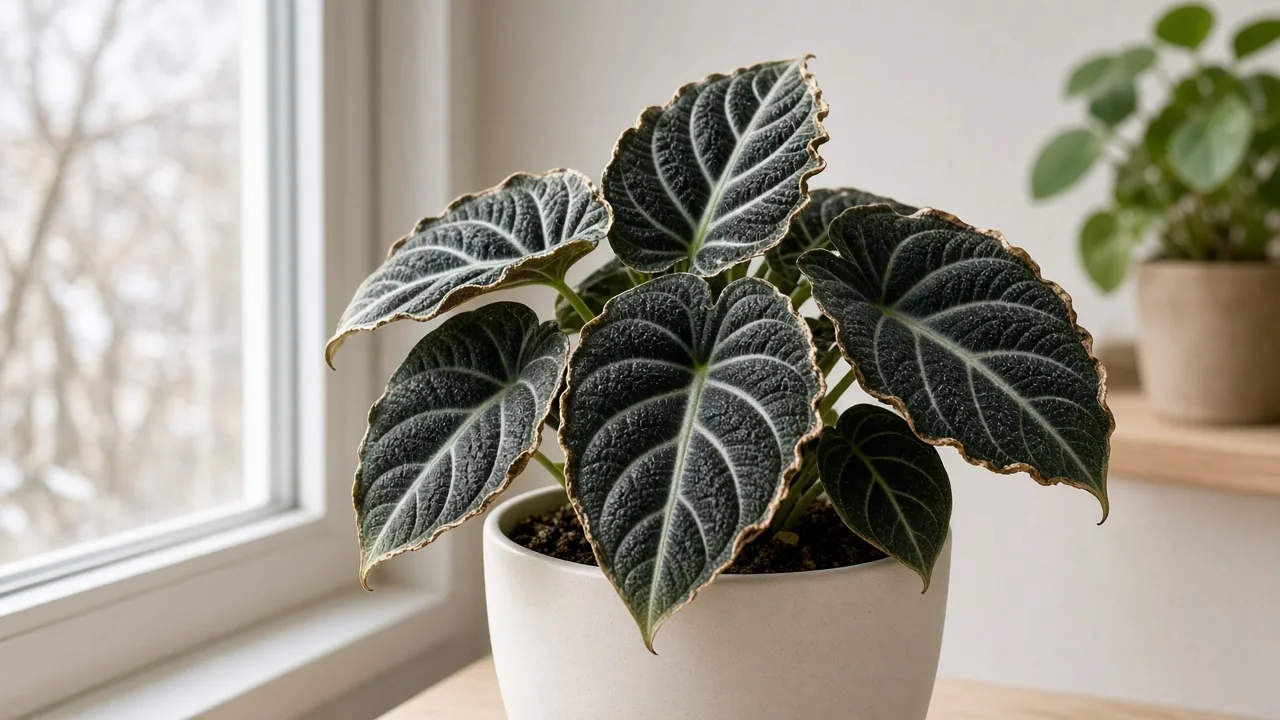
Low humidity on Alocasia Black Velvet shows as dry papery margins and tips on compact velvet leaves—often on several blades at once while soil moisture stays normal and petioles stay firm. Winter heating below 50% RH is the usual trigger. First step: place a hygrometer within 12 inches of the canopy and run a room humidifier aimed at ambient air, not the fuzzy foliage.
Low Humidity on Alocasia Black Velvet: Causes, Checks & Fixes
This guide covers low humidity on Alocasia Black Velvet. See also the general Low Humidity guide, watering, and light pages for this plant.
Low Humidity on Alocasia Black Velvet: Causes, Checks & Fixes
Quick answer
Alocasia Black Velvet (Alocasia reginula) evolved in warm, humid Borneo understories. Indoors, dry winter air hits its compact bullate leaves before the shallow corm fails — margins and tips turn papery brown on several small blades while petioles often stay firm and soil moisture looks normal.
For how dry air crisp leaf edges on houseplants in general, see our low humidity hub. On Black Velvet, dry air most often shows as brown margins across multiple velvet leaves, stuck unfurl tears at the crown, and rising spider-mite risk — easy to confuse with underwatering, salt tip burn, or normal winter dormancy on a bare-looking pot.
First step: place a hygrometer within 12 inches of the canopy and run a room humidifier aimed into ambient air — not at the fuzzy foliage. If readings already sit near 65% and only one old outer leaf has a crisp edge, fix placement and mites before buying more gear.
When to use this page vs other Black Velvet guides
| Pattern | Read next |
|---|---|
| Isolated tan bands at tips only, not full margins | Brown tips |
| Light pot, dry mix 2–3 cm down, slight droop | Underwatering |
| Yellow lower leaves, wet soil, soft petioles | Overwatering or root rot |
| Fine stippling and webbing on dark undersides | Spider mites |
| Inward curl along the midrib in dry air | Curling leaves |
| Stuck dry roll with brown crease on newest leaf | Distorted leaves |
| Whole blades turning brown, not just margins | Brown leaves |
This page covers dry-air crisping on velvet margins and crown unfurling when the root zone is otherwise stable.
What low humidity looks like on Alocasia Black Velvet
Black Velvet does not collapse like a peace lily when the air is dry. Symptoms concentrate on small 8–15 cm heart-shaped blades with matte black velvet and white veining — the farthest leaf margins desiccate first.
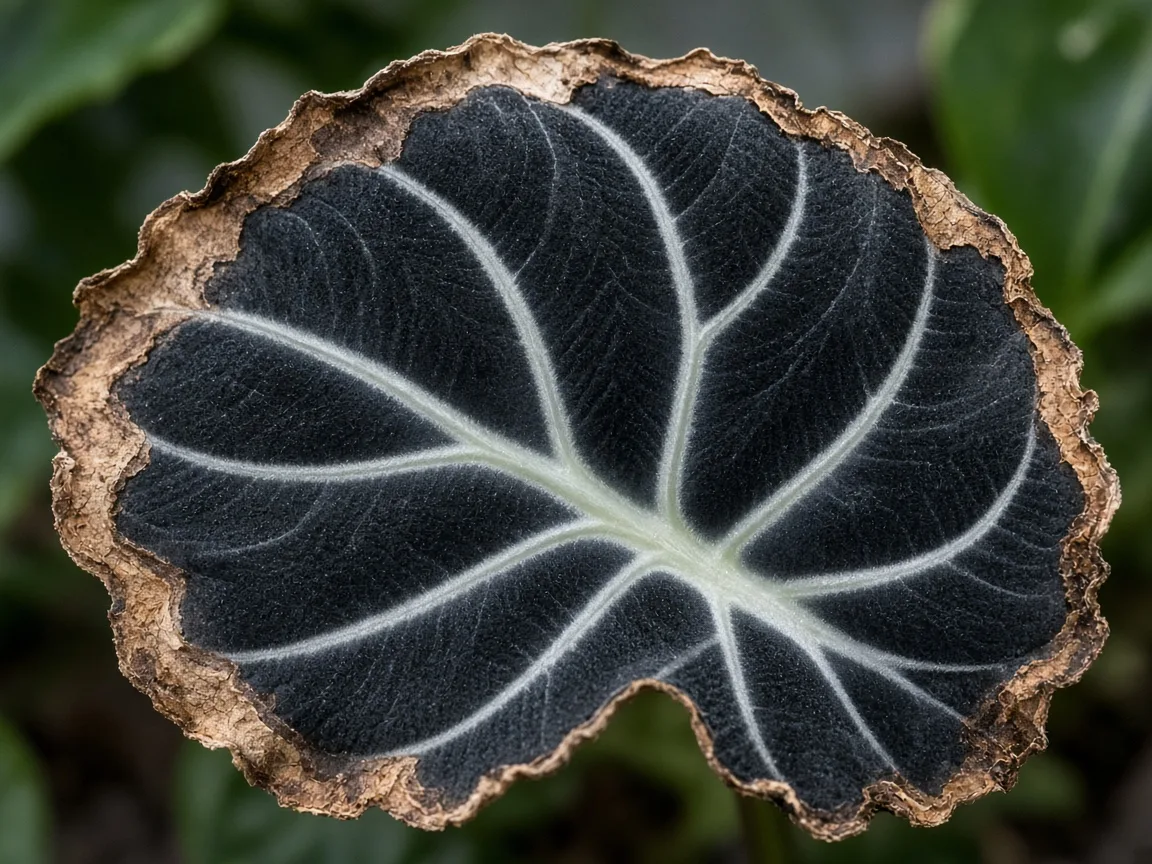
Low humidity on Black Velvet — dry papery margins on a compact velvet blade; existing tan tissue will not re-green.
Typical signs when dry air is actually involved:
- Papery brown margins along the wavy edge of multiple compact leaves, not just one isolated tip
- Crisp tan tissue on otherwise firm, dark velvet blades with clear white veining
- Worsening from late fall through early spring when central heating runs constantly
- Normal soil moisture at the top 2–3 cm while several blades crisp at once — petioles stay firm at the base
- Stuck or torn unfurl on the newest crown leaf — a dry brown crease where the folded blade stuck together while opening
- Slow spread over weeks in a dry room — not overnight mushy collapse
Usually not low humidity:
- Light pot, dust-dry mix, and drooping before margins crisp — underwatering
- Yellowing lower leaves with soggy mix — overwatering
- Isolated tip bands without full margin involvement — brown tips
- Stippling, dull patches, and fine webbing on undersides — spider mites in hot dry air
- Every leaf drops in winter with a firm corm below — dormancy, not an humidity emergency; see the overview
A healthy Black Velvet in adequate humidity usually carries three to five firm dark leaves with sharp white veins. Judge the newest emerging blade separately from aging outer leaves at the base.
Bullate velvet leaves: why misting fails on Black Velvet
This anatomy section is Black Velvet-specific and does not apply to glossy alocasias like Polly or larger elephant ears.
- The bullate, hair-covered leaf surface traps water droplets instead of absorbing brief mist — stagnant moisture invites fungal spotting and permanent brown marks that mimic humidity damage.
- Compact 8–15 cm blades have a high edge-to-area ratio, so dry air pulls moisture from margins faster than the slow, shallow root system replaces it.
- Dark velvet leaves hide early stippling — owners often notice crisp margins before they spot spider mites colonizing the same dry micro-climate beside a heat register.
- New crown leaves unfurl from a tight spiral; in air below 50% RH, the folded tissue can stick and tear, leaving linear splits or center holes — see holes in leaves when unfurl damage is the main pattern.
Raise humidity with a humidifier, pebble tray, or bright bathroom — the same methods the RHS recommends for alocasia humidity. Wipe dust gently with a barely damp microfiber cloth, supporting the leaf from underneath; never spray directly onto velvet foliage.
Crown unfurl tears vs whole-plant wilt
Run this five-minute check before changing watering or repotting:
| What you see | More likely cause |
|---|---|
| Crisp margins on several leaves; firm petioles; moist top 2–3 cm | Low humidity — this page |
| Stuck dry roll with brown crease on newest crown leaf only | Dry air during unfurl — also distorted leaves |
| Light pot, dry mix, slight droop before margins fully crisp | Underwatering |
| Soft petioles, wet soil, yellow lower leaves | Overwatering |
| Stippling + webbing on undersides | Spider mites beside sunny glass |
The RHS notes that low humidity can cause browning on alocasia leaf edges and may attract red spider mites in a dry atmosphere. On Black Velvet, where the tan tissue appears — margins on many blades vs mushy stems — matters more than the hygrometer reading alone.
Why Alocasia Black Velvet gets low-humidity symptoms
Winter heating and forced-air paths
Radiators, heat vents, and single-pane winter glass create micro-climates far drier than the rest of the room. Many homes sit at 25–40% RH for months while Black Velvet wants 65–80% at canopy height. Proven Winners notes that alocasia is accustomed to high humidity in its native habitat and recommends a room humidifier or pebble tray rather than letting the plant bake beside dry forced air.
Small blades, slow roots
Black Velvet carries a compact corm and shallow root system in a snug 10–15 cm pot. NC State Extension recommends moist, well-drained soil for alocasias — drained, not constantly wet. When air is very dry, transpiration from thin leaf margins can outpace what those slow roots deliver even when the mix feels correctly watered. The pot may feel appropriately moist while only margins crisp — not a signal to pour more water.
Spider mites in hot dry micro-habitats
Colorado State Extension reports that dry weather greatly favors spider mites on houseplants. Black Velvet beside a sunny winter window and a heat register matches that habitat. Mite damage adds stippling and webbing — inspect undersides before you humidify alone.
The bright-window winter trap
Black Velvet needs bright indirect light to hold three to five dark leaves — often an east window or filtered south exposure. That placement beside cold glass plus heating creates the classic failure mode: vivid foliage under 30% RH for weeks, margins crisp on multiple blades, and the owner misted leaves daily without raising room humidity. Match irrigation to the watering guide top 2–3 cm dry-down check, not to misting frequency.
Dormancy confusion in dry winter air
In late autumn, a healthy Black Velvet may drop leaves and leave bare mix with a firm corm below — dormancy, not death. Low humidity can still crisp the last remaining blades before they fall. Do not overwater an empty-looking pot or run a humidifier directly onto bare soil thinking the corm needs tropical fog. Keep the corm warm, reduce watering to every 2–4 weeks, and resume humidity support when spring growth returns.
How to confirm the cause
Work through these checks in order. One change at a time makes it easier to read the plant’s response over the next two to three weeks.
-
Hygrometer at canopy height — Place a digital hygrometer within 12 inches of the top leaves. Readings below 50% with margin crisping on multiple blades strongly support low humidity. Target 65–80% for recovery on this species.
-
Soil dry-down cross-check — Press your finger into the top 2–3 cm of chunky aroid mix. Crisp margins with dust-dry mix and a light pot mean fix watering first. Crisp margins with appropriate moisture and firm petioles point to air humidity.
-
Draft and heat map — Feel for moving air from vents, fireplaces, and winter glass. Relocate once at least 3–4 feet from forced-air registers before buying more hardware.
-
New-growth watch — The decisive test is the next emerging leaf. Clean margins and intact white veining on new tissue confirm your fix. A stuck dry unfurl on the crown leaf means humidity was too low during opening even if older blades look stable.
-
Underside scan — Check dark velvet undersides for stippling and fine webbing in the same dry spell. NC State Extension notes alocasias are prone to spider mites; treat pests before assuming humidity alone will restore foliage.
You have likely confirmed low humidity when new leaves open with clean edges for two to three weeks, canopy RH holds near 65%, and petioles stay firm with appropriate soil moisture.
First fix for Alocasia Black Velvet
Run a small room humidifier several hours daily in the same room, aimed into ambient air rather than directly on velvet foliage. This is the single best first action when canopy RH reads below 50% and multiple margins are crisping while soil moisture is normal.
Supplement with a gravel tray — wide tray, stones, water just below the stone surface, pot on top, never submerged. Bright bathrooms help only when light is bright enough. Grouping plants modestly raises local humidity but rarely reaches 65% alone in a heated room.
Do not increase watering because margins look dry if the top 2–3 cm of mix is already moist — soggy mix invites corm rot on this species. Do not mist velvet leaves.
After the humidifier runs for one week, re-check the hygrometer at canopy height. If RH holds near 65% but the next leaf still opens with a stuck unfurl crease, keep the humidifier running through the full unfurl cycle — crown leaves are the most humidity-sensitive tissue on Black Velvet.
Recovery timeline
Damaged leaf tissue is permanent. Brown or crispy margins will not turn green again. Judge success by stopped spread to healthy tissue and clean margins on newly emerged leaves.
- After humidifier fix: Margin crisping on new growth usually stabilizes within two to three weeks when canopy RH holds near 65%.
- Crown unfurl tears: The damaged crease on an opened leaf stays; the next leaf after stable humidity should open without sticking.
- Older leaves: May keep brown margins indefinitely; remove them only if more than half the blade is dead.
If three consecutive new leaves open with clean edges and sharp white veining, consider the low-humidity problem controlled. Keep monitoring through heating season.
What not to do
- Do not mist velvet leaves to fix dry air — water trapped in leaf hairs causes separate damage.
- Do not increase watering because margins are crisp if soil is already moist; soggy mix invites corm rot.
- Do not fertilize a stressed plant before humidity stabilizes — see the fertilizer guide after new growth looks healthy.
- Do not repot on day one unless roots are mushy — see repotting after the plant stabilizes.
- Do not confuse winter dormancy with humidity failure — a firm corm in bare mix needs less water, not a rescue repot.
How to prevent low humidity stress on Black Velvet
- Run a hygrometer through heating season and act when canopy RH drops below 50%.
- Use a humidifier instead of misting for long-term RH in the 65–80% range.
- Keep stable placement away from vents and cold glass once the plant acclimates.
- Match watering to the top 2–3 cm dry-down per the watering guide — dry air is not fixed by wetter soil.
- Inspect emerging crown leaves weekly during heating season so unfurl tears are caught early.
- Watch for spider mites when humidity stays low for weeks — dry air and mites often arrive together.
When to worry
Treat as urgent if crisp damage spreads to most new leaves within a week, petioles soften at the soil line, soil smells sour, or fine webbing appears on undersides — those patterns point past cosmetic dry-air burn toward root rot, overwatering, or spider mites.
Lower urgency: papery margins on older outer leaves while petioles stay firm, soil moisture is appropriate, and new growth is still emerging. Fix humidity and placement before escalating to repotting.
Conclusion
Low humidity on Alocasia Black Velvet is one of the most common reasons collectors see crispy velvet margins in winter — not a mysterious disease. Compact bullate leaves telegraph dry heated air at the margins before the corm fails, and misting only makes the surface worse. Measure humidity at the canopy, run a humidifier into ambient air, and watch new emerging leaves for the real verdict. Old margins stay tan, but clean new growth with sharp white veining means you found the right lever.