Scale Insects on Alocasia Polly (African Mask): Causes
Quick answer
Scale insects on Alocasia Polly look like flat tan or brown bumps glued to lower woody petioles and leaf undersides—often with sticky honeydew on glossy arrowhead blades below. First step: isolate if needed, then scrape every visible bump with a cotton swab dipped in 70% isopropyl alcohol before reaching for sprays.
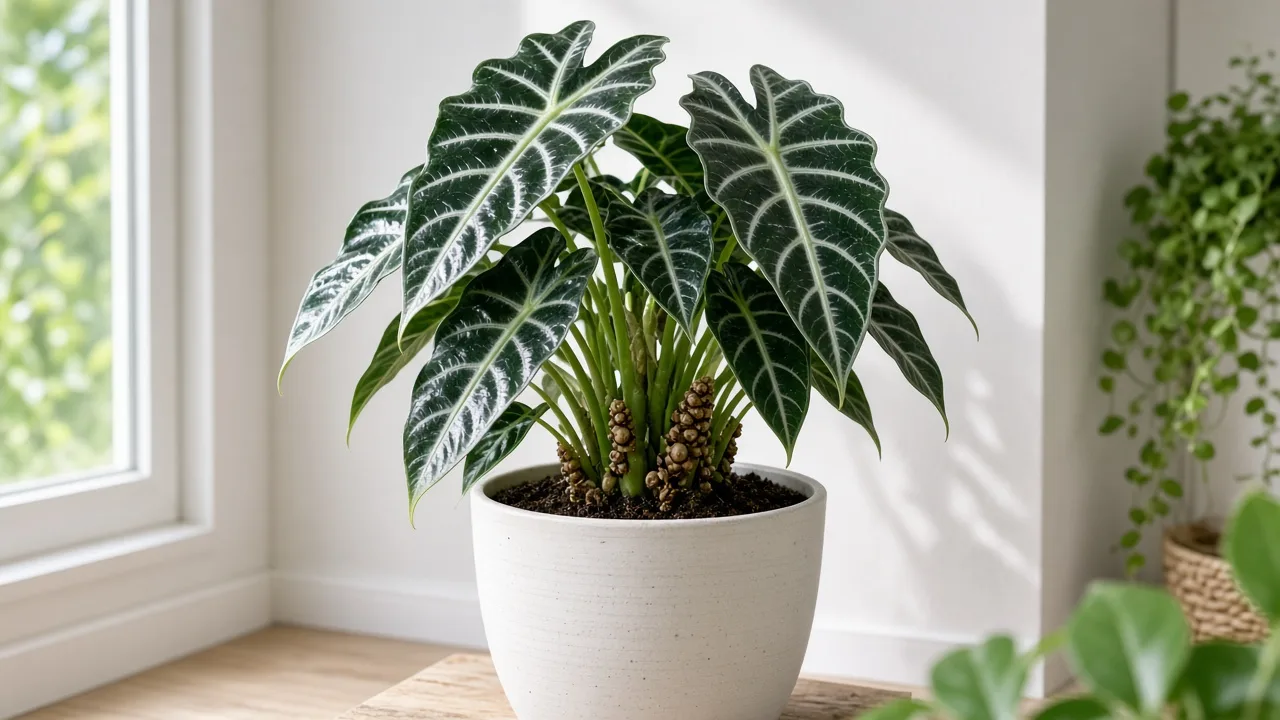
Scale Insects on Alocasia Polly: Causes, Checks & Fixes
This guide covers scale insects on Alocasia Polly. See also the general Scale Insects guide, watering, and light pages for this plant.
Scale Insects on Alocasia Polly: Causes, Checks & Fixes
Quick answer
Scale insects on Alocasia × amazonica ‘Polly’ (African Mask) are small, immobile sap feeders protected by a waxy or shell-like cover that look like flat tan or brown bumps glued to lower woody petioles, leaf midribs, and undersides of arrowhead blades. They pierce tissue, drain sap, and—on soft scale species—leave sticky honeydew that can feed sooty mold on lower leaves.
For how scale life cycles work indoors in general, see our scale insects guide. On Alocasia Polly, the practical pattern is firm disks on lower toughened petioles near the corm, sticky shine on glossy arrowhead blades that shows up before owners notice bumps, and extra caution because seasonal growth pulses mean one infested flush stays visible for months.
First step: isolate the plant if other houseplants sit nearby, then scrape every visible bump with a cotton swab dipped in 70% isopropyl alcohol—then re-inspect in three days before spraying anything.
Wear gloves—Alocasia contains insoluble calcium oxalate crystals that irritate skin and are toxic to cats and dogs if chewed.
When to use this page vs other Alocasia Polly guides
This page is the pest-first entry for immobile tan or brown bumps on African Mask leaves and petioles.
| Pattern | Read next |
|---|---|
| White cottony patches in crown axils | Mealybugs |
| Soft pear-shaped insects on new crown flush | Aphids |
| Fine webbing and stippling on arrowhead leaves | Spider mites |
| Silvery scars on leaf blades | Thrips |
| Tiny flying white insects when disturbed | Whiteflies |
| Black spots without removable shells | Black spots |
| Yellow lower leaves, wet mix, soft crown | Overwatering or root rot |
What scale insects look like on Alocasia Polly
Scale insects are protected by a waxy or shell-like cover that makes adults essentially immobile once they settle. On African Mask they are easy to mistake for normal stem texture, dried sap, or the dark green petiole coloration until colonies build:
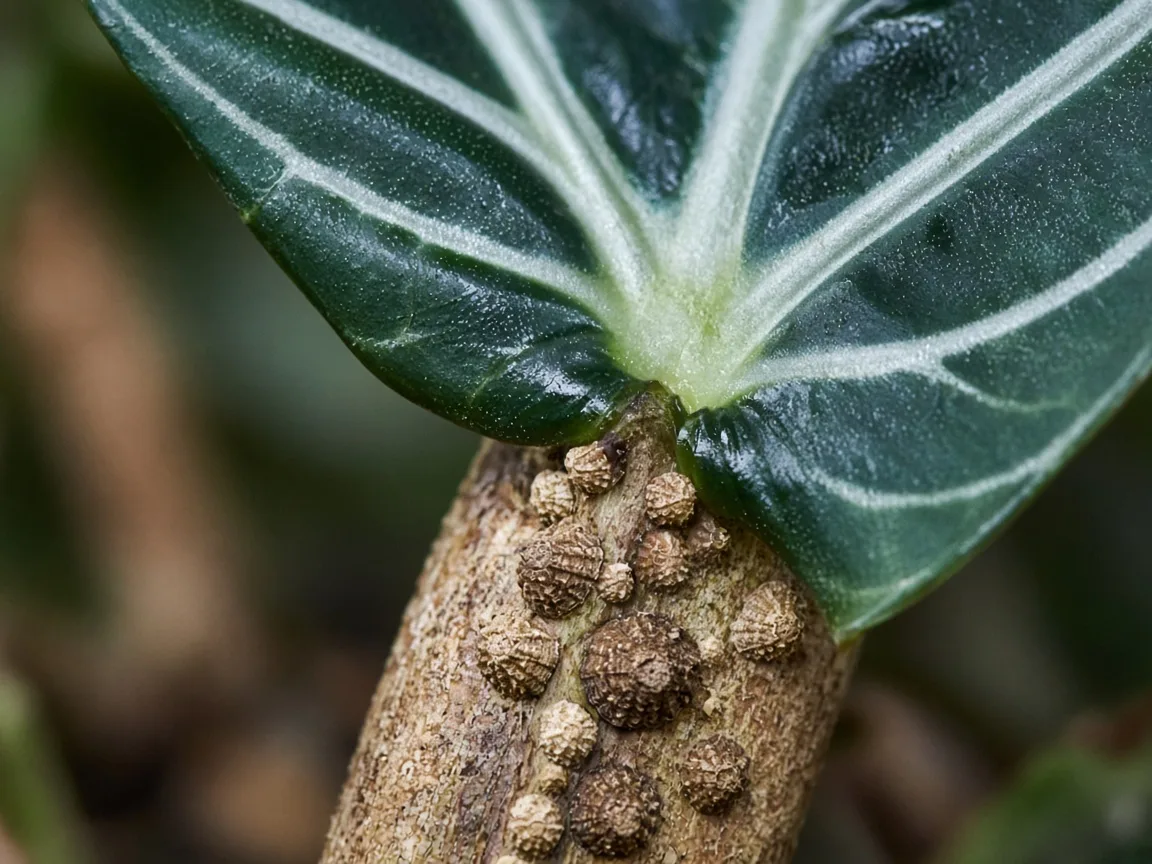
Flat tan scale shells along a lower petiole groove—compare with firm green tissue on mature arrowhead blades above.
- Flat or dome-shaped tan, brown, or gray bumps on lower petiole bases, leaf midrib grooves, and undersides of arrowhead blades
- Disks that do not wipe away with a dry cloth—unlike mineral dust or water spots on glossy leaves
- Sticky shine on young arrowhead leaves — Honeydew collects on foliage and nearby pot rims
- Black sooty coating on lower leaves — Fungus growing on dried honeydew, not leaf spot disease
- Ant trails on the saucer or shelf — Ants harvest honeydew and protect scale colonies from natural enemies
- Yellowing or dull lower leaves — Heavy feeding while the crown stays firm
- Pale crawlers before shells harden — Mobile nymphs are tiny and yellow to orangish until they settle and grow armor
Healthy Polly leaves are compact arrowheads with bold silver veining on dark green blades. Mature lower petioles can look perfect from across the room while woody tissue near the corm carries scale—do not assume the plant is clean because the dramatic crown leaves are firm.
Where scale hides on lower woody petioles—not just the crown
Alocasia Polly grows as a compact upright rosette with arrowhead leaves on stiff petioles. As stems age near the corm, tissue toughens—and scale follows that lower woody zone, not the humid crown center where mealybugs usually cluster.
Scale often concentrates in somewhat protected areas such as branch crotches, stem joints, and along leaf petioles. On Polly, the equivalent hot zones are:
- Lower woody petiole bases near the corm — Where mature stalks thicken; bumps blend with green-brown tissue
- Petiole grooves on arrowhead leaves — Silver veining can camouflage tan shells when you look only at the blade face
- Leaf undersides along midribs — Scale settles on the pale underside where routine watering misses
- Overlapping petiole angles — Inner stems in a dense rosette trap honeydew and shelter insects from a quick rinse
- Newest crown flush — Softest tissue attracts egg-laying females before arrowheads harden
- Soil line and pot rim — Crawlers travel between nearby houseplants on shared shelves
This lower-petiole inspection pattern is plant-specific. A mealybug guide tells you to open unfurling crown folds first; on Polly you are bending mature lower leaves aside to see woody petiole bases and tracing each stalk from tip to corm with a swab or lens. Crown-only treatment clears wax in axils but leaves scale shells on lower stems untouched.
Why silver veining camouflages scale on African Mask
Tan or brown scale shells blend into the dark green petioles and silver-veined arrowhead pattern on Polly. Owners who check only the dramatic upper crown miss colonies that have been feeding for weeks along lower woody tissue.
The same bold foliage that makes Polly a statement plant also delays diagnosis until honeydew or sooty mold appears on lower blades. Cross-check the light guide if every new leaf is small and coated—pests and weak growth often overlap when light is too dim.
Why Alocasia Polly gets scale insects
Scale insects are common sap-sucking pests on houseplants that arrive on nursery stock, shared benches, or nearby infested specimens. What makes African Mask vulnerable is its morphology and seasonal growth rhythm, not weak culture alone.
Lower woody petioles hide armored shells. As Polly matures, lower stalks toughen near the corm while the crown stays dramatic. Adult scales are relatively protected from contact sprays by their waxy covering, so disks on lower petioles survive one casual wipe aimed at the crown.
Seasonal flush keeps soft tissue available. Polly pushes new arrowhead leaves in warm months and may go dormant in winter, but tender petiole bases stay vulnerable during each active flush longer than on fast-growing pothos.
Indoor conditions without predators. Outdoors, lady beetles, lacewings, and parasitic wasps suppress scale numbers. Inside, populations can build unnoticed because nothing is eating them.
Ant protection. Ants on pot rims shield scale from lady beetles, lacewings, and parasitic wasps. A windowsill plant with ant highways often holds larger lower-stem colonies.
Hitchhikers from new plants. Scale commonly enters collections on fresh nursery stock. It is not a sign you failed at watering—but wet, stagnant crowns plus pests are a worse combination than either alone.
Dormancy does not clear pests. Leafless or slow-growing Polly in winter can still harbor colonies on lower petioles and at the soil line. Do not assume pests cleared themselves because the plant dropped foliage—inspect woody stems before new spring growth emerges.
Soft scale vs. armored scale on Alocasia Polly
Most indoor Polly scale outbreaks involve soft scale species that excrete honeydew and form rounded, slightly convex covers. Armored scale species are flatter, often smaller, and do not secrete sticky honeydew—so you may see bumps without tacky blades or sooty mold. Armored covers typically stay fused to the petiole when you try to lift them; soft scale shells may separate more easily under a swab.
That distinction matters for treatment. Honeydew-producing soft scale often responds to repeat horticultural oil or insecticidal soap. Armored scale needs thorough contact sprays on crawler hatch windows and does not respond reliably to soil-applied imidacloprid. On Polly’s short petioles, both types hide at lower stem bases where overlapping leaves block casual view.
How to confirm the cause
Work through these checks before you treat:
- Scrape test — Pick one bump on a lower petiole base. If it flakes off and leaves a soft insect underneath or a clean scar, you have scale. If the spot is fixed in the tissue and feels like normal color variation, compare with black spots.
- Honeydew check — Run a finger along young blades below suspicious petioles. Tacky residue that returns after wiping suggests active sap feeders—usually soft scale, not armored species.
- Shell hardness — Try to lift the edge of a bump with a toothpick. Armored scale covers stay glued flat; soft scale may feel slightly raised and convex.
- Mealybug rule-out — White powdery cotton at crown axils means mealybugs, not scale—treatment overlaps, but identification guides how thoroughly you search crevices.
- Aphid rule-out — Soft pear-shaped insects on crown flush mean aphids, not immobile shells.
- Distribution pattern — Scale clusters along lower petiole bases and midribs; yellow leaves from old-leaf senescence or dormancy appear on lower blades without removable shells.
- Collection scan — Inspect plants you bought in the last two months or grouped within arm’s reach. Scale on one pot often means others are incubating crawlers.
- Magnifier pass — Newly hatched crawlers are tiny and mobile. A hand lens along lower petiole grooves catches reinfestation early.
If bumps are fixed color spots, blades are dry and glossy, and the corm is firm, you likely do not have scale—no pesticide needed.
First fix for Alocasia Polly
Isolate the plant if other houseplants sit nearby, then scrape every visible bump with a cotton swab dipped in 70% isopropyl alcohol.
Place Polly on a washable surface. Dip a cotton swab in 70% isopropyl alcohol and dab each bump along lower petiole bases and midrib grooves, then wipe honeydew from leaf blades with a soft cloth. Manual removal with alcohol swabs is a standard first step for houseplant scale when colonies are still reachable.
Wear gloves—Alocasia is toxic to cats and dogs if chewed. Keep treated plants off pet-accessible shelves during cleanup.
This single step confirms diagnosis, cuts the adult population immediately, and makes later sprays more effective. Do not start with horticultural oil alone on a heavy infestation—the shells protect insects underneath.
Wait until leaf surfaces dry before moving the plant back to its spot. Re-inspect in three days before scheduling repeated oil or soap sprays.
Step-by-step recovery
After manual removal, work through these steps in order:
- Scout every three to four days through warm indoor growth. Scale can rebound from missed crawlers within weeks.
- Rinse leaf blades carefully — Lukewarm water over leaf surfaces removes honeydew and dislodges crawlers. Do not soak the crown center—Polly’s compact rosette traps water in crevices and invites stem rot. Follow water when top inch is dry after treatment.
- Apply horticultural oil or insecticidal soap — Coat lower petiole bases, crown axils, and leaf undersides on label repeat intervals, typically every five to seven days for two to three cycles, to catch newly hatched crawlers. Test one leaf first; Alocasia can be sensitive to soaps and oils on stressed tissue.
- Repeat alcohol spot treatment — Between spray days, swab any bumps that reappear on lower woody petioles—the favorite hiding zone on mature African Mask.
- Manage ants when trails are heavy. Sticky barriers on pot rims can let predators reach scale. Ant control alone is not a substitute for scraping.
- Hold extra fertilizer until scale is under control. Resume light feeding per the fertilizer guide after new crown flush comes in clean.
- Wash sooty mold off lower leaves with plain water once honeydew production stops. Trim blades that stay heavily coated if they no longer contribute to the rosette.
- Monitor the collection — Treat or inspect neighboring plants that shared a shelf. Crawlers walk to adjacent pots before you notice honeydew on Polly.
Prune only heavily infested, fully coated leaves that block the crown and fail two scrape cycles. Polly grows in seasonal pulses; see the pruning guide before removing more than one or two blades at a time.
Recovery timeline
Alocasia Polly recovers from scale slowly because new arrowhead leaves emerge over weeks, not days.
- Days 1–7: Honeydew stops accumulating if adults are removed; existing sooty mold can be wiped off
- Weeks 2–4: No new shells on previously cleaned petioles means treatment is working; continue scheduled sprays through crawler hatch windows
- Months 1–3: New arrowhead leaves with bold silver veining signal crown health; old stippled blades may remain until you prune them for appearance
Judge success by absence of new bumps and firm petioles, not instant leaf greening. A Polly that pushes one clean new arrowhead after treatment is on track even if older leaves stay yellow-edged.
Improvement signs: Flat arrowhead leaves on new flush, no new stickiness, firm petioles, stable corm color.
Worsening signs: Sticky residue spreading to multiple stems, ants on every new tip, crown softness with sour-smelling mix, or colonies rebounding after two scrape cycles—escalate to targeted soap treatment or compare with root rot if the corm softens.
Lookalike symptoms
| What you see | More likely | Quick check |
|---|---|---|
| Tan/brown bumps on lower petioles; may scrape off | Scale insects | Honeydew on young leaves; shell flakes under swab |
| White cottony tufts in crown axils | Mealybugs | Waxy coating; not hard shell |
| Soft insects on crown tips | Aphids | Pear-shaped; not immobile |
| Fine webbing + stippling | Spider mites | Dry heat; no hard bumps |
| Fixed dark spots without honeydew | Black spots | Spot does not scrape off |
| Yellow lower leaves, no stickiness | Yellow leaves | Normal aging, dormancy, or wet roots—check mix |
Mistakes to avoid
Do not soak the crown repeatedly while rinsing leaf blades. Polly hates wet rosette centers—empty the saucer within 30 minutes after any rinse and see overwatering if stems soften.
Do not spray horticultural oil on a cold-shocked or drought-stressed plant without a test patch. Oils can damage sensitive plants on drought-stressed tissue.
Do not ignore ants while treating scale only with alcohol. Ant protection keeps colonies rebounding on lower petioles.
Do not increase fertilizer during an active infestation. Soft lush shoots feed the next generation.
Do not strip every lower leaf at once. Seasonal Polly needs mature blades for photosynthesis—remove only heavily infested tissue.
Do not assume one scrape is enough. Warm indoor growth and multiple scale generations per year mean follow-up scouting matters more than the first removal.
How to prevent scale insects next time
Scout lower petiole bases and crown flush weekly during active growth—before stickiness reaches the shelf surface.
Quarantine new alocasias for two weeks and inspect lower stems before placing them in a shared room or shelf.
Preserve beneficial insects when possible. Tolerate small colonies when damage is cosmetic and lady beetles, lacewings, or parasitic wasp emergence holes are visible on shells.
Manage ants on pot rims in windowsill and patio setups.
Keep the plant in bright indirect light with airy chunky aroid mix so petioles mature quickly and firm up before scale builds large colonies on lower stems.
Avoid heavy nitrogen feeds that push soft shoots—follow the seasonal schedule in the fertilizer guide.
When to worry
Small scale colonies on one lower petiole during warm indoor growth are common on firm Polly and rarely threaten the corm if you scrape early. Escalate when tan bumps crust multiple lower stems, ants protect large colonies on every new flush, or arrowheads fail to unfurl across the whole rosette.
Act urgently if the crown softens, lower leaves yellow in waves, and mix stays wet for weeks—switch to root rot diagnosis rather than assuming insects alone are the problem.
Pet safety: Keep Polly on a stand pets cannot reach during and after treatment. If a pet ingests plant material, contact your veterinarian. Chewing any part causes oral irritation from oxalate crystals—treatment does not remove that risk.
Related Alocasia Polly guides
- Overview — African Mask culture and pet toxicity
- Watering — avoid wet crowns during rinse treatments
- Light — firm arrowhead growth vs soft etiolated tips
- Mealybugs — cottony patches in crown axils
- Aphids — soft insects on new crown flush
- Spider mites — webbing and stippling on arrowhead blades
- Problems hub — full symptom index
Conclusion
Scale insects on Alocasia Polly are a lower woody petiole and leaf-underside problem in most homes—not a mysterious whole-rosette collapse. Bend mature lower leaves aside, magnify where each stalk meets the corm, scrape colonies off arrowhead petioles, and keep the crown dry while you treat. Firm petioles and clean new arrowheads on the next flush are the recovery signal; old stippled blades can stay imperfect without harming the corm.
Related tool
Use the Pest Identifier Tool to narrow causes for scale insects on this plant before changing multiple variables at once.