Scale Insects on Aluminum Plant: Causes, Checks & Fixes
Quick answer
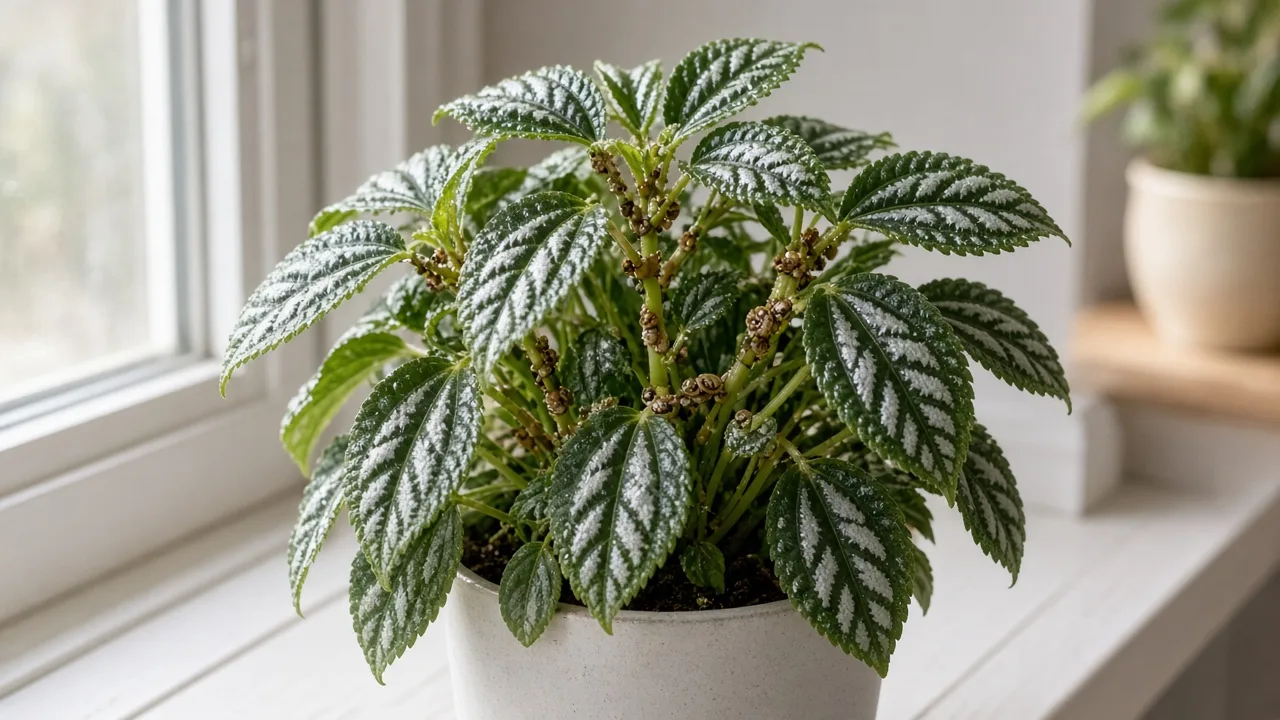
Scale insects on Aluminum Plant look like flat tan or brown bumps glued to stems, leaf axils, and along main veins on the undersides of silver-marked leaves. First step: isolate the plant and dab every visible bump with a cotton swab dipped in 70% isopropyl alcohol before spraying anything else.
Scale Insects on Aluminum Plant: Causes, Checks & Fixes
This guide covers scale insects on Aluminum Plant. See also the general Scale Insects guide, watering, and light pages for this plant.
Scale Insects on Aluminum Plant: Causes, Checks & Fixes
Quick answer
Scale insects on Aluminum Plant (Pilea cadierei) are small, immobile sap feeders protected by a waxy or shell-like cover that look like flat tan or brown bumps glued to stems, leaf axils, and along main veins on leaf undersides. They pierce tissue, drain sap, and—on soft scale species—leave sticky honeydew that can feed sooty mold on the silver patches that make this plant distinctive.
For how scale life cycles work indoors in general, see our scale insects guide. On Aluminum Plant, the practical pattern is firm disks tucked into the bushy crown and leaf axils, sticky shine on silver-marked foliage, and colonies that spread slowly to neighboring small pots if you skip isolation.
First step: move the plant away from others and dab every visible bump with a cotton swab dipped in 70% isopropyl alcohol—then re-inspect in three to five days before spraying anything.
When to use this page vs other Aluminum Plant guides
This page is the pest-first entry for immobile tan or brown bumps on stems and leaf axils.
| Pattern | Read next |
|---|---|
| White cottony clusters in leaf axils | Mealybugs |
| Soft pear-shaped insects on new tips | Aphids |
| Fine webbing and stippling on silver leaves | Spider mites |
| Tiny flying white insects when disturbed | Whiteflies |
| Yellow leaves without confirmed insects | Yellow leaves |
| Wilting with dry mix and no bumps | Underwatering or wilting |
What scale insects look like on Aluminum Plant
Scale insects are protected by a waxy or shell-like cover that makes adults essentially immobile once they settle. On Pilea cadierei, they are easy to mistake for normal stem texture or dried sap until colonies build:
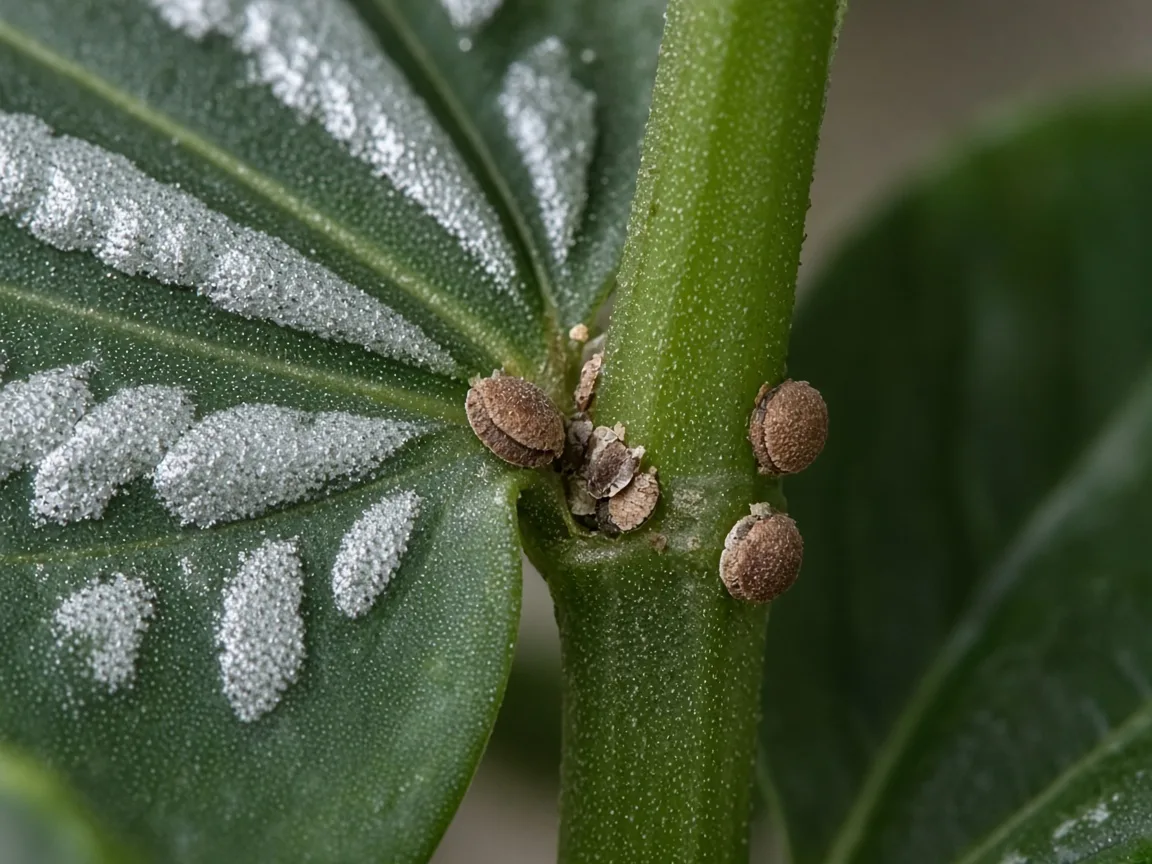
Flat tan scale shells along a stem joint—compare with healthy silver-marked leaf tissue nearby.
- Flat or dome-shaped tan, brown, or amber bumps along square stems, leaf axils, and main veins on leaf undersides
- Disks that do not wipe away with a dry cloth—unlike mineral dust or dried water spots on silver patches
- Sticky shine on leaf tops and stems — Honeydew dulls the metallic silver markings that define this cultivar
- Black sooty coating on lower leaves — Fungus growing on dried honeydew, not a fungal leaf disease
- Ant trails on the pot rim or shelf — Ants harvest honeydew and protect scale colonies from natural enemies
- Yellowing or slight stunting on heavily fed leaves — Sap loss while the bushy crown still looks otherwise firm
- Pale crawlers before shells harden — Mobile nymphs are tiny and orangish until they settle and grow armor
Healthy Aluminum Plant leaves show fixed silver patches on dark green oval foliage—part of the cultivar, not pests. Scale breaks that pattern with new bumps that grow over days and sticky residue that returns after wiping.
Where scale hides on silver-marked leaf axils and the bushy crown
Pilea cadierei grows as a compact shrubby clump with overlapping oval leaves. Scale follows the sheltered crevices that bushy habit creates, not just the outer leaves you see from across the room.
NC State Extension notes that scale is among the insect problems to monitor on Pilea cadierei, and scale often concentrates in somewhat protected areas such as stem joints and leaf petioles. On Aluminum Plant, the equivalent hot zones are:
- Leaf axils — Where each oval leaf meets the square stem; the tightest overlap zone on this species
- Crown center — The bushy heart of the plant where new shoots emerge and leaves stack on top of each other
- Along main veins on leaf undersides — Flat feeding sites a quick top-side glance misses
- Lower stems near the soil line — Crawlers travel between nearby pots on the same shelf
- Nodes on propagation cuttings — Where leaves were removed before rooting; a common hitchhiker site on shared trays
This axil-and-crown inspection pattern is plant-specific. A fiddle-leaf fig guide tells you to search broad leaf faces; on Aluminum Plant you are rotating the pot and lifting overlapping leaves to trace every stem joint with a swab or hand lens.
Why Aluminum Plant gets scale insects
Scale insects are common sap-sucking pests on houseplants that arrive on nursery stock, gifted plants, or nearby infested specimens. What makes Aluminum Plant vulnerable is its compact bushy geometry and indoor culture, not weak care alone.
Overlapping leaves create protected feeding sites. The same tight clump that keeps Pilea cadierei attractive indoors shelters scale shells from rinses and casual wipes. Adult scales are relatively protected from contact sprays by their waxy covering, so disks in leaf axils survive one pass with a damp cloth.
Moderate to fast growth pushes tender shoots. NC State recommends pinching stem tips to keep the plant compact and notes that the best foliage appears on new plants and new growth. Fresh shoots give crawlers soft tissue before leaves harden.
Propagation culture spreads crawlers. Many growers replace leggy plants each spring from cuttings. Shared cuttings, nursery imports, and crowded shelf neighbors are predictable entry routes—and cuttings often show pests before the parent plant.
Ant protection keeps colonies rebounding. Ants on pot rims defend honeydew sources in the crown, blocking lady beetles and lacewings that would otherwise control numbers indoors.
Indoor stability favors overlapping generations. Brown soft scale produces crawlers continuously on houseplants, so one alcohol pass rarely clears a colony; plan on weekly monitoring.
Stress from overwatering on Aluminum Plant, cold drafts, or dim corners does not cause scale directly, but sap-depleted plants recover more slowly after treatment.
How to confirm the cause
Work through these checks before committing to sprays:
- Scrape test — Pry a bump with a toothpick or alcohol swab. Scale should lift as a firm dome; mealybugs smear pink beneath cottony wax
- Axil-and-crown focus — Disks cluster in leaf joints and the crown center, not evenly across every silver patch
- No cottony wax — White tufts that smear pink when dabbed point to mealybugs, not scale
- No webbing — Fine silk with stippling points to spider mites, not scale
- Honeydew and ants — Sticky residue with ant trails supports sap feeders; dry crisp leaves without stickiness fit low humidity or mineral dust
- 10× lens on stem joints — Immobile domes versus soft pear-shaped aphids on new tips
- Armored vs soft scale — Armored scales do not secrete honeydew; sticky shine points to soft scale species common on indoor plants
Re-check in three to five days if you see empty shells but no live insects—crawlers resettle quickly in the same axils.
First fix for Aluminum Plant
Isolate the plant and dab every visible bump with 70% isopropyl alcohol on a cotton swab.
Move the pot to a separate room or at least two feet from other houseplants. Alcohol dissolves the waxy cover on contact and kills the insect beneath. Work stem by stem, coating each bump until the swab contacts the body—not just the shell surface.
Do not start with a full-neem drench or repot on day one. Isolation plus targeted alcohol contact is the fastest way to stop spread while you confirm how far the colony reaches. If the plant sits in direct sun or was recently stressed, spot-test one hidden leaf axil and wait 24 hours before treating the whole plant—alcohol can burn tender tissue in hot, bright conditions.
Because Aluminum Plant has smooth—not hairy—leaves, you can work alcohol into axils more aggressively than on fuzzy African violets. That is a real advantage on this species.
Repeat alcohol dabs every five to seven days for at least three cycles. You will need to repeat treatments until crawlers stop hatching because shells the first pass misses protect eggs underneath.
Step-by-step recovery
After the first alcohol pass, continue in this order based on severity:
- Repeat alcohol dabs weekly — New crawlers hatch over several weeks. Re-inspect axils, crown, and leaf undersides every seven days and dab any fresh bumps.
- Shower or rinse if colonies are widespread — Lukewarm water on leaf undersides and stems knocks down crawlers before they resettle. Let foliage dry in bright indirect light, not harsh midday sun.
- Add insecticidal soap or horticultural oil for heavy infestations — Once alcohol has reduced visible adults, a thorough insecticidal soap or oil spray on stems and leaf undersides can reach thin wax on young nymphs. Soaps are especially effective against crawler stages. Cover insects directly; these products have little residual effect.
- Wipe honeydew — Clean sticky leaves with a damp cloth so sooty mold does not block light to silver markings.
- Inspect neighbors — Check other pileas, peperomias, and bushy houseplants on the same shelf. Scale crawls short distances and hitchhikes on hands and tools.
- Check stems near soil — If stems look clean but the plant keeps declining, unpot and examine the base after the aboveground colony clears.
- Hold fertilizer — Skip feeding until new growth looks healthy for two weeks. Align with the fertilizer guide once the plant is pest-free.
For a lightly infested Aluminum Plant, alcohol alone may be enough. Escalate to soap or oil only when bumps return after two alcohol cycles or when insects sit deep in the crown where swabs cannot reach.
Recovery timeline
You should see fewer bumps within one to two weekly alcohol passes. Crawlers that hatch from eggs you missed may appear in week two or three—that is normal, not treatment failure.
Good signs: no new disks for three to four consecutive weeks, firm new leaves with clear silver patterning, and sticky honeydew drying up.
Old damage (yellowed leaves, dull silver patches, or slight stunting) may persist until you prune or replace them with new growth. Expect four to eight weeks of monitoring before you call the plant clear during active spring or summer growth; slower winter recovery is common if the plant was stressed or heavily fed upon.
Worsening signs: bumps multiplying on new stems despite weekly treatment, ants farming honeydew on the pot rim, or widespread leaf drop and stem softening—those warrant escalation or discarding severely compromised plants to protect the collection.
Lookalike symptoms
- Mealybugs — White cottony clusters in axils; smear pink when crushed. See mealybugs on Aluminum Plant.
- Hard water or fertilizer residue — Chalky film on leaf tops after misting; no clustering in stem joints, no honeydew.
- Normal silver markings — Fixed metallic patches on Pilea cadierei leaves are part of the cultivar; they do not look like raised disks or increase over days.
- Aphids — Soft pear-shaped insects on new tips, usually green; mobile, not armored.
- Edema or fungal spots — Raised blisters or round lesions without immobile shells; see black spots if lesions spread.
What not to do
Do not return the plant to a group display after one treatment. Isolation should last until you see no new bumps for at least two weeks.
Avoid 70% alcohol on sun-stressed leaves in hot direct light without a spot test—phytotoxicity shows as browned patches where alcohol pooled in leaf axils.
Do not compost infested prunings indoors or leave cuttings in water on the kitchen counter; crawlers can migrate to healthy plants.
Skip broad-spectrum indoor pesticides as a first response—they rarely reach hidden colonies in the crown and can stress a small Pilea more than alcohol dabs.
Do not over-fertilize while fighting pests; tender nitrogen-flushed shoots attract the next generation of crawlers.
Aluminum Plant is pet-safe, but keep cats and dogs away from freshly treated foliage until alcohol and sprays have dried.
How to prevent scale insects next time
Quarantine every new plant and cutting for two weeks and inspect plants before bringing them home before it joins your Aluminum Plant shelf. During weekly watering, rotate the pot and check the crown center—thirty seconds catches most outbreaks early.
Match care to the species: bright indirect light, water when the top half-inch of soil dries per the watering guide, and steady humidity near 50–60%. A vigorous plant tolerates minor pest hits better than one already yellowing from overwatering or cold drafts.
Use balanced fertilizer at half strength only in active growth; avoid nitrogen pushes that produce soft, scale-friendly shoots.
If you propagate stem cuttings from Aluminum Plant, inspect parent and cutting before sharing pots—scale hides under nodes where leaves were removed.
When to worry
Act the same day if multiple plants show tan bumps, ants are trailing to your Pilea, or sooty mold covers more than a few silver-marked leaves. Those patterns mean an established colony, not a single hitchhiker.
On one plant, escalate if weekly alcohol for four weeks still finds fresh bumps in the crown, or if stems soften and leaves drop despite clearing visible insects—check for root-zone stress or secondary rot per the root rot guide.
Discarding a heavily infested, stunted Aluminum Plant is sometimes the practical choice when treatment cost exceeds replacing a fast-rooting cutting. That protects the rest of your collection.
Conclusion
Scale insects on Aluminum Plant are a contact-and-patience problem, not a mystery disease. Confirm tan disks in leaf axils and along stems, isolate the pot, and dab with alcohol before reaching for sprays. Repeat weekly until crawlers stop appearing, watch new growth—not old damaged leaves—for recovery, and inspect neighbors before you declare victory. Pilea cadierei roots easily from healthy cuttings; saving the collection matters more than saving every bump on one tired stem.
Related Aluminum Plant guides
- Aluminum Plant overview
- Aluminum Plant watering
- Aluminum Plant light
- Aluminum Plant soil
- Mealybugs on Aluminum Plant
- Aphids on Aluminum Plant
- Spider mites on Aluminum Plant
- Aluminum Plant problems
Related tool
Use the Pest Identifier Tool to narrow causes for scale insects on this plant before changing multiple variables at once.