Black Spots on Aluminum Plant: Causes, Checks & Fixes
Quick answer
Black spots on Aluminum Plant are dark lesions on oval, silver-marked leaves—usually fungal or bacterial leaf spot from wet foliage in humid, stagnant air, or scale and mealybug honeydew stains. First step: stop misting and overhead watering, dry the leaves, and check whether spots are water-soaked with yellow halos or dry specks with waxy bumps in leaf axils.
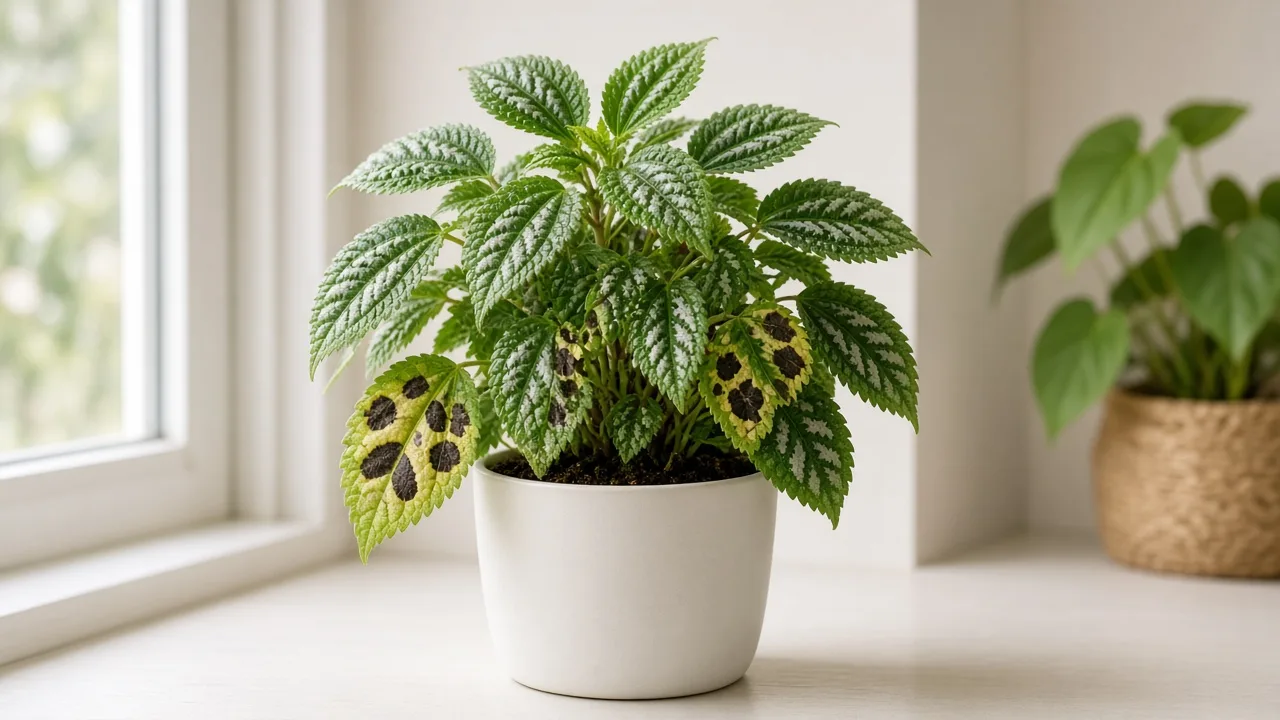
Black Spots on Aluminum Plant: Causes, Checks & Fixes
This guide covers black spots on Aluminum Plant. See also the general Black Spots guide, watering, and light pages for this plant.
Black Spots on Aluminum Plant: Causes, Checks & Fixes
Quick answer
Black or dark brown spots on Pilea cadierei (Aluminum Plant) are localized tissue death on quilted, silver-marked oval leaves—not random soil mold or dust on the metallic patches. The most common indoor cause is bacterial or fungal leaf spot when foliage stays wet in humid, poorly ventilated rooms or terrariums. Scale, mealybugs, and cold injury on damp leaves are the main lookalikes.
First step: Stop misting and overhead watering onto leaves. Wipe blades dry, water at soil level only, and note whether spots are water-soaked with yellow halos or dry specks with raised waxy bumps in leaf axils.
For general spot-disease mechanics, see our black spots guide. On aluminum plant, the quilted leaf surface and silver marbling can hide early lesions until humidity keeps blades wet for hours—leaf spot spreads faster than on thick succulent leaves. Route to overwatering if spots coincide with soggy mix, yellow lower leaves, and a heavy pot that never lightens.
When to use this page vs other Aluminum Plant guides
| Pattern | Read next |
|---|---|
| Wet soil, yellow lower leaves, mushy stems | Overwatering |
| Dry white cottony clusters in leaf axils | Mealybugs |
| Dry bumps on stems or veins, sticky residue | Scale insects |
| Brown tips only, no round or streaked blotches | Brown tips |
| Mushy roots, sour soil smell | Root rot |
| Leggy stems, pale new growth, wet mix in dim corner | Not enough light |
What black spots look like on Aluminum Plant
Aluminum plant leaves are elliptic to obovate with serrated edges and four rows of upraised silver patches that look metallic against dark green tissue. Spots often start on lowest leaves draped over the pot rim or where condensation pools on the quilted surface—not as random dust on the silver bands.
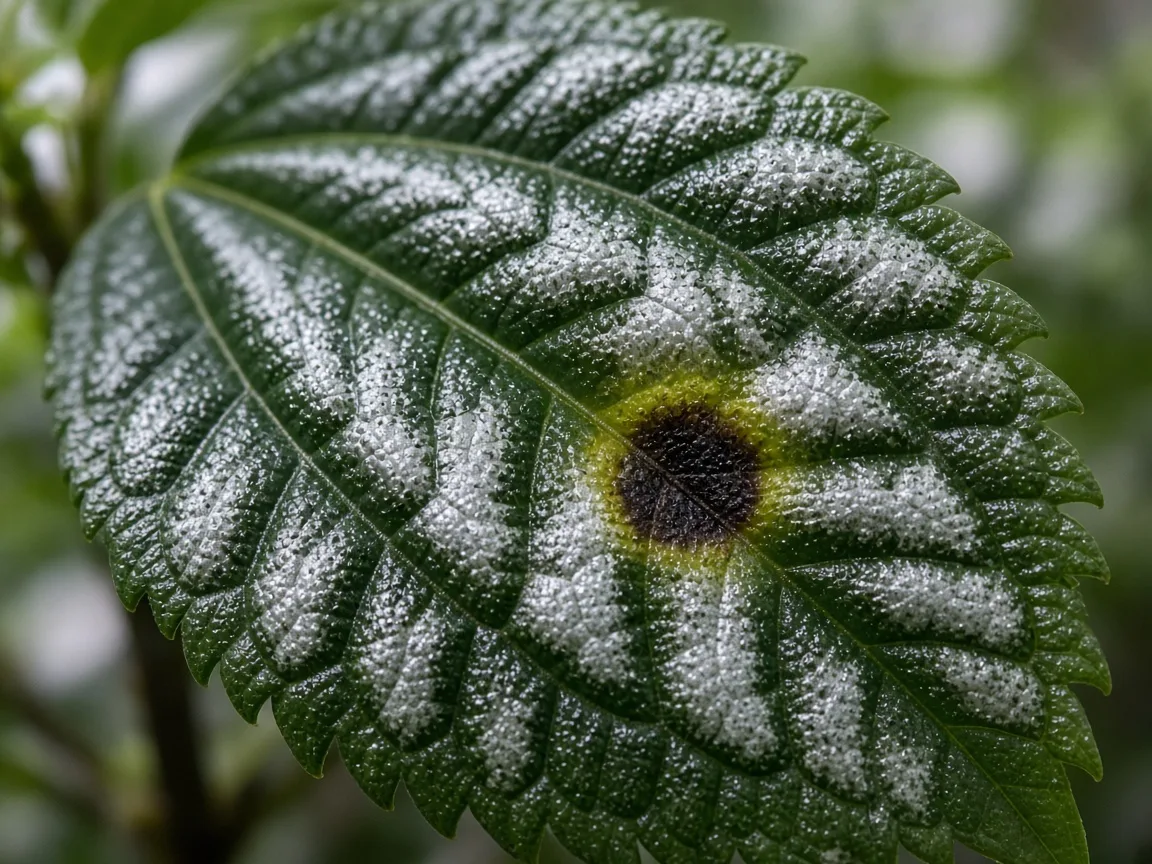
Leaf spot on a quilted aluminum plant blade—water-soaked halos follow wet foliage; dry specks in axils suggest mealybugs or scale.
Fungal or bacterial leaf spot — Dark brown or black lesions, often with a yellow halo, starting on lower or inner leaves in a humid terrarium, bathroom shelf, or crowded windowsill. Worse after misting, splash watering, or leaves touching wet glass.
Mealybugs and scale — Dry black or brown specks near leaf axils where mealybugs commonly hide on foliage plants, with cottony white clusters or raised waxy bumps and sticky honeydew on nearby leaves.
Sooty mold from pest honeydew — Black powdery film on leaf surfaces above a sticky patch, not true leaf tissue death. Follow the pest trail to mealybugs, scale insects, or aphids.
Cold injury — Water-soaked dark patches after a draft on damp leaves. Aluminum plant prefers warm room temperatures and does not tolerate cold stress well when foliage stays wet.
Normal aging — A few fully brown-black lower leaves on an otherwise bushy plant with clean new tips are often old tissue dying back—not active disease.
The silver-patch camouflage problem (Aluminum Plant only)
Early leaf spot on aluminum plant is easy to miss because dark lesions can sit beside or within the raised silver patches that already break up the green leaf surface. Owners often notice spots only after they spread across several quilted blades or when lower leaves blacken while new tips at the crown still look fine. Check both sides of serrated margins and the groove where each oval leaf meets the stem—water films linger there longer than on flat succulent leaves. If spots are multiplying but you still see firm silver-marked new growth, you are usually in time for a cultural fix before repotting or fungicide.
Terrarium humidity trap (Aluminum Plant only)
Aluminum plant is a popular terrarium and high-humidity houseplant that appreciates moist air—but enclosed glass multiplies leaf wetness without adding root-zone drainage. Condensation on quilted leaves that never fully dries is one of the fastest paths to black spotting on this species. If your plant lives under a cloche or in a closed terrarium, open ventilation daily, keep leaves from touching wet glass, and water the soil lightly rather than misting foliage. Pair humidity with bright indirect light so the mix still dries on schedule; see low humidity only when leaf tips crisp—not when the problem is wet leaves.
Axils, pinch points, and pest stains (Aluminum Plant only)
This fast-growing pilea is often pinched at stem tips to stay bushy, which creates dense clusters where opposite leaves overlap. NC State notes mealybugs, scale, aphids, and spider mites as common problems on this species—and those pests concentrate in the tight axils between quilted leaves and green stems. Honeydew from sap-feeding insects on indoor plants can dry into black specks that look like fungal spots until you find the bump or cottony mass underneath. Run a cotton swab along axils before assuming leaf spot; route to spider mites if you see fine webbing on new growth.
Why Aluminum Plant gets black spots
Wet foliage plus poor airflow is the primary fungal and bacterial pathway. Water on foliage encourages leaf spot diseases on houseplants, and aluminum plant’s quilted, serrated blades hold moisture in grooves longer than smooth leaves.
High humidity without ventilation stacks the risk. Powdery mildew can occur in high humidity or poor circulation on this species; while mildew is usually white, the same stagnant conditions that favor it also keep leaf spot pathogens active on wet tissue.
Misting and overhead watering splash water into serrated margins and leaf axils. Aluminum plant wants room humidity around 50–60%—not foliar soaking. See the watering guide for soil-level rhythm.
Root-zone weakness from overwatering invites secondary infection—overwatering or poor drainage commonly causes root rot on aluminum plant, and stressed plants spot more easily. Wet surface mold on mix may signal the same damp habit; check mold on soil if the pot top stays soggy.
Pests in dense bushy growth leave honeydew stains that darken over time. Inspect after bringing home new plants or refreshing a terrarium planting.
Confirm the cause in five checks
- Watering method: Mist, spray bottle, terrarium condensation, or splash on blades—especially evening wetting?
- Halo test: Yellow ring around a dark spot → leaf spot. Dry speck with waxy bump → scale or mealybug.
- Spread speed: New spots after humid nights or misting → cultural fix first.
- Location on plant: Lowest draping leaves and inner terrarium foliage first → moisture problem. Axil clusters with stickiness → pest route.
- Soil and stems: Heavy wet pot 7+ days → overwatering. Soft stems at soil line → root rot.
First fix by confirmed cause
| Confirmed cause | First fix | After 10–14 days if stable |
|---|---|---|
| Leaf spot (wet foliage) | Stop foliar wetting; water soil only when top half-inch dries; improve airflow | Remove worst spotted leaves with sterile shears |
| Mealybugs or scale | Isolate; wipe visible pests with alcohol on a test leaf | Full mealybugs or scale insects protocol |
| Sooty mold from honeydew | Treat underlying pest first | Wipe sooty film with damp cloth once pests are controlled |
| Cold injury | Move to stable warmth off glass and vents | Trim only fully dead tissue |
| Root-zone weakness | Dry-down per watering guide | Overwatering if mix stays heavy |
One action first: dry the leaf routine—stop misting, wipe quilted blades dry, and water at soil level only—before any fungicide or repotting.
If more than half a leaf is spotted or tissue is mushy, remove that leaf after you have stopped wetting foliage. Partially spotted firm leaves can stay if spread stops—they still support a bushy clump until you pinch new tips.
Recovery timeline
Spotted tissue does not heal back to green and silver. Spot-free new oval leaves with crisp metallic patches from stem tips are the recovery marker. In stable dry culture, expect clean growth within two to four weeks; heavy terrarium outbreaks may need several lower leaves removed and better ventilation first. Escalate if spots appear on newest crown leaves, stems soften, or soil smells sour—see root rot.
What not to do
Do not mist aluminum plant leaves, overhead-water in a humid bathroom, or apply fungicide while foliage is still getting wet. Do not repot on day one unless the crown is soft or roots are mushy. Do not confuse brown tips from dry air with round or streaked blotches on the leaf blade. Do not stack repotting, heavy pruning, and pesticide on the same day.
How to prevent black spots on Aluminum Plant
Water at soil level when the top half-inch of mix dries, empty saucers promptly, and give bright indirect light so blades and soil dry predictably. If you use a terrarium or cloche, ventilate daily. Pinch leggy tips per the pruning guide to keep airflow through the clump, quarantine newcomers, and inspect axils monthly. Use a pebble tray or humidifier for air moisture—not foliar misting.
Related Aluminum Plant guides
Conclusion
Black spots on aluminum plant are wet-leaf and airflow problems first on quilted, silver-marked foliage—not mysterious blight. Stop foliar wetting, dry the oval blades, and watch whether new metallic-splashed leaves stay clean for two weeks. Mealybugs, scale, and cold injury leave different patterns—match texture and history before spraying. Route to root guides if soggy mix stacks with crown softness or yellowing lowers.
Related tool
Use the Plant Problem Diagnosis Tool to narrow causes for black spots on this plant before changing multiple variables at once.