Potassium Deficiency on Anacharis / Elodea: Causes, Checks
Quick answer
Potassium deficiency on Anacharis / Elodea shows as pinholes, yellow or brown leaf margins, and scorched edges on older whorls while new stem tips stay green. First step: inspect the lowest mature whorls for mid-leaf pinholes with clean margins, then dose a comprehensive aquarium fertilizer with potassium—or add a dedicated K supplement if your all-in-one formula omits it.
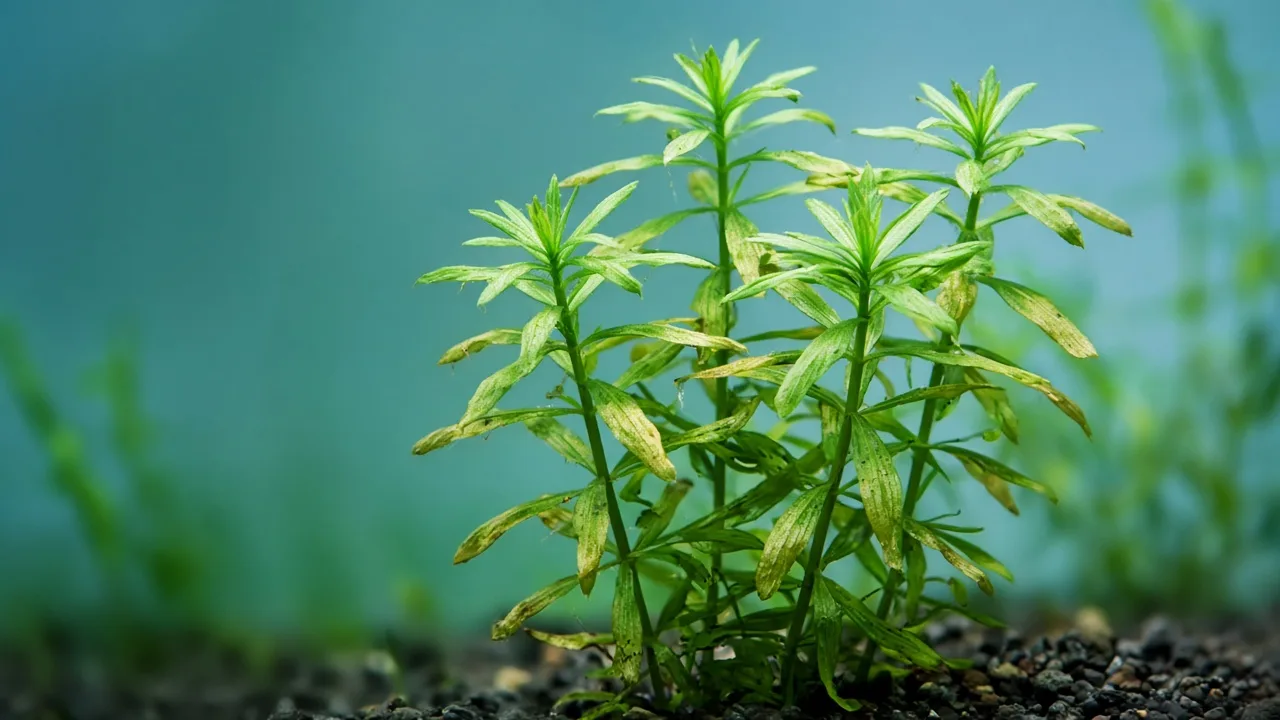
Potassium Deficiency on Anacharis / Elodea: Causes, Checks & Fixes
This guide covers potassium deficiency on Anacharis / Elodea. See also the general Potassium Deficiency guide, watering, and light pages for this plant.
Potassium Deficiency on Anacharis / Elodea: Causes, Checks & Fixes
Quick answer
Potassium deficiency on Anacharis (Egeria densa) shows as pinholes, yellow or brown leaf margins, and scorched edges on older whorls while new stem tips usually stay green. Potassium is mobile within plants—when the water column runs low, Anacharis strips potassium from mature submerged leaves to fund new growth at the apex.
See our potassium deficiency guide for general mobile-nutrient mechanics. On Anacharis, inspect the lowest mature whorls on firm green stems—pinholes and marginal burn on old tissue with healthy tips above is the classic column-fed stem pattern, not a soil-root problem.
First step: scan lower whorls for mid-leaf pinholes with clean margins, then dose potassium through a comprehensive aquarium fertilizer or dedicated K supplement. Anacharis pulls minerals through its water-column leaves, not potting mix. Fast growth in shrimp-only, betta-only, or high-light planted tanks often outpaces all-in-one formulas that omit adequate potassium.
This guide covers submerged aquarium culture only. For baseline feeding cadence, see the Anacharis fertilizer guide. For pale new tips with green veins, see iron deficiency. For yellow oldest whorls with green tips, see nitrogen deficiency.
When to use this page vs other Anacharis guides
| Pattern | Read next |
|---|---|
| Pinholes or scorched margins on older whorls, green tips | Potassium deficiency (this page) |
| Pale new tips with dark green veins, normal shape | Iron deficiency |
| Yellow oldest whorls first, green tips | Nitrogen deficiency |
| Interveinal yellow on older whorls, no pinholes | Magnesium deficiency |
| Twisted or cupped new whorls at stem tips | Calcium deficiency |
| Ragged edge tears from tank mates | Holes in leaves from grazing |
| Whole stem fades within 7–14 days after purchase | Transition melt |
| Mushy translucent stems after Excel or copper | Chemical damage |
What potassium deficiency looks like on Anacharis
Healthy Anacharis whorls are bright emerald green along the full submerged stem. Potassium shortage targets older tissue first because the plant mobilizes potassium from mature leaves to keep new tips growing when dissolved K in the water column is limited.
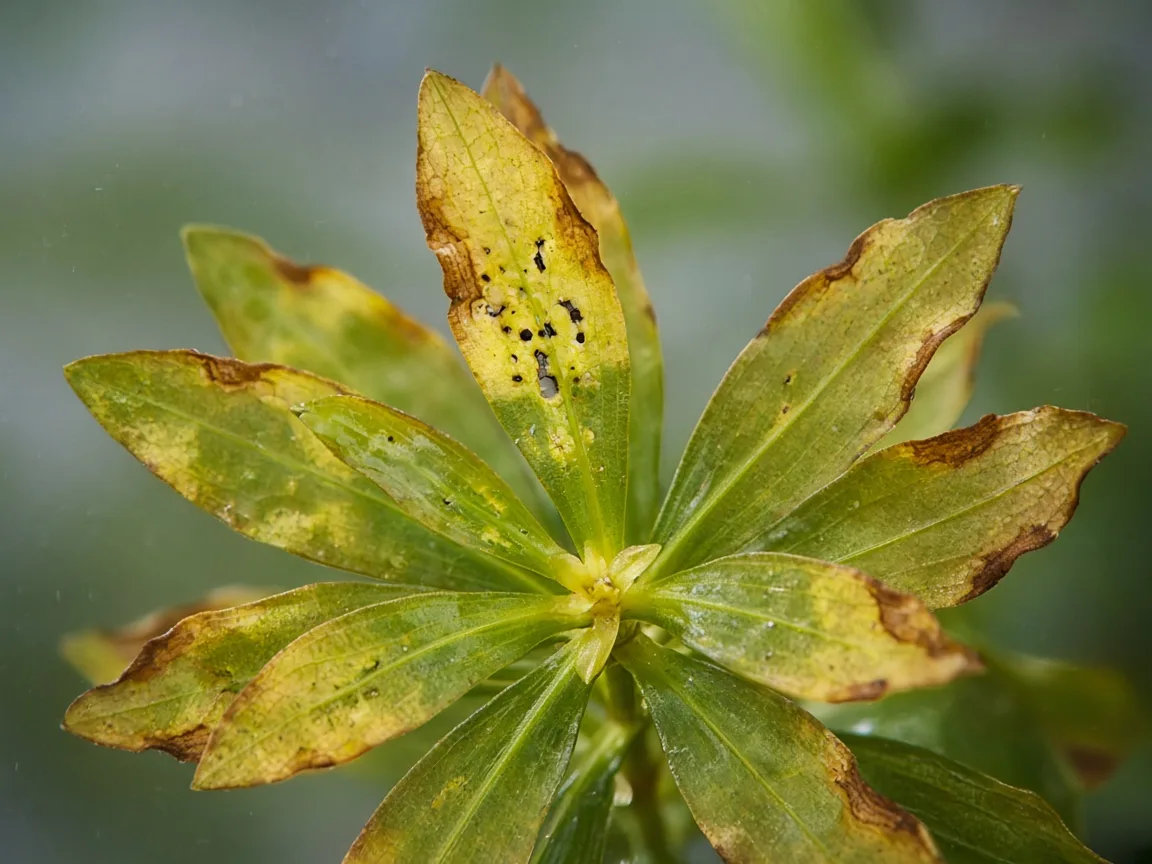
Pinholes and chlorotic margins on a lower Anacharis whorl—compare with normal green tissue on newer whorls higher on the same stem.
Classic potassium pattern (confirm this before dosing):
- Oldest to mid-stem whorls develop small pinholes, dark specks, or perforated tissue—often in the leaf blade center
- Yellow, tan, or brown margins appear on mature leaves before tips collapse
- Newest whorls at stem tips stay green for days or weeks while only lower leaves look sick
- Multiple stems show the same lower-whorl damage in planted displays, not one random chewed shoot
- Stems stay firm—not the translucent mush of melt or chemical burn
What it is not:
- Pale new tips with green veins, normal shape → iron deficiency, not potassium
- Yellow bottom whorls turning translucent, green tips → nitrogen deficiency
- Cupped or crinkled new whorls at the apex → calcium deficiency
- Ragged edge tears with obvious bite marks → turtle, goldfish, or snail grazing—see holes in leaves
- Whole-plant washout after shipping in the first 7–14 days → transition melt
- Tip-only burn on one shaded lower leaf → brown tips from light or flow before broad K dosing
Anacharis is expressive: where on the stem the damage sits matters more than the word “holes” in a forum title.
Why Anacharis runs short on potassium
Anacharis is a fast column-feeding submerged stem plant in the Hydrocharitaceae family. Its thin whorled leaves absorb potassium directly from the water. That design works well when macros match growth speed—but fast stems in lightly stocked or high-demand planted tanks can strip dissolved K faster than fish waste or a weak all-in-one replaces it.
Common potassium-deficiency triggers on Anacharis:
- All-in-one liquid without adequate potassium — Many comprehensive formulas cover nitrogen and iron well but leave K short for fast stem plants; check the label for potassium (K).
- Shrimp-only or betta-only planted tanks — Minimal bioload plus fast Anacharis growth; weekly comprehensive liquid with macros is usually required per the Anacharis fertilizer guide.
- High-light or CO₂-driven growth — PAR and carbon accelerate uptake; K demand rises with weekly trimming volume.
- Large weekly water changes on soft tap — Dilutes accumulated macros; redose after changes rather than assuming residual K remains.
- Turtle tanks with sparse feeding — Moderate turtle bioload on tap water often supplies some nutrients, but heavily grazed, frequently cleaned tanks with little dissolved organic input can still run low on macros if stems regrow fast.
- Over-reliance on root tabs — Anacharis is a column feeder; buried tabs help rooted stems marginally but do not replace water-column K for floating or lightly anchored bunches.
Many community tanks on moderate fish stocking and tap water show adequate potassium without dedicated K bottles. Potassium deficiency is more common in shrimp display tanks, new high-tech planted setups, and tanks dosed with iron-heavy micro blends but weak macro packages.
Whorl-position diagnosis on submerged stems
Anacharis does not have a soil root zone to inspect. Your field test is which whorls show damage along each submerged stem.
Work stem by stem:
- Start at the lowest mature whorl — Leaves three to six nodes above the substrate or float line, not the freshest tip.
- Look for pinholes mid-blade — Small perforated spots with relatively clean edges fit potassium shortage better than edge-first grazing.
- Check margins for yellow or brown scorch — Older leaves show blotchy chlorosis and marginal burn in classic K stress.
- Compare to the apex whorl — If tips stay green while only lower whorls perforate, mobile-nutrient logic supports potassium over iron or calcium.
- Scan multiple stems — One damaged leaf from mechanical scraping differs from several stems with the same lower-whorl pattern after a fertilizer routine change.
This whorl-position check is wrong for terrestrial houseplants and wrong for slow rhizome plants like Anubias—it is specific to fast submerged whorled stems that drink from the water column.
Pinhole vs turtle, snail, and goldfish grazing
Anacharis in turtle tanks and goldfish setups gets chewed often. Grazing damage and potassium pinholes both leave holes—but the pattern and tank context differ.
| Clue | Potassium deficiency | Herbivore grazing |
|---|---|---|
| Damage location | Mid-leaf pinholes; marginal scorch on older whorls | Ragged tears from leaf margin inward |
| Stem position | Lower and mid whorls; tips often green | Any whorl turtles can reach; random on grazed stems |
| Margin shape | Relatively clean edge around each hole | Uneven shredded edge, bite marks |
| Tank mates | Shrimp-only or planted display | Turtles, goldfish, large apple snails |
| Spread | Similar pattern on multiple stems over 1–2 weeks | New damage daily where animals feed |
| Stem feel | Firm green tissue | Firm unless rot follows uneaten debris |
If turtles are actively grazing, float backup stems in a separate tub or accept some edge damage while you confirm whether ungrazed lower whorls still develop mid-leaf pinholes. Pinholes on stems out of reach of tank mates strongly support potassium—not bites.
Rule out overfertilization and fertilizer burn if holes appeared immediately after a double-strength macro dose—burn can look like necrotic spots but usually hits tender new tissue or follows a dosing error, not a slow lower-whorl march.
Nitrate, potassium, and all-in-one fertilizer gaps
Macros interact. Before you buy a potassium-only bottle, read what you already dose.
| Setup | K risk | First check |
|---|---|---|
| Shrimp tank, comprehensive liquid weekly | Medium if formula is micro-heavy | Label for potassium; stem trim volume |
| Betta jar with trace-only drops | High | Switch to complete aquarium fertilizer |
| High-tech CO₂ with lean macros | High | K target alongside nitrate |
| Well-stocked community on tap | Low | Confirm pattern is not grazing |
| Turtle tank, frequent water changes | Medium if stems regrow fast | Lower-whorl pinholes on ungrazed stems |
| New tank, first 14 days after purchase | Hold diagnosis | Transition melt first |
Target context: planted-aquarium references often cite roughly 8–25 ppm potassium in the water column for maintenance, with many hobbyists working near 10–20 ppm through weekly dosing and water-change rhythm. Hobbyist potassium test kits exist but are less common than nitrate kits; many aquarists dose to label rates and watch new whorls instead of chasing exact ppm.
If nitrogen deficiency and potassium deficiency overlap—bottom yellow and pinholed margins—address comprehensive fertilizer with both N and K over two weeks rather than single-nutrient spikes on one day.
How to confirm potassium deficiency (not melt or iron)
Work through this checklist in order. One clear pattern beats guessing from a photo.
- Symptom position — Pinholes and marginal scorch on older whorls with green tips strongly supports potassium. Pale new tips with green veins points to iron instead.
- Symptom shape — Mid-blade perforations and edge burn fit K. Cupped new tips fit calcium.
- Tank age and purchase date — Stems added in the last 14 days may show yellowing from emersed-to-submersed transition. Hold potassium diagnosis until firm submerged growth establishes.
- Fertilizer label — All-in-one without listed potassium raises probability; iron-only micro blends do not replace K.
- Stocking and growth speed — Fast trim volume in lightly stocked tanks increases K demand.
- Grazing check — Confirm pinholes on stems animals cannot reach.
- Recent medication — Copper or glutaraldehyde stress melts stems; rule out chemical damage if holes followed treatment, not a feeding routine change.
When potassium is confirmed
Proceed when lower whorls show pinholes or marginal scorch, stem tips stay green, grazing and melt are ruled out, and the plant is past the first-week shipping window. Change one variable—usually weekly comprehensive fertilizer with potassium or a measured K supplement—and re-evaluate in two weeks. Do not stack full-strength macros, iron, GH booster, and light changes on the same day.
First fix: dose potassium through the water column
First action: dose a comprehensive aquarium liquid fertilizer that includes potassium at label strength—or add a dedicated potassium supplement if your current formula omits K. One clear step, not macro boosters plus root tabs plus Epsom salt on day one.
Practical paths for Anacharis:
- Shrimp-only or low-fish planted tank — Weekly Tropica Specialised Nutrition at 6 mL per 50 L covers macros including potassium for column feeders when growth is moderate.
- All-in-one without adequate K on the label — Add potassium sulfate (K₂SO₄) or a dedicated aquarium K product per manufacturer rate; many guides target roughly 10–20 ppm maintenance through repeated small doses rather than one spike.
- After each water change — Redose macros into the new volume; large changes dilute accumulated potassium.
- Well-stocked turtle tank on tap — If only ungrazed stems in a quarantine tub show pinholes, dose there first; main tank may already carry enough K from bioload.
- Suspected double deficiency — Use comprehensive NPK liquid rather than iron-only micros when bottom leaves yellow and perforate.
Use a 1 mL syringe for small tanks. Pour liquid fertilizer into high-flow areas so it distributes before it settles on the substrate.
Do not dump terrestrial plant food or garden potassium into turtle water. Use aquarium-labeled products only, and match any mineral change to your livestock species’ tolerance.
Trim-and-float recovery for perforated lower whorls
When several lower whorls are pinholed but mid-stem tissue and tips are firm green, use Anacharis’s column-feeding recovery habit:
- Trim each stem just above the last healthy whorl — Remove heavily perforated lower leaves so decay does not foul turtle or shrimp water per the watering guide.
- Float upper cuttings near moderate light if lower stems were buried too deep or bases look stressed.
- Wait for the next two whorls after K stabilizes — Judge new tissue, not old holes.
- Replant shallowly once roots form—strip lower leaves so nothing rots in gravel; see stem rot prevention.
- Thin dense bunches so lower whorls receive light—shaded pale leaves are often a light problem misread as nutrients.
This trim-float path is nonsense for potted Aglaonema and wrong for cactus—it is how aquarists salvage fast stem plants when older whorls were starved of potassium but upper nodes remain viable.
Step-by-step recovery and when to adjust again
After the first potassium correction:
- Do not remove all photosynthetic tissue unless it is mushy—green mid-stem whorls fuel recovery.
- Keep photoperiod stable at 8–10 hours per the light guide; sudden PAR jumps stress recovering stems.
- Wait 14 days before doubling K dose—watch new lower whorls for fresh pinholes, not old perforated leaves.
- Retest nitrate if bottom leaves yellow while margins scorch—split N and K deficiency can need comprehensive fertilizer over two weeks.
- Siphon perforated leaf bits during water changes so they do not clog filters in turtle setups.
- Hold ich or copper medications until stems show firm green new growth when possible.
In shrimp tanks, avoid pairing a large K spike with molting stress from sudden parameter swings—raise dosing gradually if you use dry salts.
Recovery timeline and what to watch
| Phase | Timing | Good signs | Bad signs |
|---|---|---|---|
| First dosing | Days 1–7 | No new pinholes on lowest healthy whorl | Margins scorch spreading upward fast |
| New growth check | Days 10–21 | Next whorls emerge without perforations | Fresh holes on mid-stem tissue |
| Established rhythm | Days 21–35 | Stable green tips; trim old damage once | Tips pale between veins (iron gap) |
| Maintenance | Week 5+ | Weekly dose prevents relapse | Pinholes return every cycle—review label K |
Existing pinholes rarely close. Judge success by the next one or two whorls emerging clean after trimming heavily damaged lower leaves. Mild potassium shortage in a dosed shrimp tank often shows improvement within two to three weeks. Tanks that ran lean macros for months may need a full month of consistent comprehensive feeding before dense lower growth looks pristine.
If lower whorls keep perforating after four weeks at label macro dosing and PAR is adequate, rule out magnesium deficiency, stunted growth from chronic imbalance, and CO₂ instability in high-tech setups before escalating K alone.
What not to do
- Do not diagnose potassium during the first 1–2 weeks after purchase — Yellowing or hole-like melt on newly shipped Anacharis is often transition shock, not K hunger.
- Do not dose iron as a fix for pinholed older leaves — Iron targets new-tip chlorosis, not mid-stem perforations.
- Do not add garden fertilizers or Epsom salt blindly — Aquarium-labeled comprehensive products keep NPK ratios safer for fish, shrimp, and turtles.
- Do not confuse grazing with deficiency — Edge-first ragged tears from turtles need management, not more potassium.
- Do not use liquid carbon (Flourish Excel) on Anacharis — Glutaraldehyde products melt Elodea; they are not a substitute for balanced macros.
- Do not check soil moisture or repot — This plant grows submerged in aquarium water. Fertilizer labels and stem patterns diagnose potassium—not potting mix.
How to prevent potassium deficiency next time
Match macro strategy to stocking and trim volume, not the largest iron number on a bottle:
- Shrimp-only or betta planted tanks — Weekly comprehensive liquid with potassium per the Anacharis fertilizer guide.
- High-light or CO₂ tanks — Confirm K on the label; increase comprehensive dose modestly when weekly trim volume rises.
- After large water changes — Redose macros into the replacement volume.
- Turtle tanks — Accept some grazing damage; dose only if ungrazed backup stems in a tub show the same pinhole pattern.
- Product swaps — When changing brands, compare potassium content—not all “plant boosters” are equal.
Trim tall stems weekly so lower whorls receive light—shaded marginal yellow on one old leaf is often flow or PAR, not a tank-wide K crisis. Never release trimmings into ponds or streams—Egeria densa spreads aggressively outside tanks.
When to worry (shrimp, turtles, chronic perforation)
Escalate if new whorls keep pinholing after four weeks of label macro dosing with confirmed adequate light and non-zero nitrate—consult a local fish store or planted-tank forum with photos of lower vs upper whorls on the same stem. Chronic perforation despite good NPK can indicate magnesium shortage, CO₂ swings, or repeated mechanical damage from filter intake suction.
If stems turn translucent and mushy—not merely perforated—rule out chemical damage, heat stress, and root rot from buried leaves before adding more potassium.
For overview context on column feeding and legal disposal of trimmings, see the Anacharis care overview.
Related Anacharis / Elodea guides
- Anacharis / Elodea overview
- Anacharis / Elodea watering
- Anacharis / Elodea light
- Anacharis / Elodea fertilizer
- Anacharis / Elodea problems
- Nitrogen deficiency on Anacharis
- Iron deficiency on Anacharis
- Brown tips on Anacharis
Related tool
Use the Fertilizer Dilution Calculator to check dose rates for comprehensive aquarium fertilizers and potassium supplements—without stacking multiple nutrient changes on the same day.