Nitrogen Deficiency on Anthurium: Causes, Checks & Fixes
Quick answer
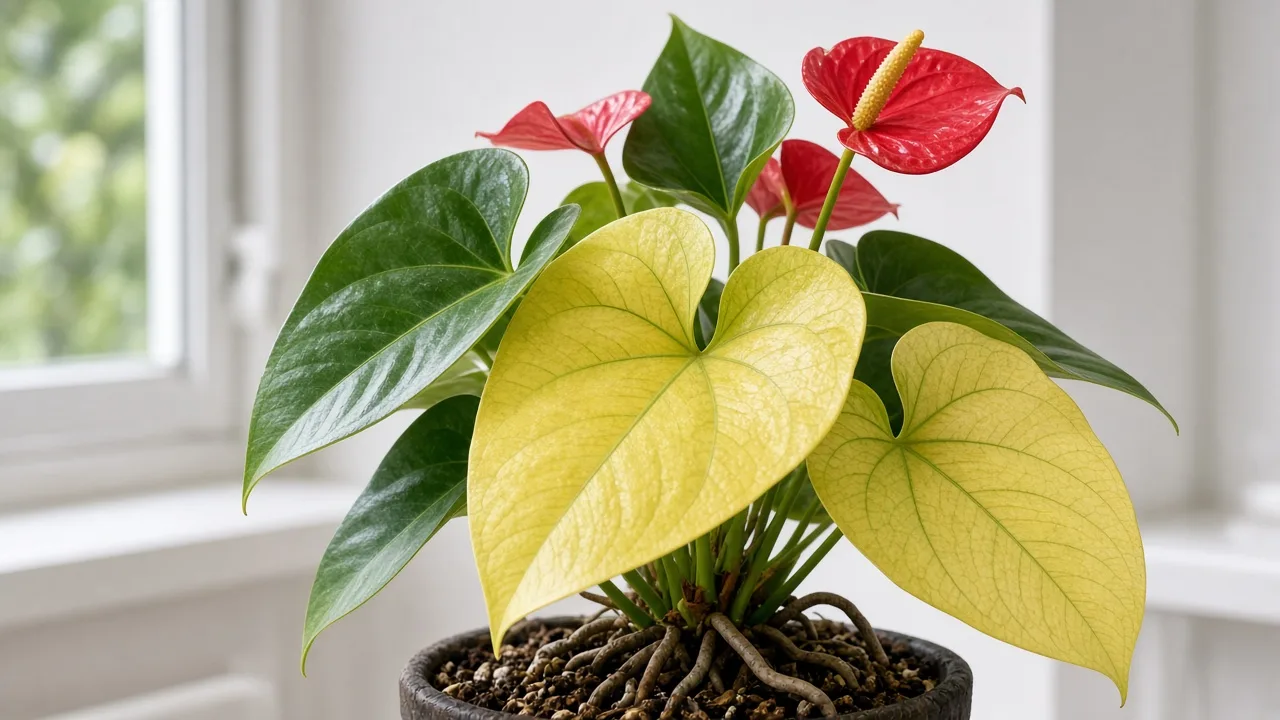
Nitrogen deficiency on anthurium shows as pale or yellowing older heart-shaped leaves while new foliage and spathe size stay small. First step: confirm yellowing starts on lower older leaves—not root rot on chronically wet orchid-like mix.
Nitrogen Deficiency on Anthurium: Causes, Checks & Fixes
This guide covers nitrogen deficiency on Anthurium. See also the general Nitrogen Deficiency guide, watering, and light pages for this plant.
Nitrogen Deficiency on Anthurium: Causes, Checks & Fixes
Quick answer
Nitrogen deficiency on anthurium (Anthurium spp.) shows as pale green to yellow older heart-shaped leaves while new foliage and spathe size stay small. Nitrogen supports chlorophyll and leafy growth—mobile nitrogen moves from old leaves to new shoots and inflorescences.
See our nitrogen deficiency guide. On anthurium, watch the lowest older heart leaves first—they pale before new crown growth and spathes fail to size up if nitrogen is low.
First step: confirm lower old heart leaves pale first on firm roots—not mushy overwatered mix.
When to use this page vs other Anthurium guides
| Pattern | Read next |
|---|---|
| Old heart leaves pale, small spathes | Nitrogen deficiency (this page) |
| Green leaves, no spathes, dim spot | Not enough light |
| Mushy roots, wet mix | Overwatering |
| Yellow between veins on old leaves | Magnesium deficiency |
| Tips brown on green leaves | Brown tips |
| No flowers despite good light | No flowers |
What nitrogen deficiency looks like on anthurium
Anthurium pairs foliage health with spathe production—nitrogen deficiency shrinks both: oldest lower heart leaves pale while new leaves and spathes stay undersized. The glossy heart-shaped leaf surface may look dull when chlorotic.
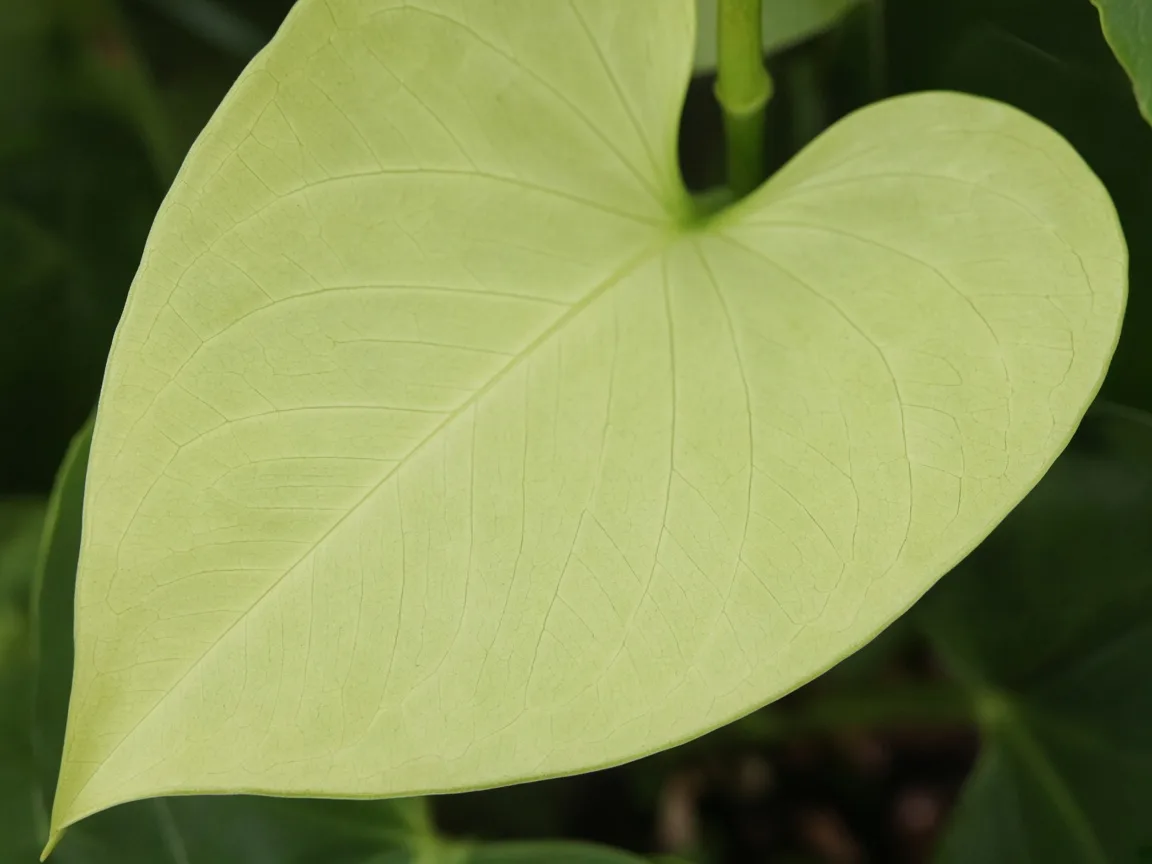
Uniform pale chlorosis on a lower anthurium heart leaf—the whole blade washes out while new crown leaves and spathes stay undersized.
Typical signs:
- Uniform pale green or yellow on lowest older heart-shaped leaves (nitrogen-deficient plants show pale older leaves first)
- Smaller new heart leaves from the crown
- Reduced spathe size and fewer inflorescences
- Firm aerial roots and base unlike mushy overwatered anthurium
- Glossy leaf surface may look dull when pale
- Progressive washout on lowest leaves over months without feed
Not nitrogen deficiency:
- Mushy roots on wet mix — overwatering / root rot
- New leaves yellow with green veins — iron deficiency
- Brown tips on otherwise green leaves — salt or water quality
- No spathes in dim light — not enough light
- Yellow between veins on old leaves — magnesium deficiency
Why anthurium gets nitrogen deficiency
Anthurium is an epiphytic aroid grown for foliage and spathes in bright indirect light. Years without fertilizer, exhausted coarse orchid-like mix, or owners who under-feed “blooming” plants show washed-out lower foliage and small spathes.
Anthurium-specific causes:
- Skipped feeds chasing blooms only — Phosphorus-heavy bloom boost without nitrogen for leaves.
- Depleted coarse mix — Same pot years without refresh in bark-perlite media. Container epiphytes deplete nutrients over time.
- Leaching from regular watering — Per the watering guide on open mix.
- Confusion with overwatering — Yellow leaves plus mushy roots on wet mix.
- Confusion with no flowers — Low light vs small pale spathes from nitrogen lack.
- Winter rest without spring resume — Feeding stopped and never restarted.
Heart leaves and spathe size together
Anthurium pairs foliage health with spathe production—nitrogen deficiency shrinks both: oldest lower heart leaves pale while new leaves and spathes stay undersized. That differs from no flowers from insufficient light alone, where leaves may still look deep green, and from overwatering, which yellows leaves alongside mushy roots rather than progressive lower-leaf pale on firm epiphytic roots.
Bloom-boost fertilizer without adequate nitrogen is a common cause—feed balanced nutrition first per the fertilizer guide, then optimize light for spathe color. Small spathes on otherwise pale lower foliage point to nitrogen, not light alone.
Aerial roots and the feeding decision
Anthurium produces aerial roots along the stem that absorb moisture and nutrients from humid air. Before feeding for nitrogen deficiency, confirm:
- Aerial roots and base roots are firm and green or white—not brown and mushy
- Mix is open and drains within days—not waterlogged for a week after one drink
- No heavy salt crust rings the pot—flush before feeding if white deposits present
Feeding nitrogen into waterlogged epiphytic roots burns tissue and worsens yellowing. Fix drainage per watering guide and soil rhythm first, then apply one dilute balanced fertilizer at quarter to half strength.
Bloom boost vs balanced nutrition
Owners often switch to high-phosphorus bloom fertilizer when spathes shrink, assuming phosphorus alone will restore flowering. Without adequate nitrogen, foliage starves while the plant attempts inflorescences on depleted reserves—producing small pale spathes on washed-out lower leaves.
The correct sequence: balanced nitrogen-complete feed for two to three months, then evaluate light per not enough light guidance. Anthurium needs bright indirect light and adequate nitrogen for both leaves and spathes.
Lookalike symptoms
| Pattern | Likely cause | Key difference on Anthurium |
|---|---|---|
| Old heart leaves pale, small spathes | Nitrogen deficiency (this page) | Progressive lower-leaf washout; firm roots |
| Green leaves, no spathes, dim spot | Not enough light | Deep green foliage; no spathe formation |
| Mushy roots, wet mix | Overwatering | Root rot smell; yellowing may be sudden |
| Yellow between veins on old leaves | Magnesium deficiency | Interveinal banding, not uniform pale |
| Tips brown on green leaves | Brown tips | Tip-only damage; foliage otherwise green |
How to confirm
- Leaf age pattern — Lowest old heart leaves first.
- Spathe performance — Smaller spathes with pale lower leaves supports nitrogen lack.
- Feeding history — Bloom-only fertilizer or years without feed.
- Root check — Firm white and green roots vs brown mush.
- Mix moisture — Appropriate open mix dry-down vs chronic wetness.
- Light adequate — Bright indirect; pale in dim corners differs.
- Gloss and size — Dull pale lower leaves with undersized new crown growth.
First fix for Anthurium
One dilute balanced liquid fertilizer at quarter to half label strength after confirming firm roots and appropriate moisture on open—not waterlogged—mix.
Per the anthurium fertilizer guide. Anthurium prefers light feeds—one measured dose, not full-strength doubling on epiphytic roots.
Step-by-step recovery
- Feed lightly monthly through active growth with balanced fertilizer—not bloom-only all season per fertilizer guide.
- Repot into fresh coarse epiphytic mix if roots fill the pot and pale leaves persist after two light feeds.
- Maintain bright indirect light without hot direct sun on pale foliage.
- Remove fully yellow lower leaves that detach easily.
- Correct overwatering if roots are mushy—nitrogen uptake requires healthy epiphytic roots.
- Monitor new heart leaves and spathe size for improvement over four to eight weeks.
Recovery timeline
Judge recovery on new heart leaves and spathe size, not old pale lower foliage:
- 2–4 weeks: New crown leaves should darken slightly
- 4–8 weeks: New leaves and larger spathes emerge—main success signal
- 8+ weeks: Two clean flushes confirm nitrogen is adequate
Lower pale heart leaves rarely re-green. Success means deeper green new foliage and spathes approaching normal size.
Mistakes to avoid
- Chasing blooms with phosphorus-only feed while leaves pale. Balanced nitrogen first, then light optimization.
- Confusing overwatering with nitrogen pale. Mushy roots on wet mix is root failure.
- Full-strength rescue feeding on epiphytic roots. Quarter to half strength matches anthurium metabolism.
- Expecting old lower heart leaves to re-green. Judge new crown growth and spathe size.
- Ignoring years without any feed. Pot-bound anthuriums deplete nitrogen even when growth seems slow.
- Heavy feeding on waterlogged orchid-like mix. Fix drainage before repeated fertilizer.
Prevention
- Feed lightly during active growth per fertilizer guide
- Refresh coarse orchid-like mix at repotting every two to three years
- Use balanced feeds, not bloom-only all season
- Maintain open mix dry-down per watering guide
- Resume spring feeds after winter rest pause
- Track feeding dates on long-held container plants
Related Anthurium guides
- Anthurium overview
- Anthurium fertilizer
- Anthurium watering
- Anthurium soil
- No flowers
- Not enough light
- Overwatering
- Anthurium problems hub
Conclusion
Pale lower heart leaves with small spathes signal nitrogen depletion in long-neglected epiphytic mix—confirm firm roots rule out overwatering, feed balanced nutrition lightly once, and monitor new crown leaves and spathe size over four to eight weeks.
Related tool
Use the Fertilizer Dilution Calculator to narrow causes for nitrogen deficiency on this plant before changing multiple variables at once.