Black Spots on Anubias: Causes, Checks & Fixes
Quick answer
Black spots on Anubias are usually algae on long-lived submerged leaves, potassium or iron necrosis on older blades, or normal aging—not houseplant leaf spot disease. Run a gentle thumbnail scrape on one leaf; if the spot lifts, treat algae before changing fertilizer.
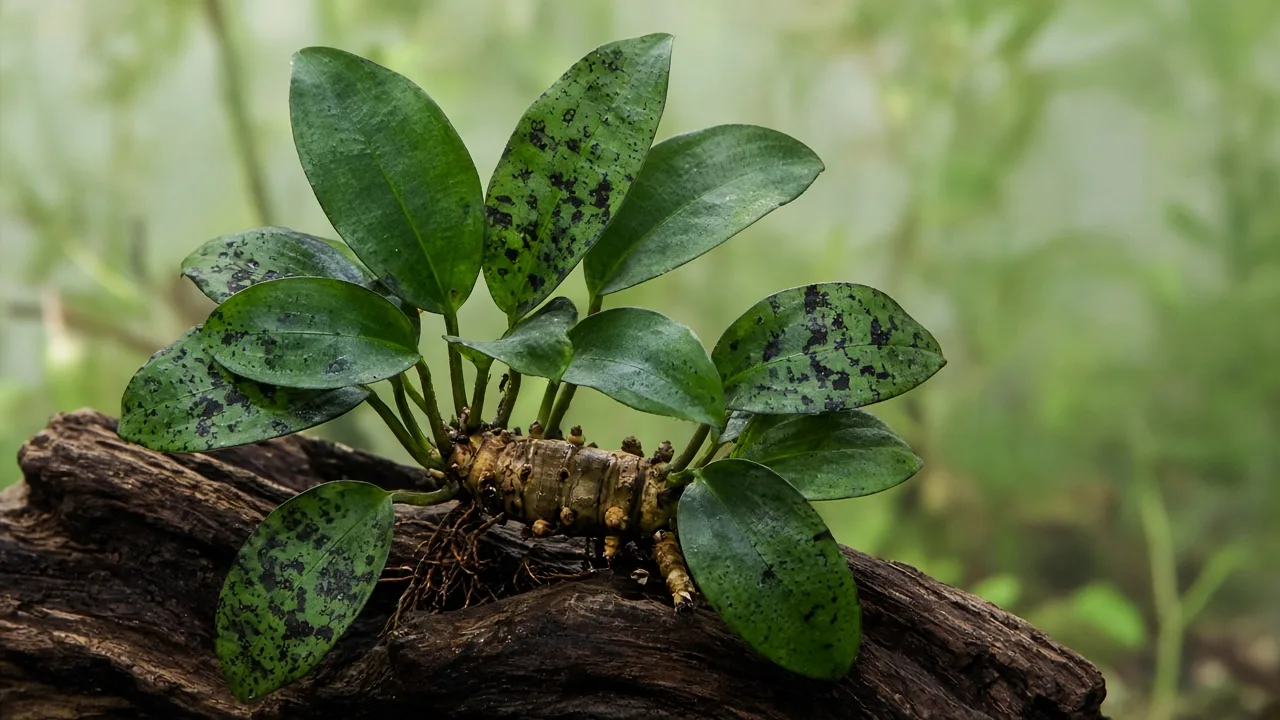
Black Spots on Anubias: Causes, Checks & Fixes
This guide covers black spots on Anubias. See also the general Black Spots guide, watering, and light pages for this plant.
Black Spots on Anubias: Causes, Checks & Fixes
Quick answer
Black spots on Anubias in aquariums fall into four buckets: surface algae on slow, long-lived leaves, necrotic patches from nutrient stress or melt, rhizome rot creeping into leaf bases, or normal aging on the oldest blades—not fungal leaf spot from houseplant guides. Anubias barteri is a slow-growing rhizome epiphyte whose submerged leaves can persist for months, which gives algae time to colonize broad green tissue before new growth replaces it.
For general spot-disease mechanics on terrestrial houseplants, see our black spots guide. On Anubias, the scrape test and rhizome firmness tell you more than misting advice ever will.
First step: gently scrape one spotted leaf with a thumbnail. If dark material lifts off and green tissue remains, treat as algae. If the spot is embedded, mushy, or tied to a soft rhizome, route to tissue-death causes before dosing algae treatments.
For mounting rules and substrate mistakes, see Anubias soil and rhizome placement. For flow, water changes, and parameter checks, see Anubias watering.
What black spots look like on Anubias
Healthy submerged Anubias shows thick, dark green, leathery leaves on a firm horizontal rhizome attached to rock, driftwood, or exposed roots in fine gravel. Black spots break that pattern in ways that map to different causes:
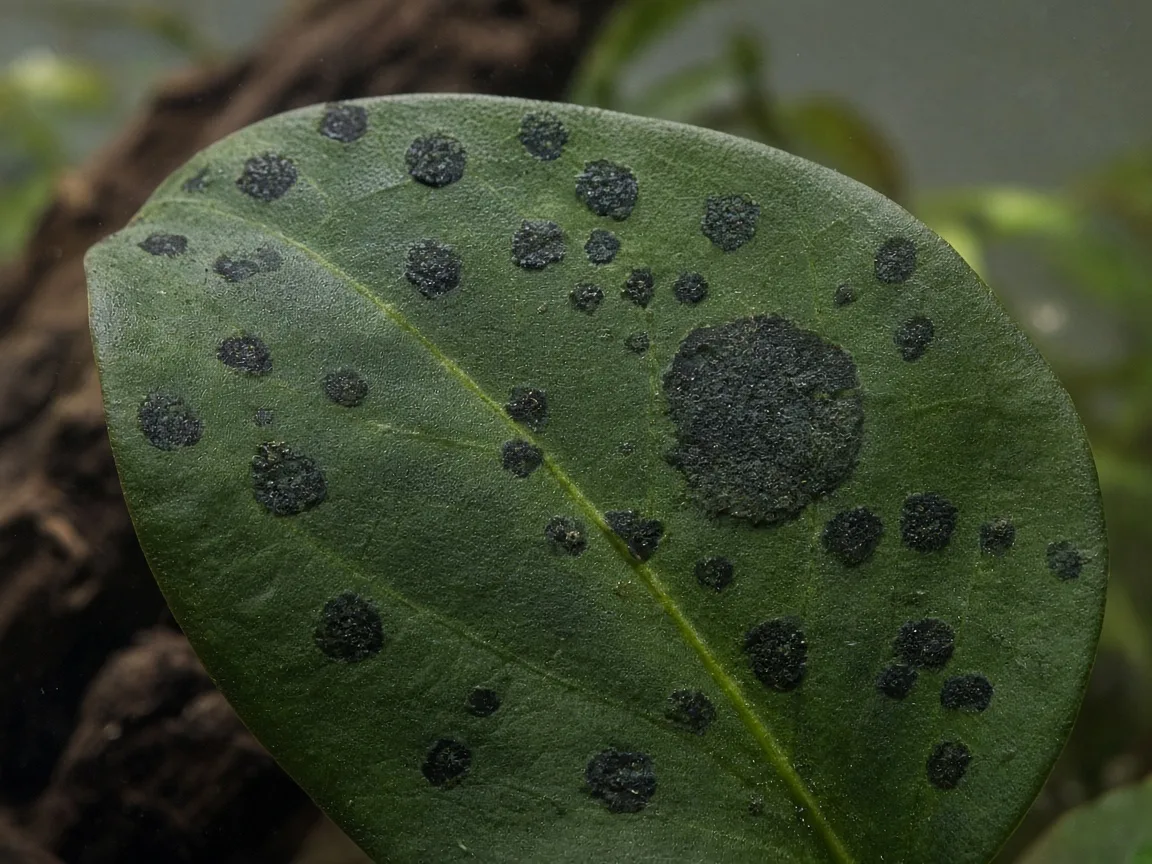
Black spot symptoms on Anubias - compare flat algae colonies with embedded necrotic tissue.
| Pattern | Location | Texture | Likely cause |
|---|---|---|---|
| Flat dark dots or film | Leaf tops in brightest tank zones | Scrapes off with thumbnail | Green spot algae or early black beard algae |
| Fuzzy black tufts | Leaf edges, rhizome, driftwood | Brush-like, hard to rub off | Black beard algae (BBA) |
| Irregular holes with dark margins | Older leaves, mid-blade | Firm leaf except at necrosis | Potassium deficiency in planted tanks |
| Black at petiole base | Where leaf meets rhizome | Soft, may smell sour | Rhizome rot or advanced melt |
| Scattered dark patches | Oldest leaves only | Dry, embedded, no spread | Normal senescence |
Anubias leaves are not thin houseplant blades—they are thick, slow-growing, and long-lived, which makes them behave more like aquarium hardscape that photosynthesizes than like fast-turnover stem-plant foliage.
Why slow Anubias leaves collect black spots
Algae on surfaces (most common)
Tropica notes that Anubias leaves survive for several years, giving slow-growing algae time to establish on leaves that are not replaced quickly. Green spot algae often starts as tiny green circles on leaf tops in bright zones, then oxidizes to dark brown or black. Black beard algae forms tufted, brush-like colonies along leaf margins, rhizome edges, and driftwood—especially when light is strong relative to plant uptake or organic waste is high.
Anubias is a favorite algae target because it tolerates the same moderate light that algae loves, grows slowly, and presents broad, stable surfaces near the light source. In turtle tanks and low-tech setups, detritus settling on leaves can accelerate the same pattern.
Nutrient necrosis on older blades
In heavily planted aquariums with stem-plant competition and minimal dosing, potassium-starved older Anubias leaves can develop irregular dark necrotic patches or pinholes while the rhizome stays firm. This is tissue death inside the leaf, not a surface colony—scraping does not remove it. Cross-check your fertilizer routine in the Anubias fertilizer guide before assuming algae alone.
Rhizome melt and rot at the leaf base
When the rhizome is buried, crushed by tight thread, or sitting in stagnant, ammonia-rich water, anaerobic decay produces black mush at petiole bases where leaves attach. Aquarium Co-Op describes rot as leaf stalks detaching with goo and a mushy rhizome—different from flat algae dots mid-blade. This overlaps with rhizome rot on Anubias and often follows the same buried-rhizome mistake covered in the soil guide.
Normal aging on the lowest leaves
The oldest Anubias leaves naturally yellow, then develop dry brown-to-black patches before the plant reabsorbs them. Spots stay on one or two bottom leaves, do not spread to new growth, and the rhizome remains firm. Trim these at the rhizome during routine Anubias pruning—no algae treatment needed.
How to confirm the cause in your tank
Work through these checks in order:
- Scrape test — Thumb pressure on one spot. Lifts = surface algae. Embedded = necrosis, aging, or rot.
- Tuft vs flat — Brush-like fringe suggests BBA; flat circles suggest green spot algae.
- Leaf age — Spots only on the oldest leaf while new submersed leaves stay clean points to aging or localized light algae, not tank-wide deficiency.
- Rhizome squeeze — Press the horizontal stem. Firm green tissue supports algae or aging; jelly-like black sections mean rot—see root rot guide.
- Mounting audit — Confirm the rhizome is fully exposed and not buried under gravel, sand, or turtle-substrate debris.
- Light map — Note whether spotted leaves sit directly under the fixture or in filter-glare zones; Anubias prefers shady placement relative to stem plants.
- Tank timeline — New-tank ammonia spikes and emersed-to-submersed transition can cause melt with black edges in the first two weeks without implying chronic algae.
Confirmed algae: surface spots, scrape off, firm rhizome, no sour smell. Confirmed rot: mushy rhizome, black petiole bases, spreading soft tissue. Suspected deficiency: embedded necrosis on multiple older leaves in a dosed tank with fast stem-plant growth.
First fix for Anubias
Run the thumbnail scrape test on one spotted leaf. If dark material lifts and green tissue remains underneath, treat as algae: trim the worst affected leaves at the rhizome with sharp scissors, remove cut tissue from the tank, and reduce direct light on that plant by repositioning it into shade or shortening photoperiod by one hour.
Do not dose copper-based fish medications on the plant as a first response—copper damages submerged foliage and is registered as an aquatic herbicide. Do not bury the rhizome deeper to “anchor” the plant while treating spots.
If scraping shows embedded necrosis and the rhizome is firm, hold algae treatments. Trim damaged leaves, review water parameters, and adjust aquarium fertilizer only after confirming potassium or iron shortage patterns.
If the rhizome feels soft or leaf bases ooze, skip algae fixes entirely: cut back to firm rhizome tissue and reattach above substrate per the root rot guide.
Recovery timeline
48–72 hours: Algae spread stops when worst leaves are removed and light on the plant drops.
1–2 weeks: Remaining leaves look cleaner; no new fuzzy colonies on fresh growth.
4–8 weeks: One or more new submersed leaves emerge from the rhizome—meaningful progress on Anubias because growth is slow by nature.
Spotted or necrotic leaf tissue will not re-green. Judge success by clean new leaves and a firm rhizome, not by saving every old blade. Rhizome rot salvage may take longer if more than half the stem required trimming.
What not to do
Do not apply houseplant leaf-spot advice—no misting bans for humidity, no “let soil dry,” no fungicide meant for potted foliage. Anubias lives fully submerged.
Do not leave trimmed, melting, or algae-heavy leaves in the tank to decay—they foul filters and spike organics in turtle setups.
Do not blast Anubias with maximum light to “outgrow” algae; slow growth cannot outpace algae on long-lived leaves without balanced nutrients and photoperiod control. See Anubias light.
Do not scrape sporangia-like structures unless you have confirmed algae—on Anubias, confirm with the scrape test first.
Do not stack a rescape, heavy fertilizer overhaul, and hydrogen peroxide treatment on the same day after identifying algae.
Lookalike symptoms
| What you see | Often confused with | How to tell them apart |
|---|---|---|
| Brown translucent patches spreading inward | Yellow leaves from melt | Melt is glassy before turning dark; algae stays surface-textured |
| Black leaf margins on old blades | Brown leaves from aging | Aging stays on lowest leaves only; algae hits lit surfaces |
| Dark fuzzy fringe on wood and leaves | Mold on soil in emersed setups | Submerged BBA tufts brush-like; emersed mold is on exposed substrate |
| Holes chewed through blades | Turtle or snail grazing | Clean bite margins, not circular algae colonies |
How to prevent black spots next time
Mount Anubias barteri cultivars with the rhizome exposed on porous rock or driftwood per the soil guide. Place plants in moderate diffuse light or shade under the canopy of faster growers rather than directly under the brightest LED zone. Maintain weekly partial water changes, trim aging or algae-heavy leaves before they shed into filter intakes, and keep ammonia at zero in turtle tanks.
In nutrient-hungry planted aquariums, use modest liquid dosing so potassium does not deplete silently while stem plants consume macros. For BBA that persists on hardscape, spot-treat exposed colonies with diluted hydrogen peroxide only after removing fish-sensitive invertebrates per label guidance—BBA often takes months to establish and equally long to fully clear.
When to worry
Escalate when black mush climbs from the rhizome into multiple leaf bases, the rhizome smells rotten, or every new leaf shows spots within days of planting in an otherwise stable tank. Salvage only firm rhizome sections; discard plants with no firm core left.
In turtle tubs, a large mass of decaying Anubias leaves can clog intakes and stress water quality even when livestock look unaffected—remove spotted, melting tissue aggressively before adjusting meds or adding animals.
If algae persists after light reduction and trimming, review the full cluster on the Anubias problems hub before assuming a bad batch.
When to use this page vs other Anubias guides
- Anubias watering guide — Use for routine parameter checks before assuming black spots are the main issue.
- Anubias problems hub — Browse all common issues on this species.
- Rhizome rot on Anubias — Use when black tissue is mushy at the rhizome, not flat on the leaf surface.
- Yellow leaves on Anubias — Use when whole blades yellow or melt before dark spots appear.
- Brown leaves on Anubias — Use when margins brown on old foliage without fuzzy algae texture.
Related Anubias guides
- Anubias overview
- Anubias watering
- Anubias light
- Anubias soil
- Rhizome rot on Anubias
- Yellow leaves on Anubias
- Anubias pruning
- Anubias problems
Related tool
Use the Plant Problem Diagnosis Tool to narrow causes for black spots on this plant before changing multiple variables at once.