Nitrogen Deficiency on Aparajita: Causes, Checks & Fixes
Quick answer
Nitrogen deficiency on Aparajita shows as uniform pale yellow-green on the oldest lower trifoliate leaf clusters along twining stems, with smaller new leaflets at active vine tips and slow summer extension despite full sun. First step: confirm the washout is on mature lower compound leaves—not green-veined new growth or interveinal banding—and check whether sterile balcony mix or a young vine lacks working root nodules before feeding.
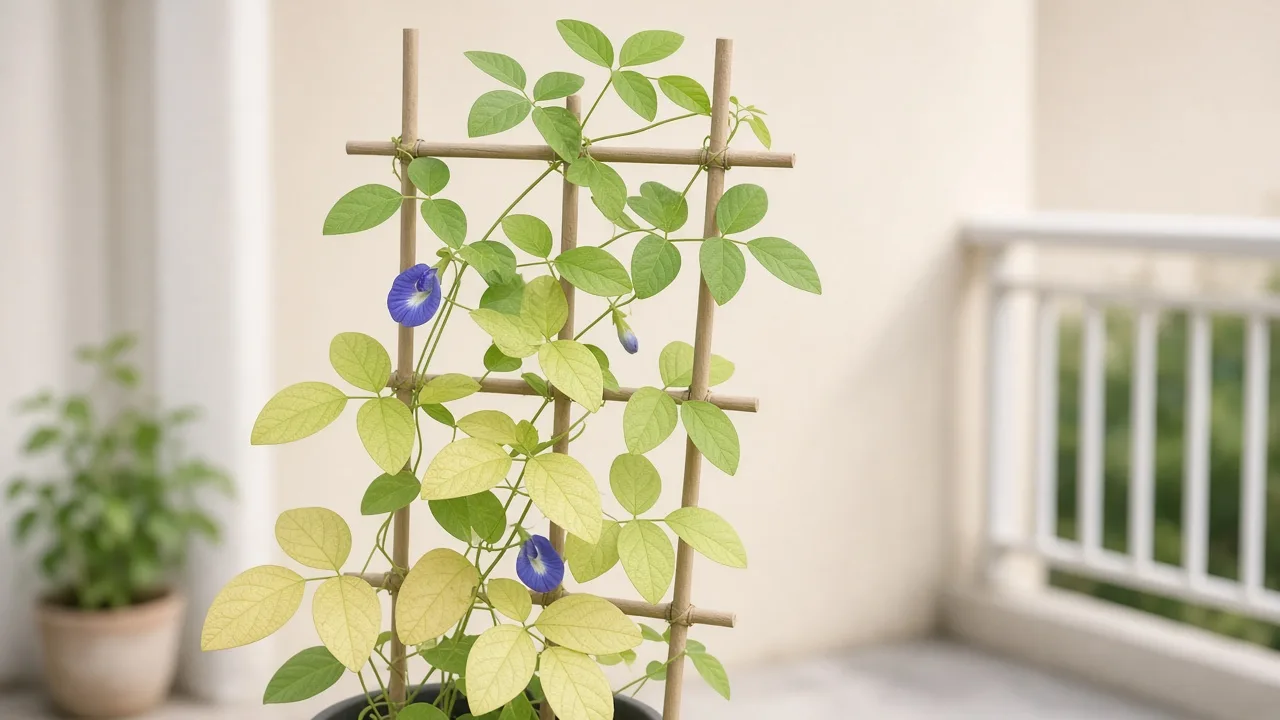
Nitrogen Deficiency on Aparajita: Causes, Checks & Fixes
This guide covers nitrogen deficiency on Aparajita. See also the general Nitrogen Deficiency guide, watering, and light pages for this plant.
Nitrogen Deficiency on Aparajita: Causes, Checks & Fixes
Quick answer
Nitrogen deficiency on Aparajita (Clitoria ternatea, butterfly pea vine) shows as uniform pale yellow-green on the oldest lower trifoliate leaf clusters along twining stems, with smaller new leaflets at active vine tips and stalled summer extension even when the plant gets full sun. Nitrogen is mobile in plants, so deficiency symptoms show up first on the lower leaves as a general yellowing—veins and tissue fade together, unlike magnesium deficiency (interveinal banding on old leaves) or iron deficiency (green veins on new vine-tip leaflets).
See our nitrogen deficiency guide for general mobile-nutrient mechanics. On Aparajita, inspect the lowest mature trifoliate cluster on each stem during warm active growth—even washout there, with the leading shoot still pushing smaller new blades, is classic nitrogen starvation before wet-root failure or weak-light pale leaves.
First step: confirm uniform pale color on the oldest lower trifoliate leaves—not interveinal chlorosis, new-tip green veins, or one isolated bottom leaf aging out—and check root nodules and years without complete fertilizer in a leached balcony pot.
When to use this page vs other Aparajita guides
| Pattern | Read next |
|---|---|
| Uniform pale oldest lower trifoliate leaves, smaller vine-tip leaflets | Nitrogen deficiency (this page) |
| Yellow between veins on oldest leaves | Magnesium deficiency |
| Yellow new vine-tip leaflets with green veins | Iron deficiency |
| Cupped or margin-burned newest leaflet at vine tip | Calcium deficiency |
| Brown scorched margins on old leaves | Potassium deficiency |
| Washed-out green across whole vine, dim balcony | Pale leaves or not enough light |
| All leaves yellow on persistently wet soil | Overwatering or root rot |
| Lush dark green vine, few blue flowers after heavy feed | Aparajita fertilizer — excess nitrogen, not deficiency |
| One bottom trifoliate only while tips push full-size green leaves | Yellow leaves — normal aging |
What nitrogen deficiency looks like on Aparajita
Healthy butterfly pea pushes fast-growing trifoliate compound leaves on twining stems toward a trellis or balcony railing, with sky-blue flowers opening from summer through fall. Nitrogen stress breaks that pattern on mature foliage on the lower part of each stem, not with a vein-retained banding pattern.
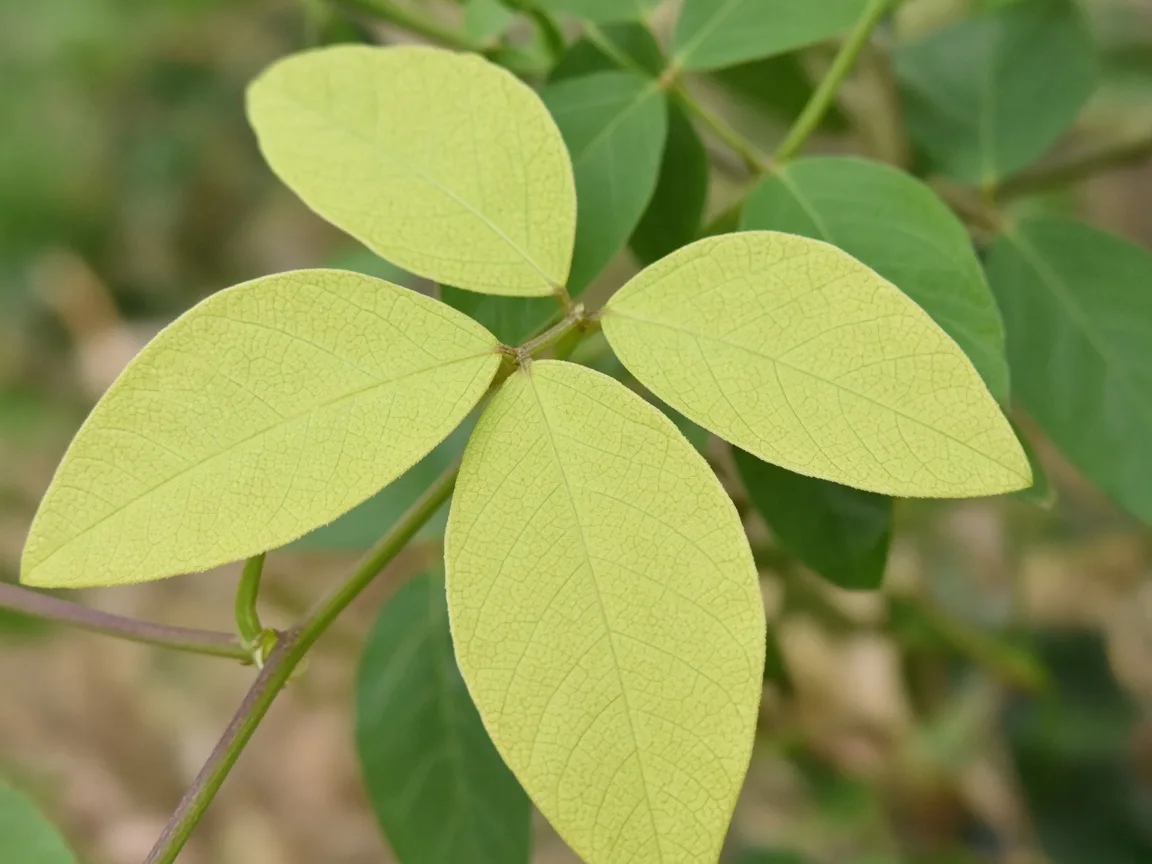
Oldest lower Aparajita trifoliate cluster with uniform pale yellow-green chlorosis—veins and tissue faded together, unlike interveinal magnesium banding or green-veined iron chlorosis on new growth.
Typical signs:
- Uniform pale yellow-green on the oldest lower trifoliate leaf cluster along each stem—veins and tissue lose color together
- Progressive climb upward over weeks as the plant strips nitrogen from old tissue to fund vine-tip growth
- Smaller or thinner new leaflets at the leading shoot and slower internode extension during summer active growth
- Fewer blue flowers on a sun-exposed trellis that otherwise meets light requirements
- Firm roots and pinkish-white nodules on lateral roots when fixation is working; brown mushy roots suggest overwatering instead
- Overall thin, pale vine on a balcony specimen that has not received any complete feed for a full warm season
Not nitrogen deficiency:
- Yellow tissue between dark green veins on oldest leaves—magnesium deficiency (magnesium deficiency initially develops on lower or older foliage with interveinal chlorosis)
- Yellow new vine-tip leaflets with dark green veins—iron deficiency
- Cupped or margin-burned newest leaflet still opening at a vine tip—calcium deficiency
- Seasonal slowdown and sparse growth when nights stay cool—normal winter rest, not hunger
- Uniform washed-out green across the whole vine in a shaded corner—not enough light before assuming starvation
- All leaves yellow at once on persistently wet soil—overwatering or root rot
- One old lower trifoliate only while vine tips push full-size green blades—normal aging on yellow leaves
- Dark lush foliage with almost no blooms after repeated high-nitrogen feed—excess nitrogen on a legume, covered in the fertilizer guide
UC IPM notes slow growth and uniform yellowing of older leaves as the first symptoms of nitrogen deficiency. On a fast twining butterfly pea, that lower-leaf washout is easiest to read on the lowest mature trifoliate cluster on each tied stem during warm months when the vine should be racing up the trellis.
Why Aparajita gets nitrogen deficiency
Aparajita is a fast-growing twining legume that fixes its own nitrogen through root nodules—but that biology misleads balcony growers into skipping fertilizer entirely while the vine exhausts a small pot. Nitrogen is a core component of chlorophyll and proteins—when soil reserves run low and fixation cannot keep pace, the plant dismantles chlorophyll in older lower tissue and redirects nitrogen to vine tips and flower buds.
Aparajita-specific causes:
- Assuming legumes never need nitrogen — NC State nitrogen fixation guidance explains that legumes supply their own nitrogen but still need phosphorus, potassium, and micronutrients. A vine in the same depleted 10-inch balcony pot for a full season can show lower-leaf chlorosis even when nodules look healthy.
- Sterile potting mix without rhizobia — Young seedlings and cuttings in bagged soilless mix may lack the bacteria that form nodules. Without pinkish-white nodules on lateral roots, the plant behaves like a non-legume and yellows on bottom leaves within weeks of active growth.
- Never fed in container culture — Repeated watering flushes nitrogen through drainage holes. In-ground vines tap a larger soil bank; potted butterfly pea on a railing does not.
- High demand during peak bloom season — Each daily blue flower, new trifoliate flush, and trellis extension draws nitrogen from the same limited root zone. Summer vine extension in full sun outpaces what compost alone supplies in a unchanged pot.
- Root stress blocking uptake — Chronic overwatering in weak light limits nitrogen transport regardless of what is in the fertilizer bottle. Pale lower leaves on wet, sour-smelling mix are root failure—not hunger.
- Competing lookalikes — Slow growth from insufficient sun mimics starvation. Confirm six hours of direct sun before feeding a pale vine in shade.
Lower trifoliate cluster yellowing vs vine-tip patterns
Aparajita allocates mobile nitrogen from oldest lower trifoliate clusters upward to the actively growing shoot you are training along the trellis. When supply fails, the lowest three-leaflet compound leaf on a stem turns uniformly pale while newer trifoliate leaves higher on the same branch may still look acceptable—a classic mobile-nutrient signature.
That pattern differs sharply from iron deficiency, which hits new vine-tip leaflets with green veins, and from calcium deficiency, which distorts the newest leaflet still unfurling at the growing point. Magnesium shows yellow bands between veins on older mid-stem leaves, not even washout across the whole trifoliate cluster.
Judge severity by how many successive lower clusters on the same stem have faded—not by one bottom leaf yellowing while a green trifoliate unfurls above. A single aged-out lower cluster on an otherwise vigorous vine is normal; three pale clusters climbing the stem on stable summer care points to starvation.
Root nodules and the legume paradox on balcony pots
Butterfly pea forms a partnership with Rhizobium bacteria that colonize root nodules and convert atmospheric nitrogen into a form the vine can use. Healthy nodules feel firm and look pinkish-white when sliced—not brown or hollow.
On a balcony, three situations break that system:
- Sterile commercial potting mix at sowing or rooting—no compatible bacteria in the bag.
- Young plants before nodules establish—the first month of trifoliate growth may outpace fixation.
- Depleted mix after a full season—nodules persist but the vine still needs other minerals and occasional nitrogen top-up when leaching is heavy.
Gently brush soil from lateral roots after sliding the root ball partway out of the pot. Absent nodules on an otherwise healthy white root system in sterile mix explains bottom-leaf yellowing better than guessing. Legume inoculant at sowing (per label directions) helps; a light complete feed still supports container vines per the Aparajita fertilizer guide.
Missouri Botanical Garden notes butterfly pea does not require high-nitrogen fertilizer as a legume but still grows in well-drained, moderately fertile soil—starvation in a exhausted balcony pot is a container problem, not proof the species ignores nutrition.
Flowering slump vs nitrogen excess
Aparajita growers often chase blue blooms and misread the vine. True nitrogen deficiency shows pale lower old trifoliate leaves with thin extension and fewer flowers on an otherwise correctly placed sun vine.
Excess nitrogen—from lawn fertilizer, fresh poultry manure, or repeated high-N liquid feed—produces the opposite headline: dark lush foliage, soft stems, and disappointing flower counts without the uniform bottom-leaf washout. That is not this page; see the fertilizer guide for bloom-leaning ratios.
If lower leaves are uniformly pale and the vine is thin with sparse blooms, deficiency fits. If the vine is deep green and bushy with almost no blue flowers, back off nitrogen instead of adding more.
Lookalike symptoms
| Pattern | Check | Likely cause |
|---|---|---|
| Uniform pale oldest lower trifoliate cluster | Leaf position on stem | Nitrogen deficiency (this page) |
| Yellow between veins on old leaves | Vein pattern | Magnesium deficiency |
| New vine-tip leaflet yellow, green veins | New vs old tissue | Iron deficiency |
| New vine-tip leaflet cupped or margin-burned | Unfurling leaflet | Calcium deficiency |
| Whole vine limp, wet soil | Root feel | Overwatering |
| Long bare stems, washed-out green, few flowers | Light exposure | Leggy growth or not enough light |
| Dark green lush vine, almost no blooms | Recent feed history | Excess nitrogen — fertilizer guide |
How to confirm
- Old vs new tissue — Uniform pale color confined to the lowest mature trifoliate clusters while newer compound leaves on the same stem stay greener strongly suggests nitrogen.
- Vein pattern — Even chlorosis across the whole leaflet blade; dark green veins on new growth point to iron instead.
- Root nodules — Pinkish-white firm nodules on lateral roots vs absent nodules in sterile mix or on young vines.
- Feed history — A full warm season in the same small pot with zero complete fertilizer or only bloom-only low-N products without any nitrogen replacement.
- Root health — White firm roots vs brown mush from soggy soil.
- Watering rhythm — Consistent top-3 cm dry-down per the Aparajita watering guide; chronic saturation blocks uptake.
- Light — Five to six hours of direct sun confirmed; shade-pale vines need placement change before feed.
- Season — Symptoms during warm active growth with continuous new shoots fit deficiency better than winter slowdown alone.
First fix for Aparajita
One half-strength dose of complete balanced or low-nitrogen fertilizer on already-moist mix—only after confirming uniform pale lower trifoliate leaves, firm roots, stable top-3 cm dry-down rhythm, full sun active growth, and no chronic wet soil.
Do not repot, prune hard, and triple-feed a recently relocated butterfly pea the same week. Stabilize watering per the Aparajita watering guide first—water when the top 3 cm is dry, empty cachepot standing water after each watering.
If root nodules are absent on a young vine in sterile mix, a measured complete feed addresses immediate chlorosis; consider legume inoculant at the next repot per label directions. Do not use high-nitrogen lawn or leafy-green products—they promote foliage at the expense of the blue flowers you are growing this vine for.
Step-by-step recovery
- Rule out wet roots — Confirm mix dries at the top 3 cm and roots are firm white, not brown mush from overwatering.
- Apply half-strength complete feed once on moist mix during active growth; repeat at three- to four-week intervals through the warm season if the next trifoliate flush responds per the fertilizer guide.
- Maintain consistent top-3 cm dry-down—uptake fails when roots alternate between saturated and desiccated in heavy decorative pots during monsoon swings.
- Repot into fresh well-draining mix if roots fill the pot and lower-leaf chlorosis persists after two measured feeds on firm roots—see Aparajita repotting.
- Confirm trellis placement delivers five to six hours of direct sun—weak light slows growth and mimics starvation.
- Monitor the next two vine-tip trifoliate flushes—yellowed lower clusters rarely re-green; recovery shows on larger new leaflets and resumed blue blooms.
- Check nodules at repot—if absent in sterile mix, add legume inoculant when refreshing soil rather than relying on nitrogen-heavy feeds.
Recovery timeline
The currently pale lower trifoliate clusters rarely return to deep green once chlorophyll is stripped from mature tissue. The next one or two compound leaves and vine extension after corrected feeding and stable watering usually look brighter within three to five weeks on firm roots—faster than slow houseplants because Aparajita grows quickly in warm weather, but only when the plant is actively transpiring in full sun.
Severe root damage from chronic overwatering may delay recovery until the next warm growth flush. If successive new vine-tip leaflets stay undersized despite complete feed and stable summer care, inspect roots for rot before repeating fertilizer or repotting again.
Mistakes to avoid
- Do not confuse interveinal magnesium banding or green-veined iron chlorosis on new growth with uniform lower-leaf washout—read the leaflet pattern first.
- Do not heavy-feed with high-nitrogen products on a legume—you may fix lower-leaf color while killing bloom count.
- Do not feed a butterfly pea on wet soil or during cool winter slowdown—fix drainage and wait for active growth.
- Do not expect current pale lower trifoliate leaves to re-green—judge the next vine-tip flush.
- Do not stack repotting, hard pruning, and full-strength feed the same week on a stressed vine.
- Do not skip feeding entirely because the plant is a legume—container culture and sterile mix break the nitrogen-fixation safety net.
Prevention
- Feed lightly with complete balanced or low-nitrogen fertilizer during active spring and summer growth per the Aparajita fertilizer guide—MBG notes butterfly pea does not require high-nitrogen fertilizer as a legume but still benefits from complete nutrition in containers.
- Refresh depleted mix annually when roots crowd the pot on balcony vines.
- Inoculate seedlings in sterile mix if nodules are absent at first repot.
- Maintain consistent top-3 cm dry-down rhythm per the watering guide.
- Inspect lower trifoliate clusters monthly during peak summer growth—early uniform pale color is easier to correct than a thin leading shoot.
- Pause fertilizer when growth slows in cool weather and resume only when new shoots return.
Related Aparajita guides
- Aparajita overview
- Aparajita fertilizer
- Aparajita watering
- Aparajita light
- Aparajita soil
- Yellow leaves
- Magnesium deficiency
- Aparajita problems hub
Conclusion
Uniform pale yellow-green on the oldest lower trifoliate clusters along Aparajita stems points to nitrogen starvation in mobile lower tissue—confirm the old-vs-new leaf pattern, rule out wet roots and shade, check nodules in sterile balcony mix, apply one measured complete feed during active growth, and judge recovery by the next vine-tip trifoliate flush and resumed blue blooms.
Related tool
Use the Fertilizer Dilution Calculator to narrow causes for nitrogen deficiency on this plant before changing multiple variables at once.