Iron Deficiency on Asparagus Fern: Causes, Checks & Fixes
Quick answer
Iron deficiency on Asparagus Fern shows as yellow or pale new cladode sprays with dark green veins (interveinal chlorosis) unfurling at wiry stem tips while older fine needle sprays on the same branch may stay green. First step: confirm the green-vein pattern is on the newest expanding spray—not drought-yellow needles dropping from dry soil—and check whether tuberous roots are firm and mix is not chronically wet or depleted before applying chelated iron.
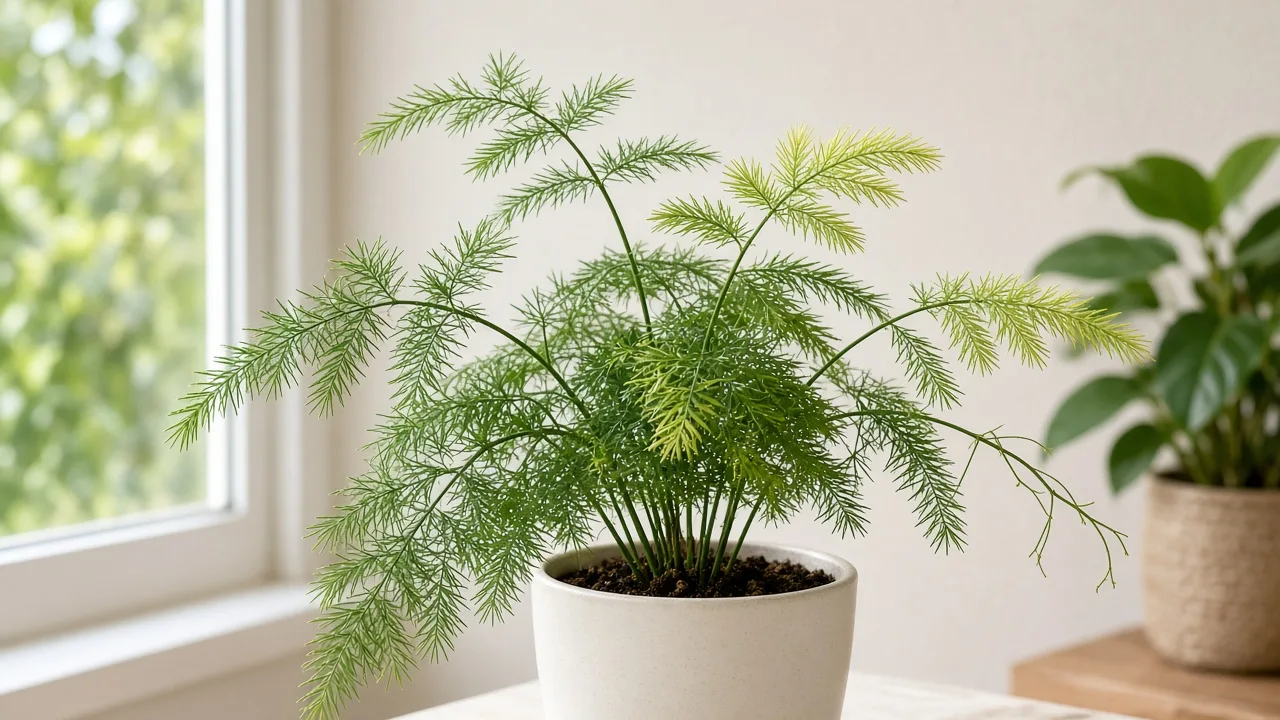
Iron Deficiency on Asparagus Fern: Causes, Checks & Fixes
This guide covers iron deficiency on Asparagus Fern. See also the general Iron Deficiency guide, watering, and light pages for this plant.
Iron Deficiency on Asparagus Fern: Causes, Checks & Fixes
Quick answer
Iron deficiency on Asparagus Fern (Asparagus setaceus) shows as yellow or pale new cladode sprays with dark green veins (interveinal chlorosis) unfurling at wiry stem tips while older fine needle-like sprays on the same branch may stay green. Iron is immobile in plants, so chlorosis appears on young expanding tissue first—not on the lowest old sprays the way nitrogen deficiency does.
See our iron deficiency guide for general chlorosis mechanics. On Asparagus Fern, inspect the newest cladode spray still opening at each stem tip—veins stay green while tissue between the fine needles yellows on the newest spray.
First step: confirm green-vein chlorosis on the newest cladode spray, then check tuber firmness and whether potting mix stays too wet or nutrient-depleted before applying chelated iron.
When to use this page vs other Asparagus Fern guides
| Pattern | Read next |
|---|---|
| New cladode spray yellow with green veins at stem tips | Iron deficiency (this page) |
| Old lower sprays pale uniformly first | Nitrogen deficiency |
| Interveinal yellowing on older mid-stem sprays | Magnesium deficiency |
| Cupped or tip-burned new sprays without vein pattern | Calcium deficiency |
| Washed-out green across many sprays in dim room | Pale leaves or not enough light |
| Many soft yellow needles + heavy wet pot | Overwatering or root rot |
| Crispy brown tips on old sprays without vein pattern | Brown tips or low humidity |
| General yellowing with unclear pattern | Yellow leaves |
What iron deficiency looks like on Asparagus Fern
Healthy Asparagus Fern pushes dense sprays of fine green cladodes along wiry scrambling stems—one of the fastest-growing houseplants when light, moisture, and humidity align. The flat triangular sprays most people call leaves are actually cladodes; true leaves are tiny dry scales. Iron supports chlorophyll in expanding tissue, so when uptake fails, the newest cladode spray still opening at a stem tip shows chlorosis while older sprays on the same branch often look fine.

New cladode spray at an Asparagus Fern stem tip: pale yellow tissue between dark green veins while older fine sprays on the wiry branch may stay normal—classic iron chlorosis on expanding foliage.
Typical signs:
- Yellow or pale new cladode spray at a stem tip with veins remaining darker green
- Successively paler new sprays on the same wiry branch if untreated
- Older established cladode sprays farther down the branch may look completely normal
- Narrower or thinner new spray when chlorosis is severe
- Firm tubers at the soil line if uptake is functional—soft mushy tubers on wet mix point to overwatering instead
- Pale new shoots emerging from the crown during a spring flush while lower stems stay green
- Hanging basket with green lower sprays but chlorotic tips on the longest new runners
Not iron deficiency:
- Uniform pale lower old sprays without green-vein pattern—nitrogen deficiency
- Interveinal yellowing on older mid-stem sprays—magnesium deficiency
- Cupped or tip-burned new sprays without vein contrast—calcium deficiency
- Widespread yellow needle drop on dry soil—underwatering; NC State notes yellow needles from stress will not rejuvenate, and recovery shows only as new growth at the soil line
- Fine stippling and webbing between cladodes—spider mites
- All sprays yellow on persistently wet soil—root rot overlap
The classic symptom of iron deficiency is interveinal chlorosis where leaf tissue yellows while veins stay green. On a fast-growing Asparagus Fern in a bright window, that pattern is easiest to read on the cladode spray still opening at a stem tip—not on mature lower sprays that may simply be aging out.
Why Asparagus Fern gets iron deficiency
Asparagus Fern is a fast-growing evergreen vine with tuberous roots that can scramble several feet per season indoors. Each new cladode spray at a stem tip needs iron for chlorophyll. Iron chlorosis often results when roots cannot absorb iron even when it is present in fertilizer—high pH, waterlogged mix, compacted peat, or salt crust block uptake while the vine keeps pushing new sprays.
Asparagus Fern-specific causes:
- Depleted potting mix — A specimen in the same container 12–18 months without feeding exhausts available micronutrients; this fast grower in bright light outpaces its nutrient reserve faster than slow succulents.
- Overwatering in hanging baskets — Wet peaty mix reduces root oxygen and micronutrient uptake; symptoms worsen in poorly drained soils. Heavy decorative pots with soggy lower mix are a common indoor pattern on a plant that prefers evenly moist but not soggy soil.
- Alkaline tap water — Repeated hard tap irrigation raises pot pH over time and locks iron chemically, especially in a plant that prefers slightly acidic, organically rich soil.
- Salt buildup from excess fertilizer or hard water — White crust on the pot rim injures roots and blocks micronutrient absorption; overlap with mold on soil and chronic overfeeding.
- Pot-bound tubers — Large tuberous roots can become pot bound quickly on this fast grower, limiting fresh mineral uptake even when watering looks correct.
- Low transpiration in weak light — A plant in not enough light may look pale overall without the green-vein chlorosis pattern; fix light before assuming iron alone.
- Misread drought yellowing — NC State notes insufficient water will result in yellow needles that drop and will not rejuvenate—drought yellowing is uniform needle loss, not interveinal chlorosis on a single new spray.
Do not diagnose iron deficiency on sour wet soil with soft tubers—that is root failure from chronic saturation until you confirm mostly firm white roots.
Interveinal chlorosis on unfurling cladode sprays
Asparagus Fern shows iron stress on the cladode spray still opening from a tight cluster at the end of a wiry branch—a pattern that would be nonsense on a snake plant vertical sword or a pothos heart at a vine tip. Veins remain green while the expanding fine needles between them yellow before the spray fully flattens.
That crown-tip-only chlorosis distinguishes iron from nitrogen, which starts on the lowest mature sprays at the base of a branch. It also differs from normal juvenile color: a brand-new spray is briefly lime green for a few days, then deepens. Worry when every new stem-tip spray stays yellow-green with dark veins for weeks after hardening.
Because Asparagus Fern can produce several new cladode sprays per month in bright indirect light, compare three consecutive new sprays on the same branch. One pale opener after repot stress may be transient; three in a row with green veins is a strong iron signal.
Tuber firmness before iron drenches
Asparagus Fern stores water in tuberous roots at and just below the soil line. Before any chelated iron correction, gently probe the base through the pot wall or tip the plant slightly—firm white tubers with healthy white roots support one measured iron drench during active growth.
Firm, smooth tubers with evenly moist (not waterlogged) mix support one chelated iron application at label rate in spring or summer. Soft, discolored, or mushy tubers on constantly wet mix mean root rot—not a micronutrient label problem. Correct drainage and moisture rhythm per the watering guide before any iron on soggy roots.
If only one branch shows veined yellow sprays while other stems open normal green sprays and tubers stay firm, inspect that branch’s root zone separately—it may sit in a wet pocket of an overcrowded hanging basket.
Fast summer flush vs winter rest gaps
Asparagus Fern metabolism tracks warmth and light. Missouri Botanical Garden notes regular watering in spring through autumn and sparingly in winter for indoor culture. Iron correction only works when the plant is actively transpiring and taking up water—drenching a slow winter specimen that is barely pushing new tips does not fix spring chlorosis and risks salt buildup.
When long wiry stems and fresh cladode sprays emerge in spring, iron demand spikes at each stem tip. Growers who skipped complete fertilizer through the prior summer and then see veined yellowing on the first spring flush often have depleted mix and locked iron—not a disease on the fine needles.
Closing the gap means one chelated iron drench plus half-strength complete feed with micronutrients during active growth per the fertilizer guide, not heavy nitrogen alone to force bushier sprays the roots cannot supply with iron.
Lookalike symptoms
| Pattern | Check | Likely cause |
|---|---|---|
| New stem-tip spray yellow, green veins | Vein pattern on newest spray | Iron deficiency (this page) |
| Old lower sprays pale first | Spray position on branch | Nitrogen deficiency |
| Interveinal yellow on old mid-stem sprays | Mid-stem pattern | Magnesium deficiency |
| Cupped or tip-burned new spray | Margin shape | Calcium deficiency |
| Mushy tubers, wet soil, widespread yellow drop | Tuber feel | Overwatering or root rot |
| Crispy tips on many old sprays, flat new growth | Humidity, light | Brown tips or low humidity |
| Whole plant pale, stretched stems | Light level | Not enough light |
| Yellow needles dropping on dry soil | Soil moisture | Underwatering |
How to confirm
- New vs old tissue — Chlorosis on newest cladode spray with green veins; older sprays on the same wiry branch still green.
- Tuber and root inspection — Firm white tubers and roots support micronutrient fixes; brown mushy tubers need drainage first.
- Soil moisture at full depth — Wet many days after watering in an oversized hanging basket?
- Salt crust — White rim on pot or soil surface suggests flush before iron.
- Complete fertilizer history — Chlorosis despite occasional feeding points to uptake block, not starvation.
- Successive new sprays — Two or more veined-yellow stem-tip sprays in a row on stable summer care points to iron, not one-time stress.
- Light cross-check — Very dim rooms slow new spray production; see not enough light if sprays stretch pale without green-vein pattern.
RHS notes that interveinal chlorosis is usually indicative of iron, manganese, or magnesium deficiency, with iron affecting the youngest leaves first. If soil is wet throughout, tubers soften, and roots are mostly mushy, treat as confirmed overwatering or root rot overlapping with chlorosis—not a mild iron-only case.
First fix for Asparagus Fern
Confirm tubers are firm and mix is not chronically waterlogged, then apply one chelated iron drench at label rate for houseplants during active growth only if roots are healthy.
Do not iron-feed waterlogged tubers. Chelated iron is absorbed more readily than non-chelated forms in pot culture when pH or salts have limited uptake. One corrected even-moisture rhythm plus one iron application is the first fix—not repotting, heavy pruning back to the crown, and triple fertilizer the same week.
Step-by-step recovery
- Adjust watering per Asparagus Fern watering guide—the top 2 cm should feel barely moist before the next drink, and the pot should never sit in standing cachepot water.
- Flush soil if white salt crust rings the pot—leach salts before micronutrient drenches.
- Apply chelated iron once at label rate during spring or summer active growth; repeat only per label if the next stem-tip spray still chlorotic after three to four weeks.
- Repot into fresh well-draining mix if tubers fill the pot and old peat has compacted—see Asparagus Fern soil for ratios.
- Use complete balanced fertilizer with micronutrients at half strength per the Asparagus Fern fertilizer guide—not nitrogen-only feeds.
- Monitor the next one or two unfurling stem-tip sprays for greener tissue between veins.
Do not foliar-spray iron on hot sunny windows when the cladode spray is still soft from unfurling; foliar iron can burn foliage above 85°F and damages softening tissue at the growing point.
Recovery timeline
The cladode spray currently chlorotic rarely re-greens fully once the fine needles harden and flatten. The next one or two new sprays after corrected care usually show improvement within two to four weeks in bright active growth—faster than slow succulents because Asparagus Fern pushes new sprays frequently when conditions align.
Judge recovery by unstreaked green between veins on new unfurling tissue, not by old chlorotic sprays darkening again. If two successive new stem-tip sprays stay pale despite firm tubers and one chelated iron cycle, reassess compaction, pH drift from tap water, and whether slow growth from low light is compounding the problem.
Mistakes to avoid
- Iron before drainage — Chelated iron on waterlogged tubers wastes product and delays the real fix.
- Nitrogen-only fertilizer — Fast Asparagus Fern pushing frequent new sprays still needs complete micronutrients during growth.
- Repot + iron + full-strength feed same month — Stack one change at a time on a stressed plant.
- Assuming briefly lime-green new sprays are always iron — Normal juvenile color deepens within days; chlorosis persists with green veins.
- Treating drought yellow needle drop as iron chlorosis — Drought drops needles uniformly; iron shows veined yellowing on one new spray.
- Feeding a dim, dormant specimen — Fix light and moisture before micronutrient drenches on a plant not actively opening new sprays.
Prevention
Feed complete liquid fertilizer with micronutrients at half strength monthly during spring and summer active growth per the fertilizer guide. Flush the pot every few months if you use hard tap water or feed heavily.
Repot into fresh well-draining mix when tuberous roots crowd drainage holes and water runs through dry channels—usually every one to two years for fast growers.
Avoid leaving specimens in the same depleted mix for years without any micronutrient source, especially if you rely on alkaline tap water alone.
Place hanging baskets where they receive enough indirect light to open new cladode sprays regularly; a plant that never pushes new growth will not show iron chlorosis—but it also will not recover visibly until light and moisture support active growth.
When to worry
Iron chlorosis alone rarely kills Asparagus Fern—it is a durable species when tubers stay firm. Act within weeks when chlorosis pairs with:
- Wet soil for months and spreading yellow sprays at multiple stem tips
- Tuber softening at soil level or sour-smelling mix
- No new stem-tip spray for two months despite spring light and corrected moisture
- Successive new sprays staying white or necrotic between veins
- Wilting wiry stems while tubers soften and the crown chloroses
In those cases, inspect roots before assuming more iron solves everything.
Related Asparagus Fern guides
- Asparagus Fern overview
- Asparagus Fern fertilizer
- Asparagus Fern watering
- Asparagus Fern light
- Asparagus Fern soil
- Nitrogen deficiency
- Magnesium deficiency
- Asparagus Fern problems hub
Use this page when new stem-tip growth shows green-vein chlorosis. Use yellow leaves when multiple sprays yellow without a clear vein pattern, and brown tips when only old spray margins crisp without interveinal yellowing.
Conclusion
Yellow new cladode sprays with dark green veins at Asparagus Fern stem tips point to iron uptake failure on expanding tissue—confirm the new-vs-old spray pattern, check tuber firmness and moisture rhythm, apply one chelated iron drench on healthy roots during active growth, and judge recovery by the next stem-tip spray flush.
Related tool
Use the Fertilizer Dilution Calculator to narrow causes for iron deficiency on this plant before changing multiple variables at once.