Scale Insects on Asparagus Fern: Causes, Checks & Fixes
Quick answer
Scale insects on Asparagus Fern look like flat tan or brown bumps glued along wiry stems and cladode axils—often with sticky honeydew on needle-like foliage. First step: isolate the plant and scrape every visible bump with a cotton swab dipped in 70% isopropyl alcohol before spraying the whole crown.
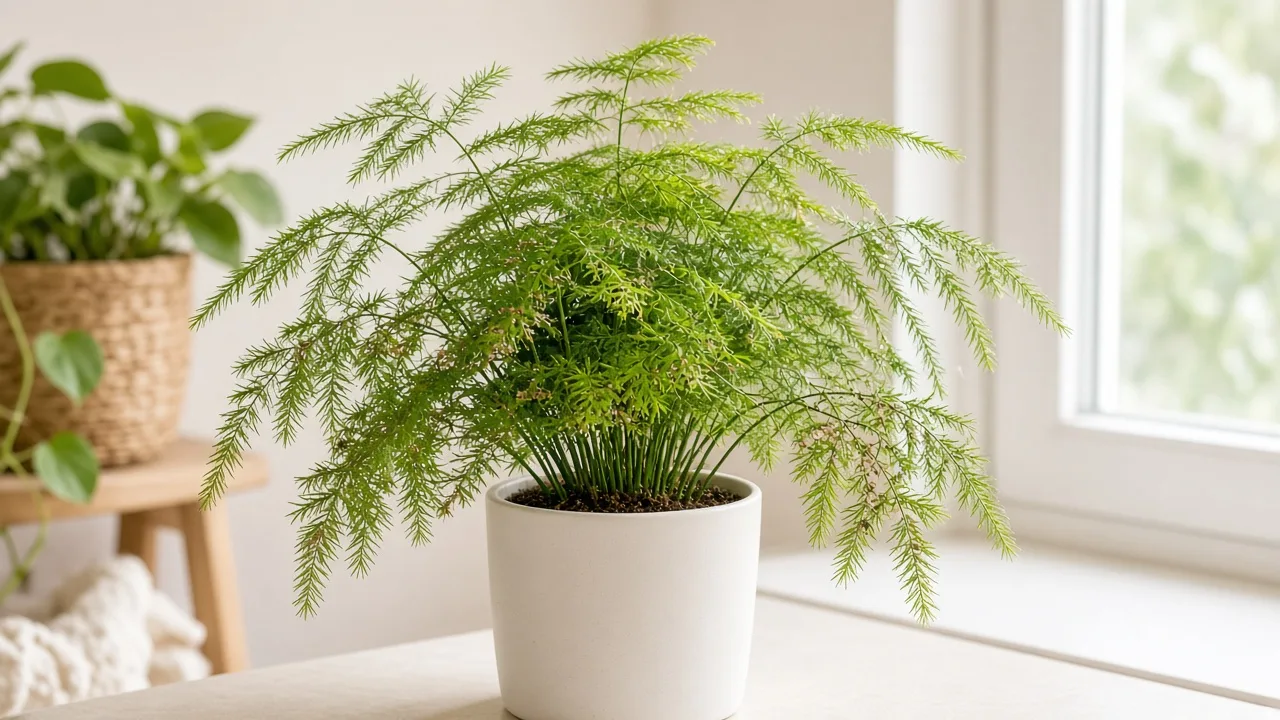
Scale Insects on Asparagus Fern: Causes, Checks & Fixes
This guide covers scale insects on Asparagus Fern. See also the general Scale Insects guide, watering, and light pages for this plant.
Scale Insects on Asparagus Fern: Causes, Checks & Fixes
Quick answer
Scale insects on Asparagus setaceus are immobile sap feeders protected by a waxy or shell-like cover that look like flat tan or brown bumps glued along wiry arching stems and cladode axils. They pierce tissue, drain sap, and—on soft scale species—leave sticky honeydew that can feed sooty mold on needle-like cladodes or the shelf below a hanging basket.
For how armored versus soft scale life cycles work indoors in general, see our scale insects pest guide. On Asparagus Fern, the practical pattern is hard disks wedged where feathery cladodes branch from wiry stems, sticky shine on inner crown junctions, and colonies that stay invisible until you lift the outer cascade and inspect from below.
First step: isolate the plant away from neighbors, then scrape every visible bump with a cotton swab dipped in 70% isopropyl alcohol—then re-inspect in three to five days before spraying anything.
A soft, mushy tuber base on wet mix is a different emergency—see the Asparagus Fern root rot guide before you treat pests.
When to use this page vs other Asparagus Fern guides
This page is the pest-first entry for immobile tan or brown bumps on wiry arching stems.
| Pattern | Read next |
|---|---|
| White cottony clusters in cladode axils | Mealybugs |
| Soft pear-shaped insects on fresh tips | Aphids |
| Fine webbing and stippling without hard bumps | Spider mites |
| Tiny white insects that fly when disturbed | Whiteflies |
| Limp fronds on dry mix, no disks | Underwatering |
| Soft tubers, wet mix, sour smell | Overwatering or root rot |
What scale insects look like on Asparagus Fern
Scale insects are protected by a waxy or shell-like cover that makes adults essentially immobile once they settle. On Asparagus Fern they are easy to mistake for normal woody stem texture or dried sap until colonies build:
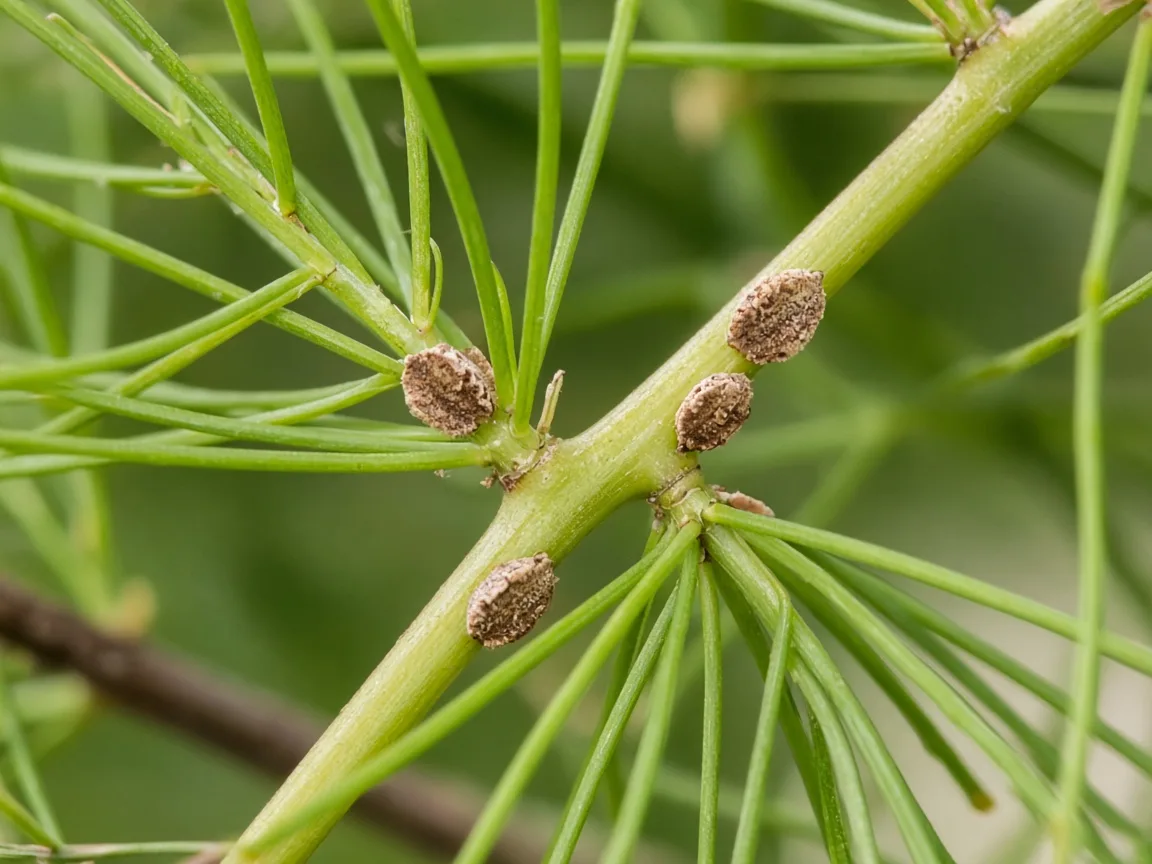
Flat tan scale shells at a cladode junction—compare with healthy needle-like tissue on the same arching stem.
- Flat or dome-shaped tan, brown, or bark-colored bumps along wiry arching stems, cladode axils, and older woody sections near the soil line
- Disks that do not wipe away with a dry cloth—unlike mineral dust on open cladodes
- Sticky honeydew on feathery needles or the pot rim — Sap feeders excrete honeydew that can feed sooty mold
- Black sooty coating on lower cladodes or the table below — Fungus growing on dried honeydew, not stem rot
- Ant trails on hangers and pot rims — Ants harvest honeydew and protect scale colonies from lady beetles and lacewings
- Yellowing, curling, or dropping cladodes on one arching frond when feeding is heavy
- Pale orangish crawlers before shells harden — Mobile nymphs are tiny until they settle and grow armor
Unlike the fixed feathery texture of healthy cladodes, scale bumps sit as separate removable disks at junctions. Unlike mealybugs, which form cottony wax clusters, scale looks hard and immobile. Unlike aphids on soft new tips, scale persists on older wiry stems.
Sticky residue on furniture below a hanging basket is a classic Asparagus Fern warning sign—the insects were feeding on inner stems you rarely inspect during routine watering.
Where scale hides on wiry cladode stems and arching fronds
Asparagus setaceus is not a true fern—it is a fast-growing asparagus relative with fine, needle-like cladodes on wiry arching stems. Scale exploits exactly that geometry: protected axils along multiple stems where a quick glance sees only healthy green fluff.
Scale often concentrates in somewhat protected areas such as branch crotches, stem joints, and along leaf petioles. On Asparagus Fern, the hot zones are:
- Cladode axils — Where needle-like cladodes branch from the main wiry stem
- Inner crown junctions — Beneath the outer feathery cascade on hanging baskets
- Older woody stem sections — Tan bumps can blend with natural bark-like texture near the base
- Underside of arching fronds — Disks pressed against upward-facing junctions
- Pot rim, hanger hardware, and drainage holes — Crawlers travel between shared hooks and shelves
This arching-stem inspection pattern is plant-specific. A rubber plant guide tells you to search broad leaf undersides; on Asparagus Fern you are tracing each wiry stem inward with a swab or lens, especially from below on cascading baskets.
Why hanging-basket geometry shields scale colonies
Mealybugs and scale are common houseplant pests that feed on plant sap and often cluster where leafstalks join stems and in tight crevices. What makes Asparagus Fern vulnerable is its growth rhythm and basket placement, not weak culture alone.
Outer fronds hide inner feeding sites. You water from above and see the green curtain—not the junctions where stems divide inside the pot. Scale on upward-facing axils can feed for months before honeydew drips onto the shelf below.
Continuous new growth extends the buffet. During spring and summer this plant pushes fresh cladode tips constantly in bright indoor light. Warm room temperatures let scale populations reproduce year-round indoors without the cold breaks that suppress them outdoors. Fast growth does not cause scale, but it gives crawlers fresh tender tissue once they arrive.
Introduction from new stock. Scale hitchhikes on nursery plants, shared shelves, tools, or neighboring houseplants that were never quarantined. They do not appear from thin air on an isolated healthy fern.
Ants protect colonies. When ants farm honeydew on pot rims, natural enemies have a harder time controlling scale. A basket with ant trails on the hanger often needs ant management alongside scraping.
Stress weakens recovery, not always the initial cause. Chronically dry soil or dim corners yellow cladodes and slow new tips, but scale still needs introduction. If you see stickiness plus hard bumps, treat pests first; if yellowing spreads without insects, cross-check watering and light separately.
Confirm scale vs. mealybugs, aphids, mites, and rot
Work through checks in order so you do not scrape alcohol on a rotting crown:
- Tuber-base press — Firm tubers with disks only on stems point to insects. Soft or mushy tissue at the crown on damp mix means rot risk first.
- Inner-stem scan — Follow arching stems to cladode axils with a hand lens, starting at the soil line.
- Shell lift test — Pry one bump gently: armored scale covers can be removed from the body and leave the insect beneath; mealybugs smear pink-orange under cotton wax.
- Honeydew test — Wipe a stem junction; if stickiness returns within a day, sap feeders are still active.
- Moisture cross-check — Top 2 cm should feel barely moist before watering again per the watering guide; true drought stress usually hits the whole spray evenly, not just sticky nodes.
Symptom lookalike comparison
| What you see | Likely cause | Key check |
|---|---|---|
| Flat tan or brown bumps on wiry stems | Scale insects | Stationary shell; does not smear like cotton |
| White cottony masses in cladode axils | Mealybugs | Wax smears pink-orange when crushed |
| Soft pear-shaped insects on fresh tips | Aphids | Colonies move when disturbed |
| Fine webbing and stippling, no disks | Spider mites | Dry air; favors very low humidity |
| Tiny white insects that fly when disturbed | Whiteflies | Cloud rises from undersides |
| Even green needle-like cladodes on arching stems | Normal Asparagus setaceus growth | Fixed to stem; no removable shell |
| Limp fronds, soft tubers, wet mix | Overwatering | No scale shells; sour soil odor possible |
Confirmed diagnosis — Immobile bumps plus honeydew or ants on stem junctions with firm tubers. Suspected — Sticky nodes without visible insects may need a magnifying glass on the youngest cladode axils before treating.
First fix: isolate and scrape with alcohol
Isolate the plant away from other houseplants until you see no new bumps for at least two weeks after treatment.
Scrape every visible bump with 70% isopropyl alcohol first. Manual removal with alcohol-soaked swabs is the lowest-risk first fix for Asparagus Fern—targeted contact on shells without coating the entire feathery crown. Work stem by stem from the soil line outward, using a fresh swab for each major cluster. Test alcohol on one stem first and wait one to two days for phytotoxicity before treating the whole plant.
Re-inspect in three to five days—scale egg cycles hatch on a staggered schedule, so one pass rarely clears a mature colony hidden in inner junctions.
Light vs. heavy infestation protocols
Light colony (a few disks on one or two inner stems): Scrape with alcohol, then shower arching stems to knock off crawlers. Repeat weekly for at least three to four cycles.
Heavy infestation (bumps on most stems, honeydew on pot and shelf, ants present): Scrape all reachable shells after isolation, shower the crown from multiple angles, then apply insecticidal soap or horticultural oil on stem junctions where alcohol cannot reach. Horticultural oil is effective when crawlers are active and coats insects the spray actually touches. Repeat every four to seven days for two to three cycles. Manage ants on hangers and shelves so natural predators can help if present.
Do not repot, prune heavily, or fertilize during the first treatment week. Asparagus Fern repotting does not remove foliar scale and adds stress. Fertilizer pushes tender cladodes that new crawlers prefer.
What not to do the same day
Do not skip isolation because the infestation looks small. A few disks on one inner stem can spread across a full basket within weeks on a fast-growing plant.
Do not apply alcohol to sun-stressed cladodes in hot direct light without a patch test. Feathery needles dry quickly and burned tissue shows as brown tips unrelated to the original pest.
Do not reach for systemic insecticides as a first response indoors—many are less effective on armored scales and can disrupt beneficial insects without clearing hidden colonies in dense crowns.
Step-by-step recovery
After the initial alcohol scrape pass:
- Shower arching stems from above and below to dislodge crawlers—rotate hanging baskets so water hits inner crown junctions.
- Re-inspect in three to five days — Follow the same wiry stems to inner junctions with a hand lens. If live shells return, repeat scrape and rinse.
- Apply insecticidal soap or horticultural oil if colonies persist after two scrape-and-rinse cycles. Work spray into cladode clusters on stem junctions; avoid flooding the tuberous base with every application.
- Repeat alcohol, soap, or oil weekly for at least three to four cycles to catch nymphs hatching from eggs left in axils.
- Wipe sooty mold off coated needles with a damp cloth once honeydew production stops. Mold is cosmetic but blocks light on heavily blackened sections.
- Trim isolated bad stems if one arch carries colonies you cannot reach with swab or spray. Cut at a junction rather than pulling cladodes by hand.
- Inspect tuberous roots if shells reappear at the soil line within days of clean foliar checks—scale on roots may need repotting with fresh mix, not more foliar alcohol alone.
- Manage ants on pot rims and hangers if they are protecting scale from predators.
- Hold the plant isolated until you see at least one week with no live scale after your last treatment.
Asparagus Fern is toxic to cats and dogs. Keep treated plants where pets cannot chew wet foliage after spraying, and wear gloves if sap irritates your skin during wiping or pruning.
Recovery timeline for continuously flushing Asparagus Fern
First week: Visible scale shells should decline sharply after isolation and systematic alcohol scraping. Honeydew production slows when feeding stops.
Two to three weeks: With weekly repeats, you should find no new live bumps in axils or inner crown junctions. Sooty mold stops spreading once honeydew is wiped away.
Three to four weeks: Plan on three to four weekly treatment passes before calling the plant clear indoors. Crawlers hatch on a staggered schedule; most failures come from stopping after one scrape.
Ongoing: Judge recovery by clean new cladode tips emerging at stem ends—not by old yellowed needles flattening instantly. Asparagus Fern keeps flushing new growth in bright seasons; that tissue should look firm and bump-free.
Long term: Heavily fed or sooty-coated cladodes may stay dull until they age out or you trim affected stems. Cosmetic damage on old needles is normal even after pests are gone.
Worsening signs: Shells return within days of treatment, colonies spread to every arching stem, ants intensify, or bumps appear on tuberous roots—escalate to root inspection and consider disposal if repeated cycles fail.
Mistakes to avoid
Do not stop after one alcohol scrape. Dense feathery crowns need repeated passes and weekly cycles.
Do not use dish detergent in place of products labeled for plants. Homemade soap mixes can burn tender cladodes and lack predictable contact action.
Do not return the plant to a mixed shelf the moment you stop seeing bumps. Hold it apart for at least one week of clean checks.
Do not increase nitrogen fertilizer to help recovery during an active infestation—that produces soft cladodes scale crawlers prefer.
Do not confuse normal woody stem texture with scale on older base stems—run the shell lift test before treating the whole plant.
Do not ignore neighboring pots. Scale on one Asparagus Fern often means hidden colonies on nearby houseplants sharing the hook or shelf.
Asparagus Fern care cross-check
While treating scale, keep baseline care steady rather than overcorrecting:
- Light — Bright indirect light supports recovery and continuous clean new tips. Sudden moves to dim corners slow the flush you use to judge success—see the light guide.
- Water — Evenly moist soil without waterlogging. Let the top 2 cm feel barely moist before watering again; chronic overwatering yellows fronds without removing pests.
- Humidity — Moderate humidity suits this species. Very dry air favors spider mites, a separate problem that can overlap with pest stress.
- Fertilizer — Hold heavy feeding until new growth looks clean for two weeks. Normal modest doses resume after the infestation clears per the fertilizer guide.
Fixing only the bugs while ignoring wet soil, dark placement, or yellow-leaf overlap often brings symptoms back within a month.
How to prevent scale insects next time
Quarantine every new plant for two to three weeks before it joins your Asparagus Fern. Inspect inner stem junctions on day one and again before merging collections.
Scout arching stems weekly during fast spring and summer growth when cladode production is highest. Five minutes with a hand lens on inner crown junctions catches problems when alcohol scraping still solves them.
Inspect hanging baskets from below as well as above—the highest-yield scale sites hide under the cascade.
Feed at normal strength during active growth; avoid doubling fertilizer to push extra-soft shoots.
Space pots so fronds do not touch neighboring plants. Crawlers bridge gaps on crowded shelves.
Examine plants regularly when you water—pests hide in tight crevices that casual glances miss on feathery species.
See the Asparagus Fern overview for baseline light, water, and soil standards that keep arching stems resilient.
When to escalate
Treat as urgent when scale covers most arching stems, ants farm honeydew across the hanger and pot, sooty mold coats most visible fronds, or shells return at the soil line within days of foliar treatment—root-zone scale on tuberous roots may be the real source.
Also escalate if the fern stops pushing new cladodes during what should be active growth despite normal light and moisture, or if multiple houseplants show bumps at once—shared introduction or crawler spread through a dense collection.
When infestations become severe, consider discarding houseplants rather than repeatedly treating them with insecticides—especially if neighbors remain at risk and treatment cycles have failed three times.
Seek a different diagnosis if stems collapse despite moist soil, tubers turn mushy with sour smell, or yellowing spreads from the base upward without hard bumps—that pattern is root rot or chronic overwatering, not scale alone.
A few isolated disks on one inner stem, caught early during spring growth, are manageable. Isolate, scrape, rinse, and monitor before reaching for stronger products.
Conclusion
Scale insects on Asparagus Fern hide along wiry stems and cladode axils—especially inner junctions on hanging baskets that look healthy from across the room. Isolate first, scrape every visible bump with alcohol, shower from multiple angles, then repeat weekly until new tips emerge clean. Stable bright light, even moisture, and weekly inner-stem checks keep this fast-flushing species ahead of the next crawler wave. For related problems on the same plant, compare mealybugs, spider mites, and root rot before you treat the wrong symptom.
When to use this page vs other Asparagus Fern guides
- Asparagus Fern watering guide — Use for routine moisture checks before assuming scale is the main issue.
- Asparagus Fern problems hub — Browse all common issues on this species.
- Yellow Leaves on Asparagus Fern — Different entry point when yellowing overlaps with sap-feeding pests.
- Slow Growth on Asparagus Fern — Different entry point when stalling overlaps with heavy pest feeding.
- Spider Mites on Asparagus Fern — Different entry point when stippling appears without hard stem bumps.
Related Asparagus Fern guides
- Asparagus Fern overview
- Asparagus Fern watering
- Asparagus Fern light
- Asparagus Fern soil
- Yellow Leaves on Asparagus Fern
- Mealybugs on Asparagus Fern
- Spider Mites on Asparagus Fern
- Asparagus Fern problems
Related tool
Use the Pest Identifier Tool to narrow causes for scale insects on this plant before changing multiple variables at once.