Whiteflies on Asparagus Fern: Causes, Checks & Fixes
Quick answer
Whiteflies on Asparagus Fern show as powdery white moth-like adults on cladode undersides and along arching stems that rise in a brief cloud when disturbed, plus flat pale nymphs glued to needle-like foliage. First step: isolate the plant away from neighbors, then rinse every cladode spray underside with lukewarm water before applying any spray.

Whiteflies on Asparagus Fern: Causes, Checks & Fixes
This guide covers whiteflies on Asparagus Fern. See also the general Whiteflies guide, watering, and light pages for this plant.
Whiteflies on Asparagus Fern: Causes, Checks & Fixes
Quick answer
Whiteflies on Asparagus Fern (Asparagus setaceus) appear as tiny white, moth-like insects on the undersides of needle-like cladodes and along wiry arching stems. Disturb the foliage and they flutter away in a white cloud before resettling—one of the clearest pest signals on a feathery hanging basket.
Immature nymphs look like flat disks glued to cladode undersides and do not fly. Both stages suck sap, excrete sticky honeydew, and can leave cladodes dull, yellowed, or coated in black sooty mold. Honeydew on the floor below a hanging basket is often the first clue owners notice before they ever see the insects on inner stems.
For general whitefly biology and control options, see our whiteflies guide. On Asparagus Fern, adults and nymphs concentrate on cladode undersides along arching stems, inner crown junctions, and sheltered layers inside hanging baskets—places a quick glance at the green cascade from across the room never reaches.
First step: isolate the plant away from neighbors, then rinse every cladode spray underside with lukewarm water before applying any spray.
When to use this page vs other Asparagus Fern guides
| Pattern | Read next |
|---|---|
| White cloud when disturbed + flat nymphs on cladode undersides + sticky honeydew | This page |
| Pear-shaped clusters on newest tips, no flying cloud | Aphids |
| Cottony white wax in cladode axils, no flight | Mealybugs |
| Silvery scrape marks, slender fast insects | Thrips |
| Fine stippling and webbing in dry air | Spider mites |
| Tiny dark flies hovering at soil surface | Fungus gnats |
| Yellow cladodes + soggy mix smell, no insects | Overwatering or root rot |
What whiteflies look like on Asparagus Fern
Adult whiteflies are about 1/16 inch long, white, wedge-shaped, and moth-like with powdery wings. Nymphs are tiny, flat, pale green or whitish ovals stuck to cladode undersides—easy to miss until populations build on dense feathery sprays.
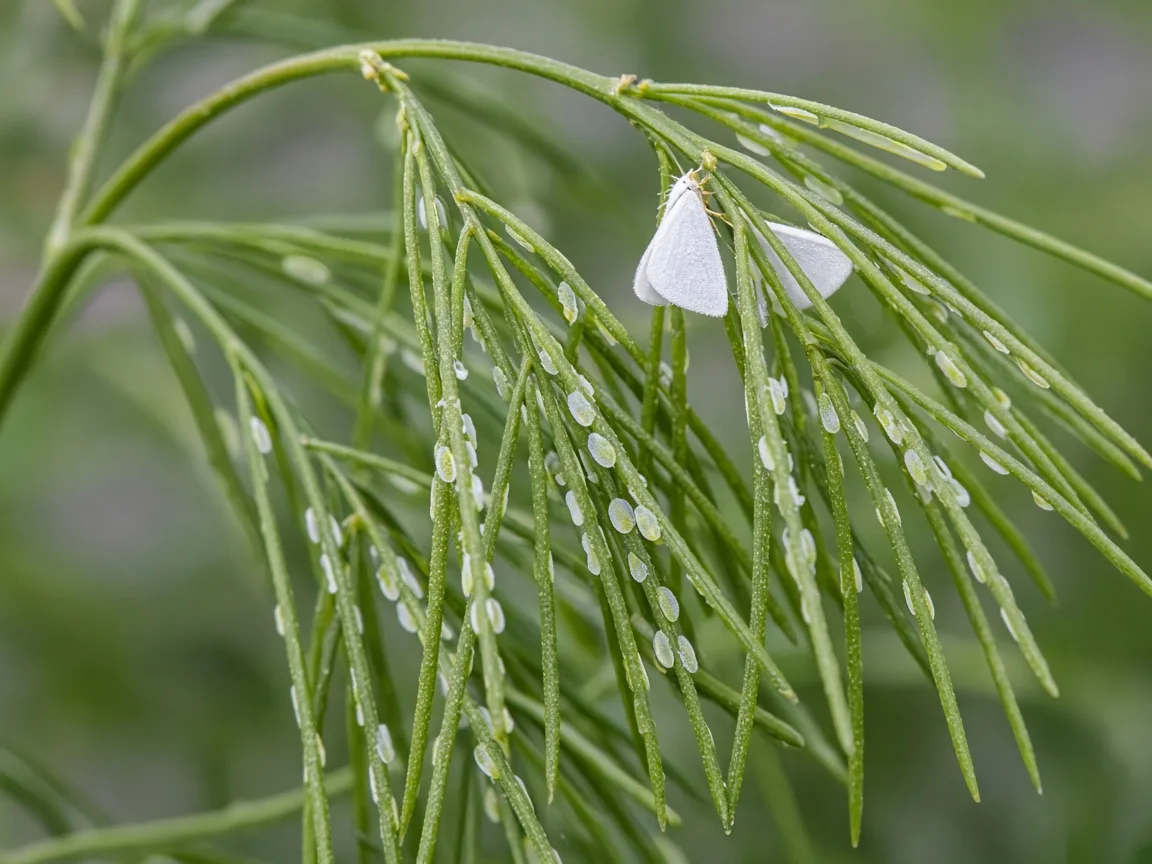
Flat pale nymph disks and powdery white adults on needle-like cladode undersides—compare with a clean neighbor stem on the same arch.
Typical signs on this species include:
- A white cloud of insects rising when you water, mist, or brush past arching stems
- Flat immobile specks on the backs of needle-like cladodes, especially along inner stems and near the crown
- Sticky honeydew on cladodes, pot rims, hangers, or the shelf or floor below a basket
- Black sooty mold growing on honeydew-coated needles
- Yellowing or dropping cladodes when feeding is heavy on one arching frond
- Ant trails on hangers or pot rims farming honeydew from colonies above
Unlike mealybugs, whiteflies lack cottony wax and actively fly when disturbed. Unlike fungus gnats, they stay on foliage, not at the soil surface. Unlike spider mites, they do not leave fine stippling and webbing—though heavy honeydew can look similar to other sap feeders until you trigger the flight response.
Where whiteflies hide on arching cladode sprays
This is the Asparagus Fern pattern generic whitefly pages miss. Before you spray, know where nymphs cling on fine, needle-like cladodes on wiry arching stems:
| Location | Why whiteflies settle here | What you might miss |
|---|---|---|
| Cladode undersides along arching stems | Protected feeding sites on needle sprays | Flat nymphs invisible from above |
| Inner crown junctions | Newest cladodes are softest and still partially folded | Nymph disks inside overlapping stems |
| Sheltered layers in hanging baskets | Outer cascade hides colonies on upward-facing axils | Sticky floor below basket before visible insects |
| Newest tips at stem ends | Continuous flush provides tender tissue | Adults resettling after flight test |
| Lower older cladode sprays | Heavy nymph colonies on shaded foliage | Yellowing blamed on underwatering alone |
Unlike compact rosette plants, Asparagus Fern grows as a tangle of wiry stems with horizontal cladode planes. You cannot inspect from one angle—you must lift outer fronds, rotate the pot, and spray water upward into the inner crown where stems divide. A basket that looks perfect from across the room can harbor nymphs two layers deep on junctions you never see during top-down watering.
Why Asparagus Fern gets whiteflies
Asparagus Fern is not uniquely prone to whiteflies compared with hibiscus or poinsettia, but its growth habit makes certain spots easy targets. The plant pushes fresh cladode tips constantly in bright indirect light—exactly the conditions that keep tissue soft and sap-rich during spring and summer flushes.
Introduction from outside is the usual starting point. Common entry routes include nursery stock, open summer windows, shared greenhouse benches, and plants moved between rooms without inspection. Whiteflies can arrive on any new plant like other houseplant pests; they do not appear from thin air on an isolated healthy fern.
Warm indoor rooms without predators let whiteflies reproduce year-round because there is no cold season to break the cycle and few natural enemies indoors. UC IPM notes outbreaks often occur when biological control is disrupted.
Hanging-basket geometry shields colonies. Outer cladode sprays cascade downward while whiteflies feed on upward-facing undersides and inner crown junctions. You water from above and see the green curtain—not the junctions where stems divide inside the pot.
Over-fertilized soft growth attracts sap feeders. Nitrogen-heavy feeding pushes tender new cladodes that whiteflies prefer; hold heavy fertilizer until the infestation clears.
Stress weakens recovery, not always the initial cause. Chronically dry soil or dim corners yellow cladodes and slow new tips, but whiteflies still need introduction. If you see stickiness plus flying adults, treat pests first; if yellowing spreads without insects, cross-check watering and light separately.
Iowa State Extension notes whiteflies are extremely difficult to control on houseplants once established—prevention and early isolation matter more than with slower-spreading pests like scale.
Honeydew and sooty mold on feathery cladodes
Asparagus Fern’s airy needle sprays make honeydew damage visible in ways compact plants hide longer. Sap feeding produces sticky honeydew on leaves and fruit that black sooty mold can colonize within weeks.
On cladodes: Honeydew feels tacky across multiple needle sprays—not the dry dust that wipes off cleanly. Yellow halos may appear around feeding sites on green needles.
Below hanging baskets: Sticky residue on shelves, tables, or floors is often the first owner complaint. Inspect upward into the inner crown before assuming the mess came from elsewhere.
What sooty mold does not do: Mold grows on the sticky residue—it does not infect asparagus fern tissue directly. Once honeydew production stops, wipe affected cladodes with plain water. Do not scrub delicate needles aggressively; light dabbing preserves healthy tissue better than harsh rubbing.
How to confirm the cause
Work through these checks before reaching for spray:
- Disturbance test — Tap an arching stem or gently shake the pot. Whiteflies fly up briefly; mealybugs and scale insects stay attached.
- Underside inspection — Lift outer fronds and examine every cladode back with bright light. Nymphs look like flat disks; adults cluster near veins on inner stems.
- Honeydew check — Rub a sticky cladode with a damp cloth. Honeydew wipes off cleanly; normal dust or low-humidity tip browning does not feel uniformly tacky across multiple sprays.
- Yellow sticky trap — Place a trap near the pot for 48 hours. Flying adults stick to yellow cards, confirming active whitefly presence even when counts look low.
- Lifecycle timing — Nymphs cause most of the damage and survive single applications. One treatment rarely clears a full generation—plan for repeated cycles.
- Neighbor scan — Check other houseplants on the same shelf or hook cluster, especially hibiscus, poinsettia, and fuchsia, which whiteflies favor—but asparagus fern on the same stand can harbor them too.
- Recent history — Note new purchases, outdoor summer stays, open windows, or propagation jars shared with other cuttings in the past month.
If you find flying white adults plus flat nymphs on cladode undersides with sticky honeydew, whiteflies are confirmed. Yellow lower cladodes alone, without insects or stickiness on new growth, points to watering or light stress—not whiteflies.
Symptom lookalike comparison
| Pest or issue | Key sign on Asparagus Fern | Honeydew? | First differentiator |
|---|---|---|---|
| Whiteflies | White cloud when disturbed; flat nymph disks on cladode undersides | Yes, sticky | Powdery moth-like adults fly and resettle |
| Mealybugs | Cottony wax in cladode axils | Yes | No flight; pink smear on crush |
| Aphids | Pear-shaped insects on softest tips | Yes | Naked bodies on new growth; less flight |
| Thrips | Silvery scrape marks on cladodes | Sometimes | Slender fast insects; no white cloud |
| Spider mites | Fine stippling and webbing | No | Paper-tap test; favors dry winter air |
| Fungus gnats | Tiny flies at soil surface | No | Insects on mix, not on cladodes |
| Underwatering | Dry crumbly soil; dropping needles | No | No insects; pot weight very light |
| Overwatering | Yellow cladodes; wet sour mix | No | Mushy tubers; no flying insects |
First fix for Asparagus Fern
Isolate the plant and rinse every cladode spray underside with lukewarm water until runoff clears honeydew from inner stems.
Move the fern away from other houseplants immediately. Winged adults disperse when disturbed and can colonize neighboring pots within hours. Place the pot in a sink, bathtub, or shower and use lukewarm water with moderate pressure—firm enough to dislodge adults from nested needles, not so hard that brittle wiry stems snap.
Tilt hanging stems so spray hits the inner crown and cladode undersides, not just the outer cascade. Rotate the pot and repeat from below as well as above. Cup your hand over the soil surface so tuberous roots do not wash out during repeated rinses. Let foliage dry in bright indirect light the same day; avoid leaving the crown soggy overnight in a dark corner.
This rinse pass is the correct first response because it removes a large share of exposed adults without chemical risk and lets you see how many flat nymphs remain glued to undersides. Do not apply soap or oil on day one before knockdown—you need a clear post-rinse inspection.
Light vs. heavy infestation protocols
Light colony (a few flying adults, scattered nymph disks on one or two inner stems): Rinse twice in the first week, then apply insecticidal soap to cladode undersides where nymphs remain. Test soap on one stem first and wait one to two days for phytotoxicity before treating the whole plant. Repeat weekly for at least three to four cycles.
Heavy infestation (white cloud on most stems, honeydew on pot and floor, ants present): Rinse twice in the first week, follow with thorough soap coverage on every reachable cladode underside, and add yellow sticky traps near the basket to catch flying adults. Good coverage of leaf undersides is essential—contact products only kill insects they touch. Manage ants on hangers and shelves so natural predators can help if present.
Do not repot, prune heavily, or fertilize during the first treatment week. Asparagus Fern repotting does not remove foliar whiteflies and adds stress. Fertilizer pushes tender cladodes that new nymphs prefer.
What not to do the same day
Do not skip isolation because the infestation looks small. A few adults on one inner stem can spread across a full basket within weeks on a fast-flushing fern.
Do not apply soap to sun-stressed cladodes in hot direct light without a patch test. Feathery needles dry quickly and burned tissue shows as brown tips unrelated to the original pest.
Do not soak tuberous roots repeatedly during treatment. Asparagus Fern wants evenly moist—not waterlogged—soil; see the watering guide and let the top inch dry between drinks once foliage has drained after rinsing.
Step-by-step recovery
After the initial isolation and rinse pass:
- Re-inspect in three to five days — Follow the same arching stems to inner junctions with a hand lens. If live nymph disks remain, repeat rinse and soap on undersides.
- Apply insecticidal soap if adults persist after two knockdown rinses. Work spray into cladode clusters on stem junctions; cover undersides of all infested leaves and avoid flooding the pot base with every application.
- Repeat soap weekly for at least three to four cycles to catch nymphs hatching from eggs left on undersides. One pass rarely clears dense Asparagus Fern crowns.
- Wipe sooty mold off coated needles with a damp cloth once honeydew production stops. Mold is cosmetic but blocks light on heavily blackened sections.
- Trim isolated bad stems if one arch carries colonies you cannot reach with spray. Cut at a junction rather than pulling needles by hand.
- Manage ants on pot rims and hangers if they are protecting whiteflies from predators.
- Hold the plant isolated until you see at least one week with no flying adults after your last treatment.
Asparagus Fern is toxic to cats and dogs. Keep treated plants where pets cannot chew wet foliage after spraying, and wear gloves if sap irritates your skin during wiping or pruning.
Recovery timeline for continuously flushing Asparagus Fern
First week: Visible flying adults should decline sharply after isolation and thorough underside rinsing. Honeydew production slows when feeding stops.
Two to three weeks: With weekly repeats, you should find no new live nymph disks on cladode undersides or inner crown junctions. Sooty mold stops spreading once honeydew is wiped away.
Three to four weeks: Plan on three to four weekly treatment passes before calling the plant clear indoors. Nymphs hatch on a staggered schedule; most failures come from stopping after one rinse.
Ongoing: Judge recovery by clean new cladode tips emerging at stem ends—not by old yellowed needles flattening instantly. Asparagus Fern keeps flushing new growth in bright seasons; that tissue should look firm and pest-free.
Long term: Heavily fed or sooty-coated cladodes may stay dull until they age out or you trim affected stems. Cosmetic damage on old needles is normal even after pests are gone.
Worsening signs: Adults return within days of treatment, colonies spread to every arching stem, ants intensify, or sticky traps refill faster after each cycle—escalate or consider disposal if repeated cycles fail.
Mistakes to avoid
Do not stop after one rinse or one soap pass. Dense feathery crowns need repeated knockdowns and weekly cycles.
Do not use dish detergent in place of products labeled for plants. Homemade soap mixes can burn tender cladodes and lack predictable contact action.
Do not return the plant to a mixed shelf the moment you stop seeing adults. Hold it apart for at least one week of clean checks.
Do not increase nitrogen fertilizer to help recovery during an active infestation—that produces soft cladodes whiteflies prefer.
Do not confuse natural feathery texture with flat nymph disks and skip the disturbance flight test—treating the wrong symptom wastes weeks.
Do not ignore neighboring pots. Whiteflies on one Asparagus Fern often mean hidden colonies on nearby houseplants sharing the hook or shelf.
Asparagus Fern care cross-check
While treating whiteflies, keep baseline care steady rather than overcorrecting:
- Light — Bright indirect light supports recovery and continuous clean new tips. Sudden moves to dim corners slow the flush you use to judge success—see the light guide.
- Water — Evenly moist soil without waterlogging. Let the top inch feel barely dry before watering again; chronic overwatering yellows fronds without removing pests.
- Humidity — Moderate humidity suits this species. Very dry air favors spider mites, a separate problem that can overlap with pest stress.
- Fertilizer — Hold heavy feeding until new growth looks clean for two weeks. Normal modest doses resume after the infestation clears.
Fixing only the bugs while ignoring wet soil, dark placement, or yellow-leaf overlap often brings symptoms back within a month.
How to prevent whiteflies next time
Quarantine every new plant for two to three weeks before it joins your Asparagus Fern. Inspect cladode undersides on day one and again before merging collections.
Scout arching stems weekly during fast spring and summer growth when cladode production is highest. Five minutes with a hand lens on inner crown junctions catches problems when a rinse still solves them.
Inspect hanging baskets from below as well as above—the highest-yield whitefly sites hide under the cascade on cladode undersides.
Feed at normal strength during active growth; avoid doubling fertilizer to push extra-soft shoots.
Space pots so fronds do not touch neighboring plants. Flying adults bridge gaps on crowded shelves.
Hang yellow sticky traps near susceptible baskets during peak indoor whitefly season to catch early flyers before populations build.
See the Asparagus Fern overview for baseline light, water, and soil standards that keep arching stems resilient.
When to escalate
Treat as urgent when flying adults appear on most arching stems, ants farm honeydew across the hanger and pot, sooty mold coats most visible cladode sprays, or sticky traps refill within days of repeated soap cycles.
Also escalate if the fern stops pushing new cladodes during what should be active growth despite normal light and moisture, or if multiple houseplants show whiteflies at once—shared introduction or winged adult spread through a dense collection.
When infestations become severe, consider discarding houseplants rather than repeatedly treating them with insecticides—especially if neighbors remain at risk and treatment cycles have failed three times.
Seek a different diagnosis if stems collapse despite moist soil, tubers turn mushy with sour smell, or yellowing spreads from the base upward without insects or stickiness—that pattern is root rot or chronic overwatering, not whiteflies alone.
A few flying adults on one inner stem, caught early during spring growth, are manageable. Isolate, rinse, soap undersides, and monitor before reaching for stronger products.
Conclusion
Whiteflies on Asparagus Fern hide on cladode undersides along arching stems—especially inner junctions on hanging baskets that look healthy from across the room. Isolate first, rinse every underside from multiple angles, treat nymphs with soap on reachable foliage, then repeat weekly until new tips emerge clean. Stable bright light, even moisture, and weekly inner-stem checks keep this fast-flushing species ahead of the next generation. For related problems on the same plant, compare mealybugs, aphids, and spider mites before you treat the wrong symptom.