Pale Leaves on Basil: Causes, Checks & Fixes
Quick answer
Pale leaves on basil usually mean low light, nitrogen depletion after heavy harvest, or roots too wet to take up nutrients—not a mystery disease. First step: compare the lowest leaves still on the stem with the newest tips you have not picked; pale lowers with dark green tips point to nitrogen washout, while uniform washout with long gaps between leaf pairs means move to full sun before fertilizing.
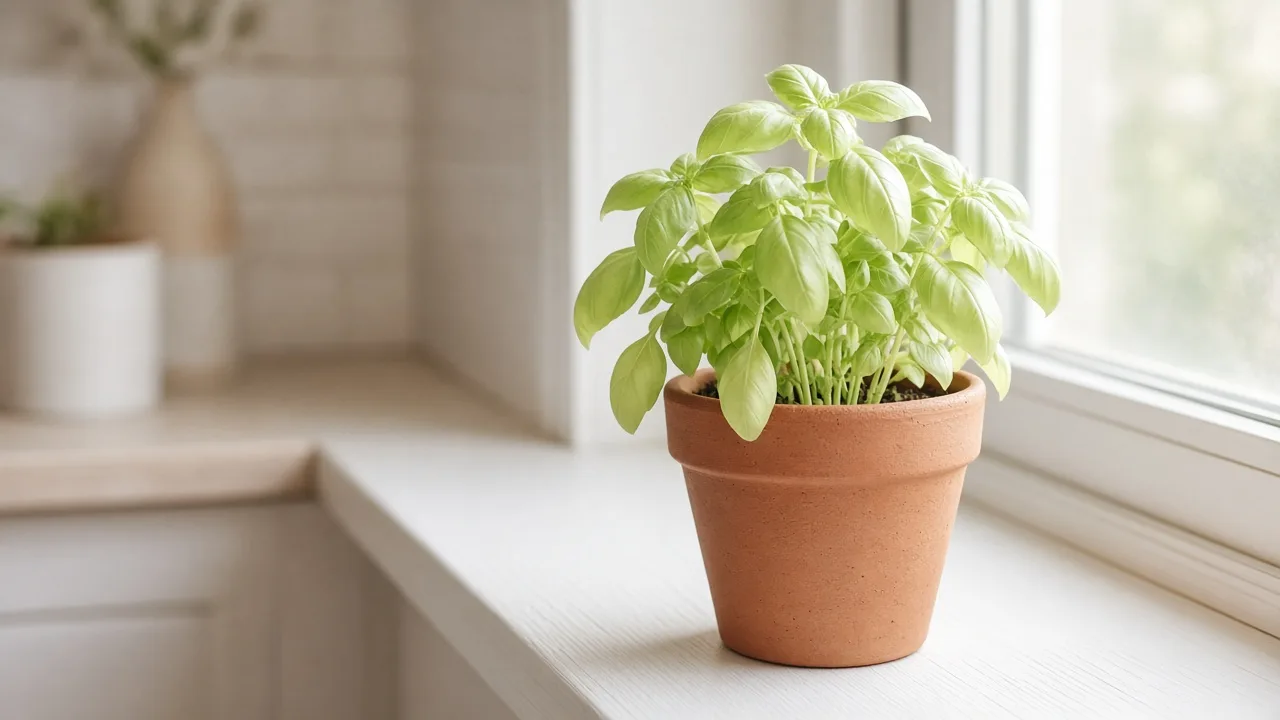
Pale Leaves on Basil: Causes, Checks & Fixes
This guide covers pale leaves on Basil. See also the general Pale Leaves guide, watering, and light pages for this plant.
Pale Leaves on Basil: Causes, Checks & Fixes
Quick answer
Pale leaves on basil (Ocimum basilicum) look washed-out, yellow-green, or lime-colored instead of the glossy deep green Genovese basil is known for in full sun. For general chlorosis mechanics, see our pale leaves guide. On basil, the split between pale lower leaves and dark harvest tips—or uniform washout with long internodes on square stems—tells you whether nitrogen, light, or wet roots is the limiter.
First step: compare the lowest leaves still on the stem with the newest tips you have not picked. Pale lowers with greener pinched tips after heavy harvest point to nitrogen deficiency. Uniform pale color across the plant with long gaps between opposite leaf pairs means move to full sun before you feed. Wet heavy soil with pale limp lowers belongs on the overwatering branch.
Basil is a fast-growing full-sun annual harvested from the top. That harvest rhythm depletes nitrogen quickly in small kitchen pots—so pale foliage often appears before full yellowing or wilt.
When to use this page vs other Basil guides
| Pattern | Read next |
|---|---|
| Uniform pale washout with stretched square stems | Not enough light |
| Pale lowers after weeks of tip harvest | Nitrogen deficiency |
| Soft yellow on wet soil, black stem base | Overwatering |
| Yellow bands between veins, gray fuzz underneath | Yellow leaves (downy mildew) |
| Thin papery pale leaves in hot afternoon sun | Underwatering |
| Fine yellow speckles with webbing | Spider mites |
What pale leaves look like on basil
Healthy basil shows glossy opposite leaves on four-sided stems with a rich green color and aromatic oils that intensify in sun. Pale foliage breaks that pattern in ways that map to specific fixes.
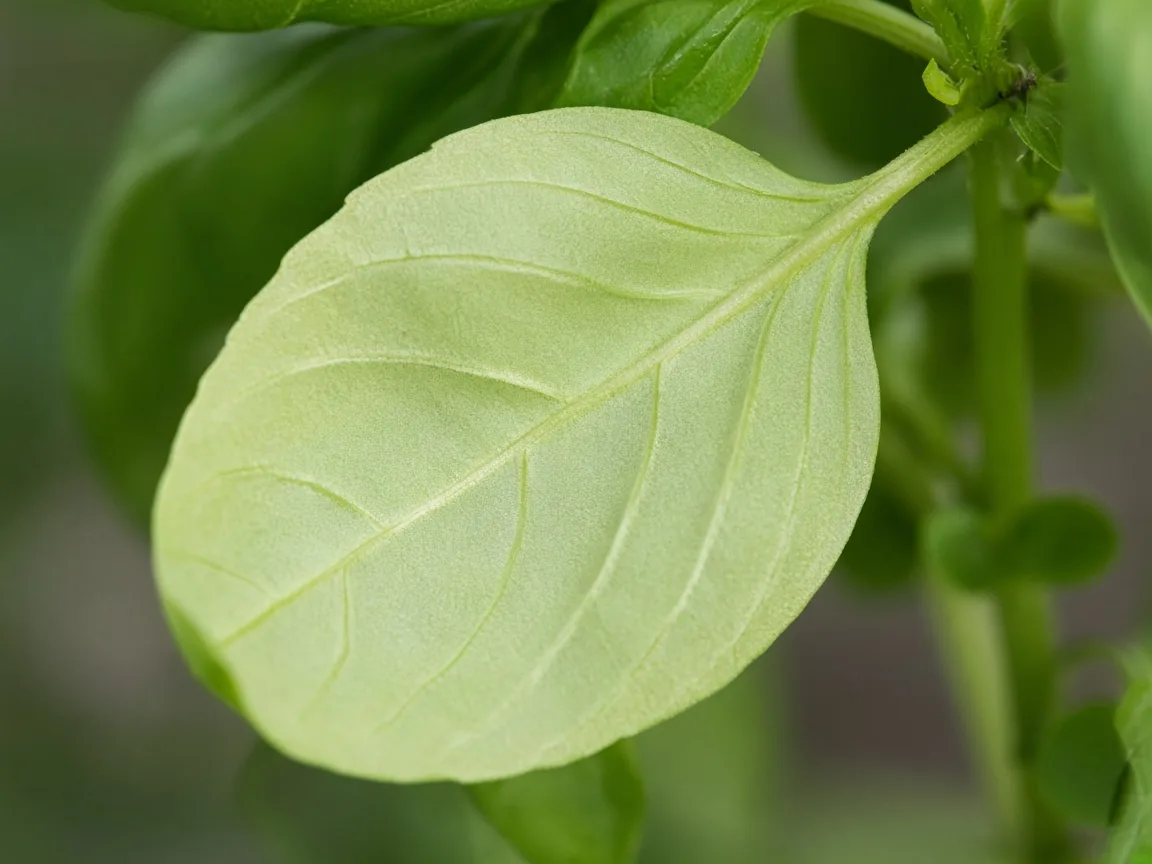
Pale leaf symptoms on basil—compare the faded blade with darker tissue on the same stem before you change care.
Low-light chlorosis (most common indoors)
- Uniform washed-out yellow-green across several leaves—not isolated spots
- Smaller, thinner new leaves at stem tips compared with older sun-grown blades
- Long internodes between opposite leaf pairs as stems reach toward the window
- Milder flavor in pale leaves—basil grown in shade tastes less aromatic than sun-grown foliage
- Plant leans hard toward the brightest direction
- Cross-check basil light guide and not enough light
Harvest nitrogen washout (classic kitchen-pot pattern)
- Lowest leaves fade to pale green or lime while newer tips above your last pinch stay slightly darker—at least briefly
- Appears after weeks of daily top harvest without feeding in a small container
- Nitrogen is mobile; basil moves it from older lowers to active growing tips
- Stems stay firm; no gray fuzz on undersides; soil moisture normal
- See nitrogen deficiency on basil and basil fertilizer
Wet-root pale (nutrients present but not absorbed)
- Lower leaves wash out yellow-green while soil stays damp 2–3 cm down for many days
- Pot feels heavy; may pair with drooping leaves or sour smell
- Upper tips may also pale if root uptake fails—not just natural aging
- Even nitrogen-rich mix cannot help when roots sit waterlogged
- Route to overwatering and root rot if stems soften
Underwatering stress pale
- Whole plant fades to light green with thin, papery leaf edges
- Soil pulls from pot walls; pot is light when lifted
- Common on patio basil in midsummer when harvest outpaces watering
- Differs from uniform dim-room washout—here soil is dry, not wet
- See underwatering on basil
Early downy mildew (before obvious yellow)
- Pale yellow patches between major veins on upper surface—band-shaped, not uniform washout
- Underside may show early gray or purple fuzz in humid mornings before full yellow collapse
- Starts on lowers and moves up—do not mistake for simple chlorosis once spores appear
- Full diagnosis: yellow leaves on basil
Spider mite stippling
- Fine yellow speckles on upper leaf surface that read pale from a distance
- Webbing on stem joints in advanced cases
- Dry indoor winter air accelerates mites—confirm before treating light or feed
Why basil fades before it fully yellows
Basil is built for at least six hours of direct sun daily and rapid leaf production. In a dim kitchen, the plant still grows toward photons—but opens smaller, paler blades with longer internodes rather than stopping entirely. That is why pale leaves often show up before widespread yellow leaves.
Pale lowers after pesto harvest
Basil is harvested from the top, but oldest lower leaves remain on the stem long enough to show nitrogen washout. Each pinching session removes the most nitrogen-rich tissue while the roots keep feeding new tips. In a 6-inch kitchen pot with daily harvest and no feed, lowers wash out within two to three weeks even when light is adequate. The tell is pattern: pale lowers, greener tips above the last cut, firm square stems, clean leaf undersides.
Square stems and the kitchen-window trap
Basil stems are naturally four-sided and somewhat thin—so owners sometimes miss stretch until the whole plant looks lime-colored. A north-facing sill or shelf blocked by a kettle may provide enough light for survival but not enough chlorophyll density for deep green. UMN extension notes basil needs warm temperatures and full sun for best flavor—pale foliage in a dim corner is the plant asking for photons, not automatically a nutrient crisis.
When wet soil mimics deficiency
Saturated mix limits root oxygen and nutrient uptake. Pale yellow-green lowers on chronically wet soil can look like nitrogen deficiency when the real issue is roots failing in soggy mix. The wilt-on-wet-soil pattern—limp pale foliage despite damp soil—belongs on the overwatering branch. Fix drainage and dry-down rhythm before adding fertilizer that stressed roots cannot use.
How to confirm the cause
Work through these checks in order—each takes under a minute:
- Light check: Count direct sun hours on the pot. Fewer than six on most days with uniform pale washout confirms low light.
- Harvest history: Have you picked tips daily for two or more weeks without feed? Pale lowers with darker tips above the last pinch confirm nitrogen washout.
- Soil moisture: Press finger 2–3 cm into mix. Wet and heavy with pale limp lowers = root stress. Bone dry with papery pale leaves = drought stress.
- Underside scan: Flip a pale leaf. Gray-purple fuzz between veins means downy mildew—do not treat as simple chlorosis.
- New growth test: After one targeted fix (move to sun or pause watering or one dilute feed), watch the next two leaf sets. Darker new tips mean you chose correctly.
The first fix to try
Move the pot to the brightest full-sun location available and compare lower leaves with unpicked tips the same day.
Basil is a full-sun herb. Many pale-leaf cases in kitchens trace to weak light—not missing fertilizer. Outdoors or on a south- or west-facing sill, aim for six or more hours of direct sun. If the whole plant is uniformly washed out with long internodes, brighter placement is the first correction.
If light is already strong and only lowers are pale after heavy harvest with firm roots and moist-not-wet soil, switch the first fix to one half-strength balanced liquid feed (see basil fertilizer). Do not feed a dim or waterlogged plant.
Do not repot, prune heavily, and fertilize on the same day. Change one variable, then read the next two leaf sets.
Step-by-step recovery
Low-light recovery
- Move to full sun outdoors or the brightest indoor sill.
- Rotate the pot every few days so opposite leaf pairs develop evenly on square stems.
- Pinch the palest stretched tips above a leaf pair to force bushier regrowth.
- Resume basil watering when the top 2–3 cm dries—dim plants use less water; avoid keeping mix wet “because it looks thirsty.”
- Judge recovery by darker, more aromatic new leaves within one to two weeks.
Nitrogen recovery after harvest
- Confirm roots are white and firm when you slide the plant partly out of the pot.
- Apply balanced liquid fertilizer at half label strength once.
- Continue pinching above leaf pairs—do not strip all lower leaves bare.
- Repeat light feed every two to three weeks during active harvest per container herb guidance.
- Older pale lowers may stay light; new tips should deepen within 7–14 days.
Wet-root recovery
- Stop watering until the top 2–3 cm dries.
- Empty saucers; confirm drainage holes are open.
- If soil smells sour or stems soften at the base, inspect roots—see root rot on basil.
- Once dry-down stabilizes, pale spread should halt; new growth stays greener within two weeks.
Recovery timeline
| Severity | What to expect |
|---|---|
| Mild low light | Darker new tips within 7–10 days after moving to full sun |
| Harvest nitrogen washout | New pinches come in deeper green within 1–2 weeks after one dilute feed |
| Mild overwatering | Pale spread stops once soil dries; next leaf sets improve in 10–14 days |
| Advanced root rot or downy mildew | Older pale tissue may not recover—restart from seed or healthy cuttings |
Existing faded blades rarely re-green. Success means the problem stops spreading and new center growth arrives firm and aromatic.
Lookalike symptoms
| What you see | Likely cause | Page |
|---|---|---|
| Uniform pale washout, long internodes | Low light | Not enough light |
| Pale lowers, greener tips after harvest | Nitrogen washout | Nitrogen deficiency |
| Pale limp lowers on wet soil | Overwatering | Overwatering |
| Pale bands between veins, underside fuzz | Downy mildew | Yellow leaves |
| Crispy pale edges, dry soil | Underwatering | Underwatering |
| Speckled pale patches, webbing | Spider mites | Spider mites |
Mistakes to avoid
- Fertilizing a dim or waterlogged basil before fixing light or dry-down rhythm
- Stripping all lower leaves to “tidy” pale foliage—removes photosynthetic area while the plant recovers
- Assuming pale always means nitrogen when the plant sits in a dark corner with stretched stems
- Ignoring leaf undersides and missing early downy mildew spores
- Letting pale basil bolt—flowering shifts flavor bitter; pinch flower spikes when color and harvest quality drop
How to prevent pale leaves next season
- Grow in full sun with six or more hours of direct light daily
- Use well-draining mix per basil soil guide—basil roots rot quickly in waterlogged pots
- Feed lightly every two to three weeks during active harvest; container herbs need regular replenishment
- Harvest by pinching tips, not denuding lowers
- Restart tired woody plants in late summer rather than nursing pale exhausted stems indefinitely
- Inspect leaf undersides weekly during humid weather for early mildew
When to worry
Treat as urgent if:
- Gray-purple fuzz appears on leaf undersides (downy mildew—remove plant, do not compost)
- Stems soften or blacken at soil line on wet mix (root failure)
- Pale spread reaches most leaves within a week despite corrected sun and watering
- New tips stay thin and lime-colored after four weeks of full sun and proper feed—roots or disease may need inspection
For species baseline and care hub: basil overview and basil problems.
Related Basil guides
- Basil overview — species baseline and care hub
- Basil light — placement and sun-hour targets
- Basil watering — dry-down checks that pair with recovery
- Basil fertilizer — feeding after harvest washout
- Basil problems — full symptom index for this species
- Not enough light — when stretch dominates over simple washout
- Nitrogen deficiency — lower-leaf pale after heavy picking
- Yellow leaves — downy mildew, cold damage, and moisture yellowing
Related tool
Use the Plant Problem Diagnosis Tool to narrow causes for pale leaves on this plant before changing multiple variables at once.