Black Spots on Begonia Maculata: Causes, Checks & Fixes
Quick answer
Black spots on Begonia maculata are usually fungal or bacterial leaf spot on wet angel-wing leaves, botrytis on lower foliage touching damp mix, or darkening that follows root stress—not the plant's normal silver polka dots. First step: stop misting and overhead watering, then remove the worst spotted leaves with clean snips.
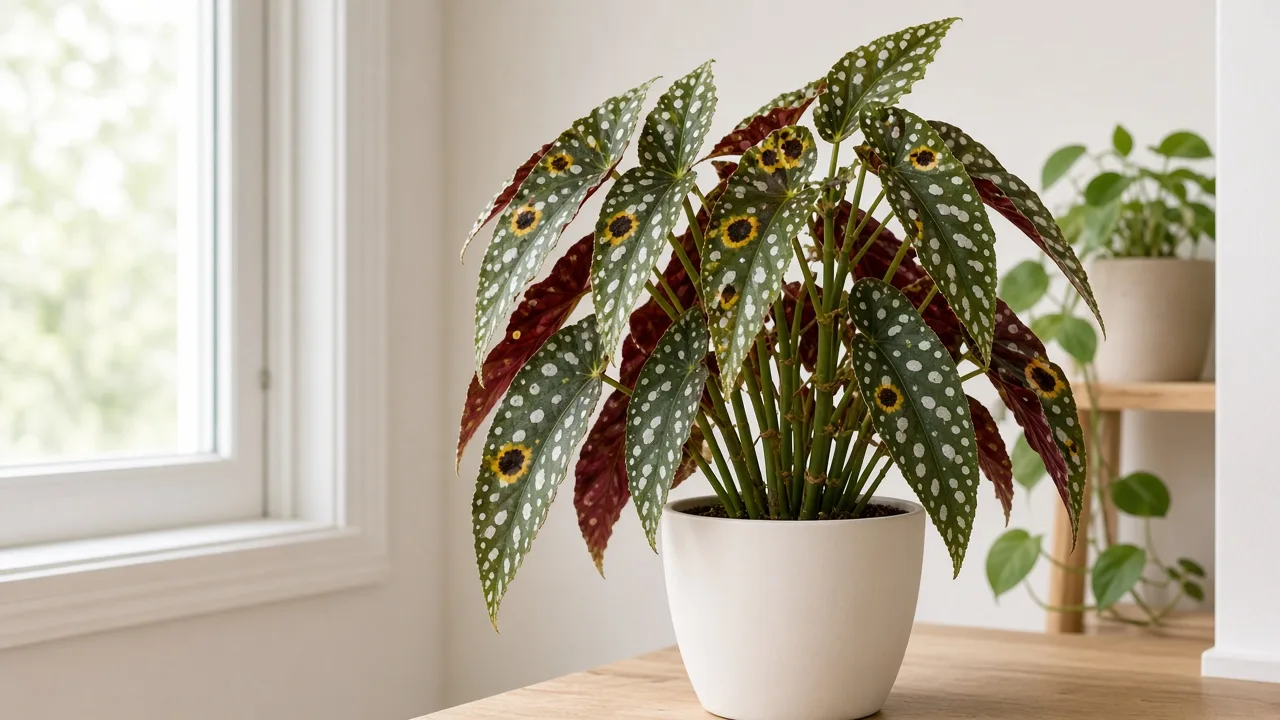
Black Spots on Begonia Maculata: Causes, Checks & Fixes
This guide covers black spots on Begonia Maculata. See also the general Black Spots guide, watering, and light pages for this plant.
Black Spots on Begonia Maculata: Causes, Checks & Fixes
Quick answer
Black spots on Begonia maculata (polka dot begonia, angel wing begonia) are localized tissue death or surface mold on thin silver-spotted blades—not the plant’s decorative white dots. On this upright cane begonia with olive-green angel-wing leaves and burgundy undersides, the pattern usually splits four ways: wet circles with yellow halos on spotted foliage suggest fungal or bacterial leaf spot after blades stay damp, soggy brown-to-black patches on lowest leaves touching wet mix trace botrytis or splash injury, black mushy tissue at the lowest cane on saturated soil overlaps overwatering and root rot, and black smear that wipes off points to sooty mold on honeydew from mealybugs or whiteflies. For general spot-disease mechanics, see our black spots guide. On maculata, owners chase humidity with mist while the care profile says never wet the leaves—droplets pool on asymmetric angel-wing blades and in cane axils overnight.
A few isolated dry black marks on one lower leaf are cosmetic. Spreading wet-looking spots on multiple new angel-wing leaves or black mushy tissue at the cane base need action the same week—not extra fertilizer.
First step: stop wetting foliage and remove the worst spotted leaves with clean snips. Water at soil level only, improve airflow around the cane cluster, and verify top 2–3 cm dry-down before the next drink. If the lowest cane dents on heavy mix, route to root rot before fungicide.
When to use this page vs other Begonia Maculata guides
| Your question | Best page |
|---|---|
| Dark spots or smears on spotted angel-wing leaves | This page |
| Whole leaves yellowing on wet soil | Yellow leaves |
| Mushy roots, sour smell, black lowest cane | Root rot |
| Heavy pot, damp surface, firm canes | Overwatering |
| Crispy brown edges, not round spots | Brown tips |
| White cotton in leaf axils | Mealybugs |
| Fine webbing on leaf undersides | Spider mites |
What black spots look like on Begonia Maculata
Healthy maculata leaves are elongated angel wings—olive green above with round silver-white polka dots, burgundy to red-purple below, on bamboo-like cane stems. Black spotting breaks that pattern in recognizable ways:
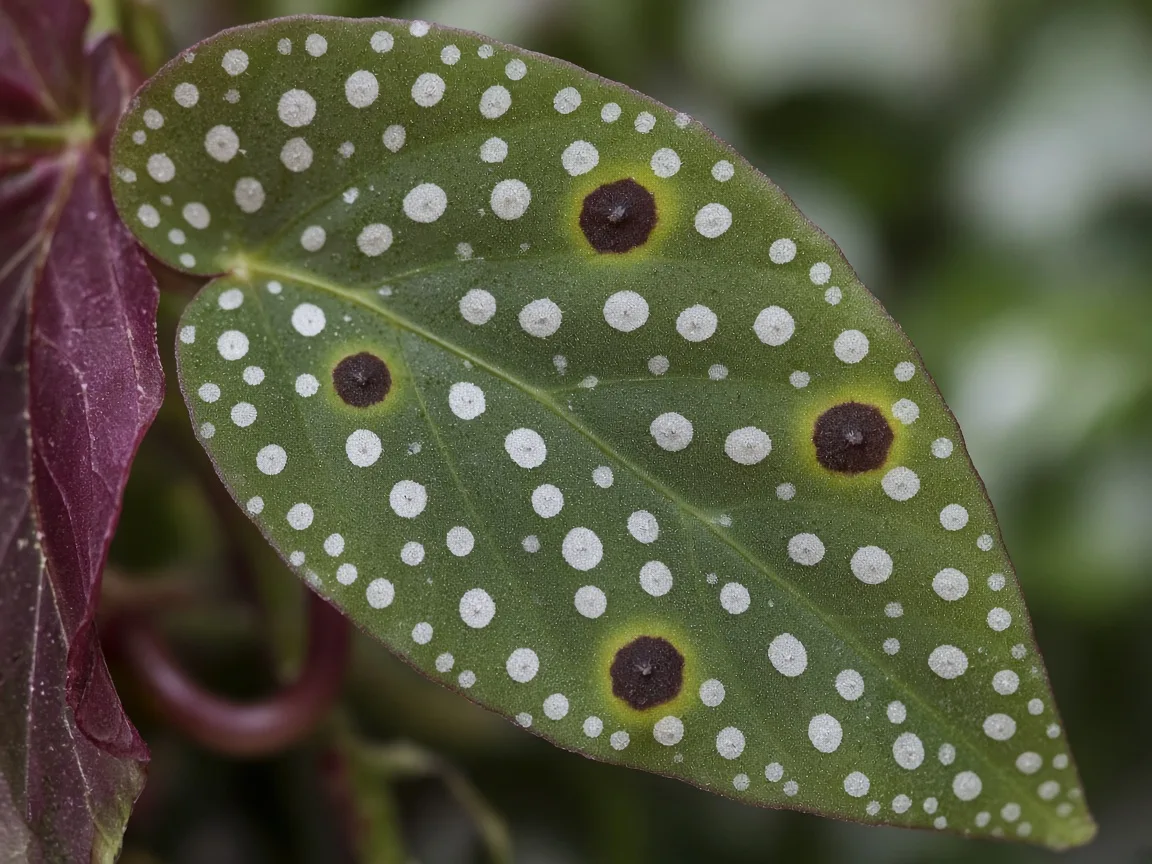
Dark lesions on silver-spotted Begonia maculata foliage—compare wet leaf-spot halos with the plant’s normal decorative dots.
- Small dark brown to black circles with yellow halos — Often start water-soaked, then crisp at center. RHS notes dark spots with yellow margins may be fungal leaf spot on wet foliage.
- Soggy brown-black blotches on lowest angel-wing leaves — Lower blades rest against damp mix or a wet saucer; botrytis blight often starts where foliage touches wet surfaces in stagnant air.
- Raised pimple-like spots that stay angular — Bacterial leaf spots on ornamentals can appear water-soaked at first, then turn brown or black; begonias are common hosts in greenhouse collections.
- Black coating that wipes off with a damp cloth — Sooty mold on sticky honeydew from mealybugs nesting in cane axils; the spotted leaf underneath is often still green.
- Fixed dry black mark after cold exposure — Chilling below about 55°F (13°C) can discolor tender begonia foliage; maculata near a winter window may show papery black patches that do not spread like infection.
- Single dry black mark, no halo, no spread — Bumping a fragile angel-wing leaf, pet damage, or a healed wound. Stable for months.
Spots on newest leaves at cane tips are more urgent than one old mark on the lowest senescing blade.
Silver polka dots vs disease spots
This is the maculata-specific trap that sends owners to the wrong fix. Normal silver dots are uniform, round, and present from unfurling—they sit on the upper surface as part of the plant’s identity and do not enlarge or develop yellow halos. Disease spots are new, often start water-soaked or greasy, may have yellow margins, and spread or merge on blades that were recently wet.
If you are unsure, photograph one leaf and compare: variegation repeats across the plant at a similar size; lesions are irregular, clustered, or advancing on one side of a cane. When only the silver pattern is present and leaves feel firm, you do not need this page—return to light and watering basics.
Why angel-wing foliage traps moisture
Maculata is marketed as humidity-loving, which is only half the story. RHS cane begonia guidance calls for compost that stays moist but well drained in bright filtered light—not constantly wet leaves in a dim bathroom. The thin angel-wing blades that make maculata photogenic also hold mist, splash water, and condensation in the asymmetric leaf base and along serrated edges.
When owners mist heavily, shower-rinse weekly, or pour from a narrow-spout can over the crown, droplets sit on spotted foliage for hours. NC State Extension recommends watering at the base and avoiding the leaves because begonias are susceptible to fungal leaf diseases such as powdery mildew and botrytis when foliage stays wet. In a dense cane cluster with poor airflow, that culture converts humidity enthusiasm into leaf-spot pressure within days.
Black cane base vs black leaf spots
On cane begonias, black mushy tissue at the soil line is not the same problem as black spots on blades. Rot often climbs from saturated fibrous roots into the lowest cane segment while upper spotted leaves still look acceptable—a pattern that sends owners toward “leaf fungus spray” when the real issue is chronic overwatering.
Squeeze the lowest cane at the soil line before you treat foliage. Firm cane with wet mix and scattered leaf spots may still be leaf-spot culture fixable with dry blades and sanitation. Soft, denting, or blackened cane with sour-smelling mix means route to root rot immediately—trimming spotted upper leaves alone will not save the plant.
Why Begonia Maculata gets black spots
Common triggers on maculata tie to how this species is actually grown indoors:
- Overhead watering or misting while following “high humidity” advice without airflow
- Lower angel-wing leaves resting on wet mix or a full saucer after bottom-watering
- Dense cane growth in a corner with no fan movement after evening drinks
- Shower rinses for pest control that leave blades wet overnight in cool rooms
- Stress from wet roots in dense peat—begonias are highly susceptible to root rot when overwatered, and failing roots weaken leaf defenses
- Honeydew from mealybugs or whiteflies leading to sooty mold that reads as “black spots”
- Cold drafts below about 55°F (13°C) causing fixed necrosis on exposed blades
Because maculata leaves are fragile, mechanical tears can also dry into dark marks—but those stay fixed at the wound site rather than spreading with yellow halos.
How to confirm the cause
Work through this checklist before spraying anything:
- Dot test — Are marks new lesions with halos, or stable silver variegation? If variegation only, stop here.
- Wipe test — Does a damp cloth remove the black coating? Sooty mold wipes off; leaf-spot necrosis does not.
- Moisture history — Has the top 2–3 cm of mix stayed damp for a week? Have you misted, showered, or splashed the crown recently?
- Cane firmness — Squeeze the lowest segment. Soft black cane = root-zone problem, not foliage fungus alone.
- Spread pattern — Leaf spot advances on several blades on one cane or cluster; chilling injury stays on exposed leaves; mealybugs leave cotton and sticky residue in axils.
- New growth — Spots on unfurling angel-wing leaves at cane tips confirm active pressure; one old bottom mark may be senescence.
If roots are firm, canes are solid, and spots appeared right after wet foliage, treat as leaf-spot culture on this page. If the base is mushy, open the root rot guide instead.
First fix for Begonia Maculata
Stop all overhead moisture and remove the worst spotted leaves with clean, sterilized snips. That single sanitation step limits spore and bacterial splash while you correct the environment—do not mist “for humidity” on the same day you discover spreading lesions.
Workflow:
- Isolate the plant from other begonias if spots are wet and spreading—bacteria spread through splashing water and shared tools.
- Cut off heavily spotted blades at the petiole base. Bag and discard tissue; do not compost infected leaves.
- Switch to soil-level watering only. Let the top 2–3 cm of mix dry before the next drink per the watering guide.
- Improve airflow around the cane cluster—space plants, open a vent, or run a gentle fan so incidental moisture dries within a few hours.
- Inspect axils for mealybugs if any spots smear off; treat pests before fungicide.
Hold fertilizer, heavy misting, and repotting until new growth looks clean for two weeks. If spots keep appearing on new leaves after seven to ten days of dry foliage culture, consider a labeled fungicide for ornamental foliage diseases—test on one leaf first because begonia blades can be sensitive.
Step-by-step recovery
Mild leaf spot: firm canes, limited lesions
When canes stay firm and only some blades are affected:
- Remove spotted leaves as above; keep healthy spotted foliage if the plant needs photosynthetic area.
- Water at the soil line when the top 2–3 cm is dry; empty saucers within thirty minutes.
- Raise ambient humidity with a humidifier or pebble tray—not foliar mist on maculata.
- Monitor new angel-wing leaves weekly; clean unfurling without halos means success.
Moderate spread: multiple canes, wet culture history
When several blades on one cane show halos after misting or splash:
- Strip the worst third of spotted foliage; sterilize snips between cuts with rubbing alcohol.
- Move to brighter indirect light if the plant sat in a dim humid corner—see light guide.
- Top-dress is not a substitute for dry-down; if mix stays wet for weeks, ease watering before fungicide.
- Optional: apply a houseplant fungicide labeled for leaf spot per package intervals if new lesions continue.
When to escalate to root rot page
If the lowest cane softens, mix smells sour, or leaves collapse despite wet soil, stop leaf-spot treatment and follow root rot recovery. Cane-node propagation may be the salvage path when upper stems stay firm.
Recovery timeline
Stabilization after sanitation and dry foliage often takes one to two weeks once watering shifts to soil-level dry-down. Cane tips should stay firm; new spotting should slow.
Clean new angel-wing leaves are the best success signal—expect them in two to four weeks during warm active growth, sometimes longer if recovery started in a cool winter room. Old black lesions will not re-green; remove them once the plant stabilizes for appearance.
Worsening signs: spots on every new unfurling leaf after dry culture, cane base blackens upward, sour smell returns, or leaves collapse on heavy wet mix—those mean root-zone failure or discard, not another mist session.
What not to do
Do not mist spotted foliage to “help humidity”—maculata needs ambient moisture, not wet blades. Do not shower the whole plant and return it to a stagnant corner the same evening.
Do not confuse silver polka dots with disease and prune healthy variegation. Do not apply fertilizer on stressed spotted leaves hoping they recover color.
Do not ignore a soft black lowest cane while trimming upper spots—that is root rot, not leaf spot alone. When handling diseased tissue, wear gloves—Begonia is toxic to cats and dogs.
How to prevent black spots next time
Match watering to how fast your pot dries in your light. Allow the top 2–3 cm of mix to dry before the next drink. Water at the soil line; never wet angel-wing leaves during routine care.
Use airy peat-perlite-bark mix in a pot with open drainage—see soil guide. Raise humidity with a humidifier or pebble tray rather than foliar mist in dim rooms. Space cane begonias for airflow; quarantine new plants before adding them to a begonia collection.
Treat fungus gnats and chronic wet mix as early warnings. Inspect cane axils weekly for mealybugs that leave honeydew and sooty mold.
Related Begonia Maculata guides
- Begonia Maculata overview — Light, watering, humidity, and general care
- Watering Begonia Maculata — Primary dry-down prevention
- Light for Begonia Maculata — Bright indirect placement without scorch
- Soil for Begonia Maculata — Drainage that prevents wet-root stress
- Overwatering — Wet mix before confirmed rot
- Root rot — Soft black cane base and mushy roots
- Mealybugs — Honeydew and sooty mold lookalike
- Begonia Maculata problems — Full problem hub
Conclusion
Black spots on Begonia Maculata are new necrotic lesions or surface mold on angel-wing leaves—not the plant’s silver polka dots. Stop wetting foliage, remove the worst spotted blades with clean snips, dry the culture with soil-level watering and airflow, and route soft black canes to root rot before fungicide. Polka dot begonia rewards dry blades and predictable root-zone moisture far more than it rewards mist on already-damp spotted foliage.