Whiteflies on Begonia Rex: Causes, Checks & Fixes
Quick answer
Whiteflies on Begonia Rex flutter from leaf undersides when disturbed and leave sticky honeydew on painted foliage. First step: isolate the plant and wash every reachable leaf underside with lukewarm water while keeping the shallow rhizome crown dry.
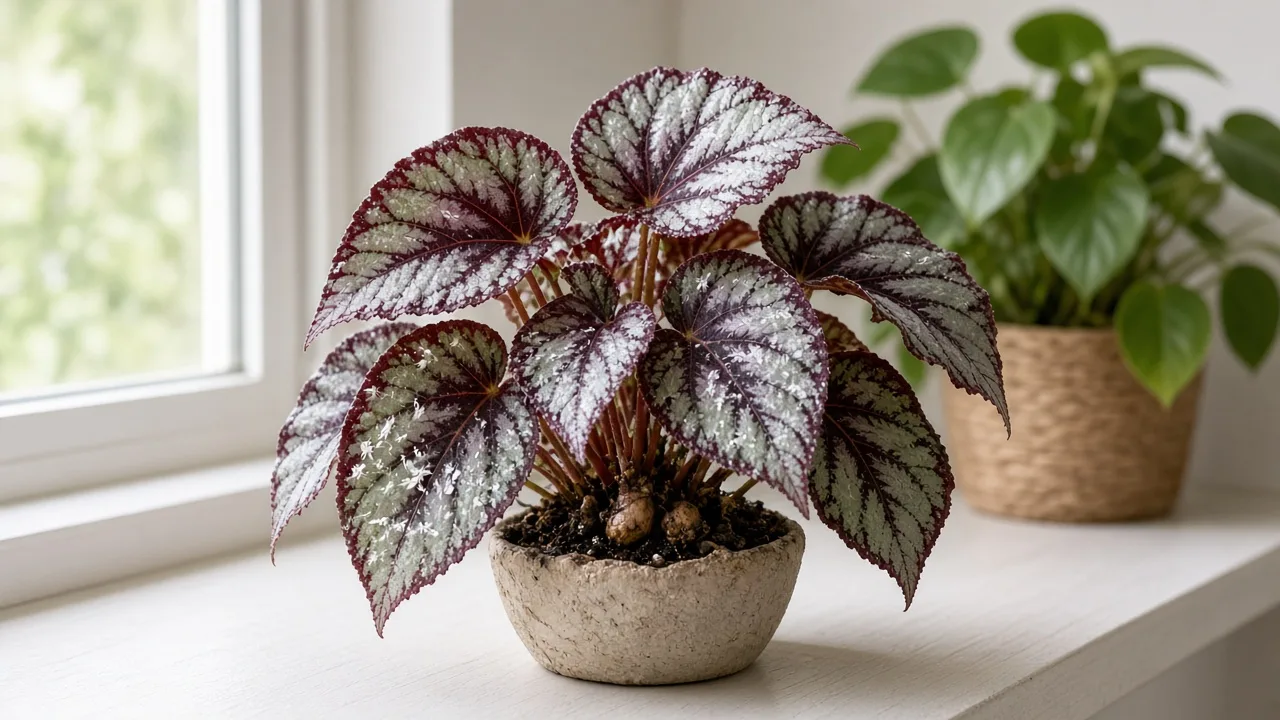
Whiteflies on Begonia Rex: Causes, Checks & Fixes
This guide covers whiteflies on Begonia Rex. See also the general Whiteflies guide, watering, and light pages for this plant.
Whiteflies on Begonia Rex: Causes, Checks & Fixes
Quick answer
Whiteflies are tiny, sap-sucking insects that fly when disturbed. On Begonia rex-cultorum, adults look like miniature white moths tucked under the painted leaves that form each low rosette. Disturb a blade and a white cloud rises before insects resettle on undersides. Immobile nymphs look like flat pale disks glued to the same surfaces.
For general whitefly biology and life cycle, see our whiteflies pest guide. On Rex begonias, pests concentrate on leaf undersides, the crown where new painted blades unfurl, and the protected axils between overlapping leaves—places a quick glance at the colorful leaf faces will miss.
First step: isolate the plant if other houseplants sit nearby, then wash every reachable leaf underside with lukewarm water while keeping the shallow rhizome crown dry.
When to use this page vs other Begonia Rex guides
This page is the pest-first entry for flying white sap feeders on painted rex foliage.
| Pattern | Read next |
|---|---|
| Soft pear-shaped insects on newest crown leaves | Aphids |
| White cottony tufts in crown axils | Mealybugs |
| Fine webbing and stippling on painted blades | Spider mites |
| Flat brown or tan bumps without flying adults | Scale insects |
| Silvery scarring on new leaves | Thrips |
| Yellow lower leaves, wet mix, soft crown | Overwatering or root rot |
What whiteflies look like on Begonia Rex
Healthy Rex begonias carry broad painted leaves in silver, burgundy, green, and pink patterns above a shallow rhizome at the soil line. Whiteflies exploit the flat undersides of those blades and the soft tissue at the rosette center.
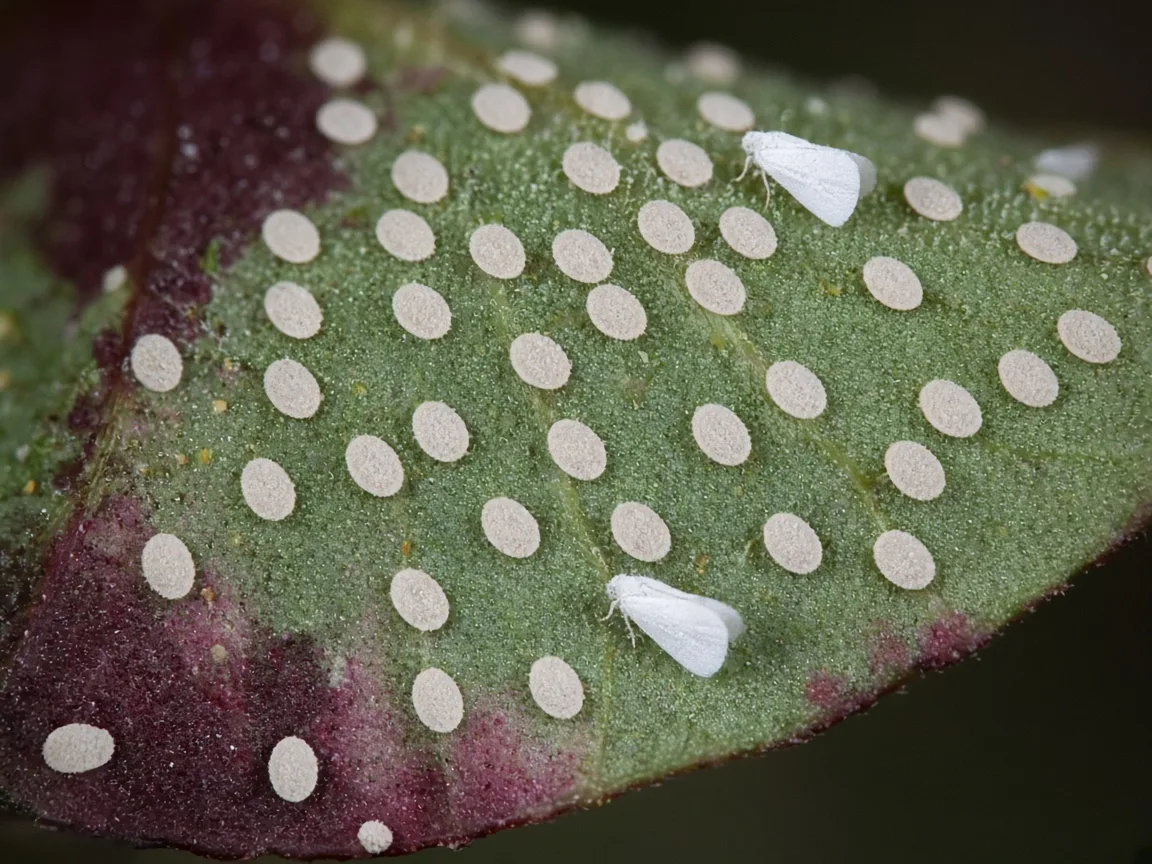
Flat pale whitefly nymph disks on a painted leaf underside—distinct from the colorful pattern visible from the front.
Typical signs:
- A sudden white cloud when you water, move, or tap a leaf
- Tiny moth-like adults resting on blade undersides
- Flat, oval, pale nymphs glued to the same surfaces after crawlers settle
- Sticky, shiny honeydew on young painted foliage, pot rims, or shelves below
- Black sooty mold growing on honeydew-coated lower leaves
- Yellowing or dull blades when feeding is heavy—while petioles stay firm
Whiteflies differ from mealybugs on Begonia Rex, which form cottony wax clusters in crown axils rather than flat disks and flying adults. They differ from aphids, which cluster as soft pear-shaped insects on tender crown tips without a white flying cloud. Spider mites cause fine stippling and silk without flying adults.
Unlike brown tips from dry air or salt, whitefly damage comes with live insects, stickiness, or sooty mold—not isolated edge burn on otherwise clean blades.
Where whiteflies hide on painted leaf undersides and crown flush
Rex begonias grow as a low, spreading rosette with a shallow rhizome. Whiteflies follow the protected undersides on each leaf, not the painted faces owners admire from across the room.
Large colonies often develop on the undersides of leaves. On Begonia Rex, the equivalent hot zones are:
- Leaf undersides — Where each painted blade attaches along the rhizome; nymphs hide from casual front-view inspection
- Crown center flush — Softest new leaves emerging rolled from the rosette center
- Overlapping leaf axils — Where mature leaves stack tightly in a dense rex rosette
- Lower leaves on the pot rim — Hard to reach without tilting the pot; colonies build here undisturbed
- Soil line and nearby pots — Adults fly short distances between begonias on shared shelves
The greenhouse whitefly is common on herbaceous ornamentals indoors and has a wide host range—exactly the profile that fits Rex begonias in warm, humid collections.
Why Begonia Rex gets whiteflies
Whiteflies rarely appear from nowhere indoors. They hitchhike on new plants, cuttings, or bouquets placed nearby, and spread when isolation is skipped. Open windows in warm weather can also introduce winged adults.
Rex begonias are not uniquely whitefly-prone, but their care profile creates favorable feeding sites:
- Fast spring and summer growth produces the tender shoots whiteflies prefer
- Begonia Rex light guide plus steady humidity (50–60% RH) keeps the plant pushing new painted leaves for months
- Crowded shelves slow airflow and let colonies spread before you notice a white cloud
- Bottom watering is correct for Rex begonias, but it also means you may skip inspecting leaf undersides for weeks
Stressed plants—recently repotted, moved to hot sun, or sitting in wet mix—can also attract whiteflies, but the pattern on Begonia Rex is usually leaf undersides + sticky residue + flying adults, not random yellowing of old leaves alone.
How to confirm the cause
Work through these checks in order:
- Shake test — Tap a lower leaf over white paper. Flying white adults that resettle on undersides confirm whiteflies.
- Look with a hand lens — Flat pale disks that do not move are nymphs. Mealybugs look cottony; aphids are soft and pear-shaped.
- Test for stickiness — Honeydew feels tacky and may collect dust or turn sooty black. Mineral hard-water spots wipe off dry; honeydew does not.
- Check sooty mold — Black coating on honeydew-coated leaves points to sap feeders, not fungal leaf spot alone.
- Scan neighbors — Whiteflies spread plant to plant. Inspect every begonia, fern, or flowering pot on the same stand.
- Rule out lookalikes — Powdery residue without insects may be mealybugs. Crisp painted-leaf edges without stickiness fit low humidity better than whiteflies.
If you see flying white adults on leaf undersides plus honeydew, the diagnosis is confirmed. Yellow leaves alone, without insects or stickiness, may be watering stress—keep monitoring for a week.
First fix for Begonia Rex
Isolate the plant and wash every reachable leaf underside with lukewarm water while keeping the rhizome crown dry.
Move the pot away from other plants. In a sink or shower, use gentle pressure to rinse leaf undersides, petioles, and the lowest blades where colonies hide. Hold the pot tilted so water runs off leaves and does not pool around the rhizome crown—Rex begonias rot quickly when the crown stays wet, and you normally bottom-water precisely to avoid that.
Pat excess water from leaf surfaces with a clean towel and set the plant in bright indirect light with good airflow so foliage dries within an hour. This single step removes a large share of adults and dislodges crawlers without chemical burn risk on sensitive painted leaves.
Do not spray insecticidal soap, neem, or alcohol over the whole plant until you have done this rinse and confirmed how many insects remain.
Step-by-step recovery
After the initial wash, continue in this order based on severity:
- Repeat physical removal every two to three days — Water sprays dislodge adults and many nymphs. A damp microfiber cloth on tight leaf axils reaches spots a spray misses on compact Rex rosettes.
- Prune only heavily infested leaves — If one lower leaf cluster is packed with nymph disks, cut it off with clean scissors and bag the debris. Do not compost indoors.
- Hang yellow sticky traps near the pot — Traps monitor and reduce adult numbers as part of integrated control, not as a sole fix.
- Test then apply insecticidal soap if needed — Rex begonias are somewhat sensitive to soaps and oils. Spot-test one lower leaf, wait 24 hours, then spray only where live whiteflies remain—especially leaf undersides. Treat in early morning or evening, not under hot lamps.
- Repeat soap every five to seven days — Soaps kill on contact only; two to three cycles catch newly hatched nymphs hiding under curled young leaves.
- Manage ants if present — Ants protect whiteflies for honeydew. Sticky traps on pot legs or removing the plant from ant trails helps natural control work.
- Hold fertilizer — Skip feed until new growth looks clean for two weeks. Soft nitrogen-rich shoots invite reinfestation.
- Resume normal bottom watering — Once foliage is dry and pest-free, return to watering at the base when the top 2–3 cm of mix is dry. Do not let recovery showers replace your usual dry-down rhythm.
For heavy infestations on multiple plants, treat every affected pot on the same schedule so adults do not fly back from a neighbor.
Recovery timeline
First rinse: You should see fewer flying adults immediately and less fresh honeydew within a day or two.
One to two weeks: With repeated washing or two soap cycles, colonies on accessible leaf undersides should collapse. Old sticky spots on mature painted leaves may remain until you gently wipe them or trim affected foliage.
Two to four weeks: Watch for clean new leaves unfurling without yellowing or stickiness—that is the best recovery sign on Rex begonias. Painted leaves that were heavily fed on or stained often do not regain full color; focus on healthy new growth instead.
Worsening signs: Spreading stickiness after treatment, new nymph disks on fresh shoots each week, or crown softness after repeated foliar soaking means escalate—trim more aggressively, verify soap tolerance, and inspect for ants farming the plant.
Lookalike symptoms
- Low humidity brown tips — Dry, crisp leaf margins without insects or honeydew; fix humidity and watering, not pesticides.
- Mealybugs on Begonia Rex — White cottony masses in leaf axils and crowns; alcohol dabs work better as a first pass than water rinses alone.
- Scale insects — Hard brown or tan bumps that do not move; scrape test confirms scale, not whiteflies.
- Powdery mildew — White powder on leaf surfaces without sticky honeydew or flying insects.
- Edema or water spots — Bumpy translucent patches from overwatering on Begonia Rex or misting; no insect clusters.
What not to do
Do not mist leaves as treatment—Rex begonias are prone to grey mold and permanent water marks on painted foliage, and misting does not reliably kill whiteflies.
Avoid dish soap mixes not labeled for plants; homemade soap products can burn plants, and sensitive begonia leaves show damage quickly.
Do not drench the rhizome crown repeatedly with soap or oil solutions. Begonia Rex rots when the shallow rhizome sits wet—keep sprays on foliage and let the plant dry quickly.
Skip full-strength oil or soap in hot, direct sun or on wilted plants; phytotoxicity shows up as bronzed or spotted leaves within hours.
Do not return the plant to the collection after one treatment. Wait until you see no live whiteflies for two weeks of monitoring.
When handling prunings or heavily sprayed plants, remember begonias are toxic to cats and dogs—keep cuttings and treated pots out of reach.
Begonia Rex care cross-check
Whitefly recovery sticks better when baseline care is stable:
- Light: Bright indirect light—not hot midday sun on soap-treated leaves
- Water: Bottom-water when the top 2–3 cm of mix is dry; avoid soggy mix that stresses roots
- Humidity: Target 50–60% RH with a humidifier rather than wetting leaves
- Airflow: Gentle circulation between plants reduces stagnant pockets where honeydew accumulates
- Feed: Resume balanced liquid fertilizer at half strength only after pest-free new growth appears
If the pot stays wet for days or leaves scorch in a south window, fix those conditions while treating pests—otherwise new soft growth keeps appearing faster than you can rinse.
How to prevent whiteflies next time
Quarantine new plants for two weeks before placing them near Rex begonias. Inspect leaf undersides and new shoots every few days during quarantine.
During weekly care, check the center of the rosette and leaf undersides with a lens—whiteflies are easiest to stop when only a dozen insects are present.
Avoid over-fertilizing during active growth; lush nitrogen pushes tender shoots whiteflies prefer.
Keep ants off plant stands so they cannot protect whitefly colonies from predators.
When buying Rex begonias, choose plants with clean leaf undersides and no stickiness on the pot rim—early honeydew is a red flag at the nursery.
When to worry
Escalate if honeydew coats multiple crown leaves, sooty mold covers large painted areas, or ants persist despite trapping. Also act fast if whiteflies appear on several species in one room—shared HVAC or open windows may mean a collection-wide outbreak, not a single pot.
A few whiteflies on one lower leaf after quarantine failure is manageable with isolation and rinsing. Winged adults, sticky shelves, and yellowing new growth on every shoot need a structured multi-week treatment plan across all nearby plants.
Conclusion
Whiteflies on Begonia Rex are a leaf-underside pest that announces itself with a flying white cloud and stickiness before painted leaves lose their look. Confirm live insects on tender shoots, isolate and rinse first while keeping the rhizome dry, then use tested insecticidal soap only where needed. Recovery is measured by clean new leaves, not by salvaging every honeydew-stained old one—and prevention comes from quarantine, moderate feeding, and weekly checks on the undersides Rex begonias hide from casual view.
When to use this page vs other Begonia Rex guides
- Begonia Rex watering guide — Use for routine moisture checks before assuming whiteflies is the main issue.
- Begonia Rex problems hub — Browse all common issues on this species.
- Mealybugs on Begonia Rex — Different entry point when symptoms overlap with whiteflies.
- Spider Mites on Begonia Rex — Different entry point when symptoms overlap with whiteflies.
- Yellow Leaves on Begonia Rex — Different entry point when symptoms overlap with whiteflies.