Distorted Leaves on Bird's Nest Fern: Causes, Checks & Fixes
Quick answer
Distorted leaves on Bird's Nest Fern are puckered, twisted, or stuck strap fronds—usually on the newest coiled growth in the central nest—from thrips scarring, dry air during unfurl, too much sun, or mechanical damage to fragile emerging fiddleheads. First step: magnify the innermost coiled frond for silver streaks, black frass specks, or insects before you change watering or repot.
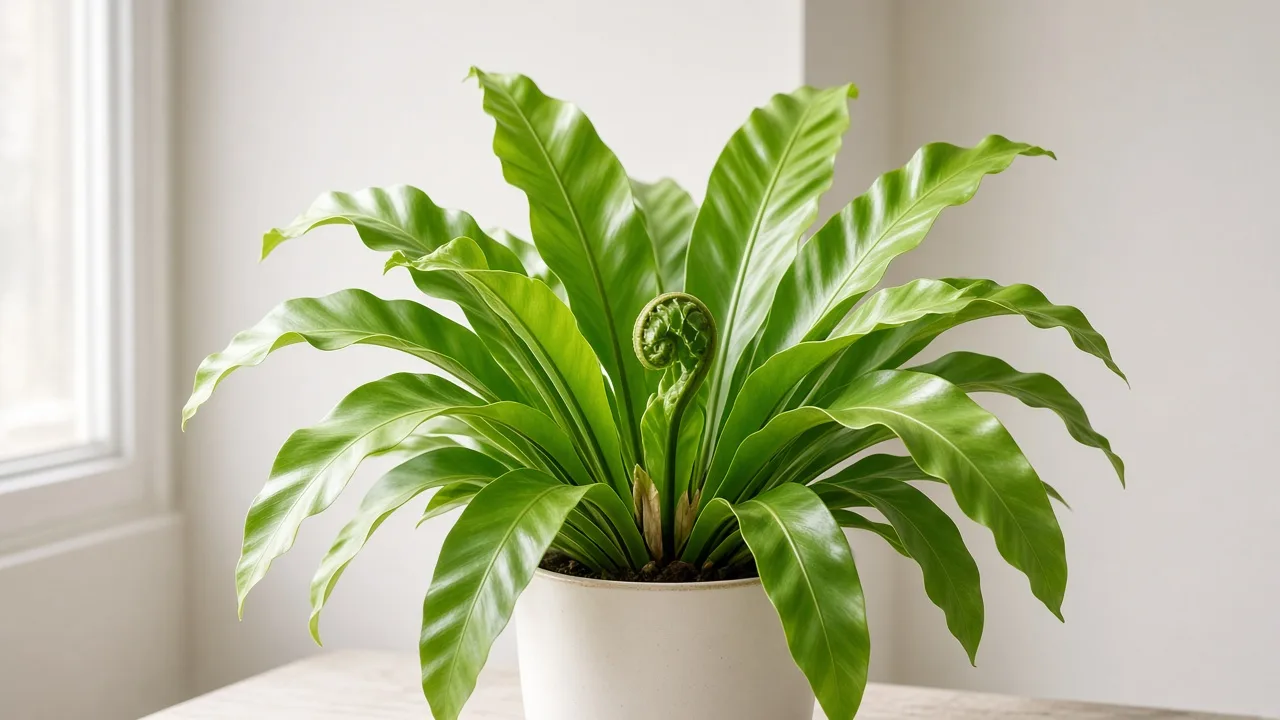
Distorted Leaves on Bird's Nest Fern: Causes, Checks & Fixes
This guide covers distorted leaves on Bird's Nest Fern. See also the general Distorted Leaves guide, watering, and light pages for this plant.
Distorted Leaves on Bird's Nest Fern: Causes, Checks & Fixes
Quick answer
Distorted leaves on Bird’s Nest Fern (Asplenium nidus) mean strap-shaped fronds that open puckered, twisted, rippled in the wrong places, or stuck partway unfurled instead of lying flat with smooth wavy margins. On this rosette fern, the damage almost always starts on the newest coiled fiddlehead in the central nest—the tight spiral where fronds emerge—because that tissue is soft while it uncurls. For how misshapen foliage develops in general, see our distorted leaves guide. On bird’s nest fern, thrips scarring on the nest fiddlehead, dry air during unfurl, direct sun warp, and touching fragile emerging fronds are the usual indoor causes—not “random fern stress.”
First step: gently part the outer fronds and magnify the innermost coiled fiddlehead for silver streaks, black frass specks, thrips, or scale before you repot, fertilize, or overhaul watering.
When to use this page vs other Bird’s Nest Fern guides
| What you see | Read next |
|---|---|
| Silvery scars + black specks on new fronds | Thrips |
| Crispy edges, moist soil, dry winter air | Low humidity |
| Fronds cup or roll without puckered nest tissue | Curling leaves |
| Yellow fronds after a sunny window move | Not enough light (too much sun) or overview placement |
| White cotton or tan disks in the nest | Mealybugs or scale insects |
| Nest center brown and mushy on wet mix | Root rot / crown failure—overlap with overwatering |
Use this page when fronds look misshapen while unfurling or just after opening from the nest. Use sibling guides when the symptom is crisp margins only, whole-plant wilt, or confirmed pest species needing a full treatment ladder.
What distorted leaves look like on Bird’s Nest Fern
Healthy bird’s nest fern fronds are simple, strap-shaped, glossy green blades with a dark midrib and naturally wavy margins—especially on cultivars bred for ruffle. Distortion is a step beyond that baseline: the frond opens unevenly, stays crumpled, or locks into a twist that does not relax as the blade hardens.
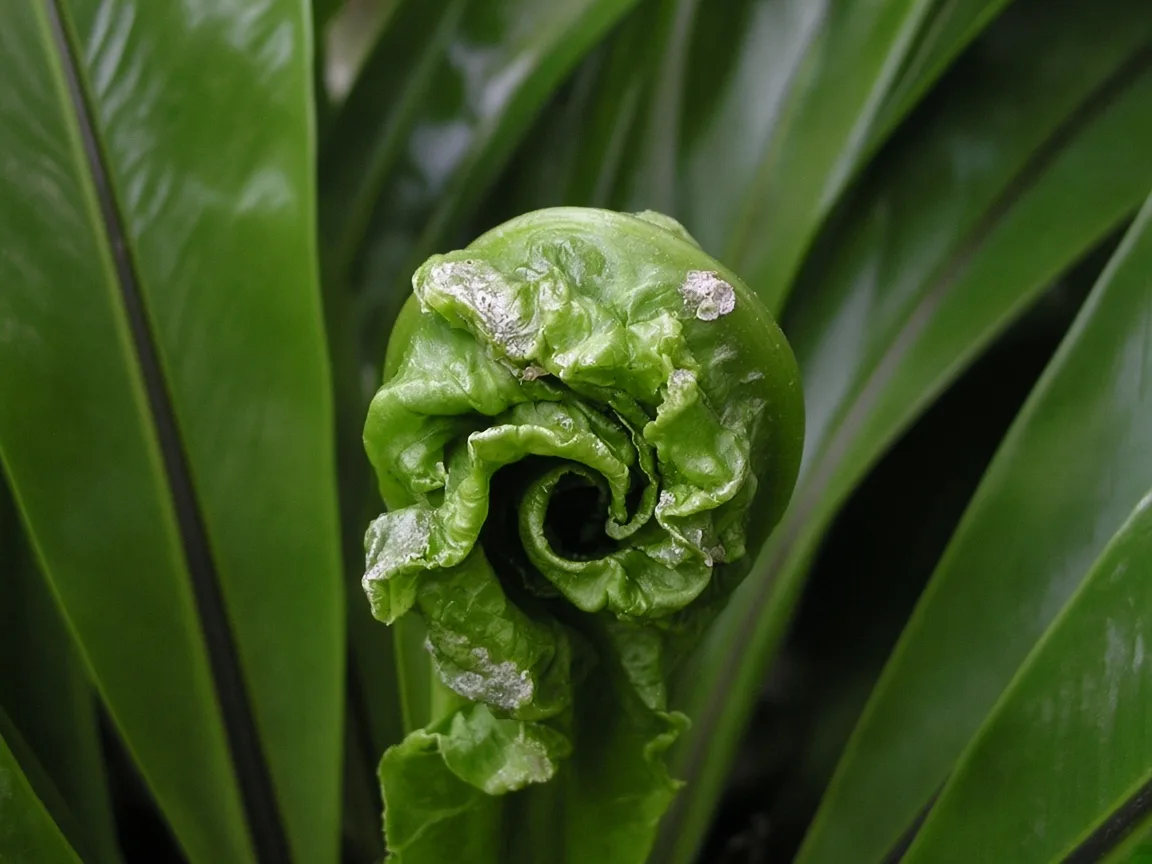
Distorted growth on bird’s nest fern—inspect the coiled fiddlehead in the nest center before assuming normal cultivar waviness.
Thrips scarring on the nest fiddlehead (common indoors):
- Newest frond shows silvery or bronze streaks, crinkles, or a stuck spiral as it uncurls
- Thrips feeding distorts growing tips and leaves tiny black varnish-like frass specks on the frond surface
- Damage is worst on the soft coiled center; older fully opened fronds may look fine until the next flush
Dry-air stuck unfurl:
- Fiddlehead stalls mid-coil with crinkled, papery edges while the top inch of soil still feels lightly moist
- Often follows winter heating, AC drafts, or a new spot above a heat vent
- Overlaps low humidity—but distortion here is shape failure during uncurl, not only brown tips
Too much sun or heat warp:
- Fronds turn pale or yellow and growth slows or stops after a sunny window move
- UF/IFAS notes that in sunnier sites fronds turn yellow and the plant stops growing—blades may open narrow, cupped, or scorched along the side facing glass
- Distinct from pest scarring: no silver streaks or frass, uniform light-side damage
Mechanical damage to fragile emerging fronds:
- NC State Extension warns that foliage is fragile—handle gently; bruised or bent fiddleheads harden crooked
- Common after repotting, pet brushing, or wiping the nest center while fronds are still coiled
Cultivar waviness vs true distortion:
- Cultivars such as ‘Crispy Wave’ and ‘Victoria’ are sold for rippled margins on every frond—that is genetics, not a problem
- Worry when only the newest nest frond is misshapen while older blades match the cultivar’s normal wave
What distortion is not: parallel brown lines of sporangia on the frond underside (normal reproduction); a single aging lower frond yellowing at the base (yellow leaves); open chew holes (holes in leaves).
Reading the nest fiddlehead (plant-specific check)
Bird’s nest fern has no branching stems—all fronds arise from one funnel-shaped rosette. UF/IFAS describes fronds that uncurl from a tight rosette center, giving the nest effect. That makes the innermost coil your best diagnostic sample.
Before any treatment:
- Lift outer fronds gently with both hands—never tug a half-open fiddlehead.
- Look inside the coil for insects, cottony mealybug clusters, or tan scale disks.
- Backlight the coil with your phone torch—thrips scars show as silvery scratch lines on green tissue.
- Compare left and right sides of the same emerging frond—one-sided warp suggests sun, draft, or physical bend; even crinkle around the coil suggests pests or dry unfurl.
If the nest center smells sour or feels mushy while mix stays wet, stop inspecting and cross-check watering—crown saturation causes collapse, not just puckering.
Why Bird’s Nest Fern gets distorted fronds indoors
Soft tissue at the uncurl point
Fern fronds expand from a tightly coiled crosier (fiddlehead). Cells at the unfolding edge are thin-walled and stay vulnerable for days. Thrips and scale concentrate on that soft tissue; scars set permanently as the frond hardens. That is why distortion clusters on new nest growth while older skirt fronds look normal.
Epiphyte humidity expectations
In rainforests, bird’s nest fern grows as an epiphyte and litter trapper with humid air around the crown. The species does not tolerate dry conditions and has poor drought tolerance. When indoor RH drops during unfurl, the coil dries and creases before it can expand—classic winter distortion with otherwise acceptable soil moisture.
Light mistakes on broad fronds
NC State notes too much sun may turn fronds yellow or stop growth. Bird’s nest fern belongs in bright indirect or light shade—not south glass. Heat plus light can warp the expanding blade on the exposed side while the shaded side stays narrower, producing a permanent twist.
Pests and nematodes extension lists
UF/IFAS Gardening Solutions lists foliar nematodes, scale, slugs, and snails on bird’s nest fern and warns that insecticides are typically damaging to ferns. FP054 also notes foliar nematodes among pest issues. Distorted, water-soaked streaking on fronds without insects may need professional lab diagnosis—do not keep spraying broad chemicals on puckered nest tissue.
How to confirm the cause
Work in this order so you do not treat the wrong variable:
- Nest magnifier pass — Silver streaks + black specks → pests (thrips, scale). Shake a distorted frond over white paper; thrips appear as slender moving specks per UC IPM thrips guidance.
- Hygrometer at frond height — RH below 50% with stuck coils on moist mix → humidity unfurl stress; see low humidity.
- Light history — Recent move to brighter window + yellowing or stalled growth → sun/heat warp; review light guide.
- Handling timeline — Repot, pet, or cleaning incident right before a crooked fiddlehead → mechanical scar.
- Cultivar baseline — Even ripples on all mature fronds → likely normal for wavy cultivars; only new abnormal coils need action.
- Soil and crown — Wet heavy pot + mushy nest → crown/root issue on problems hub, not this page alone.
First fix for Bird’s Nest Fern
Gently inspect the innermost nest fiddlehead with magnification for thrips, scale, or mealybugs; if you see silver scarring or insects, isolate the pot and rinse frond surfaces with lukewarm water—avoid pouring water into the nest center.
That single step answers the most common urgent cause—pest scarring on emerging tissue—without stacking repot, fertilizer, and oil sprays on day one. If rinse reveals active thrips, follow the species treatment ladder on thrips. If you find scale or mealybugs in the crown, route to scale insects or mealybugs before repeated rinses.
If the nest is pest-free and air is dry, run a humidifier or pebble tray (pot above water line) per Clemson bird’s nest fern guidance—do not mist directly into the rosette. If the plant recently moved into stronger sun, shift it back to bright indirect light and judge the next fiddlehead only.
Step-by-step recovery
- Day 1 — Confirm pest, humidity, light, or mechanical cause; apply one matching fix.
- Days 2–7 — For pests, repeat rinse or targeted treatment per sibling guide; keep isolated from fern collection.
- Weeks 2–4 — Watch the next coil unfurl. A flat, glossy new frond means the cause is controlled.
- Pruning — Trim only fronds that are mostly destroyed or still harbor insects. Partially green distorted blades still photosynthesize.
- Repotting — Delay repot until nest growth stabilizes unless mix is sour or roots are mushy (root rot).
Avoid harsh chemical insecticides on fern foliage when softer methods work—extension sources note ferns are easily damaged by sprays.
Lookalike symptoms
| Pattern | Likely cause | Next step |
|---|---|---|
| Silvery crinkle on nest coil only | Thrips | Thrips |
| Stuck coil, moist soil, dry room | Low humidity unfurl | Low humidity |
| Yellow + narrow fronds after sun move | Too much light/heat | Move to indirect light; light |
| Even ripples on all fronds | Cultivar (‘Crispy Wave’, etc.) | No fix needed—compare new vs old |
| Brown parallel lines underside | Spores (normal) | Not distortion—see overview |
| Mushy nest on wet mix | Crown rot | Overwatering / root rot |
Mistakes to avoid
- Pouring water or mist into the nest while fiddling with distorted coils—invites crown rot; water at the pot edge per watering guide
- Assuming every ripple is disease on wavy cultivars sold for ruffled margins
- Forcing a stuck fiddlehead open by hand—tears tissue that then hardens distorted
- Fertilizing a puckered plant before pest and humidity checks—salt stress worsens fragile new fronds
- Broad fungicide or oil sprays on unconfirmed pests when UF/IFAS warns insecticides damage ferns
Recovery timeline
Bird’s nest fern is a slow grower. After you fix pests, humidity, or light, expect one to two new fiddleheads to judge success over four to eight weeks. Scarred tissue on the current frond will not flatten—recovery is clean new uncurl from the nest, not repairing old ripples.
Improving signs: next coil opens fully glossy; silver streaks stop appearing; nest center stays firm and green.
Worsening signs: multiple failed coils in a row, spreading crown brown on wet mix, or frass increasing on every new frond—escalate pest or crown-rot pathways immediately.
How to prevent distorted fronds next time
- Inspect the nest weekly with a magnifier during active growth seasons
- Hold humidity near 50–70% when heating runs—humidifier beats crown misting
- Water along the outer pot edge; keep the nest dry per Clemson HGIC
- Bright indirect light only—too much sun yellows and stalls growth
- Handle fronds gently during repot and cleaning—fragile foliage bruises easily
- Quarantine new ferns before placing them beside your nest specimen
Related Bird’s Nest Fern guides
- Overview — species tolerances, pet-safe placement, and cluster map
- Problems hub — full symptom index when diagnosis is unclear
- Thrips — silver nest scarring and repeat treatments
- Low humidity — stuck unfurl with moist soil
- Watering — edge watering and crown-rot prevention
- Light — bright indirect placement after sun warp