Brown Leaves on Boston Fern: Causes, Checks & Fixes
Quick answer
Brown leaves on Boston Fern usually mean whole arching fronds or large sections of pinnae are dying—not just a crispy tip. First step: lift the basket and press the top 2 cm of mix; if it is dusty-dry with stiff tan-brown lower fronds, soak and drain at the sink. If the pot stays heavy and wet, stop watering and route to overwatering checks.
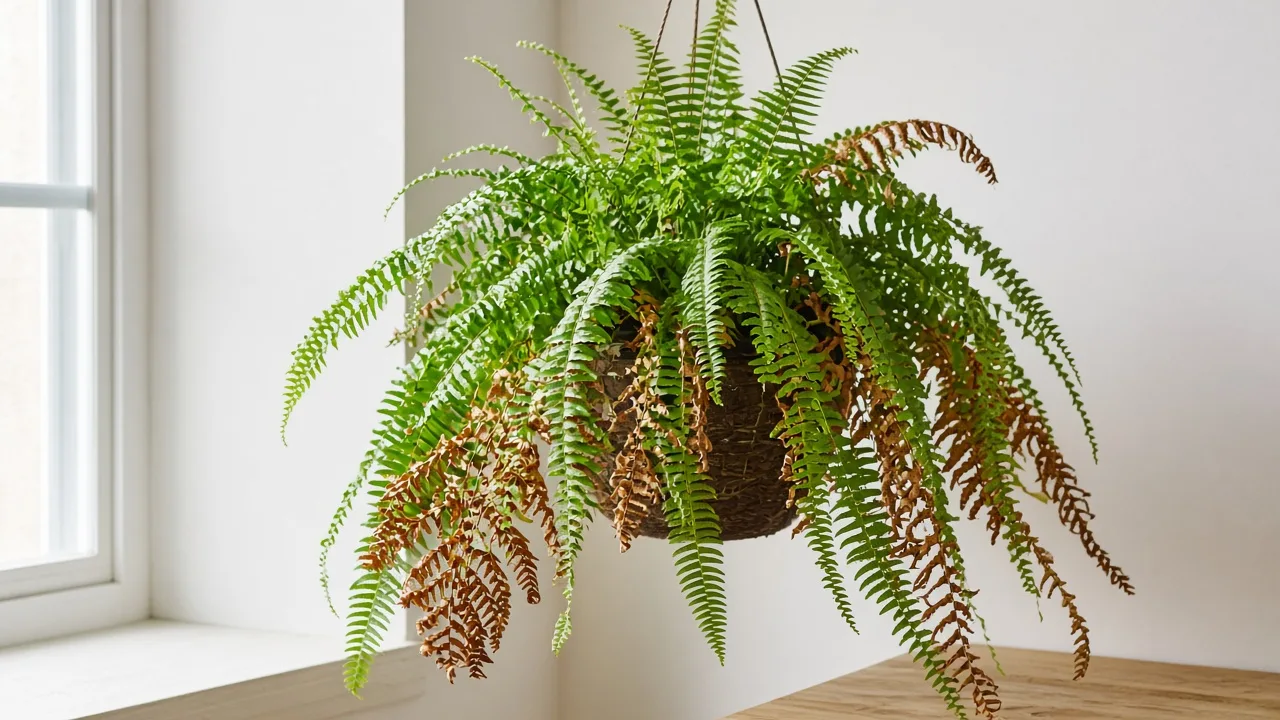
Brown Leaves on Boston Fern: Causes, Checks & Fixes
This guide covers brown leaves on Boston Fern. See also the general Brown Leaves guide, watering, and light pages for this plant.
Brown Leaves on Boston Fern: Causes, Checks & Fixes
Quick answer
Brown leaves on Boston Fern (Nephrolepis exaltata) mean more than a crisp edge—whole arching fronds or wide sections of pinnae (the small leaflets along each frond) are dying while the plant still hangs in your room. That pattern differs from brown tips, where margins brown but most of each frond stays green.
For how brown foliage develops on houseplants in general, see our brown leaves guide. On Boston fern, the first split is dry basket versus wet roots: stiff tan-brown on the lowest hanging fronds with dusty top soil fits thirst; limp yellow-brown lowers on a heavy, wet pot fits root stress.
First step: lift the basket and press the top 2 cm of mix with your finger. If it pulls away dry and the lowest fronds are stiff brown, move to the sink for a room-temperature soak until water runs free, then drain completely—before misting, fertilizing, or repotting. If the mix is wet, clings to your skin, and the pot smells sour, stop watering and work through overwatering checks instead.
When to use this page vs other Boston Fern guides
- Brown tips — crispy pinnae edges on mostly green fronds; humidity and water quality first
- Yellow leaves — whole-frond yellowing, often with too much sun or wet roots in dim light
- Low humidity — dry winter air when soil is moist but foliage still desiccates
- Underwatering — light pot, dry mix, fronds dulling from the outer arch inward
- Overwatering and root rot — heavy wet pot, limp fronds, sour smell
- Boston Fern problems hub — full symptom list for this species
What brown leaves look like on Boston Fern
Boston fern carries broad, pinnate fronds with rows of pinnae that arch outward from a central crown—classic in hanging baskets. Brown leaves show up as many pinnae drying along one frond, whole older fronds turning dull tan then papery, or patches on the frond face after sun or salt stress—not as a single sharp tip on an otherwise green leaflet.

Brown leaves on Boston fern—tan-brown dried pinnae along an arching frond with greener tissue nearby for comparison.
Common patterns:
- Lowest arching fronds stiff and uniformly brown, crown still firm, top mix dusty — underwatering or extreme dry air after a missed watering cycle
- Several fronds yellow-brown and limp, pot heavy days after watering — wet-root stress overlapping overwatering
- Tan patches on frond faces after a move toward south or west glass — direct sun on thin pinnae
- One or two old outer fronds browning evenly while bright green croziers emerge — often normal frond replacement; groom when fully dry
- Round dark brown dots in neat rows on pinnae undersides only — healthy spore sori, not insects or fungus to spray
- Fine webbing with stippled pinnae — dry-air spider mites; NC State notes mites when air is too dry
What it is not: Narrow edge burn on green pinnae belongs on brown tips. Solid yellowing of newer fronds in a dark corner often fits not enough light plus watering mistakes—not this page alone.
Why Boston Fern develops brown fronds
In nature, sword fern grows in humid, shaded places with moist soil that should not dry out completely. Indoors, the same plant hangs in the driest air in the house—heat vents, winter HVAC, and AC drafts hit the outer arch of fronds first while the crown sits in a peat mix that can swing from dusty to soggy. Brown leaves usually mean roots could not supply water, roots failed in stagnant mix, or pinnae lost tissue to sun, salt, fertilizer burn, or age.
Hanging baskets dry from the bottom arch upward
Gravity and airflow pull moisture from the lowest, oldest fronds on a hanger. When the top 2 cm dries and the pot feels light, those outer fronds desiccate before the crown wilts—especially in winter when Missouri Botanical Garden notes frond tips may brown in low humidity. That looks like “brown leaves” rather than isolated tips when whole pinnae rows crisp along the arch.
Wet mix in dim light browns from the base
Boston fern needs even moisture, but NC State warns that winter overwatering can lead to root rot when growth slows. Saturated mix drives oxygen loss at roots; lower fronds yellow-brown and stay limp even though you were “keeping it wet for the fern.” Pair with root rot if smell or crown softness appears.
Sun and fertilizer scorch pinnae faces
Wisconsin Extension recommends medium bright light without direct sun. Sudden direct rays bleach and tan patches on exposed frond faces. Over-fertilizing can brown and dry fronds from the ends inward—easy to mistake for drought if you fed a stressed plant.
Spore sori vs sick brown on pinnae
Mature Boston fern pinnae carry dark brown to black round sori in a pattern on the underside—reproductive tissue, not scale insects.
| What you see | Location | Action |
|---|---|---|
| Round dots in rows along veins | Underside only | None—healthy sori |
| Irregular tan-brown patches | Upper pinnae surface | Check sun, water, salts |
| Uniform papery brown on whole frond | Outer arch, firm crown | Often age or dry-down—remove when dead |
| Brown with webbing or stippling | Undersides, dry room | Inspect for spider mites |
Treating sori with fungicide damages fronds that were still photosynthesizing.
Crown and stolons: where new fronds come from
Unlike a rosette fern, Boston fern renews from a central crown and may send thin runners (stolons) that root when they touch mix. If the crown still pushes green croziers but only the lowest arch is brown, the growing point is alive—your job is to match water and humidity to that crown, not to shear every frond at once.
Crown-involved failure smells sour, feels soft at the soil line, or follows weeks of heavy wet soil in a dark room—route to root rot. Runner tips browning while the mother crown is firm often means the baby plant dried out in a small pot or open air; water the rooted runner separately rather than flooding the parent basket.
Lookalike symptoms
| Pattern | Soil / crown | Likely cause | First direction |
|---|---|---|---|
| Single lowest frond papery brown | Firm crown, normal moisture | Old frond senescence | Cut at soil line when fully dry |
| Many pinnae along one arch crisp | Dry top 2 cm, light pot | Underwatering | Soak and drain; see watering |
| Several fronds yellow-brown, limp | Wet, heavy pot | Overwatering | Dry-down; overwatering |
| Face patches after sunny window | Firm crown | Sun scorch | Filter light; light guide |
| Brown from frond tips inward after feeding | Moist soil | Fertilizer burn | Flush, pause feed |
| Underside dotted rows | Firm fronds | Sori | No treatment |
How to confirm the cause
- Top 2 cm moisture — dusty and separated from pot wall supports thirst; clinging wet days after watering supports rot risk.
- Pot weight — lift against a post-watering baseline; light with brown arches means soak; heavy with limp browns means stop water.
- Crown check — firm and green croziers present? Continue. Soft, sour crown? Root pathway.
- Light history — new sun exposure in the last two weeks? Face patches point to scorch, not thirst.
- Underside inspection — neat dot rows (sori) vs webbing (spider mites in dry air per NC State).
- Frond age — only the oldest skirt brown while inner fronds are glossy? Senescence is likely.
The first fix to try
After the top-2-cm test, apply one correction:
- Dry top layer + stiff brown lowest fronds — sink soak with room-temperature water until it runs free; drain cachepots and saucers. Re-check moisture in 48 hours per the watering guide.
- Wet heavy pot + limp yellow-brown fronds — withhold water until the top inch dries; confirm holes are open. Do not mist to compensate.
- Sun patches on frond faces — move 3+ feet from direct glass; do not increase watering on scorched tissue.
- Single fully papery outer frond, firm crown — wait until dry, then cut at the soil line. Wisconsin Extension notes cutting old fronds encourages new growth.
If the crown is soft or soil smells sour, the first fix is stop watering and inspect roots—not fertilizer and not same-day repotting unless mush is obvious.
Step-by-step recovery
- Stabilize placement — bright indirect light per the light guide; keep fronds away from radiator blasts.
- Even moisture rhythm — consistently moist mix, not a swamp; reduce volume in winter when growth slows.
- Humidity at frond height — humidifier or pebble tray with pot base above water; targets in low humidity care.
- Remove dead fronds at the soil line when fully brown—keeps pests from hiding in the skirt.
- Pause fertilizer until new croziers look healthy for two weeks; salts worsen browning on sensitive pinnae.
MOBOT notes that if soils dry out, the plant may shed fronds and can be cut back to about 2 inches to regenerate—reserve that hard reset for confirmed drought crash, not mild tip burn.
Recovery timeline
Brown pinnae do not re-green. Expect two to four weeks after correcting water or light to see clean new croziers; full basket fullness may take a season. Signs you are winning: browning stops at older fronds, new pinnae unfurl without embedded brown, crown stays firm. Signs you are losing: new croziers abort, crown softens on wet soil, browning climbs inward on multiple fronds within days.
Mistakes to avoid
- Misting without fixing soil moisture — wet leaves in dry air do not rehydrate roots.
- Keeping a wet pot “because ferns like moisture” in a dark winter room — invites rot.
- Shearing all green fronds because some pinnae browned — removes photosynthetic tissue the crown needs.
- Feeding a brown plant hoping for recovery — fertilizer burn starts at frond ends on Boston fern.
- Spraying underside sori — damages healthy tissue.
How to prevent brown fronds next time
Anchor prevention to arching growth: consistently moist, well-drained mix, 50–70% humidity at frond level, and no direct sun on hanging foliage.
- Check the top 2 cm before every watering — details in watering and soil
- Empty cachepots after every soak
- Groom spent lowers before they harbor scale (Wisconsin Extension advises removing affected fronds for scale)
- Match winter watering reduction to slower growth — see overview when you change rooms or pot size
When to worry
Escalate if most fronds brown within a week on a wet, sour pot, or if new croziers stop while soil stays saturated—use root rot. A single dry brown lowest frond on a plant with green croziers is usually routine.