Black Spots on Calathea: Causes, Checks & Fixes
Quick answer
Black spots on Calathea are usually fungal or bacterial leaf spot on wet patterned leaves, stress blotches from humidity swings, or blackening from chronically wet rhizomes—not normal prayer-plant aging. First step: stop misting and overhead watering, then note whether spots are dry and stable or water-soaked with yellow halos and spreading.
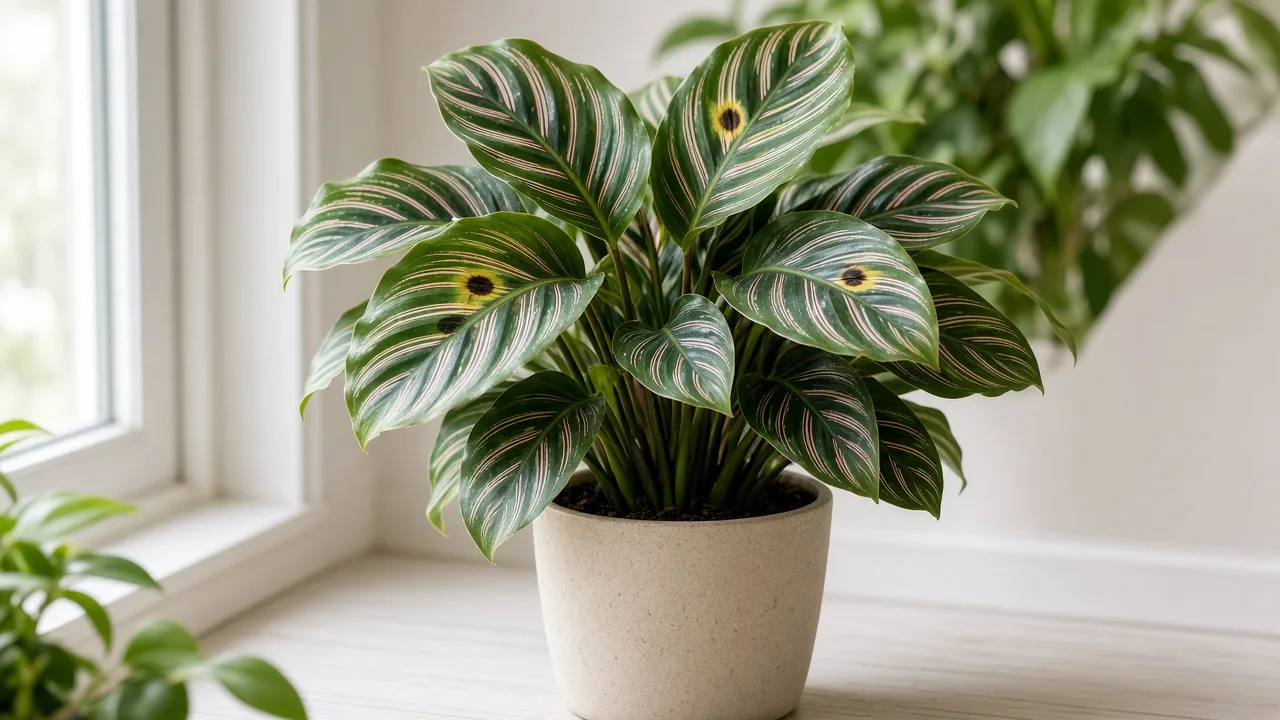
Black Spots on Calathea: Causes, Checks & Fixes
This guide covers black spots on Calathea. See also the general Black Spots guide, watering, and light pages for this plant.
Black Spots on Calathea: Causes, Checks & Fixes
Quick answer
Black spots on Calathea (Goeppertia spp., still sold as prayer plants) are localized tissue death—small patches where thin Marantaceae leaf tissue has died and turned dark brown to black. On this humidity-sensitive genus, the pattern usually splits three ways: wet spots with yellow halos on patterned blades point to fungal or bacterial leaf spot after foliage stays damp, irregular brown-to-black blotches on older leaves often track humidity swings or inconsistent watering, and blackening that creeps in from margins on lower leaves while mix stays heavy routes to overwatering before fungicide. For general spot-disease mechanics, see our black spots guide. On Calathea, thin striped leaves hold mist and tap-water residue on the surface longer than thick succulent foliage, and nightly prayer-plant leaf folding traps moisture against the blade.
A few isolated dry black marks from physical damage are cosmetic. Spreading wet-looking spots on multiple patterned leaves need action the same week—not extra fertilizer.
First step: stop wetting foliage and improve airflow around the canopy. Water at soil level only with filtered or rainwater, empty saucers, and give the plant room to breathe. Then decide whether you are dealing with leaf-surface pathogens, chronic wet mix, or a pest lookalike like spider mites.
When to use this page vs other Calathea guides
| Your question | Best page |
|---|---|
| Dark spots on leaf blades | This page |
| Brown or black tips only, no mid-leaf circles | Brown tips |
| Whole leaves yellowing on wet soil | Overwatering |
| Mushy rhizomes, sour smell, wilt on wet mix | Root rot |
| Leaves rolling up at night but crisp by day | Curling leaves |
| Fine stipple with webbing on undersides | Spider mites |
| White crust on soil surface | Mold on soil |
What black spots look like on Calathea
Healthy Calathea leaves are thin, patterned, and firm enough to fold vertically at night (nyctinastic movement). Black spotting breaks that pattern in recognizable ways:
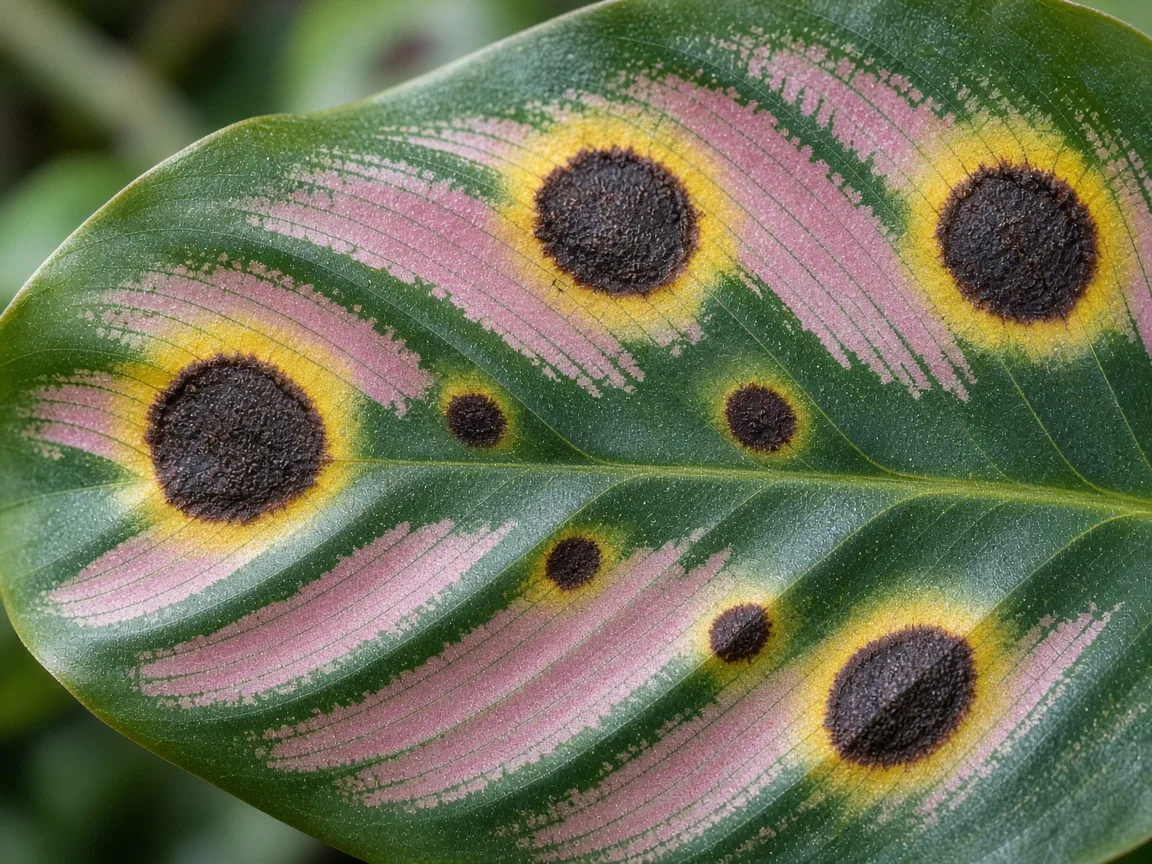
Black spot lesions on Calathea—compare wet halos and lesion edges with healthy pink-and-green striped tissue on the same blade.
- Small dark brown to black circles with yellow halos — Often start water-soaked, then crisp at center. Classic fungal leaf spot with yellow margins on wet foliage.
- Irregular brown-to-black blotches without sharp halos — Common on older lower leaves after a humidity crash or watering swing; stable once conditions settle.
- Blackening from the leaf margin inward — Often on older lower leaves while mix at 2 cm depth stays damp for days; route to overwatering before fungicide.
- Single dry black mark, no halo, no spread — Scar from unfurling under low humidity, pet damage, or a healed mechanical wound. Stable for months.
- Stippled darkening with fine webbing — Spider mites in dry winter rooms—not classic leaf spot.
- Black smear that wipes off — Sooty mold on sticky honeydew from scale or mealybugs, not fixed lesions inside the leaf.
Spots on new leaves still rolled in the central crown are more urgent than one old mark on the lowest prayer leaf.
Why patterned Calathea leaves show spots on stripes first
Calathea cultivars like ornata, medallion, and rattlesnake carry thin tissue with contrasting pigment bands. That morphology changes where spots appear:
Pink and cream sectors dry last. Variegated stripes lack the same cuticle density as dark green zones. After misting or shower-rinsing, water sits longer on pale bands—so wet halos often start on pink stripes even when the rest of the blade looks fine.
Surface residue from tap water. The RHS notes Calathea is sensitive to hard tap water and recommends rainwater when possible. Mineral and fluoride residue on leaf surfaces can look like dark speckling before true necrosis sets in—especially on leaves you mist regularly.
Lower prayer leaves sit in the splash zone. As stems arch outward, outer blades rest near the pot rim. Water running off dense peat, mold on soil debris, or overflow from a cachepot splashes onto patterned foliage and carries spores from the surface.
Nyctinastic folding and overnight wet leaves
Calathea is a prayer plant—leaves rise at night and fold vertically. That habit is diagnostic, not decorative:
Misting before the plant folds traps moisture. When you mist in the evening, folded blades press wet surfaces together for hours in still air—the exact culture fungal leaf spot favors. Spots that appear along the fold line or on leaves that were misted at dusk point to culture, not mystery disease.
Daytime curl vs disease. Healthy Calathea rolls leaves up at night and opens them by mid-morning. If blades stay curled through the day and develop wet halos, check underwatering and low humidity alongside leaf-spot pathogens—curl alone is normal; curl plus spreading black lesions is not.
Unfurling scars mimic spots. New leaves emerge rolled tightly from the crown. If humidity drops during unfurling, tissue can scar as it hardens—leaving a permanent dry black mark that never spreads. Compare against the next two unfurling leaves: scars stay stable; active disease adds new lesions weekly.
Why Calathea gets black spots
Fungal leaf spot
Fungal spores germinate on persistently wet leaves and create brown to black lesions, sometimes with yellowish margins. Splash from infected soil, shared watering cans, or wet cachepot overflow spreads spores between pots on a shelf.
Bacterial spotting
Bacterial infections produce water-soaked spots that may show yellow halos and can spread quickly in warm, humid, stagnant air. Contaminated pruning tools or wet leaves at night move bacteria across clustered rhizome shoots. If tissue turns mushy with a sour odor, escalate to root rot inspection—stem mush is beyond ordinary dry leaf spot.
Overwatering and margin blackening
Calathea likes evenly moist mix but rots quickly in soggy soil. Lower leaves blacken at edges while soil stays heavy and the plant looks limp despite damp mix—route to overwatering before fungicide. Epic Gardening notes excess moisture stops oxygen reaching roots and leads to fungal issues that stress foliage above the soil line.
Environmental stress blotches
Humidity crashes after a heating season start or AC blast can produce brown irregular patches on mature leaves—not always infection. The RHS describes browning of Calathea tips and edges from low humidity; mid-leaf blotches often ride the same dry-air pattern if humidity drops below 50% at canopy height.
Cold water splashes can leave pale or straw-colored rings per RHS leaf-damage guidance—distinct from fungal halos but easy to confuse on patterned blades.
Pest and honeydew stains
Epic Gardening lists sap-sucking pests—mealybug, scale, and spider mites—as common Calathea problems. Feeding damage creates yellow then brown patches; honeydew grows sooty mold that wipes off. Check leaf axils where new blades emerge from sheaths and along rhizome crowns at the soil line.
How to confirm the cause
Work through these checks before repotting or spraying:
- Spot texture — Wet, greasy, or water-soaked margins suggest active disease. Dry, papery black patches suggest scar, sun, cold splash, or old mechanical damage.
- Halo pattern — Yellow ring around a dark center points to fungal leaf spot. No halo on a stable mark suggests stress or scar.
- Spread speed — New lesions on multiple leaves within one to two weeks = treat now. One mark unchanged for a month = monitor.
- Soil moisture — Stick a finger 2 cm deep. Heavy wet mix plus margin blackening = overwatering first.
- Leaf undersides — Webbing, stipple, or white fluff = pests, not leaf spot alone.
- New growth — Spots on rolled crown leaves while older leaves stay clean = urgent. Spots only on lowest old leaves = often aging or past stress.
- Recent misting — If you misted in the last 48 hours, pause and reassess in one week before fungicide.
The first fix to try
Stop wetting foliage and improve airflow for one week before any fungicide or repot.
- Move the plant away from other prayer plants if spots are spreading.
- Water at soil level only with filtered or rainwater when the top 2 cm of mix are beginning to dry.
- Empty saucers and cachepots within 30 minutes of watering.
- Cancel misting; run a humidifier at canopy level to hold 50–60% RH instead—the RHS recommends high humidity for Calathea without wetting leaves.
- Wipe dry any water sitting in leaf cups at the crown.
Watch new unfurling leaves for two weeks. If wet halos keep appearing, move to secondary steps below—not before you have a clean read on whether culture alone stopped spread.
Step-by-step recovery
If fungal or bacterial leaf spot is likely
After the first-fix week:
- Remove the worst-spotted blades with clean, sharp shears. Cut at the base of the petiole; do not tear tissue.
- Sanitize tools between cuts with rubbing alcohol.
- Improve spacing so leaves do not overlap neighbors on a shelf.
- For persistent spread on high-value plants, a labeled houseplant fungicide applied per product directions may help—test on one leaf first. Calathea’s thin tissue burns easily; never double the dose.
If overwatering fits the pattern
- Let the top 2 cm dry before the next drink.
- Confirm drainage holes are open and no standing water sits in outer pots.
- If stems soften or mix smells sour, inspect rhizomes—see root rot before trimming healthy leaves.
If pests are present
- Isolate and rinse leaf undersides in the shower (avoid leaving blades wet overnight—rinse morning, let dry by afternoon).
- Treat with insecticidal soap or horticultural oil per label; repeat at recommended intervals until pests are gone.
- Fungus gnats on chronically wet mix in low light often accompany overwatering—dry the surface and address soil moisture alongside pest control.
Recovery timeline
| Severity | What to expect |
|---|---|
| Mild (few spots, firm rhizomes) | New lesions stop within 2–3 weeks after foliage stays dry |
| Moderate (multiple leaves, no stem mush) | 4–6 weeks for clean unfurling leaves; old spots remain visible |
| Severe (mushy rhizomes, crown collapse) | May require division salvage; some clumps will not recover |
Judge success by clean new growth unfurling from the crown, not by old black tissue re-greening. Necrotic patches are permanent; trim for appearance once spread stops.
Lookalike symptoms
| What you see | More likely cause | Check page |
|---|---|---|
| Wet halos on several patterned leaves | Fungal/bacterial leaf spot | This page |
| Tips and edges only, no mid-leaf circles | Tap water / low humidity | Brown tips |
| Uniform yellowing on wet soil | Overwatering stress | Overwatering |
| Fine webbing, stipple | Spider mites | Spider mites |
| Black smear that wipes off | Sooty mold on honeydew | Scale or mealybugs |
| Dry stable mark on one old leaf | Scar or mechanical damage | Monitor only |
| Whole leaves pale and washed out | Light stress | Not enough light |
Mistakes to avoid
- Misting leaves to “fix” humidity — Raises leaf wetness without solving dry air; use a humidifier instead.
- Fungicide before drying foliage — Spraying wet culture wastes product and can burn thin Calathea tissue.
- Repotting on day one — Unless rhizomes are mushy, repotting adds stress without addressing leaf-surface pathogens.
- Fertilizing spotted plants — Salt stress on already damaged tissue worsens margins. Hold feed until new growth looks healthy for two weeks.
- Stacking prune + repot + spray same day — Change one variable at a time so you can read the plant’s response.
Rhizome check when lower leaves blacken
Calathea grows from underground rhizomes, not a single woody trunk. When lower leaves blacken at margins while soil stays wet:
- Slide the plant partly out of the pot without full repotting if possible.
- Press rhizomes—they should feel firm like a fresh ginger root.
- Mushy, dark rhizomes with sour smell confirm root rot; firm white roots with only margin burn point to leaf-level issues.
- Healthy divisions can be salvaged from firm rhizome sections during spring repot—see the Calathea overview for division timing.
This rhizome inspection step is meaningless on snake plant or fiddle-leaf fig; it is essential on prayer plants before you discard an entire pot.
How to prevent black spots next time
- Water when the top 2 cm of mix begin to dry—use filtered or rainwater per RHS Calathea guidance.
- Run a humidifier to 50–60% at canopy height; Missouri Botanical Garden notes Calathea needs high humidity.
- Never mist leaves in the evening; if you must rinse pests, do it in the morning so blades dry before nightly folding.
- Space plants for airflow on shelves and windowsills.
- Quarantine new Calathea two weeks before placing near existing prayer plants.
- Keep soil structure airy with perlite so mix does not stay waterlogged in dim corners.
Related Calathea guides
Use this page when you see dark lesions on the leaf blade—especially wet halos on patterned tissue. Route whole-leaf yellowing on soggy mix to overwatering, mushy rhizomes to root rot, and edge-only crisping to brown tips. The full Calathea problems hub lists every symptom page for this plant.
Related tool
Use the Plant Problem Diagnosis Tool to narrow causes for black spots on this plant before changing multiple variables at once.