Whiteflies on Dieffenbachia (Dumb Cane): Causes, Checks &
Quick answer
Whiteflies on Dieffenbachia show as tiny white moth-like insects on the undersides of broad arching leaves—a brief white cloud rises when you mist or move the cane. First step: isolate the plant away from other houseplants, then rinse every leaf underside with lukewarm water before any spray; dumb cane is insecticidal-soap sensitive.
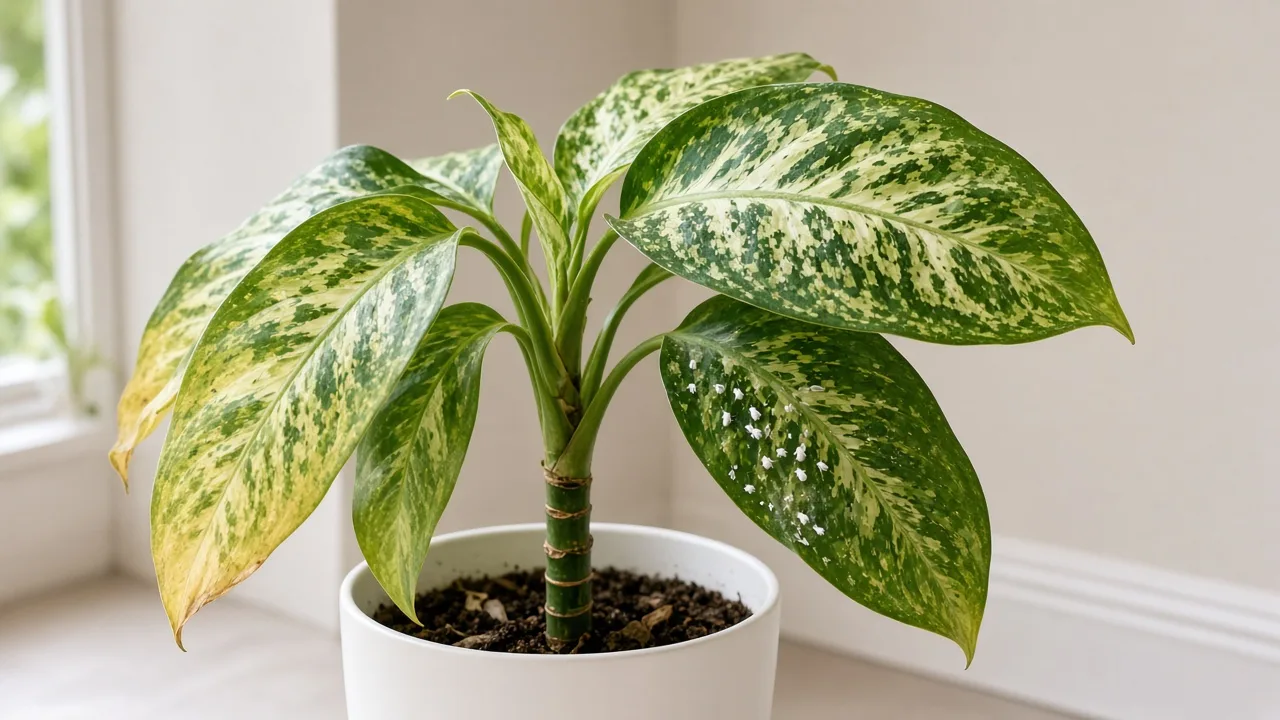
Whiteflies on Dieffenbachia (Dumb Cane): Causes, Checks & Fixes
This guide covers whiteflies on Dieffenbachia. See also the general Whiteflies guide, watering, and light pages for this plant.
Whiteflies on Dieffenbachia (Dumb Cane): Causes, Checks & Fixes
Quick answer
Whiteflies on Dieffenbachia (dumb cane) are sap-sucking insects that colonize the undersides of large arching leaves and the overlapping crown where a quick top-side glance misses them. Disturb the plant and adults rise in a white cloud before resettling—one of the clearest pest signals on an upright cane plant.
Immature nymphs look like flat disks stuck to leaf undersides and do not fly. Both stages drain sap, leave sticky honeydew, and can dull variegated blades or support black sooty mold on upper surfaces.
For how whiteflies behave on houseplants in general, see our whiteflies guide. On dumb cane, the urgent pattern is flying adults plus flat nymphs under the newest horizontal leaves at the cane tip and along the midrib of older arching blades.
First step: isolate the plant the same day you see flying white insects. Move it away from pothos, aglaonema, and other collection plants before you rinse, trap, or spray. Once isolated, wash every leaf underside with lukewarm water or a damp cloth to knock down nymphs and dislodge adults.
Wear gloves when wiping stems—dumb cane sap contains calcium oxalate crystals that irritate skin during repeated rinses.
What whiteflies look like on Dieffenbachia
Adult whiteflies are about 1/16 to 1/10 inch long, wedge-shaped, and powdery white. On dumb cane they cluster on the sheltered undersides of 8–14 inch arching leaves and in tight axils where petioles meet the cane.
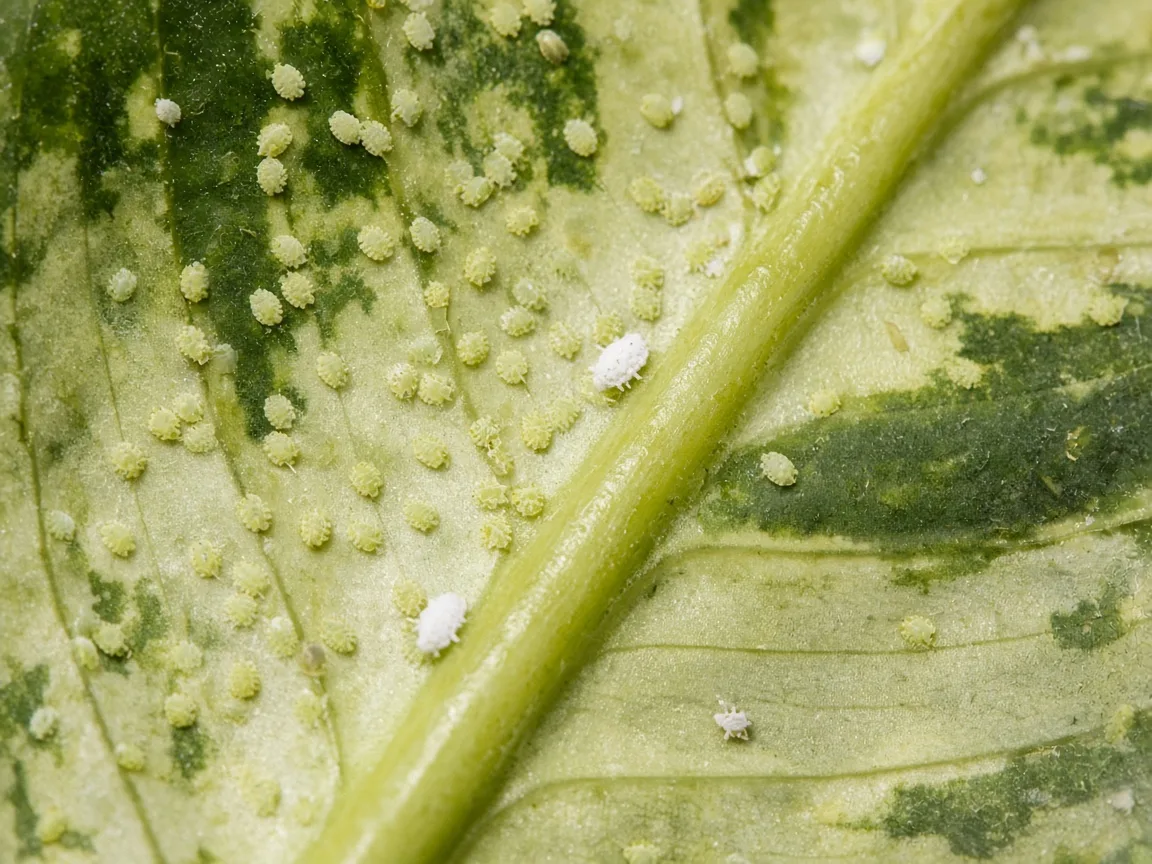
Flat pale nymphs and tiny white adults on a dumb cane leaf underside—lift each arching blade to inspect the midrib zone.
Typical signs on upright dumb cane:
- A white cloud rising when you water, mist, or rotate the pot
- Flat immobile specks on leaf backs, especially on the newest horizontal blade and along veins
- Sticky honeydew on upper leaf surfaces, the pot rim, or the floor below a tall floor plant
- Black sooty mold on honeydew-coated foliage (mold grows on the residue, not inside leaf tissue)
- Yellowing or dull variegation on heavily fed blades while the central vein may still look green
- Slow crown growth when feeding concentrates on the softest new leaves
On heavily variegated cultivars such as ‘Camille’ or ‘Tropic Snow’, pale cream sectors can hide early honeydew until stickiness spreads across the patterned zone. Dark green types like ‘Compacta’ often show dulling sooner. Because leaves arch horizontally from the cane, underside damage runs ahead of what you see from across the room—crouch and lift each blade.
Unlike mealybugs, whiteflies lack cottony wax and fly when disturbed. Unlike fungus gnats, they stay on foliage, not at the soil surface. Unlike thrips, they do not leave silvery scrape marks—though honeydew can feel similar until you trigger the flight response.
Why dumb cane gets whiteflies
NC State Extension lists whiteflies among pests to monitor on Dieffenbachia, alongside aphids, scale, spider mites, and fungus gnats. Whiteflies are not caused by one watering mistake—they arrive on contaminated stock, summer patio placements, open windows, or infested neighbors, then exploit dumb cane’s broad leaf area indoors.
Dieffenbachia-specific risk factors:
- Large horizontal leaf blades offer extensive protected feeding sites on undersides a weekly top-side water check never sees.
- Crown overlap where new leaves stack at the cane tip traps humidity and hides nymph disks between soft unfolding tissue.
- Office and living-room grouping—dumb cane is often staged beside aglaonema, pothos, and ficus; flying adults bridge pots in one afternoon.
- Nitrogen-rich soft flushes from heavy fertilizer during warm months produce tender shoots sap feeders prefer.
- Warm indoor rooms let whiteflies reproduce year-round with few natural enemies inside.
Floor-scale specimens add a practical wrinkle: when lower leaves yellow and drop naturally, exposed cane joints can still carry nymphs on the undersides of the remaining arching blades while you focus on the showy crown.
How to confirm the cause
Work through these checks before reaching for spray:
- Disturbance test — Tap a leaf or mist the crown. Whiteflies fly up briefly; mealybugs and scale stay attached.
- Underside inspection — Spread overlapping crown leaves and examine every arching blade back with bright light. Nymphs look like flat disks; adults cluster near veins.
- Honeydew check — Rub a sticky upper surface with a damp cloth. Honeydew wipes tacky across multiple leaves; guttation droplets or dust do not.
- Yellow sticky trap — Place a trap near the pot for 48 hours. Flying adults stick to yellow cards; one trap per plant is enough for monitoring.
- Lifecycle timing — Eggs hatch in about a week; nymphs feed before becoming adults. One rinse rarely clears a full generation—plan four to five applications at five- to seven-day intervals if you escalate to labeled sprays.
- Neighbor scan — Check shelf mates, especially hibiscus, poinsettia, and fuchsia whiteflies favor—but dumb cane on the same stand can harbor them too.
- Cultural cross-check — Yellow lower leaves without insects or stickiness on new growth point to overwatering or low light, not whiteflies.
Confirmed whiteflies mean pest treatment plus quarantine discipline—not a repot or fertilizer adjustment alone.
First fix for Dieffenbachia
Isolate the plant and rinse every leaf underside with lukewarm water.
Clemson HGIC recommends isolating any houseplant suspected of pests before chemical control—and whiteflies spread by flying the moment you disturb them. Move dumb cane to a bathroom or sink away from other plants. Bag the pot at the soil line if you shower the foliage so mix does not waterlog.
Work from the soil line up the cane, lifting each arching blade to hit the midrib zone and crown overlaps. Use a gentle but firm stream or a damp cloth on undersides where nymphs cling. Let leaves dry the same day in bright indirect light per our light guide.
Do not reach for insecticidal soap as your opening move—Dieffenbachia is listed among soap-sensitive houseplants, and phytotoxicity symptoms may take 48 hours to appear. Water rinses are the safer first reduction step on variegated dumb cane.
Do not return the plant to a shared shelf until sticky traps stay clean and undersides show no new flat nymphs for two full weeks.
Step-by-step recovery
After isolation and the initial rinse:
- Set yellow sticky traps near the pot to catch flying adults and track whether numbers drop between rinses.
- Repeat washing every two to three days until live nymph counts fall on inspection. Broad waxy dumb cane leaves generally tolerate repeated rinsing better than fuzzy-leaved plants—still avoid leaving foliage wet overnight in a cold room.
- Spot-test insecticidal soap on one small leaf section if adults persist after a week of rinsing. Wait 48 hours for burn before treating more. Coat undersides thoroughly; soap kills on contact and has little residual effect indoors.
- Follow label intervals—repeat every five to seven days through at least four cycles to catch eggs and newly hatched nymphs.
- Remove one or two heavily encrusted leaves when nymphs cover an entire underside and washing fails—cut at the petiole base with gloves on to limit sap exposure.
- Wash sooty mold off upper surfaces with plain water once honeydew production stops. Mold does not infect dumb cane tissue; it grows on sticky residue.
- Hold isolation until traps stay clean and crown leaves open without new disks for two weeks.
For a small dumb cane encrusted on every leaf with adults reappearing daily after four labeled treatment cycles, discarding the plant may be safer than risking a large collection—take a pest-free cutting only if a section of cane shows clean tissue (uncommon once whiteflies saturate the crown).
Recovery timeline
Rinsing and trapping show results within a few days when infestations are caught early. A full treatment course with soap or other labeled products typically takes two to four weeks because of the whitefly lifecycle. Yellowed or honeydew-coated older leaves may stay blemished; judge recovery by clean new blades opening from the cane tip, not by perfect old foliage.
Dumb cane in stable watering and bright indirect light often outpaces light whitefly damage once insects are controlled. A crown that resumes unfurling within two to three weeks signals success.
Lookalike symptoms to rule out
Mealybugs form white cottony clusters in leaf axils and along the cane. They do not fly in clouds when disturbed.
Aphids cluster on soft new growth at the cane tip as pear-shaped insects, often with cornicles. See aphids on Dieffenbachia when colonies sit on unfolding leaves without flight.
Fungus gnats are tiny dark flies at the soil surface, not powdery white insects on leaf backs.
Spider mites cause fine stippling and webbing in dry air—see spider mites when a paper tap test shows moving specks without white moths.
Powdery mildew or dust sits on leaf surfaces without stickiness, flight, or flat nymph disks on undersides.
Fluoride or low-humidity tip burn browns margins without insects—cross-check brown tips and low humidity when damage is even across margins.
Mistakes to avoid
Do not treat once and assume whiteflies are gone—nymphs and eggs survive single applications, and adults fly to neighboring pots between sessions.
Do not open with full-plant insecticidal soap on variegated dumb cane without a spot test; soap burn can look like pest damage two days later.
Do not skip leaf undersides when spraying—nymphs feed exclusively there, and dumb cane’s arching blades hide the backs from overhead misting.
Do not fertilize a pest-hit plant hoping to push replacement growth—tender new crown leaves attract whiteflies faster.
Do not spray soap or oil on dumb cane sitting in direct hot sun; treat in early morning or evening when leaves are cool.
Keep pets and children away from rinsed foliage until dry—Dieffenbachia is toxic to cats and dogs if chewed.
How to prevent whiteflies on Dieffenbachia
- Quarantine new office and nursery plants for at least two weeks before placing them beside floor-scale dumb cane.
- Inspect leaf undersides during weekly watering—lift arching blades at the crown and lowest remaining leaves on tall canes.
- Use yellow sticky traps as early monitors near susceptible collections, not only after infestations explode.
- Rinse foliage monthly in warm months to dislodge early colonizers on broad blades.
- Limit nitrogen spikes during active growth; steady feeding per our fertilizer guide produces less soft tissue.
- Isolate patio-season dumb cane from garden beds where whiteflies are common, and rinse before bringing plants inside.
- Space pots so arching dumb cane leaves do not touch pothos or aglaonema on shared shelves.
Healthy dumb cane in appropriate light and soil weathers minor pest hits faster than stressed plants in dim corners with soggy mix.
When to worry
Escalate treatment when:
- Adults fly from multiple leaves every time you water the crown
- Honeydew coats several arching blades or triggers widespread sooty mold
- New crown leaves stop opening for two or more weeks
- Sticky traps refill within days after repeated rinse cycles
- Whiteflies appear on dumb cane and nearby houseplants simultaneously
A handful of nymphs on one underside after a quarantine miss is manageable—isolate, rinse, and treat persistently. Discard only when the entire crown is encrusted, every leaf carries nymphs, and you cannot commit to four to five weekly treatment cycles—or when protecting a large collection matters more than saving one pot.
Conclusion
Whiteflies on Dieffenbachia spread quickly once flying adults establish on broad leaf undersides and the overlapping crown. Isolate immediately, rinse every underside with lukewarm water, then escalate through spot-tested soap or other labeled products while monitoring with yellow sticky traps. Dumb cane recovers well from light damage when caught early; quarantine discipline and underside checks during weekly care keep whiteflies from becoming a collection-wide problem.
When to use this page vs other Dieffenbachia guides
- Dieffenbachia watering guide — Use for routine moisture checks before assuming whiteflies is the main issue.
- Dieffenbachia problems hub — Browse all common issues on this species.
- Mealybugs on Dieffenbachia — Different entry point when white cottony wax appears without flying adults.
- Aphids on Dieffenbachia — Soft cane-tip clusters without a white cloud on disturbance.
- Yellow leaves on Dieffenbachia — Lower-leaf yellowing without stickiness or insects on new growth.