Nitrogen Deficiency on English Ivy: Causes, Checks & Fixes
Quick answer
Nitrogen deficiency on English ivy shows as uniform pale yellow-green on the oldest lobed leaves along the lowest trailing stems while newer tip growth may still look green but emerges smaller or spaced farther apart. First step: confirm even chlorosis on leaves nearest the pot rim—not interveinal banding or green veins on new shoots—then check whether roots are firm and the container has gone a full growing season without complete fertilizer.
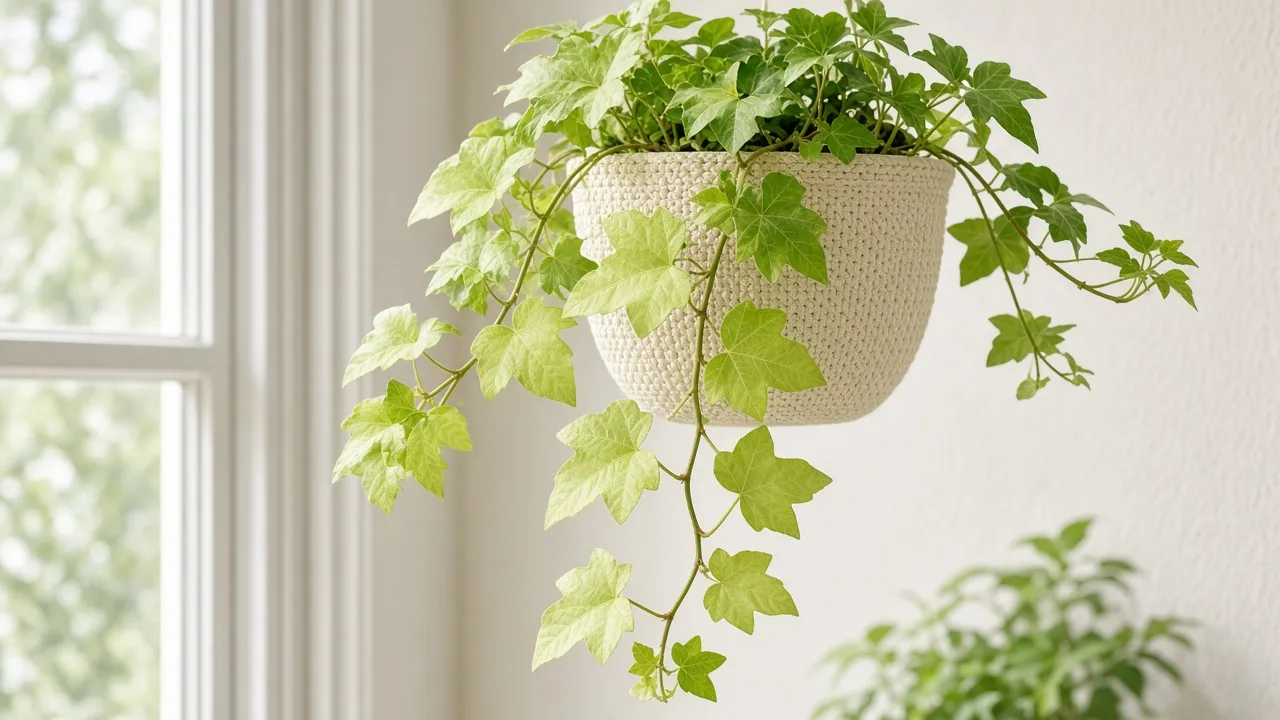
Nitrogen Deficiency on English Ivy: Causes, Checks & Fixes
This guide covers nitrogen deficiency on English Ivy. See also the general Nitrogen Deficiency guide, watering, and light pages for this plant.
Nitrogen Deficiency on English Ivy: Causes, Checks & Fixes
Quick answer
Nitrogen deficiency on Hedera helix shows as uniform pale yellow-green on the oldest lobed leaves along the lowest sections of each trailing stem while newer tip leaves may still look green but emerge smaller, thinner, or farther apart on the vine. Nitrogen is mobile in plants, so deficiency symptoms show up first on the lower leaves as a general yellowing—veins and tissue fade together, unlike magnesium deficiency (interveinal banding on old leaves) or iron deficiency (green veins on new shoots).
See our nitrogen deficiency guide for general mobile-nutrient mechanics. On English ivy, inspect the lobed leaves nearest the pot rim on each hanging strand—even washout there, with vine tips still pushing smaller new lobes, is classic nitrogen starvation before wet-root failure or dim-light pale leaves.
First step: confirm uniform pale color on the oldest lower leaves—not interveinal chlorosis or new-tip green veins—then check root firmness and seasons without complete fertilizer in leached container mix.
When to use this page vs other English ivy guides
| Pattern | Read next |
|---|---|
| Uniform pale oldest lower lobed leaves, smaller new tip leaves | Nitrogen deficiency (this page) |
| Yellow between veins on oldest lower leaves | Magnesium deficiency |
| Yellow new shoot leaves with green veins | Iron deficiency |
| Scorched or brown leaf margins on mature lobes | Potassium deficiency or brown tips |
| Whole plant washed out in a dim north window | Not enough light or pale leaves |
| Yellow lower leaves on persistently wet, heavy soil | Overwatering or root rot |
| General yellowing with multiple causes | Yellow leaves |
What nitrogen deficiency looks like on English ivy
English ivy is a trailing evergreen vine with lobed, often glossy leaves on long stems that spill from hanging baskets or climb supports. Healthy new lobes unfurl at stem tips with firm petioles and deep green color (or crisp variegation on cultivars like ‘Gold Child’ or ‘Glacier’). Nitrogen stress breaks that pattern on mature foliage closest to the soil, not with a vein-retained banding pattern.
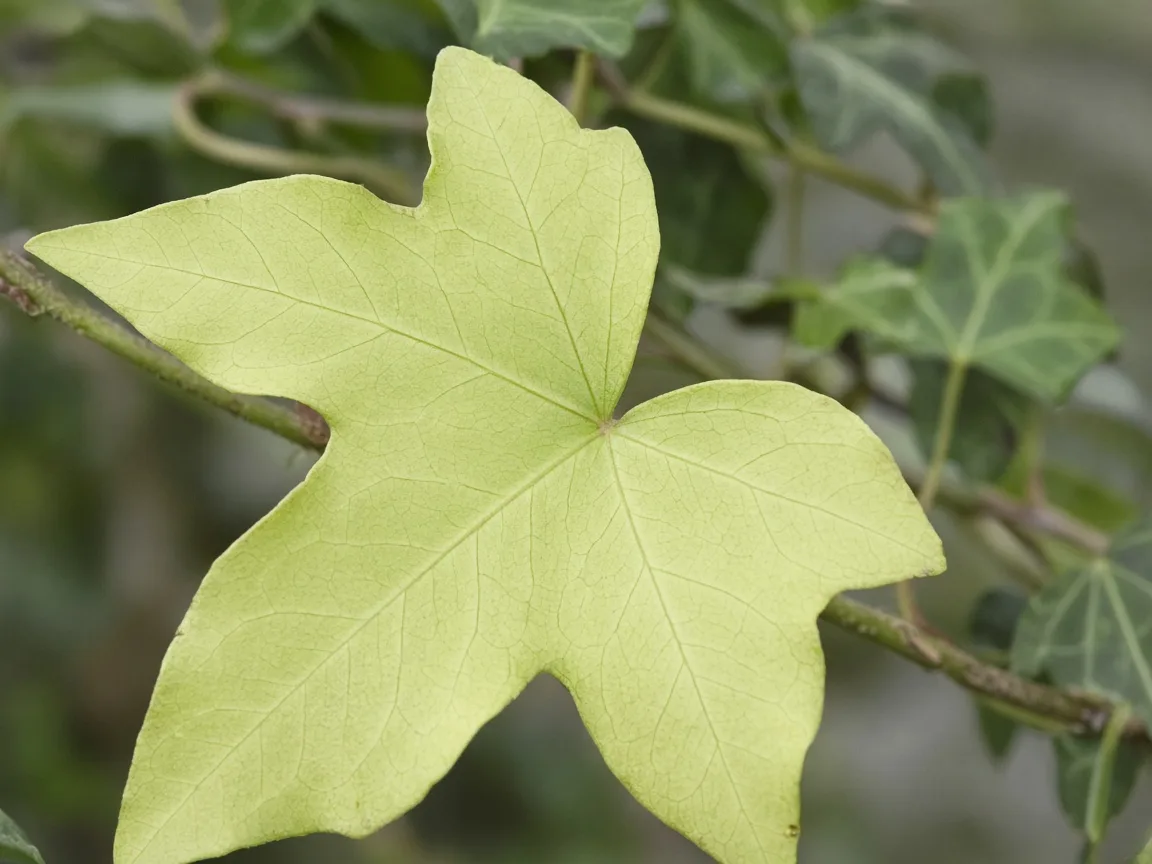
Oldest lower English ivy lobe with uniform pale yellow-green chlorosis—veins and tissue faded together along the lowest trailing stem, unlike interveinal magnesium banding.
Typical signs:
- Uniform pale yellow-green on the oldest lobed leaves along the lowest stem sections—veins and tissue lose color together
- Progressive climb up each vine over months as the plant strips nitrogen from old tissue to fund new tip growth
- Smaller or thinner new lobes at stem tips and wider spacing between nodes even in bright indirect light
- Firm stems and normal leaf texture unlike soft mushy bases from overwatered English ivy
- Variegated cultivars: read green tissue washout on oldest lowers; cream or silver zones lack chlorophyll by design, so pale patches alone are not proof
Not nitrogen deficiency:
- Yellow tissue between dark green veins on oldest lower lobes—magnesium deficiency (magnesium deficiency initially develops on lower or older foliage with interveinal chlorosis)
- Yellow new tip leaves with dark green veins—iron deficiency
- Uniform wash across all open leaves in a dark room—not enough light before assuming starvation
- Limp stems on wet mix with sour soil—overwatering or root rot
- Fine stippling with webbing on undersides—spider mites before assuming chlorosis
UC IPM notes slow growth and uniform yellowing of older leaves as the first symptoms of nitrogen deficiency. On a fast-draining hanging basket, that lower-canopy washout is easiest to read on the lobed leaves nearest the pot rim on each strand.
Why English ivy gets nitrogen deficiency
Container English ivy is a moderate to fast-growing foliage vine when light and water are right. Nitrogen is a core component of chlorophyll and proteins—when soil reserves run low, the vine dismantles chlorophyll in older lower lobes and redirects nitrogen to the shoots extending at the tips.
English ivy-specific causes:
- Leached peat-perlite mix — Thorough watering per the English ivy watering guide drains soluble nitrogen through drainage holes. A full growing season in the same small basket without complete feed leaves uniform pale lowers while tips still look glossy.
- Winter plain water — Growth slows in short days, but owners often keep watering while pausing feed; UF/IFAS recommends not fertilizing ivy when soluble salts exceed 2.0 dS/m and to avoid feed right after shipping stress—skipped spring feeds after a salt-flush winter can leave reserves thin.
- Light feeding mistaken for “no feed ever” — Ivy is a light feeder, not a zero-feed plant in containers; UF/IFAS production guidance uses 3-1-2 or 2-1-2 fertilizers for quality foliage. Years of plain water on a bright windowsill trailer still depletes nitrogen.
- Blocked uptake from wet roots — Chronic saturation in a cachepot prevents absorption even when nitrogen is present; see overwatering before heavy feeding.
- Misread drought stress — Underwatering can yellow and crisp margins, but drought usually hits all leaves on a dry strand rather than a clear oldest-leaf-first uniform wash with firm roots.
- Misread low-light paleness — Whole-vine wash without a strong oldest-leaf-first ladder points to pale leaves from weak light, not mobile-nutrient stripping.
Do not diagnose nitrogen deficiency on sour wet soil with blackening stems—that is root failure until you confirm mostly white firm roots.
Trailing stems and variegation: reading uniform chlorosis on ivy
On a solid-green ‘Baltica’ or ‘Green Ripple’ strand, nitrogen deficiency is straightforward: the lowest lobes on each vine turn evenly pale while tip lobes stay greener but smaller.
Variegated English ivy adds noise. Cream, gold, or silver sectors naturally lack chlorophyll. Nitrogen deficiency shows when the green portions of the oldest lower lobes wash out evenly for weeks while new tip lobes stay undersized—not when variegation simply looks “soft” after a move to lower light.
Compare two or three consecutive tip growth flushes rather than one briefly lime-green lobe after a long dry spell. One light opener differs from several successive smaller lobes with a persistent pale lower canopy on stable care.
Hanging baskets, bright light, and leached mix
English ivy in bright indirect light with regular watering pushes more foliage than a dim corner plant—and pulls more nitrogen from a finite pot volume. RHS notes nitrogen is easily washed out of soil by watering—hanging baskets that drain freely are especially prone to depletion unless you replace nitrogen gently during active growth.
The Spruce recommends feeding container English ivy every two weeks in spring and summer with a balanced 20-20-20 when the plant is actively growing—not when stressed by extreme heat, cold, or dry soil. Home growers often stretch that interval to every four weeks at half strength per the fertilizer guide; either rhythm works if you actually feed during the growth window instead of skipping entire seasons.
If the basket has been in the same mix for two or more years and roots circle the bottom, pale lowers may combine depleted nitrogen with root-bound slowdown—see repotting after one conservative feed trial on firm roots.
How to confirm nitrogen deficiency on English ivy
Work through these checks in order:
- Leaf age pattern — uniform pale yellow-green on oldest lower lobes on each stem; tip lobes greener but smaller? Nitrogen. Interveinal yellow on old leaves? Magnesium. Green veins on new tips? Iron.
- Root firmness — slide the root ball partly out. White, firm roots support a feed trial. Brown mush on wet mix means overwatering or root rot first.
- Feed history — any complete balanced liquid at half strength during last spring–summer? If not, nitrogen gap is likely on leached mix.
- Pot weight and drainage — light dry pot with pale lowers and crispy margins suggests underwatering instead. Heavy wet pot with limp stems is not nitrogen-first.
- Light level — if every lobe on every vine is evenly washed out in a dark hallway, fix light before fertilizer.
Because nitrogen is mobile in the plant, chlorosis is more pronounced in older leaves—that ladder from soil-line lobes upward is the signature on trailing ivy.
First fix for nitrogen-deficient English ivy
Only feed after roots are firm and mix is not waterlogged.
- Water lightly so the mix is moist, not soggy, the day before feeding.
- Apply one dose of balanced liquid fertilizer (10-10-10 or 20-20-20) at half the label strength for container foliage plants, following the English ivy fertilizer guide. Pour until a little drains, then empty the saucer or cachepot.
- Wait four to eight weeks and judge new tip lobes—size, spacing, and green depth—not old pale lowers.
- If pale lowers climb further or tips stay stunted with firm roots, repeat at half strength at the next scheduled feed—not a double dose the same week.
Do not stack repotting, hard pruning, and full-strength feed on the same day. Do not feed a vine that just arrived from shipping—UF/IFAS advises waiting about four weeks before fertilizing after transport stress.
If salts crust the soil surface or tips burned last season, flush with plain water once before resuming quarter- to half-strength feeds.
Recovery timeline
| Stage | What you should see |
|---|---|
| Week 1–2 | No change on old pale lobes; stems stay firm |
| Week 3–5 | New tip lobes slightly larger or deeper green |
| Week 6–10 | Stable tip growth rhythm; pale lowers may drop naturally |
| Beyond | Old chlorotic lobes rarely re-green; trim if unsightly |
Mild cases on a young basket often show cleaner tip growth within one growth cycle. Root-bound or multi-year depleted mix may need feed plus repot in spring for full vine density—see slow growth if tips stay tiny after two measured feeds.
What not to do
- Do not apply full-strength fertilizer to correct pale lowers—ivy is salt-sensitive and UF/IFAS links thin spindly growth to excess fertilizer with too little light.
- Do not feed when mix is dry as dust—water lightly first to protect roots.
- Do not assume every yellow lower lobe is nitrogen—wet-soil yellowing is often overwatering.
- Do not dump high-nitrogen lawn products into a houseplant basket.
- Do not ignore pests—mites and thrips can stipple leaves in patterns unlike uniform mobile-nutrient chlorosis.
How to prevent nitrogen deficiency on English ivy
- Feed half-strength balanced liquid every two to four weeks from mid-spring through early fall when vines push new lobes—see fertilizer.
- Pause in late fall and winter for typical indoor setups; resume when spring tip growth returns.
- Repot into fresh well-draining mix when roots circle and lowers pale despite feeding.
- Maintain consistent top-dry watering per the watering guide.
- Flush salts mid-season if you use hard tap water or feed frequently.
- Inspect lowest lobes monthly during active growth—early uniform pale wash is easier to correct than a chlorotic whole basket.
Related English ivy guides
- English ivy overview
- English ivy problems hub
- English ivy fertilizer
- English ivy watering
- English ivy soil
- Magnesium deficiency — interveinal banding on oldest lower lobes
- Iron deficiency — new leaf yellow with green veins
- Yellow leaves — moisture-first diagnosis when color shifts broadly
Use the Fertilizer Dilution Calculator to work out a safe half-strength dose before changing multiple variables at once.
Conclusion
Uniform pale yellow-green on the oldest lower lobed leaves along trailing stems, with smaller new tip lobes, is a nitrogen signal on container English ivy—confirm the pattern is not interveinal or new-tip chlorosis, rule out wet roots, then apply one measured balanced feed on moist mix.