How to Propagate Global Green Pothos: Stem Cuttings
How to Propagate Global Green Pothos: Stem Cuttings
How to Propagate Global Green Pothos: Stem Cuttings
Global Green pothos propagation is one of the most reliable projects in indoor gardening because the plant is built for it. A short stem section with a sound node — the swollen joint where leaves and aerial roots emerge — can form adventitious roots in warm, bright conditions within one to two weeks, sometimes faster in peak summer. Clemson Cooperative Extension confirms that pothos stem cuttings placed in water or soil need at least one node to root properly, and the RHS growing guide for epipremnum describes stem cuttings stood in water until roots appear as a standard home method. That combination of speed and forgiveness makes Global Green pothos ideal for filling hanging baskets, replacing leggy vines, sharing plants with friends, and turning one long trailing specimen into several compact new starts without buying another pot.
The two dependable home methods are stem cuttings in water and stem cuttings in moist, airy soil or perlite. Both produce vegetative clones that match the parent plant’s green-on-green mottling — lighter and darker green sectors without white or gold — which matters because Global Green pothos is grown for foliage pattern, not flowers. Seeds are not a practical route for preserving a specific cultivar look; cuttings duplicate the exact leaf coloring you already have on the parent vine. The method you choose comes down to whether you want visible roots and easy monitoring (water) or a smoother path into long-term potting mix (soil). Either way, success depends less on a secret technique and more on clean cuts, submerged nodes, and steady warmth without soggy stagnation.
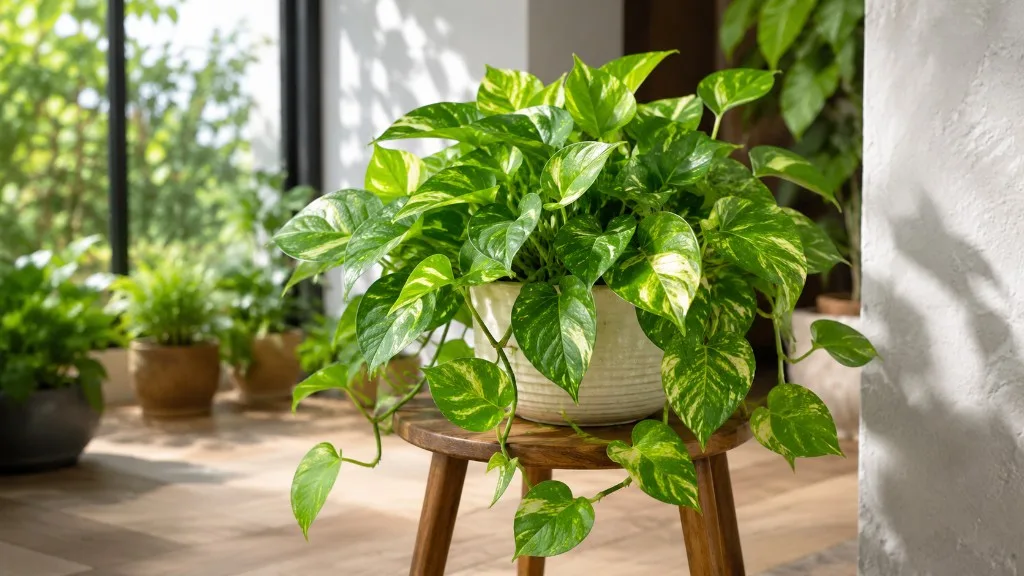
Cultivar note: Global Green Pothos (Epipremnum aureum ‘Global Green’) — green-on-green mottled pattern with darker and lighter green sectors, no white or yellow. Place cuttings in medium to bright indirect light; water when top half of parent mix dries; propagation speed matches golden pothos because the species biology is the same.
Why Global Green Pothos Is One of the Easiest Plants to Propagate
Global Green pothos (Epipremnum aureum ‘Global Green’, also called devil’s ivy) is a soft-stemmed Araceae vine native to the Society Islands (Mo’orea in French Polynesia) and widely grown indoors for decades. Its stems are herbaceous rather than woody, which means cells near a cut node can reorganize quickly into root initials when moisture and oxygen are available. The plant also carries enough stored energy in a 10–15 cm (4–6 inch) tip cutting to support leaf hydration while roots form, provided you do not strip every leaf or leave the cutting in harsh direct sun. Mature vines often develop aerial roots along nodes that already touch humid air or climb a moss pole — a head start that water propagation can activate within days.
That biology explains why pothos appears on nearly every list of plants that root in plain water on a windowsill. University of Florida IFAS notes commercial pothos cuttings with a node root in roughly three to four weeks under production conditions; home growers in warm bright rooms often see visible roots much sooner. Missouri Botanical Garden lists golden pothos — the same species — as easily propagated from stem cuttings, and the same method applies to every E. aureum cultivar including Global Green.
Propagation also solves real display problems: refreshing leggy bare vines by rooting leafy tips, duplicating an overgrown hanging basket, or dividing one long vine into several compact starts. The technique is simple, but the payoff — identical mottled foliage on new plants — is disproportionately large for the effort involved.
How Global Green Pothos Stem Propagation Works
Stem propagation asks wounded plant tissue to do two jobs at once: prevent excessive water loss through the leaves while building a new root system from nodes along the stem. A Global Green pothos cutting without roots still transpires moisture from its leaf surfaces. If it loses water faster than it can replace through stem uptake, it wilts, yellows, or rots at the submerged end. Your setup must reduce that gap: enough leaf area to photosynthesize lightly, enough water contact or soil moisture to supply the stem, and enough oxygen that microbes do not consume the cutting before roots appear.
Adventitious roots form from cells at or near nodes — the joints where leaf petioles attach to the stem. On Global Green pothos, nodes look like slight swellings, sometimes with small brown root nubs or aerial roots already visible. Submerging or burying at least one node in water or moist medium gives root initials a place to emerge. The upper leaves continue modest gas exchange and energy production, which supports rooting even before the new root system is functional. Internodal stem tissue — the smooth section between nodes — does not reliably produce roots and will soften and decay if left underwater without a node at that level.
Nodes, Aerial Roots, and What Actually Roots
A node is non-negotiable. A Global Green pothos leaf detached with no stem segment — or a stem segment with no node — may stay green for weeks but cannot reliably become a full plant. This is the most common beginner mistake: placing a pretty leaf in water and waiting months for a vine that never arrives. If a leaf breaks off with a tiny piece of stem that includes a node, treat it as a very short node cutting, but a leaf alone is not a propagation strategy for pothos. Clemson Cooperative Extension states plainly that cuttings should have at least one node to root properly — a rule that applies equally to water and soil.
For a standard tip cutting, aim for two or more nodes on the portion of stem you will submerge or bury, with at least one node fully underwater or in medium. Many growers keep the top one or two leaves and remove everything on the lower half that would sit underwater or underground. Global Green pothos leaves are heart-shaped and medium-sized, so you rarely need to halve them unless you are working with an unusually large specimen or a very short cutting. If aerial roots are present at a node, include that node in the submerged zone — those tissues often extend into water roots faster than a node that has never been exposed to humidity.
What Makes Global Green Different From Golden Pothos
Propagation mechanics are identical across Epipremnum aureum cultivars because you are cloning stem tissue, not growing from seed. What changes is what you are trying to preserve on the new plant. Global Green carries green-on-green mottling — alternating lighter and darker green patches with no white or yellow sectors. Golden pothos shows gold or chartreuse splashes. Cuttings from either cultivar reproduce the parent pattern faithfully; you cannot turn a Global Green cutting into a golden vine or vice versa.
Where Global Green differs in practice is light tolerance during rooting. Because every sector of the leaf still contains chlorophyll, Global Green pothos tolerates the moderate-to-dim corners where cuttings often sit better than heavily white-variegated types like Snow Queen or Marble Queen. UF IFAS notes that variegated pothos cultivars lose color below about 150 foot-candles; Global Green’s all-green palette usually holds up longer in those conditions, though the contrast between light and dark green sectors can soften on new leaves if rooting light is too weak. For best clone fidelity, root cuttings in bright indirect light — the same band that keeps mature Global Green looking crisp — rather than a dim shelf where mottling may flatten toward solid green.
Choosing the Best Global Green Pothos Cuttings
Start with a healthy parent plant that is actively growing, not drought-stressed, pest-ridden, or recovering from root rot on Global Green Pothos. Global Green pothos shows stress through limp leaves, faded mottling, and stalled new tips. Weak parent tissue produces weak cuttings, and propagation cannot reverse that baseline. If the plant looks tired but you still want to try, take material from the firmest new growth at the vine tip rather than woody lower sections that have lost rooting vigor and carry long bare internodes.
Prefer vines with firm stems, normal mottled pattern for the cultivar, and no black mushy spots at the nodes. Pothos rarely flowers indoors, so flowering stems are not a concern, but stems with recent mechanical damage, sun scorch, or pest residue should be avoided. If you are propagating to preserve a specific mottling pattern, take two or three cuttings rather than one — redundancy costs nothing except a spare jar and protects you from a single failed stem.
Which Vines to Cut and Which to Skip
Take cuttings from terminal shoots — the soft growing tips of vines — or from mid-vine sections when you are deliberately dividing a long trailing plant into multiple starts. The RHS propagation guide recommends collecting cutting material early in the day when stems are fully turgid; home growers often take 4- to 6-inch (10–15 cm) sections to capture two or three nodes and enough leaf area for stability. Make the cut with a sharp, clean blade just below a node so you do not crush the stem tissue.
Reject stems that are mushy, blackened at the base, coated in sticky residue, or heavily chewed by pests. Avoid cuttings taken immediately after the parent sat in bone-dry soil or sat in waterlogged anaerobic mix; both extremes reduce success. When refreshing a leggy Global Green pothos, cut the long bare vine into individual node sections, each with one leaf if possible, rather than trying to root a foot of leafless internode — that tissue lacks the nodes roots need and tends to rot instead of rooting.
The Best Time to Propagate Global Green Pothos
Global Green pothos roots fastest during active growth, when temperatures are warm and days are reasonably long. Spring through early fall is ideal for propagation in temperate homes. Room temperatures roughly 18–29°C (65–85°F) — the same comfort range Global Green pothos prefers in mature care — support steady rooting better than a cold windowsill that drops at night. Pothos tolerates average home humidity, but fresh cuttings in very dry air-conditioned rooms may wilt slightly until roots form; warmth and light matter more than calendar date alone.
Use plant readiness, not only the season. The parent should show firm new tips, crisp mottling on the newest leaves, and no active mealybug or scale outbreak. If the plant is mid-recovery from a move, repotting, or severe wilt, wait until new growth looks stable. Propagation during stress sometimes works, but it is not the example you want when learning the method. You can propagate Global Green pothos year-round indoors if light and warmth stay consistent, but most growers see the fastest water roots in late spring and summer when the parent is already pushing new leaves.
Tools, Materials, and Safety Basics
You need very little equipment: sharp bypass pruners or scissors, a clean jar or small pots with drainage holes, fresh water or moist propagation mix, optional clear plastic bag or dome for soil method humidity, labels if you are running multiple batches, and 70% isopropyl alcohol for disinfecting blades. Bypass cuts heal cleaner than crushing anvil pruners on soft stems. Disinfect before cutting and between plants if pests or rot have been an issue.
For water propagation, any clear glass or jar works if it supports the cutting without submerging leaves. Narrow openings can help hold stems upright, but do not cram so many cuttings that stems rub and wounds stay wet. For soil propagation, use a light, airy mix — straight perlite, half perlite and half peat or coco coir, or standard potting mix amended heavily with perlite. Missouri Botanical Garden’s cutting guide notes that perlite or sand improves drainage for cuttings prone to rot in wet media. Dense garden soil and heavy peat without perlite stay wet too long and invite stem rot at the node.
Keep cuttings away from pets. The ASPCA lists Epipremnum aureum as toxic to dogs and cats, with ingestion causing oral irritation, vomiting, and difficulty swallowing due to calcium oxalate crystals — a classification that covers all pothos cultivars including Global Green. The RHS advises wearing gloves when handling or taking cuttings. Toxicity does not prevent propagation, but it is a reason to place jars and rooting trays out of reach and discard trimmings promptly.
Preparing Global Green Pothos Cuttings Step by Step
Preparation is where propagation succeeds or fails before the cutting ever meets water or soil. Work on a clean surface, assemble containers first, and decide whether each cutting goes to water or medium before you cut — fresh wounds should not sit on the counter while you hunt for a jar.
Step 1: Select and cut. Choose a healthy vine and cut 4 to 6 inches (10–15 cm) of stem — or shorter node sections when dividing a long vine — slicing just below a node at a slight angle if you prefer; the angle is less important than a clean single cut. Avoid sawing or tearing.
Step 2: Strip lower leaves. Remove all leaves from the lower half of the cutting — the portion that will be submerged or buried. Any leaf sitting in water will rot and foul the jar within days. Any leaf pressed into wet soil without airflow can mildew.
Step 3: Confirm node placement. Identify at least one node on the submerged portion; two or three nodes improve redundancy if one fails. If aerial roots are present, orient that node into the water or medium.
Step 4: Rooting hormone (optional). Global Green pothos roots so readily that rooting hormone is optional, not required. Easy rooters like pothos succeed without it. A light dip before soil insertion may help marginally in cool rooms; skip it for standard water propagation.
Step 5: Insert immediately. Place the cutting in water or pre-moistened medium within minutes. Delay increases dehydration and contamination risk.
Method 1: Rooting Global Green Pothos Cuttings in Water
Water propagation is the most visible route and the one the RHS epipremnum guide describes: remove a stem section, trim just below a leaf joint, stand cuttings in a glass of water in a bright location until roots appear, then pot up. You can watch roots emerge, catch stem rot early, and share the process without mixing soil indoors. The trade-off is a water-to-soil transition later, because roots formed in water are structurally adapted to aquatic oxygen levels and can struggle if moved to dense wet soil without acclimation.
Follow the standard protocol: place the cutting in enough water to cover the zone where lower leaves were removed, ensuring at least one node is fully submerged while all leaves stay above the waterline. Use room-temperature water — tap water is fine in most municipalities. Set the jar in bright, indirect light, not direct midday sun that overheats the water, promotes algae, and scorches leaves.
Setting Up a Clean Water Jar
Choose a container you can keep clean. Algae and bacterial film accelerate rot. Change water when it looks cloudy, smells stale, or develops slime on the glass; many successful growers change it every three to seven days, while others top up evaporation and replace only when quality declines. Both approaches work if the stem stays firm and leaves remain turgid. Remove any leaf that falls into the water immediately.
Expect visible root initials in about one to two weeks under warm, bright conditions, with roots often 2.5–5 cm (1–2 inches) long within two to four weeks — aligning with UF IFAS commercial timelines and typical home results. Cool rooms, dim corners, or stressed cuttings stretch that schedule. Do not fertilize the water; the cutting is not ready to metabolize salts until it has roots and later soil.
When roots reach roughly 2.5 cm (1 inch) long — some growers pot at 1.3 cm (½ inch) to ease the soil transition — the cutting is ready for transplant. Waiting until water roots grow 10 cm (4 inches) or more often makes the shift to soil harder, because long aquatic roots are fragile and adapted to a different environment. Multiple cuttings can share one wide jar if nodes stay submerged and leaves stay above water.
Method 2: Rooting Global Green Pothos Cuttings Directly in Soil
Soil — or more accurately, a soilless propagation medium — hides roots but produces them in conditions closer to the final pot. Missouri Botanical Garden notes that while some plants root in water, cuttings often develop a better root system in a soil-less potting mix, with sand or perlite for drainage. Roots typically form in three to five weeks in medium, somewhat slower than water in many homes, but transplant shock is often lower because the roots already know porous mix.
Fill a small pot or tray with pre-moistened perlite or perlite-heavy mix. Use a pencil to make a planting hole so you do not scrape tissue off the stem when inserting. Bury at least one node; two nodes below the surface improves redundancy if one fails. Firm the medium lightly around the stem so it stands upright without packing so tightly that air is excluded.
Water once to settle the medium, then manage moisture so it stays evenly damp like a wrung-out sponge, never saturated mud. A cachepot without drainage is a common failure point; use holes and empty saucers after watering. Cuttings should not wilt badly after removal from the parent — work quickly and keep humidity reasonable.
Mix, Moisture, and Root Checks
Global Green pothos cuttings lose water through leaves faster than unrooted stems can replace it from dry air. A clear plastic bag or humidity dome over the pot — supported so plastic does not touch leaves — reduces wilting during the first week. Vent daily for a few minutes to prevent mold. Condensation streaming down the walls means the setup may be too sealed or too warm.
The tug test helps assess roots without destructive digging: after three to four weeks, give the stem a very gentle upward tug. Resistance suggests roots have anchored. No resistance does not always mean failure — keep waiting if the stem is still firm and leaves are not collapsing. Repeated aggressive tugging breaks delicate root initials. When roots are confirmed, move the cutting to a small individual pot with well-draining houseplant mix — the same general profile described in the Global Green Pothos soil guide: moist but not soggy, with good aeration.
Water Versus Soil: Which Method Should You Choose?
Both methods work. Your choice should match how you like to monitor progress and how soon you need a potted plant.
| Factor | Water rooting | Soil or perlite rooting |
|---|---|---|
| Root visibility | Excellent | Limited unless you unwrap |
| Typical speed in warm homes | Often 1–3 weeks | Often 3–5 weeks |
| Rot risk | Stagnant water, submerged leaves | Oversaturated compacted mix |
| Transition step | Required before long-term potting | Usually minimal |
| Best for | Beginners, visual learners, quick shares | Growers who want direct potting |
| Monitoring | Easy stem inspection | Tug test and pot weight |
Choose water if you want fast feedback, are propagating with children, or plan to pot up within weeks anyway. Choose soil or perlite if you dislike water changes, propagate many cuttings at once into individual pots, or tend to leave cuttings in jars too long. Many experienced growers root in water for speed, then pot into mix once roots are 1–2.5 cm (½–1 inch) long — a hybrid workflow that uses each method’s strength.
Building the Right Rooting Environment
Roots respond to warmth, light, oxygen, and stable moisture more than to secret additives. A cutting on a bright kitchen counter at 21°C (70°F) usually outperforms a darker shelf with rooting powder but cold nights.
Light, Temperature, and Humidity for Rooting
Place cuttings in bright, indirect light. An east window, a few feet back from a south window behind sheer curtain, or a moderate grow light works well. Direct sun through glass can overheat water jars and wash out mottling on new leaves before roots form. Too little light slows rooting and encourages leggy pale growth that is fragile at transplant — a common reason the contrast between light and dark green sectors looks flat on cuttings stuck in dim corners.
Keep temperatures above about 18°C (65°F) and ideally near 21–27°C (70–80°F) for fastest results — the band UF IFAS recommends for interior pothos culture. Bottom heat mats can help in cool rooms if they do not overheat the water jar; measure the water temperature, not just the air.
Humidity matters most for soil-rooted cuttings without domes and for cuttings in very dry air-conditioned rooms. Water propagation supplies stem moisture directly, but leaves still appreciate ambient humidity above extremely dry levels. Grouping jars together or keeping cuttings away from heating vents reduces edge wilting without requiring a greenhouse.
Transplanting Rooted Global Green Pothos Cuttings
Moving a water-rooted Global Green pothos to soil is the step where many projects fail — not because roots were absent, but because the pot stayed too wet after transplant. Use a small pot with drainage, roughly 9–10 cm (3.5–4 inches) for a single cutting, filled with moistened well-draining mix. Make a hole, place the cutting so roots hang naturally without cramming, and backfill gently. Bury the node that was submerged in water — roots should not sit exposed on the soil surface where they dry out.
Water once to settle the mix, then allow the top 2–3 cm to approach dryness before watering again — Global Green pothos prefers the top half of soil to dry between drinks in mature care, and young transplants need a slightly gentler but still airy rhythm. Water-rooted pothos is easy to overlove. The old roots need oxygen in mix; drowning them recreates anaerobic conditions similar to stagnant jar water but without the open visibility that warned you.
For soil-rooted cuttings, transplant when roots fill the starter pot or hold the medium together lightly when lifted. Move up one pot size, not into a large container. Oversized pots stay wet around a small root ball and stall growth. Expect temporary wilt or slight sulking for a few days after transplant — especially from water roots — but if light and moisture are correct, new growth should resume within one to two weeks. Hold fertilizer until you see fresh leaves opening; salts in early feeding burn limited roots.
Aftercare During and After Rooting
During rooting, patience beats interference. Do not pull cuttings daily to photograph roots. Do not increase water when progress seems slow unless leaves are visibly limp. For water jars, stability matters; for soil, consistent light moisture matters more than a rigid schedule.
After transplant, treat young Global Green pothos like a gentler version of the parent: Global Green Pothos light guide — medium to bright indirect is the long-term sweet spot — watering that lets the top half of mix dry between drinks, and protection from cold drafts. Wait until new top growth is obvious — often two to four weeks post-transplant — before feeding with a dilute balanced fertilizer at half strength per the fertilizer guide.
Pinch or trim the tip once the plant is rooted and growing if you want a bushier pot rather than a single long runner. Rooting several cuttings in one pot produces a fuller display faster — a useful trick when replacing a leggy parent vine.
Common Global Green Pothos Propagation Problems
Most failures trace to missing nodes, contaminated water, submerged leaves, cold, or oversaturated mix — not to Global Green pothos being difficult. Diagnose from the stem and leaf, not from impatience alone.
Black mushy stem base in water means rot. Discard the soft portion, recut to healthy tissue above the next node if enough stem remains, clean the jar, and restart with fresh water. If rot repeats, switch to perlite method or improve warmth and light.
Green stem but no roots for weeks usually means the node was not submerged or the cutting lacks a node entirely. Internodal tissue can stay green while decaying underwater. Confirm a node sits below the waterline.
Wilting with firm stem often indicates low humidity or excessive leaf surface for the root system. Move away from dry heat vents or use a humidity dome for soil cuttings. Mild wilt can recover once roots form.
No roots after many weeks in a cold or dim location suggests environment, not plant incompatibility. Move to warmer brighter spot before declaring failure. Take fresh tips from healthy growth instead of nursing stagnant cuttings.
Algae-filled sunny jar overheats and suffocates stems. Move to indirect light and refresh water.
Mottling fades on new leaves during rooting usually means light is too weak. Move cuttings to brighter indirect light; older leaves will not regain contrast, but new growth should show the pattern again.
When rot and wilting coincide, the cutting is usually past saving. Start over with a new section from a healthier vine rather than nursing a slimy stem for weeks. When roots form in water but the plant collapses after potting, overwatering on Global Green Pothos in a large pot is the prime suspect; repot into a smaller container with appropriately dry-ish mix around the roots and water lightly until new growth appears.
Conclusion
Propagating Global Green pothos from stem cuttings with nodes is straightforward because the plant cooperates: take a 4–6 inch section with at least one node (two or three is better), remove lower leaves, and root in clean water or moist perlite-heavy mix in warm bright indirect light. Water gives you speed and visibility; soil gives you a head start on long-term potting conditions. Transplant when roots are about 1–2.5 cm (½–1 inch) long, keep the first pot small and well drained, and delay fertilizer until new leaves tell you the root system is working.
Whether you are filling a hanging basket, cloning the mottled pattern you already love, or turning one leggy vine into several fresh starts, the logic stays the same — healthy material, submerged nodes, clean conditions, and moisture without stagnation. Master that chain and Global Green pothos propagation becomes one of the most reliable skills in your houseplant toolkit, not a lottery you hope to win once.
When to use this page vs other Global Green Pothos guides
- Global Green Pothos overview — Start here for whole-plant context before deep-diving propagation.
- Global Green Pothos problems hub — Jump to symptom-specific fix guides when propagation does not resolve the issue.