Scale Insects on Hoya: Identify and Treat Them
Quick answer
If you find fixed tan or brown bumps on a Hoya vine, first isolate the plant from nearby houseplants. Then inspect the bumps under bright light: scale covers stay attached, while a confirmed live scale lifts from the plant and may reveal an insect or eggs. Remove a few confirmed insects carefully and monitor the vine for new crawlers before using any spray.
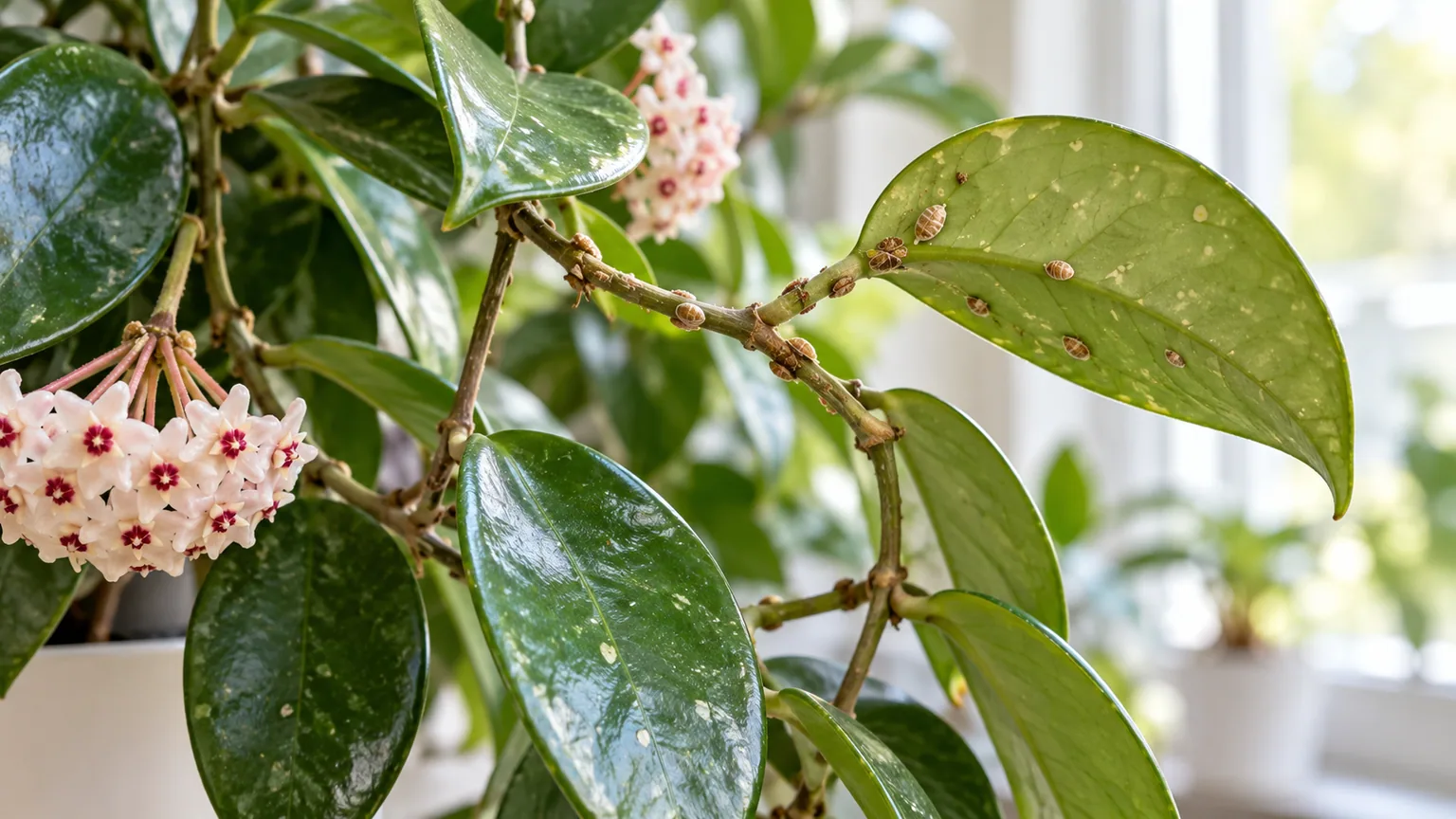
Scale Insects on Hoya: How to Confirm and Remove Them
This guide covers scale insects on Hoya. See also the general Scale Insects guide, watering, and light pages for this plant.
Scale Insects on Hoya: How to Confirm and Remove Them
Quick answer: isolate first, then confirm
When you notice hard-looking tan, brown, gray, or nearly black bumps on a Hoya vine, first move the pot away from other plants. Scale can be easy to mistake for a fixed plant mark, and the safest next step is confirmation rather than spraying every leaf. Under bright light, inspect the vine, leaf joints, leaf backs, and the narrow spaces where leaves meet stems. Test just one suspicious bump gently; do not scrape the whole plant.
Hoya has thick, glossy leaves and long stems that can hide small colonies where a leaf joins the vine; see the plant’s Hoya overview for its growth form and care context. A Hoya can also have lasting flower spurs and old scars that should not be pulled away as if they were pests. Scale is more likely when several similar covers appear in a row and one lifts as a separate shell. If the plant has sticky residue or yellowing as well, use those clues to guide the check, not as proof by themselves.
Scale insects feed on plant sap, and settled adults stay fixed under a protective cover while young crawlers move before settling, as described by WSU PestSense. A plant can look clear after one cleaning and still need follow-up inspection because mobile crawlers may settle elsewhere (Gardening Know How).
What scale looks like on a Hoya
On a Hoya, start by looking along green and older woody vines, around leaf nodes, along the midrib, and on the underside of leaves. Adult scales often look like small, rounded or flattened shields attached directly to the plant. Their colors vary by species, so a bump’s color alone cannot confirm the pest. Many are only a few millimeters across; a phone camera’s macro setting or a hand lens can help distinguish a scale cover from a speck of potting mix.
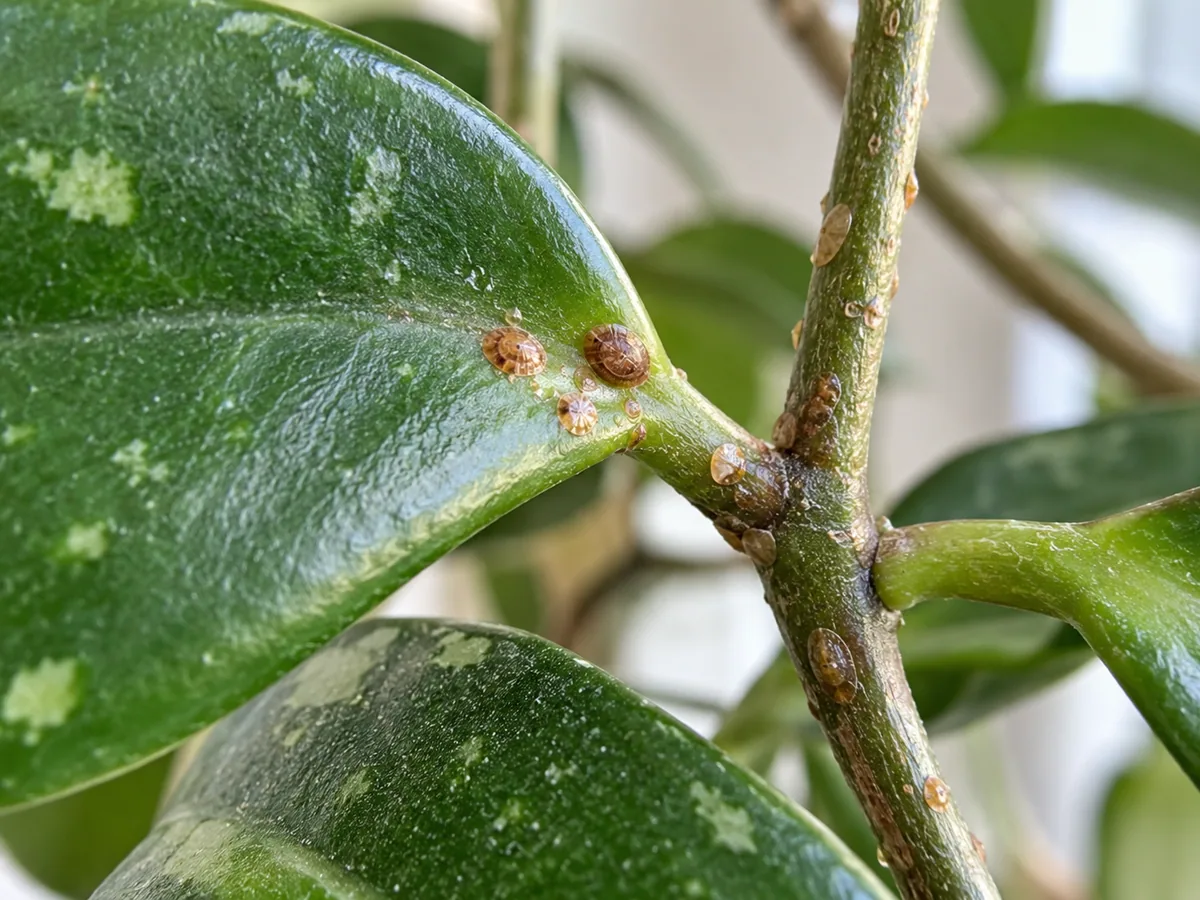
A few fixed covers on a Hoya vine warrant a close check; color and shape alone do not confirm that each bump is alive.
Look for a pattern rather than a single mark. Scales tend to stay in place when the leaf moves, and repeated bumps may line a stem or cluster near leaf joints. Soft scales may leave sticky honeydew and sooty mold, while armored scales do not produce honeydew (UConn Extension). A clean leaf therefore does not rule out armored scale.
Scale damage usually develops gradually. A growing colony can cause leaves to yellow, wilt, or drop, and the plant may lose vigor as feeding continues (WSU PestSense). On a trailing Hoya, damage may be more obvious on one infested section of vine than across the whole plant. A few bumps do not mean the Hoya is beyond saving; treat the discovery as a reason to inspect all stems and nearby plants carefully.
Confirm a live insect without damaging the vine
Use a clean fingernail, wooden toothpick, or cotton swab to nudge one bump from the side. Keep the pressure light, particularly on the thinner green tip of a vine. If the bump comes away as a separate cover and you see a soft-bodied insect, eggs, or a damp colored body beneath it, scale is likely. If the plant surface is continuous under the bump, stop: you may be looking at a scar, a natural stem feature, or a flower spur rather than a pest. WSU PestSense recommends inspecting a lifted cover because natural plant structures can resemble scale.
Do not use a knife to test a Hoya leaf or scrape multiple nodes. A small wound can remain visible on the glossy surface, while a torn stem may lose a leaf or flower spur. Check a few representative bumps only. If they look different from one another, treat them as separate observations instead of assuming every mark has the same cause.
Also ask whether the insect is alive. A dry, hollow cover may remain after treatment or after the insect has died naturally. The absence of movement in a single adult is not decisive because adult scales remain fixed once established. Look for moist bodies or eggs under a sample cover, tiny mobile crawlers on nearby tissue, and fresh signs such as new bumps or honeydew. A white sheet held beneath the vine can make tiny moving specks easier to notice when you tap the stem lightly.
Sticky leaves alone are not enough to diagnose scale. Soft scales can produce honeydew, but other sap-feeding pests can leave similar residue, and spilled nectar or household residue may also feel tacky. Sooty mold on sticky areas suggests a honeydew source but does not identify which insect made it. Wipe a small patch with a damp cloth; then check the plant above that patch for insects rather than treating the dark film as the pest itself.
For general scale life stages and treatment choices across houseplants, see the scale insects hub. The checks below focus on what to do with those signs on a Hoya vine.
Why scale can appear on Hoya
Finding scale is not proof that you watered incorrectly or that your Hoya is unhealthy. Indoor infestations are often introduced on a newly purchased or gifted plant. Colorado State Extension identifies infested incoming plants as a common source of houseplant scales and recommends quarantine and inspection for new plants. If you bring a Hoya indoors after a summer outdoors, inspect the vines and keep it separate from the collection until the check is complete.
Scale species can be host-specific or feed on a range of ornamentals (UConn Extension). The sources reviewed for this guide establish scale as a houseplant and ornamental pest, but they do not show that scale is especially common on Hoya. So avoid diagnosing a Hoya based only on a generic pest list. Confirm the fixed cover or insect under magnification before you choose a treatment. If the plant arrived recently, you can note that timing as a possible route of introduction without treating it as proof.
Care conditions do not tell you where scale came from, but they matter while you manage confirmed pests. Long Hoya vines create more nodes and leaf joints to check, and overlapping foliage can hide a small colony from a quick glance. If the plant is also recovering from root stress or poor light, keep those routines steady while you remove the insects. Review its watering needs and light guide only if the potting mix or placement already looks wrong; do not make abrupt changes as a substitute for pest control.
Lookalikes: scale, mealybugs, aphids, or a Hoya feature?
Use the texture, location, and movement together. A close look is more useful than a quick photo when the Hoya has waxy leaves or old stems.
| What you notice | More consistent with | Next check |
|---|---|---|
| Fixed tan, brown, gray, or black cover attached to a stem or leaf; may lift separately | Scale | Test one bump gently and inspect beneath it with a magnifier. |
| White cottony material clustered in a leaf axil or along a stem | Mealybugs | Check for fluffy wax and insects rather than a firm shield; see mealybugs on Hoya. |
| Small soft-bodied insects grouped around tender tips, sometimes with shed skins | Aphids | Check the newest growth and undersides; compare with aphids on Hoya. |
| Fine stippling or delicate webbing, with no fixed shell | Spider mites | Tap a leaf over white paper and look for moving specks; use the Hoya spider-mite guide. |
| A single firm part of the stem at a flowering spur, leaf scar, or node; no insect beneath it | Natural Hoya growth | Compare the location with healthy nodes elsewhere and with normal stem features. |
Yellowing and leaf drop can follow several problems. If the main change is widespread yellowing while the mix stays wet, inspect the root zone and compare it with the Hoya overwatering guide. If leaves have isolated dark lesions rather than attached insects, use the Hoya brown-leaves guide to check other causes. These pages are useful differentials; they do not replace the physical confirmation test for scale.
First fix: isolate the Hoya and map the colony
Keep the pot separate from your collection while you confirm and remove the pest. Use a different windowsill or room if possible, and avoid brushing trailing vines against neighboring plants while moving it. Colorado State University Extension recommends separating incoming plants and checking them before mixing them with established houseplants; the same precaution makes sense after you find a possible infestation on a resident Hoya.
Before treating, take a quick record: note which vines have bumps, whether any are on leaf backs, whether sticky residue is present, and which sample bumps looked alive. A few phone photographs help you compare the same nodes later. Check nearby pots for similar signs, but do not spray them automatically. This short baseline helps you tell whether a small problem is spreading and prevents unnecessary treatment of plants with no evidence of scale.
Remove a small confirmed infestation by hand
For a small number of confirmed insects, physical removal is a sensible first treatment. Hold the vine steady and lift the cover gently with a damp cotton swab, soft cloth, or fingernail. Work one node at a time, then wipe the area and discard the swab so you do not transfer insects to another section. Avoid forceful scraping across a leaf’s shiny surface; a lifted cover is the goal, not a clean-looking wound.
Inspect the full length of the vine, including the sections hidden behind leaves and near the pot rim. Hoya leaves are attached at nodes, so look around both sides of each junction. If the infestation is concentrated on one short, badly covered section, pruning that section may be less damaging than repeatedly scraping a long vine. Use clean scissors and leave healthy stem and flower spurs in place. Colorado State Extension lists handpicking scale insects as useful for houseplants, and Epic Gardening presents physical removal as a practical starting point for fixed scale covers.
If you choose a rubbing-alcohol swab, use it only on an individual insect after testing one inconspicuous leaf area and waiting to see whether the tissue reacts. Keep alcohol off healthy leaf surfaces as much as possible. WSU cautions that excess alcohol may harm some plants, and Colorado State Extension notes that alcohol can cause leaf burn on houseplants. A whole-plant alcohol spray is not a safer shortcut. If you are uncertain about Hoya sensitivity, use careful manual removal without alcohol.
After removing visible scale, wipe sticky leaves with a damp soft cloth and let foliage dry in bright, indirect light. Removing honeydew improves the plant’s appearance and makes new sticky patches easier to detect. Do not use an abrasive pad or polish; the goal is a gentle clean, not stripping the natural leaf surface.
When to consider an insecticidal product
If scale is widespread, keeps appearing after careful removal, or is too numerous to clear from the vines, consider a product specifically labeled for the pest and for indoor ornamental plants. Colorado State Extension notes that horticultural oils can control scale on houseplants; Epic Gardening also describes insecticidal soap and oil for houseplant scales, but a spray must contact the target and may injure sensitive foliage. Adults protected by a cover can be harder to reach than exposed crawlers. UConn Extension describes crawler-stage monitoring as important to scale management.
Read the entire product label and follow its directions for dilution, application, ventilation, and repeat timing. WSU PestSense advises growers to follow pesticide labels for scale controls. Do not assume a homemade dish-soap mix is equivalent to formulated insecticidal soap; Colorado State Extension notes that household detergents may injure plants. Test the labeled product on a small part of the Hoya first and wait for a plant response before treating the full vine. Keep the plant out of direct sun while wet if the label advises it, and do not apply oil or soap to a stressed, heat-exposed Hoya. Avoid mixing products or increasing concentration to compensate for missed insects.
Because Hoya leaves are smooth and can show marks after mishandling, take a conservative approach: treat only when you have confirmed the pest, use one chosen method, and record when you applied it. The product label is the authority for whether the treatment is appropriate for your indoor setting. If the plant is a valuable or rare specimen and the infestation is extensive, an extension office or experienced local nursery may help identify the scale and advise on a suitable product before you risk the foliage.
Monitor for crawlers and new damage
One cleanup is not a full monitoring plan. Check the same vine and nearby leaves at least weekly for several weeks, using a magnifier and the photos you took before treatment. Look for new tiny moving crawlers, fresh soft bodies under covers, new honeydew, or new attached bumps. Young crawlers are more mobile than settled adults; they can be missed during the first pass. If you used a labeled spray, follow the label’s interval rather than inventing a schedule or applying it more often.
An attached cover alone does not confirm that the insect is still alive; UConn Extension recommends checking under the cover for the body before deciding to retreat. Probe a representative shell gently and compare it with any new ones. If you find a live insect or fresh crawler, remove or treat that confirmed area and continue isolation. WSU PestSense recommends close monitoring because many scale controls work best against crawlers, and UConn Extension identifies crawler emergence as a key stage in the scale life cycle.
Keep the Hoya away from other plants until you have gone several weeks without finding live insects or new crawlers. Inspect the plant next to it and the surface where it sat, especially if honeydew had collected there. Wash hands or tools after working on the plant, and clean any reusable cloth or tool before using it elsewhere.
Recovery: judge the Hoya by new growth
Scale damage can remain visible after the insects are controlled. Old sooty mold can be gently washed from leaf surfaces (WSU PestSense). An already yellowed or dropped leaf is not a reliable way to decide whether scale remains; watch for new bumps, fresh sticky residue, and clean new vine growth. If you pruned one section, watch the nearest node for new growth rather than expecting the cut stem to restore its old shape.
A small infestation on an otherwise firm, actively growing Hoya is more manageable than a plant with many covered stems, widespread leaf drop, and weak or dying roots. Keep its established light and watering routine stable while you monitor. Do not fertilize heavily to force replacement growth; extra fertilizer will not remove insects and can add stress. If the potting mix is staying wet for a long time or the roots smell sour, address that separate issue using the Hoya soil guide and its watering guidance rather than treating the root problem as a scale symptom.
Consider discarding a plant only when the infestation is severe, the Hoya is declining despite sustained control, and it threatens a valuable collection that you cannot isolate. Colorado State Extension notes that a seriously infested houseplant may be best discarded (Colorado State Extension). Bag it before disposal so loose crawlers do not fall onto nearby plants. This is a last resort, not the default response to finding a few bumps.
Prevent scale from returning
Inspect new Hoya purchases before they join the collection. Check both leaf surfaces, stem joints, and the underside of a hanging vine, then keep the newcomer separate for a few weeks and inspect again. Colorado State Extension recommends quarantining new houseplants because scales and other pests can arrive with recently purchased or gifted plants. The practical value is not a magic number of days; it is the second check after the initial inspection, when a hidden pest may become easier to see.
During routine care, turn the pot and scan a few vines rather than checking only the top leaves. Hoya’s trailing growth can cross shelves or touch adjacent foliage, so give vines enough space that you can see their nodes. Clean dust gently with a damp cloth so small attached bumps are easier to notice. Keep the plant in the light and well-drained conditions that suit its type; avoid drastic environmental changes as a way to “repel” scale.
Do not overfertilize in an attempt to make the Hoya outgrow a pest problem. UConn Extension notes that excess nitrogen can favor scale on ornamental plants. Feed according to the plant’s growth and product label, not in response to yellow leaves alone. For broader Hoya collection questions, start at the plant care overview and use its care guides when you see a separate light or root-zone issue.
When to use this page vs other Hoya guides
Use this guide when you find fixed, shell-like bumps and can confirm that at least one lifts away from the plant. If the material is cottony, compare it with the Hoya mealybug guide. If soft insects gather on the newest tips, use the aphid guide; if the leaves show fine stippling or webbing, check the spider-mite guide. Those pests need different confirmation checks and may need different treatment, so do not apply an insecticide solely because the plant is sticky or yellow.
For Hoya care rather than pest identification, the watering guide covers dry-down decisions, and the light guide helps when growth is weak without visible insects. The Hoya problems hub offers the other plant-specific diagnosis routes. Use the Pest Identifier Tool to compare visible pest clues when you are still unsure what the bumps are.
Related Hoya guides
- Hoya overview — use for routine care and a broader plant profile; this page is for confirmed scale signs.
- Hoya mealybugs — use when the suspect growth is cottony rather than a hard, attached cover.
- Hoya aphids — use for visible soft-bodied groups on tender tips.
- Hoya spider mites — use for stippling or fine webbing without fixed shells.
- Hoya watering guide — use when soil dry-down or root-zone stress is a separate concern.