Iron Deficiency on Jade Plant: Causes, Checks & Fixes
Quick answer
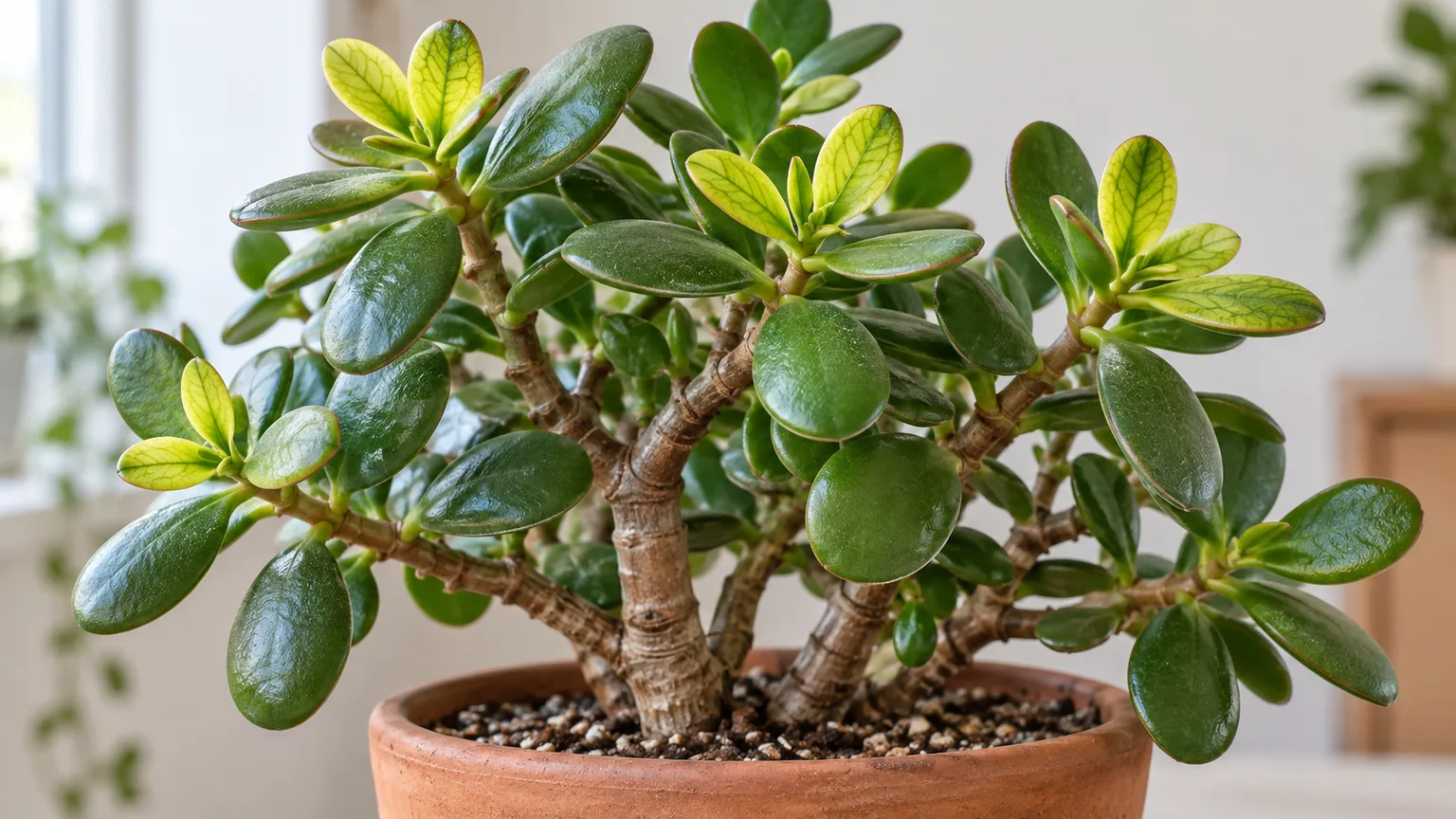
True iron deficiency is uncommon on Jade Plant and most yellowing comes from water or light problems instead. Suspect iron only when the newest fleshy leaves at branch tips turn yellow between green veins while older leaves stay deep green and stems stay firm. First step: confirm that new-growth vein pattern, then check alkaline water, salt crust, and feeding history before applying any iron.
Iron Deficiency on Jade Plant: Causes, Checks & Fixes
This guide covers iron deficiency on Jade Plant. See also the general Iron Deficiency guide, watering, and light pages for this plant.
Iron Deficiency on Jade Plant: Causes, Checks & Fixes
Quick answer
Iron deficiency is a rare diagnosis on Jade Plant (Crassula ovata). This slow-growing woody succulent is fed only twice a year and spends winter nearly dry, so most yellow leaves trace back to too much water, too little light, or exhausted mix — not missing iron. Suspect iron only when the newest thick leaves at branch tips turn yellow between green veins while older leaves stay deep green, stems stay firm, and the pot still dries on its normal schedule.
See our iron deficiency guide for general chlorosis mechanics. On jade, read the leaf still expanding at each branch tip — veins stay green while the tissue between them yellows, a pattern the University of Maryland identifies as interveinal yellowing on new growth.
First step: confirm new-growth interveinal chlorosis on firm stems with soil that dries normally, then check alkaline water, salt crust, and feeding history before applying any iron product.
When to use this page vs other Jade Plant guides
| Pattern | Read next |
|---|---|
| New branch-tip leaves yellow with green veins | Iron deficiency (this page) |
| Oldest lower leaves pale uniformly; no vein pattern | Nitrogen deficiency |
| Interveinal yellowing on older mid-stem leaves | Magnesium deficiency |
| Yellow lower leaves, heavy pot, soft stems | Overwatering or root rot |
| Whole plant washed-out in a dim corner | Pale leaves or not enough light |
| White mineral crust on pot rim with pale growth | Soil too alkaline |
| White dots on leaf surfaces, plant otherwise healthy | White spots — usually mineral exudation, not chlorosis |
| Red leaf margins in strong sun | Red leaves — normal sun response, not deficiency |
What iron deficiency looks like on Jade Plant
Healthy jade pushes thick, oval, glossy leaves from woody branch ends during warm active growth. Iron stress breaks that pattern at the growing points first: the newest fleshy blade opens pale yellow between darker green veins while mature leaves lower on the same stem keep their normal deep green.
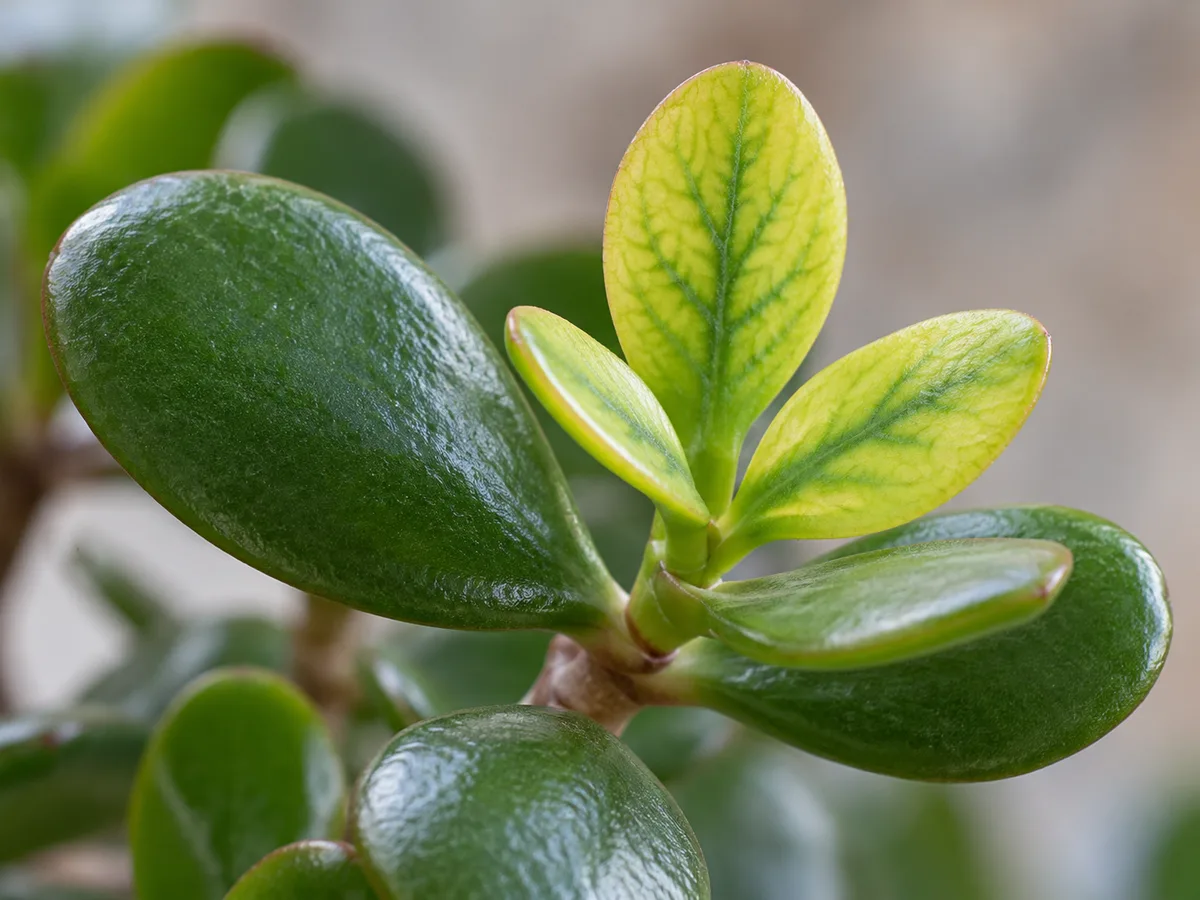
New fleshy jade leaf at a branch tip: pale yellow tissue between green veins while older thick leaves lower on the stem stay normal — classic iron chlorosis on expanding succulent foliage.
Typical signs:
- Yellow tissue between green veins on the newest expanding leaves at branch tips
- Successively paler new leaves if untreated — two or three pale openers in a row during spring or summer growth
- Older lower leaves stay deep green while only the newest tip leaf looks chlorotic
- Smaller or thinner new leaves when chlorosis persists on a plant pushing growth in strong light
- Firm woody stems at the branch base — soft or translucent stems on wet mix point to overwatering instead
The classic symptom of iron deficiency is interveinal chlorosis where leaf tissue yellows while veins stay green. RHS notes iron deficiency affects the youngest leaves first, unlike magnesium problems that tend to start on older foliage.
Thick fleshy leaves hide the vein pattern
Jade leaves are the worst possible canvas for reading chlorosis: thick, domed, and waxy, with veins buried under succulent tissue instead of printed on the surface the way they are on a monstera or hibiscus leaf. Early iron stress on jade looks like nothing more than a slightly lime-green new leaf — easy to dismiss as normal juvenile color, which is briefly lighter for a few days after unfurling.
That is why leaf position matters more than shade-matching on this plant. A single pale new leaf at one branch tip after repotting or a light change is usually transient. Worry when every active branch tip opens leaves with the same green-vein yellowing for weeks, and when two or three consecutive new leaves on the same stem stay pale after hardening. Compare the suspect leaf against the mature leaf directly below it on the same stem — that pair tells you more than any photo comparison across plants. Missouri Extension recommends using symptom location and pattern as part of diagnosis rather than relying on color alone, and on jade that discipline is the whole diagnosis.
Why Jade Plant gets iron deficiency
Jade is a subtropical succulent shrub that stores water in its leaves and woody stems, grows slowly, and needs feeding only in spring and early summer. Iron is immobile in plants, so when uptake fails, chlorosis appears on young expanding tissue first — not on the lowest old leaves the way mobile-nutrient shortages do.
Jade-specific causes:
- Alkaline tap water over years — Repeated hard-water irrigation raises pot pH, and high pH makes iron unavailable to plants even when fertilizer contains it. Jade’s preferred range is about 6.0–7.5, and Utah State explains that high-pH soil can reduce micronutrient availability and cause iron chlorosis.
- Salt buildup in old mix — Jade is fed rarely, but years of fertilizer plus hard water leave crust on terracotta rims and the mix surface. Salts injure fine roots and shift pH, creating lockout that mimics starvation. See soil too alkaline when white crust is visible.
- Micronutrient leaching through gritty mix — Jade soil drains within seconds, which protects against rot but washes micronutrients from small pots faster than twice-yearly feeding replaces them.
- Skipped feeding on a flushing plant — Owners who fear overfeeding may skip the spring feed entirely during the one growth flush when iron demand peaks. Check the fertilizer guide for the light spring-plus-early-summer schedule.
- Wet roots blocking uptake — Chronically damp mix suffocates fine roots so they cannot absorb iron. Fix drainage and watering rhythm before suspecting supply.
Do not diagnose iron deficiency on a plant with soft stems sitting in wet sour soil — that is root failure until proven otherwise.
Terracotta, gritty mix, and the alkaline crust trap
Jade’s ideal home — a porous terracotta pot filled with fast-draining mineral mix — is also a slow pH time bomb. Terracotta wicks water outward and evaporates it through the walls, leaving dissolved minerals behind as the familiar white ring around the rim. Season after season of hard tap water plus twice-yearly fertilizer concentrates those salts exactly where jade’s fine feeder roots explore: the outer inch of mix.
The trap has three stages, and iron chlorosis is stage three. First the rim crusts white. Then growth slows and new leaves emerge slightly small despite correct watering. Only then do branch-tip leaves show green-vein yellowing while the crust keeps thickening. Flushing the pot with plain water at roughly three times its volume, draining fully, resets stages one and two — and if chlorosis appeared only after the crust did, the flush alone may resolve it without any iron product. When repotting a crusted plant, discard the old surface inch entirely rather than mixing it back in, and hold the next feed until new growth resumes in fresh soil.
Winter rest is not iron deficiency
Jade slows to a near-standstill in cool short days and needs almost no water from fall to late winter. Pale, stalled, or slowly yellowing leaves on a plant kept cool with a firm woody trunk and bone-dry mix usually describe normal winter rest or simple underwatering at the wrong season — not a micronutrient shortage. Feeding or iron-drenching a resting jade accumulates salts while roots cannot use them.
The diagnostic split:
- Winter rest — cool room, dry mix, firm stems, no active branch-tip flush. Hold all fertilizer and iron until warm spring nights return and new leaves emerge.
- Iron chlorosis — warm active growth with new fleshy leaves opening at branch tips showing green-vein yellowing while stems stay firm on an appropriate dry-down.
Never apply iron to a dormant jade in a cool spot. Resume correction only when you see expanding new leaves and stable warmth.
Lookalike symptoms
| Pattern | Check | Likely cause |
|---|---|---|
| New tip yellow, green veins | Newest fleshy leaf on warm branch | Iron deficiency (this page) |
| Old lower leaves pale first, no vein net | Leaf position on stem | Nitrogen deficiency |
| Interveinal yellow on older mid-stem leaves | Leaf age | Magnesium deficiency |
| All yellow, heavy wet pot, soft stems | Stem squeeze + pot weight | Overwatering or root rot |
| Whole plant lime-green, stretched stems | Window exposure | Pale leaves or not enough light |
| White dots on leaves, plant otherwise healthy | Leaf surface | White spots — mineral exudation |
| Red margins in strong sun | Sun exposure | Red leaves — normal response |
How to confirm the cause
Work through these checks in order. Jade grows slowly, so change one variable at a time and read the next branch-tip leaf over four to eight weeks.
- Season and growth stage — Is the plant in warm active growth with new leaves opening? Iron is plausible. Cool rest with no flush? Not iron — wait for spring.
- Leaf age pattern — interveinal chlorosis on the newest branch-tip leaves only, older leaves green? Iron. Lowest leaves pale uniformly? See nitrogen deficiency.
- Vein pattern — tissue between veins yellow while veins stay green confirms interveinal chlorosis on the expanding blade, not general fading.
- Stem firmness — woody stems firm at the base; soft or translucent tissue on wet mix means fix overwatering before anything else.
- Soil moisture rhythm — mix should dry fully between waterings; NC State advises planting in well-drained potting soil and watering in moderation when the soil is dry. A heavy pot days after watering blocks uptake by itself.
- Salt and pH evidence — white crust on the rim or surface, years in the same mix, exclusively hard tap water. Flush before adding iron.
- Feeding history — no complete fertilizer for a full growing season or more during active flush growth; see the fertilizer guide.
- Light level — Wisconsin Horticulture notes jade needs bright light with direct sun and a real dry-down between waterings; confirm placement per the light guide so dim growth is not masking the pattern.
The first fix to try
Confirm firm stems and a normal dry-down during warm active growth, flush accumulated salts with plain water if crust is visible, then apply one chelated iron soil drench at the label rate for container plants — only for branch-tip interveinal chlorosis, never during winter rest.
Correct the uptake environment before the product: appropriate watering, a salt flush when the rim is crusted, and no feeding until roots are working. Iron drenches on waterlogged or dormant roots waste product and add salt stress. Do not stack repotting, heavy pruning, and iron treatment on the same day — pick the single most evidenced correction first so the next leaf tells you whether it worked.
Use the Fertilizer Dilution Calculator to halve strength if you are unsure of dose.
Step-by-step recovery
- Confirm diagnosis — green-vein chlorosis on newest branch-tip leaves during warm growth; rule out moisture stress per yellow leaves.
- Fix watering — full dry-down between deep soakings per the watering guide; empty any saucer the same day.
- Flush salts if white crust rings the pot — plain water at three times pot volume, draining fully.
- Apply chelated iron once on firm roots after steps 2–3, during active growth in spring or summer — not on a resting winter plant.
- Resume light complete feeding — the scheduled spring or early-summer feed with micronutrients per the fertilizer guide once new tip leaves green up.
- Repot into fresh gritty succulent mix if chlorosis returns after one iron cycle and roots fill depleted, compacted soil.
Recovery timeline
Jade is slow, so recovery is measured in leaves, not days. Expect four to eight weeks for the next branch-tip leaf to show greener tissue between veins after corrected watering, a salt flush if needed, and one iron drench during warm active growth. A full season may pass before two consecutive tip leaves look normal.
Signs of improvement: darker green tissue between veins on the newest unfurling fleshy leaf, normal leaf thickness returning, firm woody stems, a pot that dries on schedule.
Signs the problem is worsening: each successive tip leaf more bleached during warm growth, stems softening on wet soil, yellowing spreading beyond active tips — stop iron and check root rot.
Chlorotic leaves rarely re-green fully once hardened; judge success by new fleshy leaves, not old blade color.
Mistakes to avoid
- Iron before drainage — chelated iron on waterlogged mix fails and stresses roots; confirm a normal dry-down first.
- Iron during winter rest — a cool resting jade cannot use nutrients; salts accumulate while roots are vulnerable.
- Treating every yellow leaf as iron — one fading bottom leaf is usually normal aging or moisture stress; see yellow leaves.
- Heavy high-nitrogen fertilizer instead of iron — a nitrogen push on chlorotic tip growth does not fix an interveinal pattern and adds salt stress.
- Expecting the current pale leaf to re-green — judge the next branch-tip flush.
- Using non-chelated iron on alkaline mix — plain iron sulfate locks up fast at high pH; a chelated form stays available longer.
Prevention
- Feed lightly with complete fertilizer including micronutrients once in spring and once in early summer per the fertilizer guide — not nitrogen-only formulas alone for entire seasons.
- Flush gritty mix occasionally with plain water during the feeding season to limit salt buildup from tap water and fertilizer.
- Match watering to a full dry-down; never keep mix damp through cool months.
- Use pH-friendly water when hard alkaline tap repeatedly crusts the terracotta rim.
- Repot into fresh mineral-rich succulent mix every two to three years before roots exhaust depleted soil.
- Pause all feeding and iron when growth stalls in cool short days.
When to worry
Treat chlorosis as urgent when every emerging leaf opens bleached while growth stalls, stems soften, several branches decline together, or symptoms worsen after a corrected flush and one iron drench. A stable mild pattern on one or two branch tips allows time for measurement and one conservative correction. If the trunk base softens or the pot smells sour, the problem is root failure — follow the root rot guide before the plant collapses with little above-ground warning.
Related Jade Plant guides
- Jade Plant overview — care basics for a woody succulent
- Watering — full dry-down schedule behind most yellow-leaf complaints
- Soil — gritty fast-draining mix that leaches micronutrients
- Light — bright direct-sun needs that separate pale growth from chlorosis
- Fertilizer — twice-yearly feeding with micronutrients
- Nitrogen deficiency — oldest leaves pale first, no vein pattern
- Magnesium deficiency — interveinal yellowing on older leaves
- Soil too alkaline — crust, pH lockout, and flushing
- Overwatering — the common jade yellowing cause to rule out first
- Root rot — soft stems and failing roots that iron cannot fix
- All Jade Plant problems
Scope note: Use this page when new branch-tip fleshy leaves show green-vein yellowing during warm active growth. Use nitrogen deficiency when oldest lower leaves pale first, magnesium deficiency for vein yellowing on older leaves, and overwatering when stems soften on wet mix — regardless of leaf color.
Related tool
Use the Fertilizer Dilution Calculator to narrow causes for iron deficiency on this plant before changing multiple variables at once.