Whiteflies on Jade Plant: Causes, Checks & Fixes
Quick answer
Whiteflies on Jade Plant show as a puff of tiny white flies when you brush the crown, with sticky honeydew on the glossy leaves below. First step: isolate the plant and hose leaf undersides with a firm water spray, then hang a yellow sticky trap while you confirm nymphs.
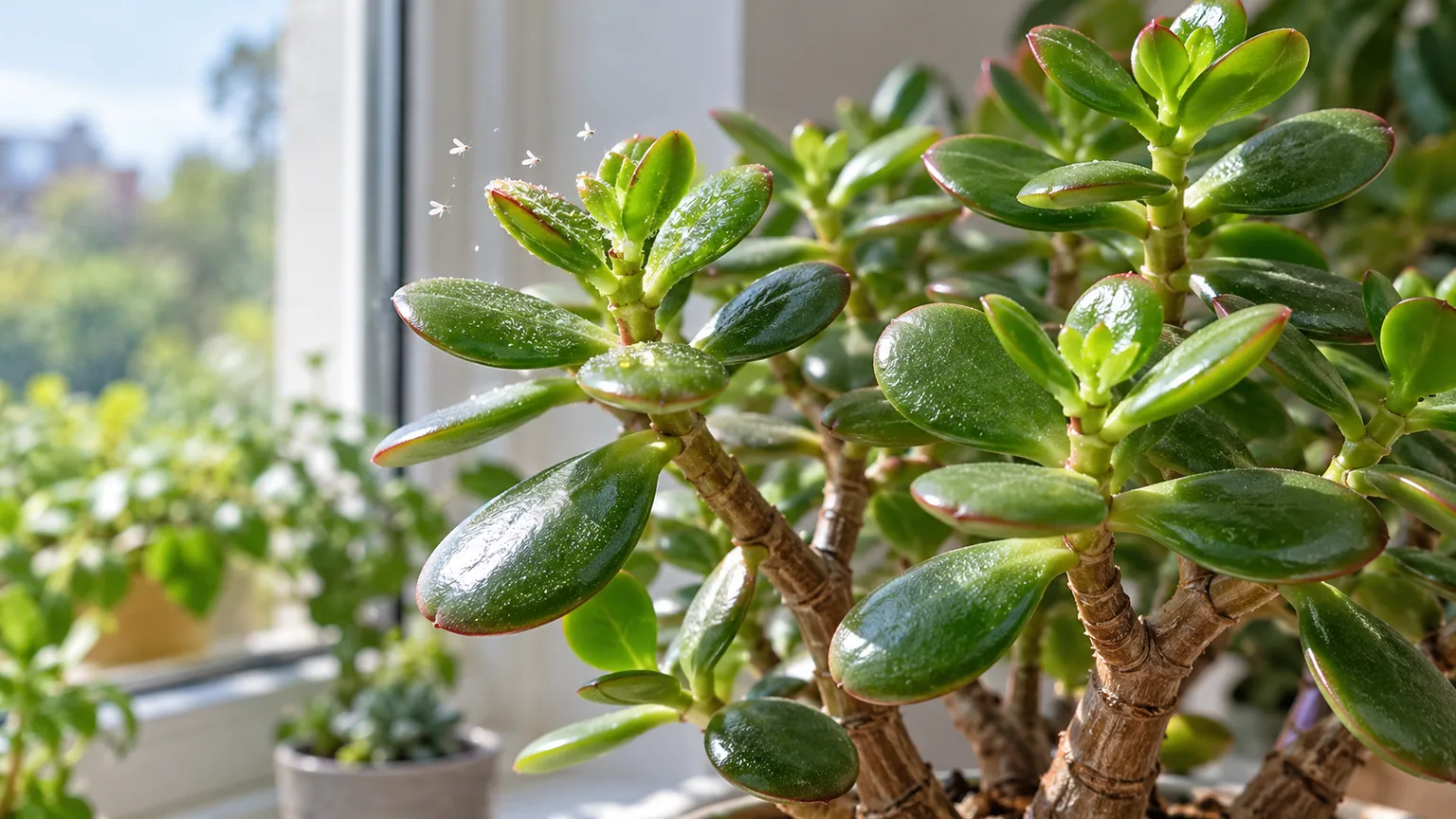
Whiteflies on Jade Plant: Causes, Checks & Fixes
This guide covers whiteflies on Jade Plant. See also the general Whiteflies guide, watering, and light pages for this plant.
Whiteflies on Jade Plant: Causes, Checks & Fixes
Quick answer
Whiteflies on Jade Plant (Crassula ovata) announce themselves when you brush the foliage: a small cloud of tiny white sap-sucking insects that fly up when disturbed rises from the crown and settles back seconds later. The giveaway underneath is sticky honeydew on leaves with black sooty mold coating the gloss on the leaf faces below the colony.
First step: isolate the plant and hose leaf undersides with a firm water spray. Move jade away from every other plant, blast the undersides of the leaves and the soft stem tips to knock adults off, and let the pot drain fully. Hosing adults off plants with a strong stream of water plus isolating infested plants buys you a clean starting point while you confirm whether flat, stuck nymphs are still feeding underneath.
For the general mechanics of whitefly damage and control across all plants, see our whiteflies hub. On jade, the pattern usually shows up as a hitchhiker colony on the softest new tips — not a plant-wide plague — because thick succulent leaves are tougher feeding than the soft foliage whiteflies prefer.
What whiteflies look like on Jade Plant
Adults are 1–2 mm white triangular flies that gather on leaf undersides and scatter the moment you touch the plant — the “whitefly flurry” that separates them from every other jade pest at a glance. The real damage comes from the stage you barely notice: oval, legless nymphs that do not move and cause most of the feeding damage, glued flat along the veins on leaf undersides.
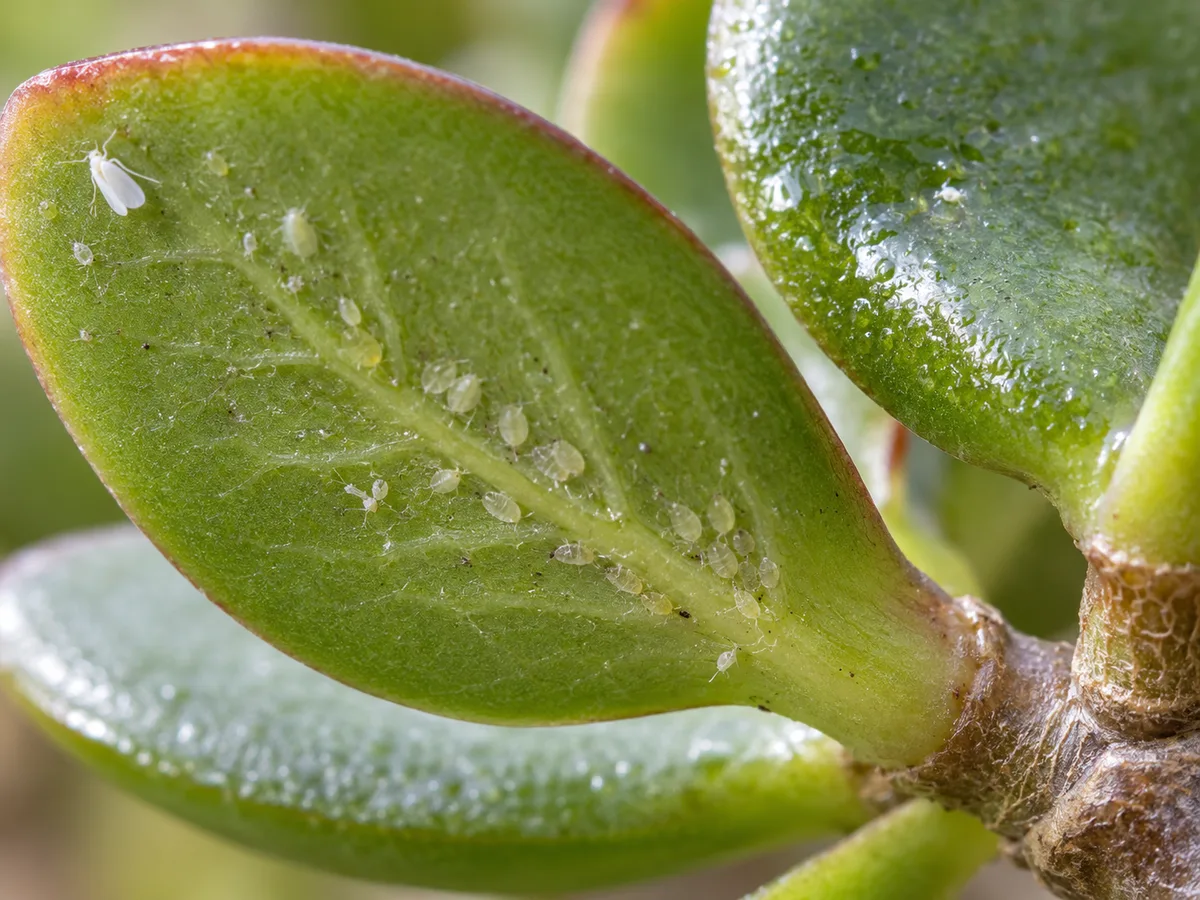
Flat oval nymphs along the veins plus sticky shine on the glossy leaf below — compare with clean firm tissue on the same branch.
On jade specifically, watch for:
- A white puff on disturbance — brush the crown and adults lift, circle, and resettle. No other common jade pest does this; mealybugs stay put in cottony clumps and aphids cluster without flying.
- Sticky gloss on thick leaves — honeydew lands on the waxy leaf faces below the colony, and jade’s smooth surface shows the shine (then black sooty mold) faster than fuzzy-leaved plants do.
- Yellowing and leaf drop starting under the colony — yellowing, silvering, or drying leaves that carry nymphs on their undersides, while leaves elsewhere on the plant stay firm.
- Pale egg clusters on undersides — tiny white eggs laid in loose or spiral patterns that change color as they mature; they are visible to the naked eye if you flip a lower leaf into good light.
Jade’s slow growth makes early colonies easy to miss: one infested flush tip can feed nymphs for weeks while the rest of the miniature tree looks perfect.
Why Jade Plant gets whiteflies
Whiteflies are an unusual primary pest on jade. Wisconsin Extension notes jade has few pests, with mealybugs the most common — whiteflies normally prefer soft, thin-leaved hosts. When they do appear on Crassula ovata, three jade-specific traits shape the outbreak.
Thick opposite leaf pairs clustered at branch ends hide nymphs. Jade leaves grow in opposite pairs clustered at the ends of branches rather than spaced evenly along them, so overlapping leaf undersides near each branch tip create sheltered feeding pockets. A colony tucked between two fleshy leaf pairs survives casual wipe-downs that would clear an open-canopy plant.
The soft spring flush is the entry point. Mature jade leaves have a tough waxy cuticle that whiteflies struggle to pierce, so adults settle on the tender new pairs pushing out during active growth. A jade pumping out soft spring tips after winter rest — especially one pushed with nitrogen — offers exactly the succulent feeding whiteflies want on an otherwise armored plant.
Indoor shelf grouping imports the problem. Most jade infestations start on a neighboring plant — a vegetable seedling, hibiscus, fuchsia, or new nursery purchase — and spill over when leaves touch. Jade’s permanent always-indoors spot on a crowded succulent shelf makes it a sitting recipient once a nearby host builds a population.
Dry dusty window air compounds all three: dust dulls the glossy leaves, the plant sits in its brightest warmest placement, and overlapping generations build without rain or predators to interrupt them.
How to confirm the cause
Work through these checks before treating:
- Shake test — Brush the crown gently. A puff of tiny white flies that resettles within seconds confirms whitefly adults; no other jade pest flies.
- Underside lens check — Flip the lowest leaves over the colony and use a 10× lens along the veins. Flat oval motionless nymphs confirm active feeding; tiny nymphs on leaf undersides are the diagnostic sign.
- Honeydew trail — Sticky shine on leaf faces below the colony, possibly with black sooty mold, points to whiteflies, aphids, or scale. The shake test separates whiteflies from the other two.
- No cottony masses — White clumps in branch forks mean mealybugs, not whiteflies. No webbing plus no stipple-dots rules out spider mites.
- Not soil flies — Tiny flies rising from the mix surface when you water are fungus gnats, which live on damp soil, not leaf undersides. Whiteflies rise from the foliage when brushed.
- Neighbor source — Check every plant that shared the shelf. Finding a heavily infested neighbor explains why jade — a non-preferred host — has a colony.
- Stem base and soil — Press the lower trunk. Firm wood with dry gritty mix means a foliage pest; a soft base with sour soil is rot — see overwatering — not whiteflies alone.
If adults puff up but you find no nymphs yet, re-check undersides in three to four days — eggs hatch fast in warm rooms and the second look catches what the first missed.
First fix for Jade Plant
Isolate the plant and hose leaf undersides thoroughly with a firm water spray.
Carry jade to a sink or shower, tilt the pot so the spray hits foliage rather than flooding the mix, and blast leaf undersides, soft flush tips, and branch forks until no adults lift off. Let the pot drain completely and empty the saucer — jade stores water in leaves and wood, so a foliage rinse is safe only when the root zone does not sit wet afterward. Follow your normal soak-and-dry watering rhythm; do not add an extra soil watering just because you rinsed the leaves.
Hang one yellow sticky trap just above the crown the same day. Sticky-coated yellow traps catch flying adults and tell you whether the population is falling — a trap that stays clean for two weeks is your clearance signal.
Step-by-step recovery
Once nymphs are confirmed, work in this order:
- Isolate — Keep jade in a separate room until sticky traps stay empty and two weekly underside checks show no live nymphs.
- Rinse weekly — Repeat the firm underside spray every five to seven days for three weeks to knock down newly hatched nymphs before they settle.
- Prune and bag the worst tips — Snip the one or two most heavily colonized flush tips, seal them in a bag, and trash them. Removing the densest egg load beats spraying it.
- Soap or oil after rinsing — If live nymphs persist, apply insecticidal soap or horticultural oil labeled for whiteflies, coating undersides until runoff. Good underside coverage is essential and repeat applications are usually required; monitor and re-treat on schedule rather than spraying once.
- Patch-test first — Treat one leaf cluster and wait 24 hours. Use caution with insecticides — succulent jade leaves can suffer phytotoxicity, especially in hot sun or above 90°F. Treat in early morning or evening, never on a sun-hot sill.
- Treat the source plant — Find the neighbor that imported the colony and treat it on the same schedule, or jade gets recolonized.
- Hold fertilizer — Skip feeding until new growth looks firm for two weeks. Soft nitrogen-pushed tips are exactly what whiteflies prefer.
Do not repot on day one. Whiteflies feed on foliage, not roots, and repotting a pest-stressed jade into fresh mix invites the rot that kills jade faster than any insect.
Recovery timeline
First week: Adult clouds should shrink sharply after isolation, the first rinse, and trapping. Honeydew production slows; existing sticky shine stays until you wipe it.
Two to three weeks: With weekly rinses plus soap or oil cycles, underside checks should show no live nymphs and traps should catch fewer adults each week. Wipe sooty mold off glossy leaves with a damp cloth once pests are gone so the crown photosynthesizes cleanly.
Four to six weeks: Clean new leaf pairs emerging firm and glossy with no honeydew below them are the success signal on slow-growing jade. Yellowed leaves from the outbreak stay marked — trim them for appearance only after clearance.
Worsening signs: Adults still puffing from multiple branches after three full treatment weeks, sooty mold spreading to previously clean leaves, or fresh honeydew appearing after traps went quiet — re-check coverage of undersides and hunt for an untreated source plant on the same shelf before assuming the plant is lost.
Lookalike symptoms
| Symptom pattern | Likely cause | Key check |
|---|---|---|
| White puff on disturbance + flat nymphs on undersides | Whiteflies | Shake test; lens on veins |
| White cottony clumps in branch forks, no flying | Mealybugs | Alcohol dab turns bodies gray-orange |
| Pear-shaped clusters on soft tips + honeydew, no flying | Aphids | Plump insects on tender growth |
| Brown bumps that scrape off on leaves or stems | Scale | Immobile shells; honeydew possible |
| Fine stipple dots + silk webbing, no honeydew | Spider mites | Tap test shows crawling specks |
| Silvery scars with black specks, no cloud | Thrips | Slender fast insects under lens |
| Tiny flies from soil surface on watering | Fungus gnats | Soil flies, not foliage flies |
| Corky bumps after wet soil, no insects | Edema | Follows overwatering pattern |
| Soft translucent leaves + sour wet mix | Overwatering | Stem base soft; not pest-primary |
What not to do
Do not reach for homemade dish-soap sprays first. University of Minnesota Extension advises against homemade soap mixtures on indoor plants because of leaf-burn risk — and jade’s succulent cuticle is documented as spray-sensitive. Use a commercial insecticidal soap at label rate after a patch test.
Do not spray oil or soap in full sun or heat. A sun-hot jade sill plus wet spray is the classic recipe for the phytotoxicity spotting Wisconsin Extension warns about on this species.
Do not stop after one rinse because adults disappeared. Adults are the visible minority; settled nymphs and eggs on undersides restart the colony within days. Three weekly cycles is the minimum.
Do not mist the crown for “humidity” during treatment. Jade prefers dry air between waterings, and warm mist on honeydew-coated leaves extends the wet period sooty mold loves.
Do not use broad-spectrum insecticides as the opener. Even the most toxic insecticides are only partially effective against whiteflies while wiping out the predators and parasites that help suppress them.
Wear gloves when handling pruned or sprayed foliage; jade plant is toxic to cats and dogs. Keep pets away from rinse runoff and sticky traps, and contact your veterinarian if a pet chews treated leaves.
How to prevent whiteflies next time
Quarantine every new plant for two weeks and run the shake test before it joins the shelf. Inspecting new plants before bringing them indoors is the single highest-leverage habit, because jade colonies almost always arrive as hitchhikers.
Keep a yellow sticky trap near the collection in warm months. Traps catch the first stray adults and warn you weeks before nymphs build — cheap early warning for a slow-growing plant that replaces foliage slowly.
Space the shelf so leaves do not touch. Whitefly adults walk and flutter between touching leaves; a finger-width of air between jade’s branch tips and its neighbors breaks the bridge.
Keep jade in strong light with sharp drainage so spring flush growth stays compact and firm. Reference the jade light guide and jade soil guide when growth stretches soft — weak etiolated tips are both harder to inspect and more attractive to sap feeders.
Rinse dusty crown foliage monthly in summer when jade sits in a bright window. Clean glossy leaves are easier to inspect for honeydew shine, and the rinse itself dislodges stray adults before they lay.
When to worry
Escalate when adult clouds rise from several branches at once, honeydew coats most leaf faces with spreading black sooty mold, or traps refill within days after three treatment weeks. Heavy sap loss plus mold-blocked light can stall a slow-growing jade for a full season even without wilting.
Seek a different diagnosis if stems soften at the base, soil smells sour, or leaves turn mushy on wet mix — that is root-zone failure, not whiteflies alone.
If repeated labeled treatments fail and a neighboring plant stays infested despite treatment, consider discarding the worst source plant rather than sacrificing the jade: removing an isolated heavily infested plant protects the whole collection when one host sustains the population.
Conclusion
Whiteflies on Jade Plant are manageable because the colony usually starts small — a hitchhiker group on the softest flush tips of a plant they would not choose first. Isolate, hose the undersides, trap the adults, then treat nymphs with caution on succulent leaves — patch-test soap or oil, repeat weekly for three weeks, and judge success by clean new leaf pairs and quiet traps, not by old yellowed tissue. Prevention comes from quarantine, shake tests on newcomers, sticky-trap monitoring, and shelf spacing — not from spraying once and assuming indoor whiteflies disappear on their own.
When to use this page vs other Jade Plant guides
- Jade Plant watering guide - Use for routine moisture checks before assuming whiteflies is the main issue.
- Jade Plant problems hub - Browse all common issues on this species.
- Mealybugs on Jade Plant - Cottony masses in branch forks when nothing flies on disturbance.
- Aphids on Jade Plant - Soft-tip clusters with honeydew but no white cloud.