Caterpillars on Monstera Deliciosa: Causes, Checks & Fixes
Quick answer
Caterpillars on Monstera deliciosa chew ragged holes through large heart-shaped leaves and leave dark pellet-like frass, often on soft unfurling tips at the moss pole. First step: isolate the plant and inspect at night with a flashlight, then hand-pick every larva before treating foliage.
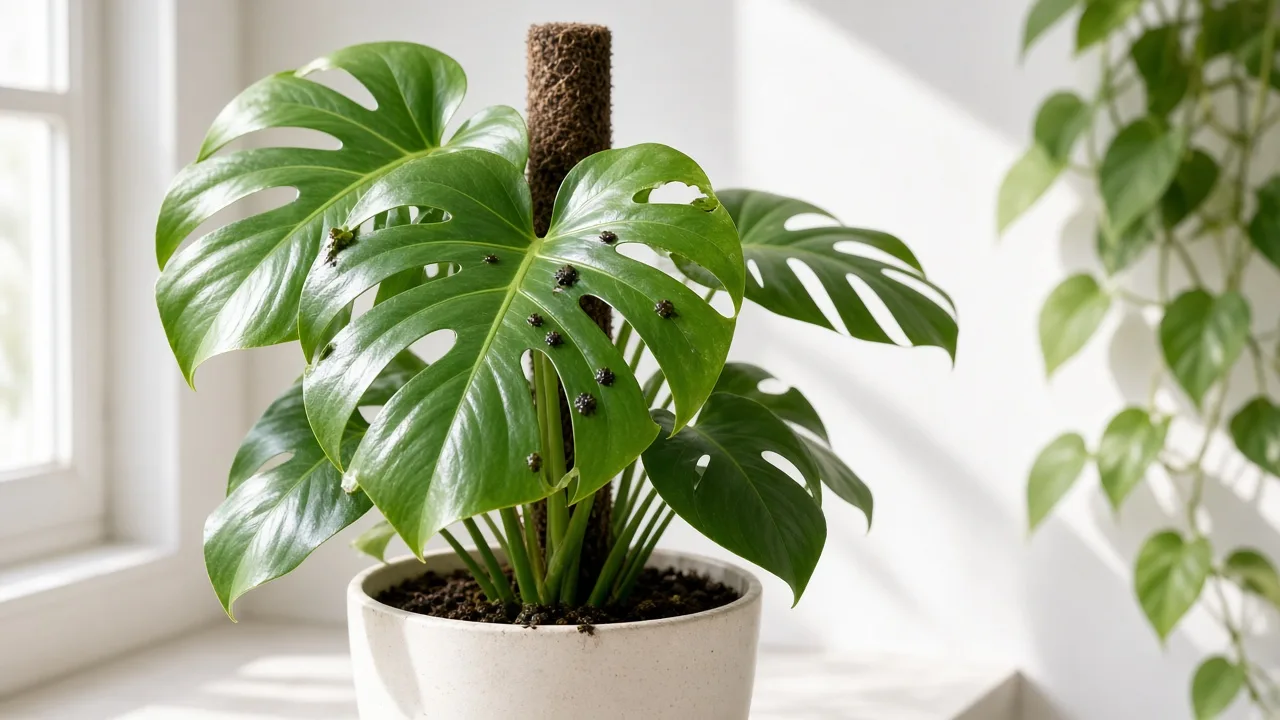
Caterpillars on Monstera Deliciosa: Causes, Checks & Fixes
This guide covers caterpillars on Monstera Deliciosa. See also the general Caterpillars guide, watering, and light pages for this plant.
Caterpillars on Monstera Deliciosa: Causes, Checks & Fixes
Quick answer
Caterpillars on Monstera deliciosa chew ragged holes through large heart-shaped split leaves and leave dark pellet-like frass on foliage or the pot rim below. Indoor cases usually trace to hitchhiking larvae after patio season, nursery stock, or a moth that laid eggs near an open window.
For general caterpillar biology and life cycle, see our caterpillars guide. On deliciosa, larvae often concentrate on soft unfurling tips still rolled at the moss pole and on the undersides of overlapping fenestrated lobes—places a quick top-down watering check misses on a tall floor specimen.
First step: isolate the Monstera and inspect at night with a flashlight, then hand-pick every larva before treating foliage.
When to use this page vs other Monstera Deliciosa guides
| Pattern | Read next |
|---|---|
| Ragged holes with frass pellets and visible larvae | This page |
| Smooth oval holes and edge splits present as the leaf unfurls | Holes in leaves (fenestration) |
| Pale winding tunnels inside the blade | Leaf miners |
| Silvery streaks and black frass, no through-holes | Thrips |
| Fine stippling and webbing on petioles | Spider mites |
| Clean mechanical tears, no frass or larvae | Physical damage — no pest treatment needed |
What caterpillars look like on Monstera deliciosa
Caterpillar damage is easy to miss on a tall floor Monstera because larvae feed at night and hide along stems and leaf backs during the day. On M. deliciosa, the symptom signature is ragged holes chewed through glossy fenestrated blades—not the smooth oval windows of natural fenestration or the bordered internal tunnels of leaf miners.
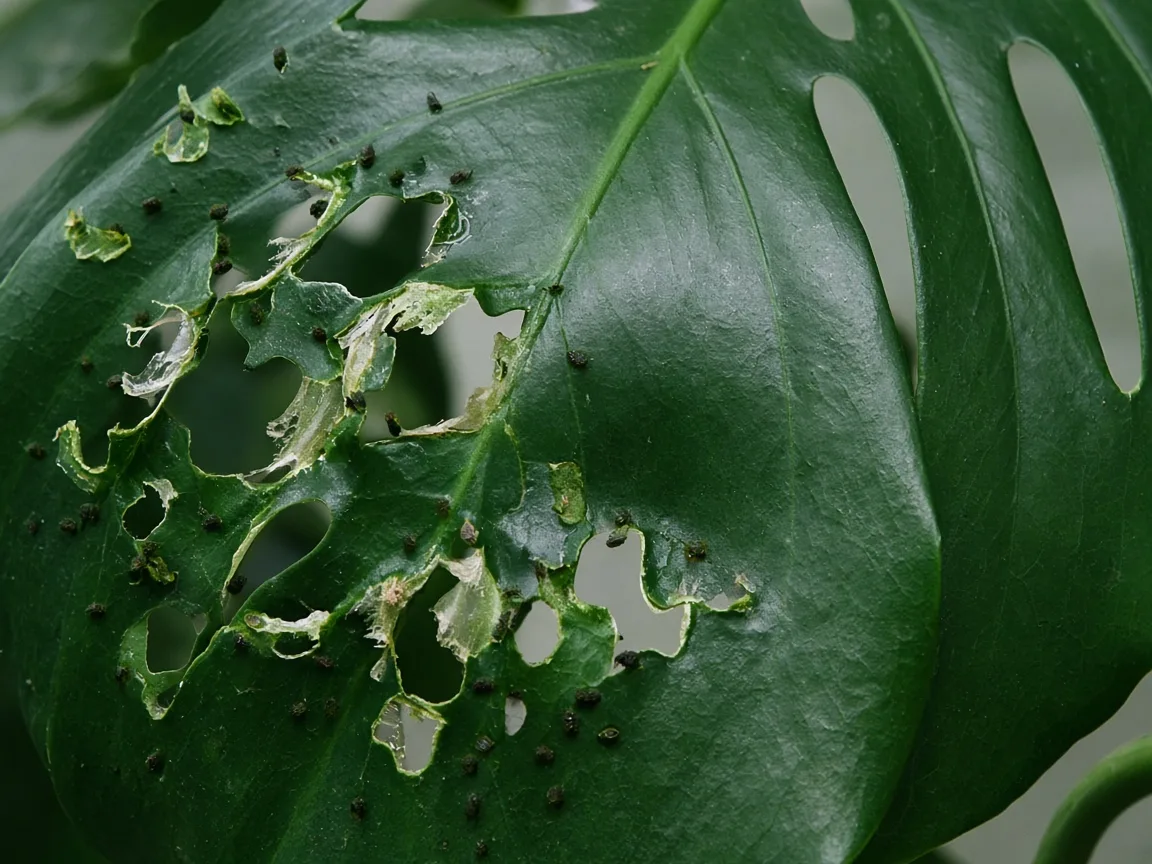
Irregular chewed holes and dark pellet-like frass on a fenestrated deliciosa blade—compare with intact tissue on the same petiole.
Chewed holes and ragged margins:
- Irregular holes punched through large heart-shaped leaves often a foot or more across—edges look torn, not the smooth finished oval of fenestrations
- Ragged notches on soft unfurling tips before splits and holes fully open
- Dark pellet-like frass on leaf surfaces, pot rims, or the floor below wide hanging blades
Larva signs (when you can see them):
- Green, brown, or patterned caterpillars tucked inside partly rolled new leaves, along thick petiole joints, or on leaf undersides
- Visible chewing on the highest moss-pole tip before damage spreads to lower overlapping splits
- Unlike leaf miners, damage goes through the leaf—not inside a bordered tunnel visible when backlit
Growth impact on deliciosa:
- Stalled or shredded unfurling tips when feeding is heavy on the active climbing point
- Stripped soft tissue on new growth while older fenestrated blades below look untouched until larvae move down the vine
Unlike spider mites, caterpillars do not produce stippling or webbing. Unlike thrips, no silvery scrape marks appear—only open chewing wounds and frass.
Why Monstera deliciosa gets caterpillars
Caterpillars are less common on indoor houseplants than sap-sucking pests, but deliciosa setups create feeding sites that quick checks miss:
Outdoor patio hitchhikers. Monstera summered outdoors or near open windows can pick up moth or butterfly eggs laid on leaf undersides. Pests arrive on nursery stock and outdoor plants and continue feeding indoors where predators are absent.
Soft unfurling tips at the moss pole. Deliciosa pushes large new heart-shaped leaves from the climbing tip. Caterpillars prefer soft, expanding tissue—one larva can shred an unfurling blade before you notice holes on mature lower foliage.
Sheltered moss-pole clusters. Larvae hide inside the tight cylinder of a leaf still rolling open, along aerial roots wrapped in moss, and on the undersides of overlapping lower lobes—places a quick glance from across the room never sees on a tall specimen.
Spring growth flushes. Fast summer growth produces tender unfurling splits where generalist moth larvae concentrate. Damage can appear suddenly across several new leaves during active climbing growth.
Indoor warmth without predators. Indoor plants lack natural enemies that control caterpillars outdoors. A single egg mass can hatch into multiple larvae feeding on the same moss-pole tip.
Fenestrations vs caterpillar holes on deliciosa
This is the Monstera deliciosa pattern generic caterpillar pages miss. Before you hand-pick or spray, confirm you are not treating beautiful normal fenestration:
| Feature | Natural fenestration | Caterpillar damage |
|---|---|---|
| Timing | Smooth oval holes and edge splits visible as the leaf opens | Ragged holes appear days after the leaf fully unfurled |
| Edge quality | Clean, finished oval margins and lateral splits | Torn, chewed, irregular margins |
| Frass | None | Dark pellets on leaf or below the plant |
| Larvae | None | Visible worms on undersides or in unfurling tips |
| Pattern | Repeats on successive new leaves along the vine | Random holes on established blades with progressive spread |
If only the newest leaf lacks holes while older leaves fenestrate normally, read the holes in leaves guide for light and moss-pole fixes—not caterpillar treatment. If ragged holes with frass appear on mature leaves after unfurling, you are on the right page.
Moss-pole tips: where deliciosa hides caterpillars
Damage follows the tender tissue at the climbing tip and highest unfurling leaves:
- One larva can shred a new blade before fenestrations open—holes may look worse once the split leaf expands
- Larvae curl inside the rolled cylinder at the moss-pole tip where spray coverage is hardest from across the room
- For tall floor specimens, prioritize the top three reachable leaves and active growing point over random lower canopy samples
- Night feeding means daytime inspections miss active larvae—plan repeated dusk or night passes rather than one rushed daytime check of visible leaf tops only
Unlike thrips scrape marks, caterpillar damage is sudden and localized—fresh holes and frass appear within days of a larva establishing on tender unfurling tissue.
How to confirm the cause
Work through these checks before you spray:
- Unfurling test — Watch the next leaf open. Smooth oval holes present from the start mean fenestration. Holes appearing days later on an already-open leaf mean damage.
- Isolate first — Move the Monstera away from other aroids. Caterpillars walk between pots and eggs can be on neighboring foliage.
- Night inspection — Inspect plants at night with a flashlight; larvae feed actively and are easier to spot on leaf backs and inside unfurling tips.
- Frass check — Hold a large blade over white paper and tap lightly. Black pellets rolling off suggest caterpillars—not sticky honeydew or silvery scrape marks.
- Backlight test — Hold a suspect leaf to light. Internal bordered tunnels confirm leaf miners, not caterpillars.
- Moss-pole priority — Examine the highest unfurling leaves and climbing tip where tender tissue attracts feeding first.
- Neighbor scan — Inspect philodendrons, pothos, and other monsteras from the same nursery batch or patio group on the same shelf.
- Recent history — Note outdoor time, new purchases, open windows, or winter bring-ins in the past month.
If you find a larva with ragged holes and pellet frass, caterpillars are confirmed. If only internal tunnels appear, switch to the leaf miners guide.
First fix for Monstera deliciosa
Isolate the plant and inspect at night with a flashlight, then hand-pick every caterpillar into soapy water.
Work petiole by petiole from the moss-pole tip to lowest leaves on tall specimens. Hand-picking is effective when you reach hidden crevices sprays miss. Check inside partly rolled new leaves and along thick petiole joints where larvae curl during daylight.
Wear gloves when handling heavily chewed deliciosa—sap contains insoluble calcium oxalate crystals that irritate skin, and the plant is toxic to cats and dogs if chewed. Keep the plant out of pet reach during treatment.
After hand-picking, shake stems over white paper to dislodge larvae you missed. Wipe frass from glossy leaf surfaces with a damp cloth so you can spot new pellets if feeding continues.
This single physical pass knocks down the active colony and gives you a clean baseline before any spray. Do not stack Bt application, heavy pruning, and repotting on the same day.
Step-by-step recovery
After the initial hand-pick, follow severity:
Days 1–7: Physical control (a few holes on one or two leaves)
- Repeat night inspections every two to three days; catch newly hatched larvae before they reach the moss-pole tip
- Remove only leaves that are mostly stripped once insects are gone
- Shower accessible foliage in the sink if needed to dislodge small larvae—avoid soaking the moss pole so it stays airy
Days 7–21: Targeted sprays if holes spread (moderate infestation)
- Apply Bacillus thuringiensis kurstaki (Bt-k) labeled for caterpillars on houseplants, coating leaf backs and unfurling tips until runoff
- Bt must be eaten—spray at dusk when larvae feed; repeat on label intervals through at least two hatch cycles
- Insecticidal soap labeled for ornamentals can supplement Bt on reachable foliage when larvae are small; test one leaf first and wait 48 hours
Heavy infestation (multiple larvae, frass across a large floor plant)
- Trim and bag only leaves too damaged to photosynthesize
- Treat every plant on the same shelf or patio group, not just the worst-looking deliciosa
- Hold fertilizer until new growth emerges without fresh holes
Recovery timeline
Judge recovery on clean new fenestrated leaves and frass-free petiole joints, not old chewed blades:
- 3–7 days after first hand-pick: No fresh frass on highest leaves; night inspection finds zero larvae
- 2–4 weeks: New heart-shaped leaves emerge with expected splits and holes—or intact blades without new ragged chew marks after pest removal
- 6+ weeks on large floor plants: Several clean perforated leaves along the climbing stem confirm the population is broken; continue monthly spot checks after patio season
Mature leaves with chew holes do not heal—the thick glossy tissue stays marked. Success means clean new growth along the vine, not a cosmetic reset of every foot-wide blade on a tall specimen.
Lookalike symptoms
| What you see | Likely cause | Key difference on deliciosa |
|---|---|---|
| Ragged holes + frass + visible larva | Caterpillars (this page) | Night inspection reveals larvae; holes go through blade |
| Smooth oval holes at unfurling | Natural fenestration | Holes in leaves — no frass, no larvae |
| Bordered pale tunnel inside leaf | Leaf miners | Tunnel visible when backlit; no through-holes |
| Silvery streaks + black frass, no holes | Thrips | Mobile insects on paper shake; scrape marks not chewing |
| Pinhead dots + fine silk | Spider mites | Stippling on undersides; no frass pellets |
| Single clean tear on outer blade | Mechanical contact | No frass, no larvae, no progressive spread |
| Brown halos before tissue drops | Leaf spot disease | Spots with halos—not ragged edge chewing |
Mistakes to avoid
- Treating fenestrations as pest damage. Smooth oval holes present at unfurling are the goal on deliciosa—not caterpillars.
- Inspecting only during the day. Caterpillars feed at night and hide along stems—daytime glances miss larvae inside rolled tips.
- Confusing leaf miners with caterpillars. Miners leave internal tunnels visible when backlit; caterpillars chew through the blade with pellet frass outside.
- Spraying Bt during the day. Bt must be eaten; apply at dusk when larvae are actively feeding on leaf tissue.
- Ignoring nearby plants. Inspect every houseplant from the same patio batch or nursery shelf, not just the deliciosa with the most visible holes.
- Increasing watering because leaves look damaged. Deliciosa roots rot easily in chronically wet mix—follow the watering guide rhythm instead.
- Using homemade dish soap sprays. Commercial insecticidal soaps are formulated for plant contact; test before full application.
Prevention
- Quarantine new deliciosa two to three weeks before placing them beside an established floor specimen
- Rinse and inspect unfurling tips and leaf undersides after outdoor patio season or near open windows
- Screen windows and doors that stay open at night, especially near plant shelves
- Scout moss-pole tips during each watering check in spring when fast new growth produces soft tissue caterpillars prefer
- Give bright indirect light and a sturdy moss pole so healthy fenestrations develop reliably—then any ragged new hole stands out immediately
- Keep floor pots out of pet reach—Monstera Deliciosa is toxic if chewed, and tooth marks mimic pest damage on lower leaves
When to worry
Escalate treatment when fresh ragged holes appear daily despite hand-picking, when frass accumulates across a large floor plant during a spring growth flush, or when larvae appear on multiple aroids from the same nursery batch. Chronic feeding can strip soft moss-pole tips even when roots remain healthy.
A single caterpillar on one leaf after a patio summer is not a lost cause—prompt isolation and hand removal usually resolves it. Reassess for leaf spot disease if brown halos precede tissue drop rather than clean chewed edges.
Conclusion
Caterpillars on Monstera deliciosa are a night-feeding, moss-pole-tip pest—ragged holes with pellet frass on fenestrated leaves mean inspect after dark, hand-pick larvae, and tell chew damage from natural splits before you spray. Judge recovery by clean new perforated growth along the climbing stem, not perfect older blades.
Related Monstera Deliciosa guides
Related tool
Use the Pest Identifier Tool to narrow causes for caterpillars on this plant before changing multiple variables at once.